Obsidian Essay] Consciousness and the Universal Law...Quantum Computer
![Obsidian Essay] Consciousness and the Universal Law...Quantum Computer](https://images.unsplash.com/photo-1614926037384-4159c33e196b?crop=entropy&cs=tinysrgb&fit=max&fm=jpg&ixid=M3wxMTc3M3wwfDF8c2VhcmNofDIzfHxnYWxheHl8ZW58MHx8fHwxNzg4NjEyNTA5fDA&ixlib=rb-4.1.0&q=80&w=1200)
The world we can see and measure is not the deepest layer of reality. -EJ Elena Shin
Three years ago, I wrote about my childhood fascination with the Cosmos here.
Do you believe there is a Universal Law? The ultimate Truth? Divine intelligence. Some might call it 'God' or 'god.'
I have always wondered about the 'universal law' — trying to find some 'pattern' in this seemingly chaotic world. Even when I was little, I approached the subject of math as a conceptual philosophy. Later, it became prime numbers, but my passion mostly sat with string theory and quantum physics, metaphysics...the search for the universal law. And then, sacred geometry.
This post is my attempt to connect the dots — from where the search began, to where it has led me.
Is there a universal law underneath all of this?
Enjoy!
The search for the pattern
I believe chaos may only look like chaos because we cannot yet see the whole pattern.
Prime numbers fascinated me precisely because they seem both orderly and unpredictable.
String theory captured my attention for a different reason: the possibility that the reality we experience may be only part of a much larger mathematical structure.
Physics does not say its extra dimensions are spiritual planes. They are mathematical dimensions. But the idea was tattooed in my brain since age 4 and has followed me nonetheless:
What if what we perceive is constrained by the reality we are capable of perceiving?
That is where science ends and my own belief begins.
I believe there is a guiding principle running through the universe — something deeper than the reality we experience through space, time and matter.
I don't think current humanity's physics has proved that (yet).
But (human) physics has repeatedly shown us that reality is much stranger than ordinary perception suggests.

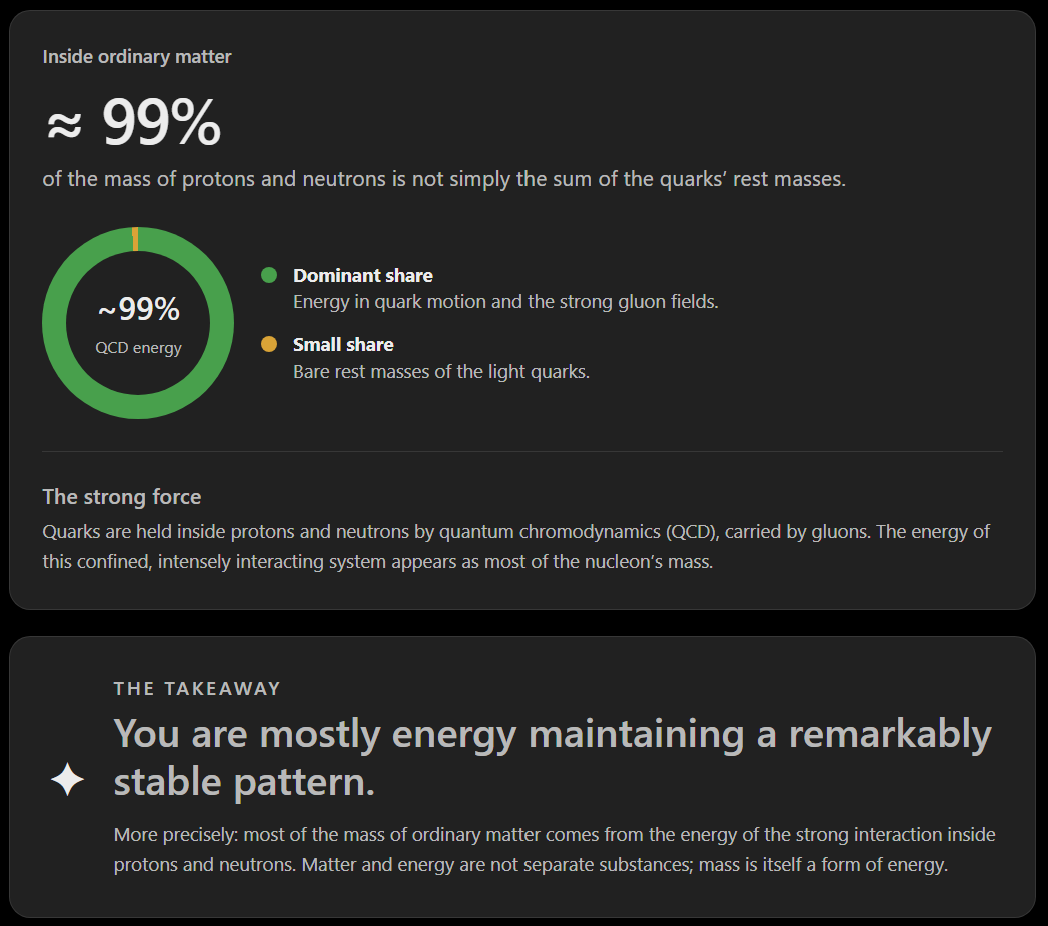
E = mc²
One of the first equations that helped me articulate my childhood conviction about what “physical reality” actually is was Einstein's E = mc². At 14, I gave a whole presentation about this to my class.
On the surface, it is remarkably simple.
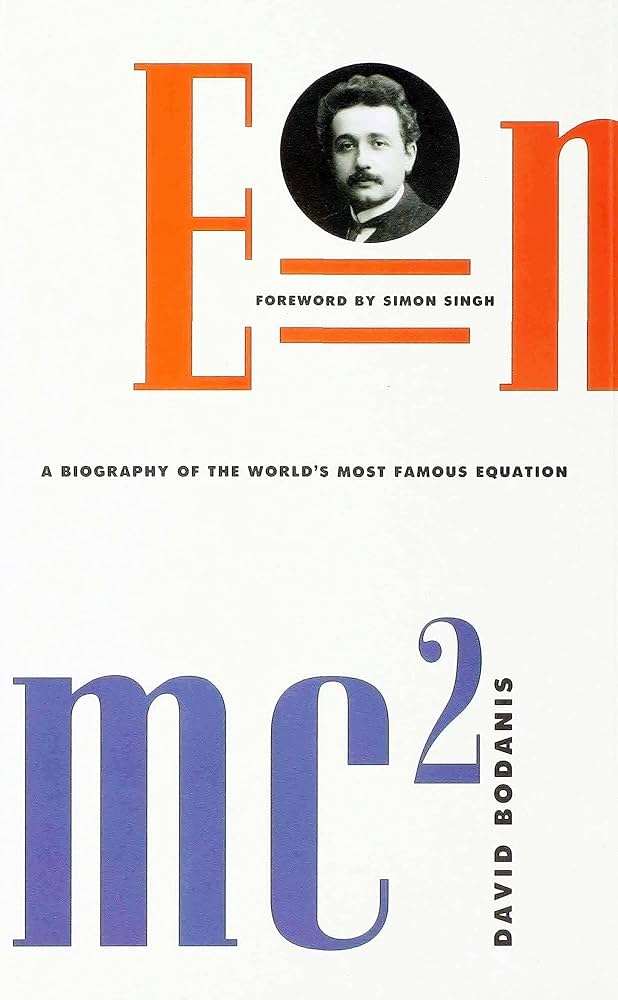
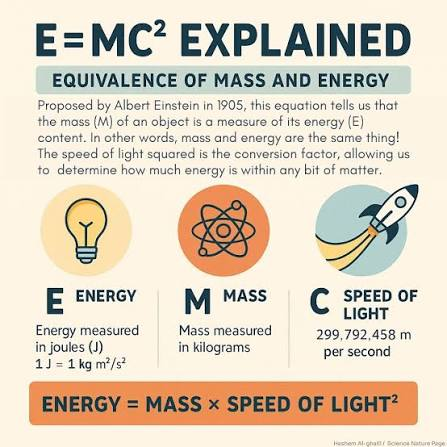
For an object at rest, its mass corresponds to an enormous amount of rest energy:
E = mc².
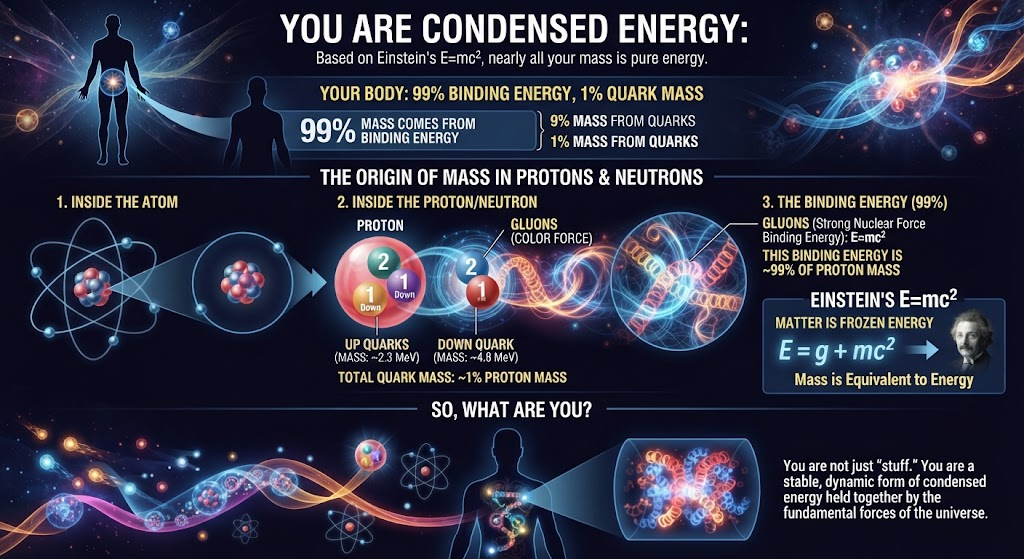
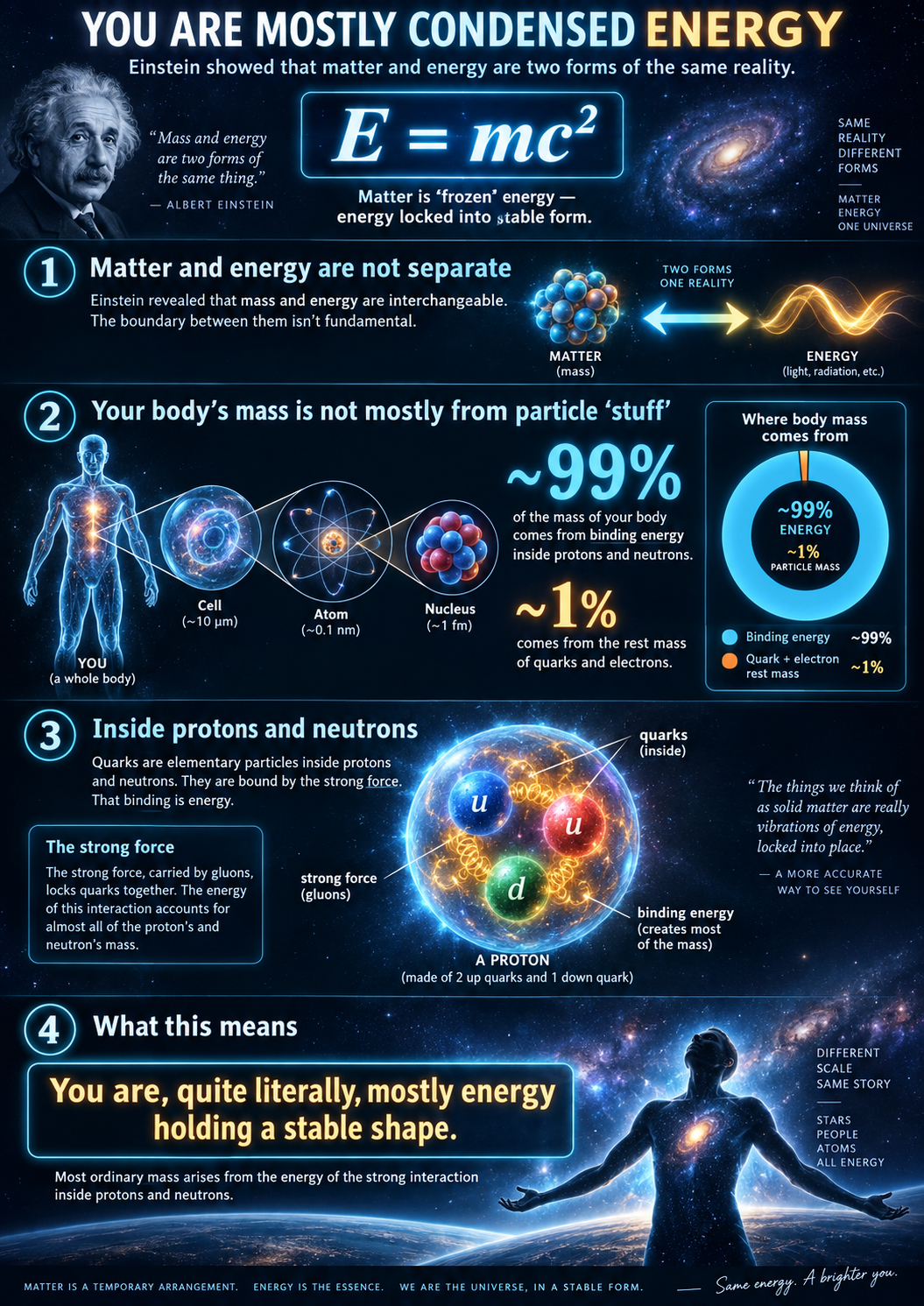
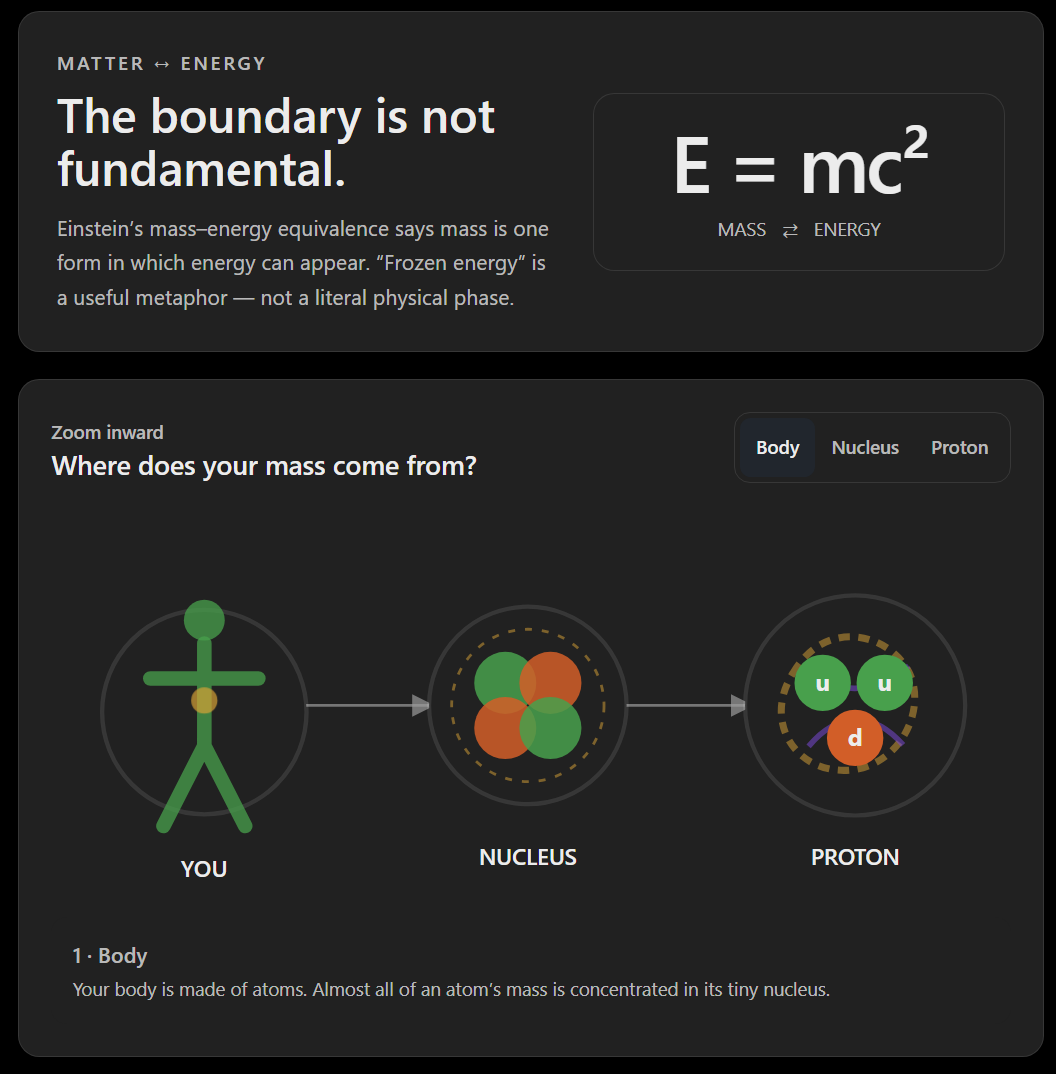
Mass has an equivalent amount of energy associated with it. Add energy to a system and its mass changes. Under the right physical processes, mass can be converted into other forms of energy and vice versa.
What we call matter and what we call energy are not completely separate categories. Einstein showed that they are deeply connected.
That does not mean that our bodies contain some mystical source of unlimited energy that consciousness can simply unlock.
But philosophically, the equation shattered something for me.
What looks solid is not quite as simple as “solid matter.”
The body, the planet, the stars — everything physical exists inside a reality in which matter and energy are intimately connected.
The boundary our senses perceive is not necessarily the boundary physics finds.
Math as the language
Long before modern physics, human beings were already trying to decode nature through number, proportion and geometry.
That is what fascinates me about the early Greek philosophers.
They were asking the same fundamental question:
What is everything made of?
What sits underneath appearances?
Is there an underlying order?
Pythagorean thought placed extraordinary importance on number, ratio and harmony. Plato later gave us the Cave — human beings mistaking shadows for reality because shadows are all they have ever seen.
Different era. Same question.
What if what we see is only a projection of something deeper?
This is also why sacred geometry intrigued me.
I don't treat sacred geometry as scientific evidence.
For me it represents something older: our instinct to look at nature, find recurring form and proportion, and wonder whether mathematics is exposing an underlying architecture.
I have always loved the idea that:
Math is the language of God.
And by “God,” I don't necessarily mean a man in the sky.
I mean the intelligence, architecture, law — whatever word we choose for the principle that makes a universe possible in the first place.
Look at the form.
Find the pattern.
Ask what created the pattern.
And then physics gets strange
At the quantum level, some of the boundaries that look obvious to us stop being so obvious.
A quantum state is the mathematical description physicists use to predict possible measurement outcomes for a quantum system.
And this world behaves very differently from the one our everyday intuition evolved to understand.
A quantum system can be in a superposition — a state described through multiple possible outcomes and their probability amplitudes.
Those possibilities can interfere with one another.
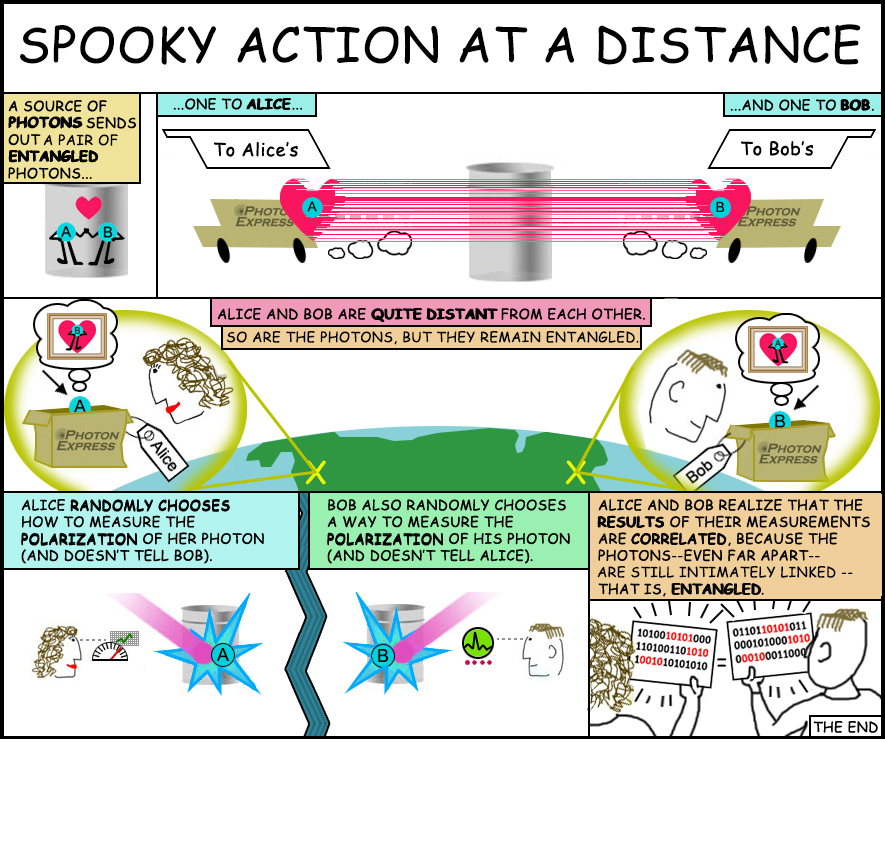
And quantum systems can become entangled, meaning that the state of one part cannot be completely described independently of the other.
The system has to be understood as a whole.
I find that extraordinary.
But because once again, reality refuses to behave according to the neat boundaries our senses want to impose on it.
When quantum physics becomes a machine
Perhaps the clearest demonstration that these strange principles are not merely philosophical abstractions is quantum computing.
A classical computer uses bits.
0 or 1.
A quantum computer uses qubits.
A qubit can exist in a superposition described by amplitudes associated with 0 and 1. Multiple qubits can also become entangled.
But quantum computing is not simply a computer “trying every possible answer at once.”
That description is tempting — but too simplistic.
Quantum algorithms manipulate probability amplitudes and use interference so that some possible outcomes reinforce one another while others cancel out. The aim is to make useful answers more likely to appear when the system is finally measured.
Think about what that means.
We have learned enough about the strange rules underneath ordinary reality that we are now building machines around them.
Superposition.
Entanglement.
Interference.
Measurement.
These aren't simply ideas written on a physicist's blackboard anymore.
They are engineering principles.
And one of the biggest challenges in building quantum computers is decoherence — interaction with the surrounding environment disrupts the delicate quantum state we are trying to preserve.
There is something profound to me about that.
Not because quantum computers prove anything about consciousness.
They don't.
But because they demonstrate something I would once have found almost impossible to believe:
the strange underlying rules of reality can actually be harnessed.
What once sounded like metaphysics became physics.
What once sounded like impossible physics is becoming technology.
And that makes me wonder which of today's “impossible” questions we simply haven't learned how to ask — or measure — yet.
The quantum yin-yang
Then there was an image I couldn't ignore.
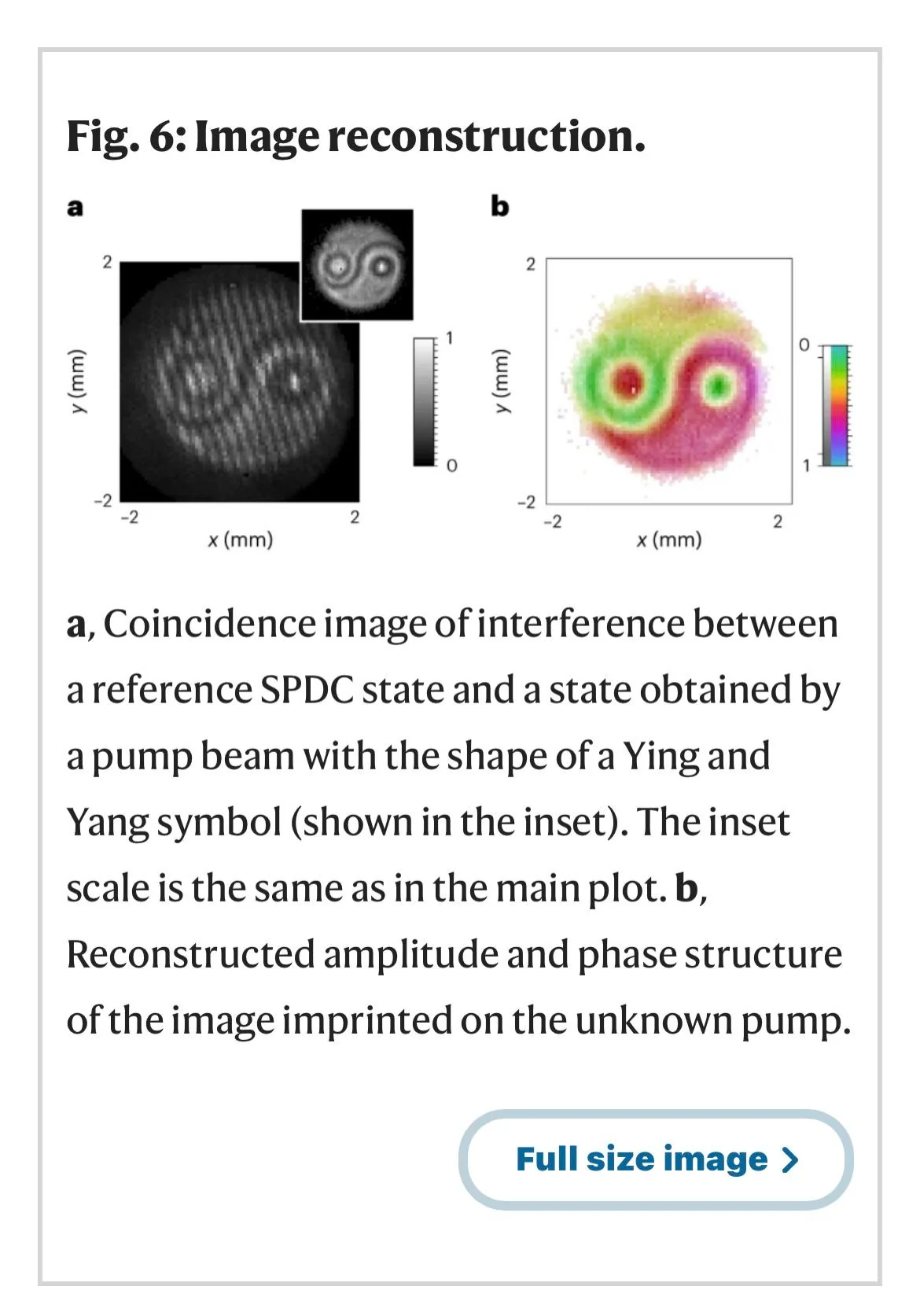
In 2023, researchers introduced biphoton digital holography, using interference with a reference state to reconstruct amplitude and phase information from spatial two-photon quantum states.
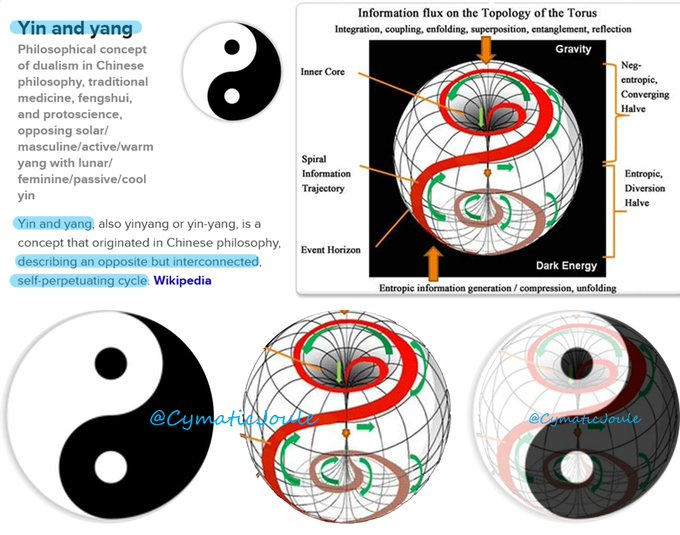
One of their visualizations became famous because it looked remarkably like a yin-yang.
The technique was real science, published in Nature Photonics, and allowed the researchers to characterize the states dramatically faster than previous approaches.
But this distinction matters:
The scientists did not discover that the universe is secretly shaped like a yin-yang.
The image reflected the particular quantum state they prepared.
The symbolism is ours.
What fascinated me was what the experiment represented:
one quantum state describing two entangled photons.
Again, the question returns.
Where exactly do we draw the boundaries between things?
The potential within us
So where does this leave us?
Quantum physics shows us that nature contains possibilities, relationships and forms of information that classical intuition completely misses.
Quantum computing shows us that some of those principles can actually be engineered.
But I don't need quantum mechanics to argue that human beings contain possibility too.
For that, neuroscience gives us something much more concrete.
We are not fixed systems.
Our brains physically change in response to experience.
Learning changes us.
Practice changes us.
Attention changes us.
Even imagination is not neurologically “nothing.”
Research on motor imagery has shown that repeatedly imagining an action can contribute to motor learning and measurable changes in neural systems involved in movement. Mental and physical practice are not identical — but imagination can participate in the biological process of learning.
Think about the implications.
An idea exists first as something intangible.
A possibility.
You imagine doing something you cannot yet do.
You rehearse it.
Attention becomes intention.
Intention affects behaviour.
Behaviour becomes repetition.
Repetition alters neural pathways.
Those changes affect what you are capable of doing next.
Eventually something that once existed only in your imagination becomes part of physical reality — not through magic, but through a chain of mind, brain, behaviour and environment.
To me, that is extraordinary enough.
I don't need to say that every imagined future literally exists somewhere in quantum superposition waiting for consciousness to choose it.
Science has not established that.
I think there is a more interesting statement we can make:
What we imagine does not automatically become reality. But what we can imagine can change what we are capable of becoming.
And perhaps that's where I see a rhyme between quantum physics and human potential.
Not equivalence.
A rhyme.
At the quantum level, the state we observe is not always the only possibility contained in the mathematical description.
At the human level, the person you are today is not the only person your biology is capable of becoming.
Those are scientifically different phenomena.
But both challenge the same intuitive assumption:
that what exists now is all that can exist.
Mind over matter?
Consciousness affects physical reality in at least one unquestionable way: through us.
A thought can trigger physiological stress.
A memory can change a heartbeat.
A decision causes electrical and chemical activity in the nervous system.
Muscles move.
Hands build.
Words change another person's thoughts.
Those thoughts can cause another chain of physical events.
Conscious experience clearly participates in the causal world through the brain and body.
But whether consciousness does something even more fundamental is another question.
There have been interpretations of quantum measurement that give consciousness a special role.
They remain interpretations — not established proof that human awareness collapses quantum states or that intention can select a desired external reality.
I am comfortable saying I don't know.
Because the questions I have always found most interesting live exactly there:
between what we already know and what we cannot yet explain.
The strangest pattern of all
Perhaps consciousness is not simply another thing inside the universe. Perhaps it is part of the mystery of what the universe is.
Science can study the brain.
It can measure neural activity associated with perception.
Memory.
Attention.
Decision-making.
Imagination.
But a remarkably simple question remains.
Why is there an experience at all?
Why isn't all this information processing simply happening in darkness?
Why does red look like something?
Why does pain feel like something?
Why is there someone inside the system experiencing any of it?
This is essentially what philosopher David Chalmers called the hard problem of consciousness: explaining why physical information processing should be accompanied by subjective experience at all.
And that brings me back to where I started.
Prime numbers.
String theory.
E = mc².
Quantum physics.
Quantum computing.
Sacred geometry.
Ancient philosophy.
Consciousness.
Perhaps I was never really interested in separate subjects.
I was always looking for the same thing.
The pattern beneath.
I don't know whether there is one universal law that will eventually connect matter, energy, space, time, information and consciousness.
Nobody does.
But I believe there is a deeper order.
And perhaps consciousness is the strangest clue of all.
Because this time, the universe isn't simply revealing another pattern to us.
The pattern has become aware enough to look back at itself.
![Obsidian Odyssey] Light. Brain. Heart.](https://storage.ghost.io/c/2a/9e/2a9e2b04-30f6-4166-8010-a3730d2eb719/content/images/size/w720/2026/10/nobel-prize-2026.webp)
![Obsidian Essay] The Walk - Even Commanders Debrief ft. Admiral McRaven](https://storage.ghost.io/c/2a/9e/2a9e2b04-30f6-4166-8010-a3730d2eb719/content/images/size/w720/2026/08/wp-GettyImages-172044198_master.jpg)
![Book] Consciousness | The Hitchhiker's Guide to the Galaxy (1979) by Douglas Adams: A Space Kid's Introduction](https://storage.ghost.io/c/2a/9e/2a9e2b04-30f6-4166-8010-a3730d2eb719/content/images/size/w720/2026/06/images.jpg)
Comments ()