Obsidian Essay | Leadership] JFK.
![Obsidian Essay | Leadership] JFK.](https://storage.ghost.io/c/2a/9e/2a9e2b04-30f6-4166-8010-a3730d2eb719/content/images/size/w1200/2026/08/231120172101-lead-image-john-f-kennedy-life-career.webp)
“We meet in an hour of change and challenge, in a decade of hope and fear, in an age of both knowledge and ignorance. The greater our knowledge increases, the greater our ignorance unfolds. No man can fully grasp how far and how fast we have come. But condense, if you will, the 50,000 years of man's recorded history in a time span of about a half a century. Stated in these terms, we know very little about the first 40 years, except at the end of them, advanced man had learned to use the skins of animals and cover them.
Then about 10 years ago, under this standard, man emerged from his caves to construct other kinds of shelter. Only five years ago, man learned to write and use a car with wheels. Christianity began less than two years ago. The printing press came this year. And then less than two months ago, during this whole 50 year span of human history, the steam engine provided a new source of power. Newton explored the meaning of gravity. Last month, electric lights and telephones and automobiles and airplanes became available. Only last week, we developed penicillin and television and nuclear power. This is a breathtaking pace and such a pace cannot help but create new ails as it dispels old.
So it is not surprising that some would have us stay where we are a little longer, to rest, to wait. If this capsuled history of our progress teaches us anything, it is that man in his quest for knowledge and progress is determined and cannot be deterred.
We shall send to the moon 240,000 miles away, a giant rocket, more than 300 feet tall on an untried mission to an unknown celestial body, and then return it safely to Earth. But why some say the moon? Why choose this as our goal? And they may well ask, why climb the highest mountain? Why 35 years ago fly the Atlantic? We choose to go to the moon. We chose to go to the moon. We choose to go to the moon in this decade and do the other things not because they are easy, but because they are hard. Because that goal will serve to organize and measure the best of our energies and skills, because that challenge is one that we're willing to accept.” - JFK @ Rice University, 1962.
JFK. I did not plan to spend this summer with John F. Kennedy, but he resurfaced on my radar about a month ago. It started with the fourth of July, Jackie Kennedy, summer memories from the Hamptons, and he started to join me on my commute. These days, on the train to the office, his speech and mind are something that helps me with my homesickness — his speeches, his interviews, played and replayed. I keep coming back to the Rice University speech from September 1962, where he describes his moment as "an hour of change and challenge, in a decade of hope and fear, in an age of both knowledge and ignorance."
He could be describing ours.
I. The Bias
I should admit: I came to Kennedy with a biased opinion. Buried under the political scandals, I had filed him away as a shiny and pretty president — romanticised into a legend, partly because he died young. Two years and ten months in office seemed too short to decide a legacy either way.
Then I actually listened to him. Not the famous clips — the full speeches, the press conferences, the interviews, where you can hear him think in real time. And I had to revise myself. He WAS a real leader, with a real VISION. Not a perfect man — the record is clear on that, and I won't pretend otherwise — but a serious mind, taking the long view at a moment when everything pushed toward the short one.
II. The Parallels Between His Time and Our Time
What surprises me most is the parallels between his time and ours.
His decade: democracy versus communism. The US versus the USSR. The race to the moon. The Cuban Missile Crisis and constant geopolitical uncertainty. And at home, the civil rights movement of the 1960s, when segregation was still a fact of American life and apartheid stood unashamed in South Africa.
Ours: the US and China. Russia's pressure on Europe. The rise of AI. Elon Musk and Mars. Social unrest in the middle of a cost-of-living crisis. Immigration, climate, and geopolitical uncertainty in Europe and well beyond it.
In the Rice speech, Kennedy gives a long arc of humanity's history — fifty thousand years compressed into fifty, so you can see how fast everything has accelerated: writing five years ago, the printing press this year, penicillin and television and nuclear power last week. He was doing what we are doing now with AI: standing in front of a new technology, telling the whole story of our species in one breath, and asking what it will do to us. He had watched the invention of nuclear weapons. He knew what innovation can do for humanity, and against it. His answer was direct: technology "has no conscience of its own." Whether it becomes a force for good or ill depends on us.
Swap the rocket for AI and the sentence needs no editing. That is why he keeps surfacing in my head. Not nostalgia — recognition.
III. Constraints Follow You No Matter What
One more thing surprised me. During the 1960 election, Kennedy was asked — seriously, in public — whether an Irish Catholic could be a good president. In those days, Irish Catholics in America were not welcome in certain establishments, as Jewish people were not. He answered the question directly, in front of an audience of Protestant ministers in Houston, in September 1960.
Two years later — to the day, 12 September, in the same city — he gave the moon speech. First he had to argue for his own belonging. Then he argued for everyone's.
It shows how far we have come that the question sounds absurd now. It also shows how far we have to go, because versions of it are being asked again, of other faiths — less so here in the UK and in Europe, but the tension is growing.
IV. JFK in London
You would be surprised to know JFK once resided in London, and there are traces of him still.
1. The Kennedy bust, International Students House, Great Portland Street. When news of the assassination reached Britain, the Sunday Telegraph opened a memorial fund with one rule: no donation over £1. More than fifty thousand readers gave. The bronze bust, by the sculptor Jacques Lipchitz, was unveiled on 15 May 1965 by Robert Kennedy, outside a new hostel for international students on Marylebone Road. A memorial priced in attention, not money. I have to be honest about the setting: after vandalism in 2017, the bust was cleaned and moved inside the foyer in 2019. You can see it through the glass doors, and the old plinth still stands empty on the road.
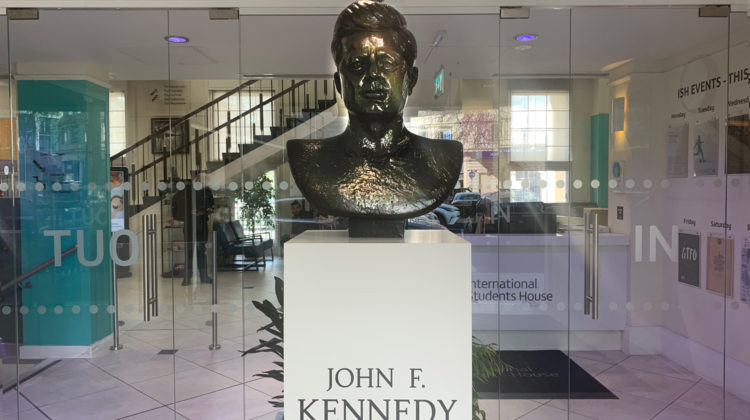
2. 14 Prince's Gate, Knightsbridge. The house overlooking Hyde Park where the Kennedy family lived while Joseph Kennedy Sr served as American ambassador, 1938–1940. A twenty-one-year-old JFK watched Europe slide toward war from this address. A plaque marks the house.
3. The Kennedy Memorial, Runnymede. The day before the bust was unveiled, the Queen dedicated Geoffrey Jellicoe's Portland stone memorial at Runnymede — on an acre of English ground given to the United States, beside the meadow where Magna Carta was sealed in 1215.
V. Practical Note
The bust is two minutes from Great Portland Street station (Circle, Hammersmith & City, Metropolitan). Prince's Gate sits between Knightsbridge and South Kensington. Runnymede needs a proper outing: rail from Waterloo to Egham, then a walk along the river — go on a weekday morning and you will mostly have the meadow to yourself. A half-day route: the bust at nine, coffee in Marylebone, Prince's Gate by eleven. Save Runnymede for a weekend.
For the History Geeks: Blue Plaques
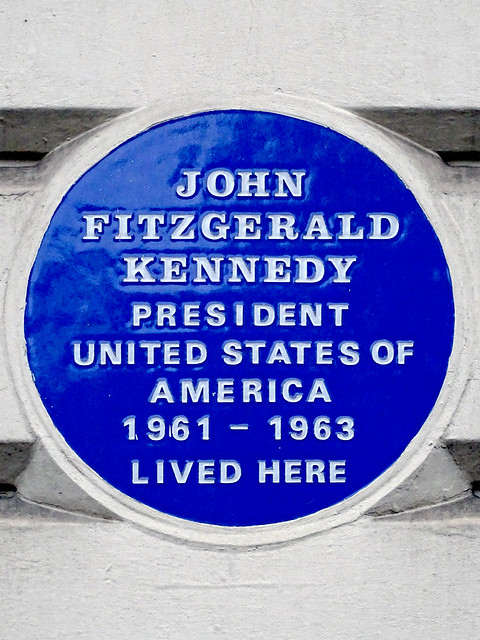
The plaque at 14 Prince's Gate records that John Fitzgerald Kennedy, President of the United States, lived here — one of very few London plaques to an American president. The house served a string of American ambassadors and was given to the US government by the Morgan family.
In Closing...
I still don't know what AI will do to humanity, any more than Kennedy knew in 1962 what the rocket would. But what steadies me on the train is not his optimism. It is his refusal to be passive — the insistence that we do things "not because they are easy, but because they are hard." That is what a real leader with a vision sounds like. It holds up, sixty-four years later, on a crowded train, a long way from home.
If you have time... watch the Rice speech in full, not just the famous forty seconds. The jokes land, the heat is visible, and the thinking is the point. The JFK Presidential Library has digitised his speeches and press conferences. They are good company on a morning commute.
https://edition.cnn.com/2023/11/22/politics/gallery/john-f-kennedy
![Obsidian Essay | Leadership] Behind the Curtain: What Sense and Sensibility (2026) Taught Me About the Female Leadership Archetype](https://storage.ghost.io/c/2a/9e/2a9e2b04-30f6-4166-8010-a3730d2eb719/content/images/size/w720/2026/09/Sense-and-Sensibility.jpg)
![Obsidian Essay | Leadership] The Queen Behind the Screen ft. Jeongsun of Joseon (정순왕후) - Life and Leadership Lessons](https://storage.ghost.io/c/2a/9e/2a9e2b04-30f6-4166-8010-a3730d2eb719/content/images/size/w720/2026/09/Screenshot-2026-09-13-024407.png)
![Leadership] The Odyssey and Superhuman](https://images.unsplash.com/photo-1728076992371-659f5540a27c?crop=entropy&cs=tinysrgb&fit=max&fm=jpg&ixid=M3wxMTc3M3wwfDF8c2VhcmNofDJ8fGl0aGFjYSUyMGdyZWVjZXxlbnwwfHx8fDE3ODg0MTA0OTZ8MA&ixlib=rb-4.1.0&q=80&w=720)
Comments ()