Art] What Cities Make of Us: Art, Power & the Human Condition Across Europe | Madrid & Barcelona: Goya, Picasso, and the Art of Bearing Witness (14/22)
On the moral responsibility of the artist with access to power — and why Spain produced the two greatest anti-war images in Western history
![Art] What Cities Make of Us: Art, Power & the Human Condition Across Europe | Madrid & Barcelona: Goya, Picasso, and the Art of Bearing Witness (14/22)](https://storage.ghost.io/c/2a/9e/2a9e2b04-30f6-4166-8010-a3730d2eb719/content/images/size/w1200/2026/03/Gemini_Generated_Image_sbowymsbowymsbow-19.png)
What Cities Make of Us: Art, Power & the Human Condition Across Europe | Post 14 of 22
On the moral responsibility of the artist with access to power — and why Spain produced the two greatest anti-war images in Western history
| Series | What Cities Make of Us — Post 14 of 22 |
| Reading Time | 8 minutes |
| Cities | Madrid & Barcelona, Spain |
| Era | 1740s – 1937 |
| Key Figures | Goya, Velázquez, Picasso, Miró, Gaudí |
| Core Argument | Goya and Picasso, two centuries apart, both decided that the artist's job in times of atrocity is to bear witness — and both paid a price for it |
On April 26, 1937, German and Italian aircraft, flying in support of Franco's Nationalist forces during the Spanish Civil War, bombed the Basque town of Guernica. It was a Monday, market day, when the town's population was at its highest. The bombing lasted several hours. Between 150 and 1,600 people were killed — the estimates vary wildly because nobody in authority was particularly motivated to count accurately. The town was largely destroyed.
Picasso had been commissioned by the Spanish Republican government to create a work for the Spanish Pavilion at the Paris International Exposition. He had not yet decided on a subject. When he read about Guernica in the newspaper on April 28th, he found his subject. He began sketching the same day.
Guernica was completed in five weeks. It is in black and white — no color, as if the event had occurred before the invention of color, as if color itself had been bombed out of existence. A horse screams. A bull watches. A woman holds a dead child and opens her mouth in a grief that has no adequate sound. A soldier lies dismembered. A lamp is held out into the darkness, illuminating nothing that helps.
It is not a pretty painting. It was not meant to be. It is the most committed act of moral witness in 20th-century art, made by a man who understood that his access to the world's attention was a form of responsibility.
Velázquez at the Court of Philip IV: The Insider's Gaze
A century and a half before Guernica, Diego Velázquez was demonstrating a different kind of moral intelligence — one that required not the outsider's protest but the insider's courage to see clearly.
Velázquez became court painter to Philip IV in 1623, at twenty-four years old. He would hold the position for the rest of his life — forty years in the most powerful court in the world, surrounded by the machinery of Spanish imperial power at its height and then at its accelerating decline. He was trusted absolutely. He traveled to Italy on state funds, purchased art for the king, was eventually given the title of Aposentador Mayor — Palace Chamberlain, the highest domestic office at court.
He used this proximity to paint some of the most psychologically penetrating portraits in the history of art.
His portraits of Philip IV — there are at least fifteen, spanning thirty years — show a man being consumed by the weight of an empire he was not equipped to manage. The early portraits show a young king performing royal authority with reasonable conviction. The later ones, painted in the 1650s when Spain's imperial decline was no longer deniable, show a man who looks exhausted, sad, and privately aware that the story he is supposed to be performing is no longer quite true.
A court painter who showed the king's weakness was taking a risk. Velázquez did not show it cruelly. He showed it honestly — with the compassion that comes from years of close observation and, perhaps, genuine human sympathy. The king seems to have understood this. The portraits were not suppressed. The relationship between painter and patron endured.
This is the most difficult position for an artist in institutional life: to tell difficult truths to power without catastrophizing them, without flattering them away, with enough compassion that the truth can be received. Most people in that position choose one extreme or the other — pure flattery or pure opposition. Velázquez did neither.
Goya: The Artist Who Stayed Too Long
Francisco Goya was born in Aragon in 1746, became court painter to Charles III, then Charles IV, then Joseph Bonaparte (Napoleon's brother, imposed as King of Spain in 1808), then Ferdinand VII. He survived, professionally, every change of regime by being too useful to remove and too old to present a serious threat.
He also, in private and in increasingly explicit public work, painted the truth about every one of those regimes with a ferocity that could have cost him his life.
The Third of May, 1808 — painted in 1814, after Ferdinand VII's restoration, when it was politically safe — depicts the execution of Spanish civilians by French troops in the days following the Napoleonic occupation. A man in a white shirt stands with his arms thrown wide, facing a firing squad that has its backs to us, faceless, a machine rather than a collection of human beings. The execution victim's face is lit by a lantern. His expression is not heroic. It is terrified — the specific, unspectacular terror of someone who knows they are about to be killed and cannot believe it is happening to them.
There are no heroes in this painting. There is no glory. The soldier who executes is as dehumanized as the civilian who dies. The painting does not condemn the French and exonerate the Spanish. It condemns the act itself — the transformation of human beings into instruments of mass killing — and it does so with a clarity that is more disturbing than any propaganda could be.
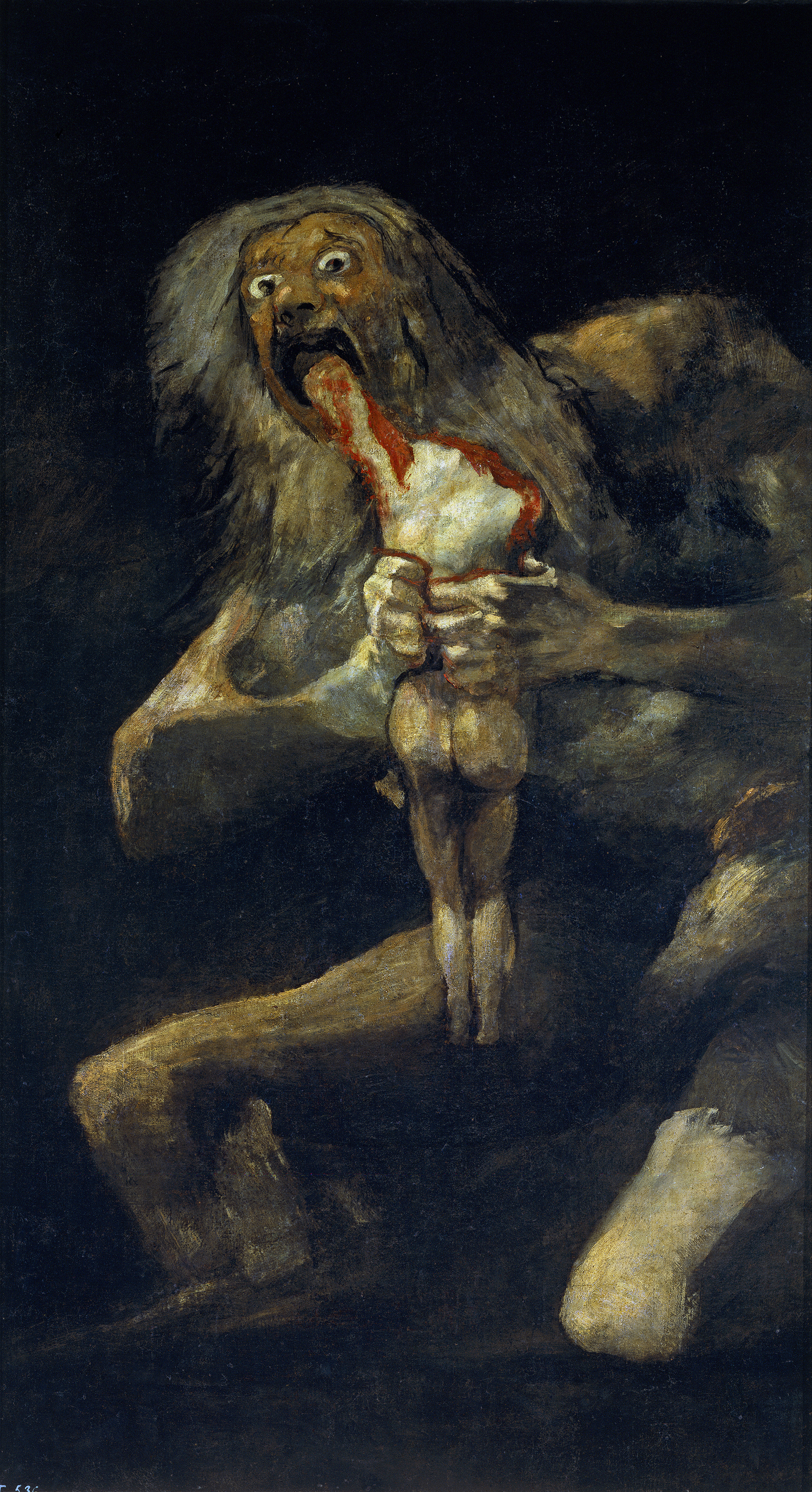
Goya also painted, privately, his Black Paintings — works made on the walls of his farmhouse outside Madrid, never intended for exhibition, showing a vision of humanity so dark and so strange that they feel less like paintings than like transmissions from a mind that has seen too much. Saturn Devouring His Son. Two men beating each other with clubs, sinking into a swamp. A dog half-submerged in sand, looking upward at an empty sky.
These were made by a man who had spent his life serving power and watching what power does. He was not protesting. He was recording.
Gaudí's Barcelona: The Architecture of Devotion
While Madrid was producing its art of unflinching political witness, Barcelona was producing something that seems to exist in an entirely different emotional register — the architecture of Antoni Gaudí, which looks, to eyes accustomed to the formal geometries of classical or Baroque architecture, like the result of a fever dream.
Gaudí worked almost exclusively in Barcelona. He was a Catalan nationalist and a fervent Catholic, and his architecture combined these two commitments in ways that produced some of the most original buildings in human history. The Casa Batlló and Casa Milà on the Passeig de Gràcia look less like buildings than like geological formations — as if the stone had been alive, had grown according to some organic logic that preceded human design. There is not a straight line in either building.
The Sagrada Família — which he began in 1883 and which remains unfinished today, more than a hundred years after his death in 1926 — is the most audacious long-term architectural project in history. It is a cathedral, but unlike any cathedral built before it: the towers are modeled on natural forms, the facades tell the Christian story with a visual language that is simultaneously medieval and modern, the interior floods with colored light in a way that makes the building feel less like architecture and more like an inhabited landscape.
Gaudí died in 1926 after being hit by a tram. He had spent his final years living in the Sagrada Família workshop. His personal effects, when they were catalogued, included very little of financial value. He had given everything to the building.
The Sagrada Família is still being built. The construction is funded by admission fees — millions of visitors per year pay to enter a building that is simultaneously a tourist attraction and an active religious site. It is expected to be completed sometime in the 2030s. A vision that began in 1883 will finally be realized in the century after its originator's death, by people who were born into a world the originator could not have imagined, using techniques he could not have anticipated.
This is either the most inspiring or the most cautionary story about long-term commitment, depending on your temperament and your position relative to the project.
Picasso and the Politics of the Gaze
Picasso is, with Bach and Shakespeare, one of the three figures in Western cultural history whose productivity strains credulity. He worked in painting, sculpture, ceramics, printmaking, and poetry, producing roughly 20,000 documented works over a career of seventy-five years. He was also, by most accounts, a difficult man — controlling, serially unfaithful, capable of real cruelty to the people close to him.
The gap between the artistic achievement and the personal conduct is one of the most consistently uncomfortable aspects of his legacy, and it has become more uncomfortable rather than less as the culture has developed better frameworks for thinking about power and its abuses. The women who appear in his paintings — Dora Maar, Marie-Thérèse Walter, Françoise Gilot — are not depicted as they were. They are depicted as he needed them to be, fragmented and reassembled according to his desire and his analytical intelligence.
This is not a reason to dismiss the work. It is a reason to look at it with clear eyes — to understand what the work is doing, what it takes for granted, who it places at the center and who it renders as material. Cubism, at its best, is a genuine epistemological revolution: the attempt to show multiple perspectives simultaneously, to refuse the single authoritative viewpoint, to acknowledge that reality is not seen from one position but from many at once. The irony that this was accomplished by a man of notably singular and dominating personal vision is not resolved by noting it. It is simply there.
The Question It Leaves Behind
Spain has been the site of some of the most extreme political violence in European history — the Inquisition, the Conquest of the Americas, the Civil War, decades of Francoist repression — and it has produced, in response, some of the most unsparing moral art that Western civilization has generated.
The connection is not coincidental. It takes a particular kind of access to extreme human experience to produce the kind of moral clarity that Goya and Picasso achieved. Most of us are fortunate enough not to have that access. The question is whether the moral clarity is still available to us — whether, in the absence of extreme experience, we can develop the capacity to see clearly enough to report honestly.
What are you witnessing, in your professional life, that you are not yet willing to paint in black and white?
One artwork to sit with: Francisco Goya, Saturn Devouring His Son (1819-23), Museo del Prado, Madrid — one of the Black Paintings, transferred from the walls of Goya's farmhouse to canvas after his death. A giant figure devours a smaller human body, its eyes wide and terrified — the eyes not of a god but of a man who cannot stop what he is doing. Goya painted this for himself, on his own wall, with no patron and no audience. He was seventy-three years old, deaf, and living alone outside a city that had spent thirty years consuming its own inhabitants. He looked at the worst of human nature without flinching. You might consider doing the same.
Next: Post 15 — Andalusia: Where Three Civilizations Learned to Live Together (and Then Didn't)
![Life | Greece Sanctuary] Skiathos #Escape](https://storage.ghost.io/c/2a/9e/2a9e2b04-30f6-4166-8010-a3730d2eb719/content/images/size/w720/2026/09/Skiathos.jpg)
![Life] What is your comfort food?](https://storage.ghost.io/c/2a/9e/2a9e2b04-30f6-4166-8010-a3730d2eb719/content/images/size/w720/2026/09/WhatsApp-Image-2026-09-18-at-10.11.32.jpeg)
![Life | London Sanctuary] The Grove: Place of Restoration #Retreat](https://storage.ghost.io/c/2a/9e/2a9e2b04-30f6-4166-8010-a3730d2eb719/content/images/size/w720/2026/08/WhatsApp-Image-2026-08-07-at-21.51.41.jpeg)
Comments ()