Book] Leadership | Lessons from Streetwise by Lloyd Blankfein (2026)
![Book] Leadership | Lessons from Streetwise by Lloyd Blankfein (2026)](https://images.unsplash.com/photo-1573801726211-6e9c899bccc4?crop=entropy&cs=tinysrgb&fit=max&fm=jpg&ixid=M3wxMTc3M3wwfDF8c2VhcmNofDI1fHx3YWxsJTIwc3RyZWV0fGVufDB8fHx8MTc3NDIxMTU2NXww&ixlib=rb-4.1.0&q=80&w=1200)
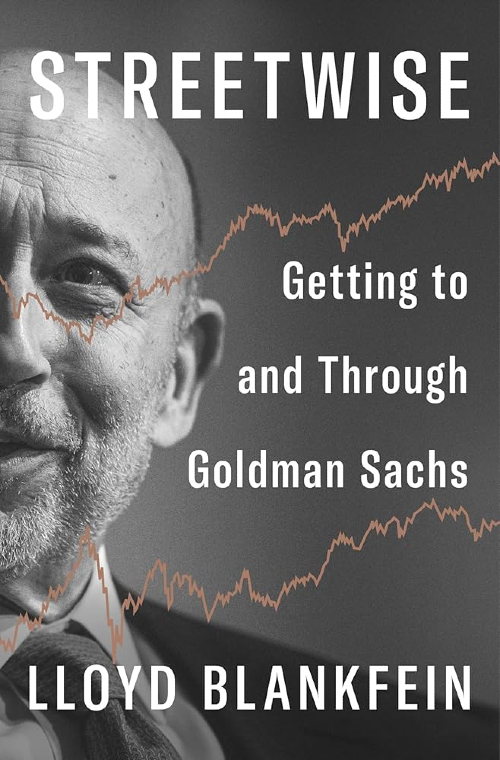
There are books you read for information. And there are books you read because they hold up a mirror to something you have been thinking about for years.
Streetwise: Getting to and Through Goldman Sachs by Lloyd Blankfein is the latter — for me, at least, and strictly through one lens: leadership. What it demands. What it costs. And what it actually takes to navigate institutions of immense power without losing the thing that got you there.
A brief and honest acknowledgment: Goldman Sachs is not without its controversies. The firm occupies a complicated place in the history of modern finance, and reasonable, intelligent people hold strong views about it. This piece is not about the institution, its practices, or its legacy in markets. It is about one man's account of resilience, of reading power, and of the interior discipline required to rise — and lead — in conditions that were never designed with you in mind.
With that said.
The Bronx Was the Education
Blankfein did not arrive at Goldman from a prep school dormitory or a family with a name on a building. He grew up in the South Bronx, in public housing, the son of a postal worker. He got to Harvard on scholarship — not as a legacy, not through a network, but through the particular clarity of mind that comes from having no safety net.
This is worth pausing on.
The institutions that govern global capital — the banks, the asset managers, the funds — were largely built by and for a particular kind of person. The codes were legible to those who had been raised inside them. The handshakes, the clubs, the unwritten rules of how rooms worked and who held the real power within them — these were not taught. They were inherited.
Blankfein was not an inheritor. He was a reader.
And this, in my view, is the first and most underestimated leadership skill in any institutional setting: the ability to read a room you were not born into. To understand the power structure not because you were handed a map, but because you watched carefully enough to draw your own.
Street intelligence — what he calls "streetwise" — is not about cunning or aggression. It is about attention. About noticing what others take for granted because they have always been comfortable. About seeing the room at a slight angle, which sometimes means seeing it more clearly than those who have always sat at its centre.
Resilience Is Not Optimism. It Is Orientation.
What strikes me most in Blankfein's account is how he frames adversity. Not as something to overcome and leave behind, but as something to metabolise — to draw orientation from.
The South Bronx did not break him, and it did not simply toughen him in the crude sense of that word. It gave him a calibration. A baseline. When you have grown up with genuine scarcity and genuine uncertainty, the volatility of markets, of institutions, of human politics within organisations — it registers differently. Not as less serious, but as more navigable. Because you already know something that many of your peers are still learning: that uncertainty is the permanent condition, not a temporary disruption.
This is the resilience that matters in leadership. Not the performance of positivity. Not the refusal to acknowledge difficulty. But a deep, practiced orientation toward continuing — toward the next decision, the next adjustment, the next room to be read and navigated — regardless of what the last one cost you. WALKING THROUGH THE FIRE.
In a world of accelerating disruption — AI reshaping entire industries, the global order being renegotiated in real time, capital flows being redirected almost seasonally — this kind of resilience is not a personal virtue. It is a strategic asset.
The leaders who will matter in the next decade are not the ones who predicted the disruption correctly. They are the ones who, when the map stopped matching the territory, kept moving.
Reading Power Structures — Without Being Consumed by Them
There is a tension at the heart of Blankfein's story that he navigates with more grace than most: how do you learn to speak the language of an institution without becoming only that language? How do you rise through a power structure without the power structure becoming your entire identity?
This is not a small question. Institutions, particularly those of Goldman's scale and culture, exert enormous gravitational pull. They reward conformity in subtle ways — in the assignments you receive, in the rooms you are invited into, in the slow accumulation of belonging that feels, over time, indistinguishable from becoming.
Blankfein remained, somehow, oriented toward his own centre of gravity. The Bronx was not baggage he shed on the way up. It was the anchor that kept him legible to himself even as the context around him changed beyond recognition.
For those of us who have navigated elite institutions from the outside — whether by geography, by background, by gender, by the subtle foreignness of being the first in a room — this is the most important chapter in his story. Not how he got in. But how he stayed himself once inside.
The skill is not resistance. It is a selective translation. You learn the institution's language fluently enough to be heard. You learn its power structures clearly enough to navigate them. But you hold in reserve the part of yourself that the institution did not form — because that is precisely the part that will allow you to lead it, rather than merely serve it.
What Streetwise Means in 2026 and Beyond
We are living through a moment where the old maps of power are being redrawn. The firms that once held structural advantages by virtue of incumbency, geography, or access are discovering that those advantages are no longer permanent. A 25-year-old with a laptop and a sufficiently clear idea can now reach markets, move capital, and build influence in ways that would have required a century-old institution a generation ago.
In this environment, streetwise is not a disadvantage to be overcome. It is increasingly the correct posture.
The leaders who are reading the new rooms most clearly are often those who were never entirely comfortable in the old ones. Who had to pay attention because comfort was not an option. Who built their orientation from observation rather than assumption.
The Bronx, in this sense, prepared Blankfein for something he could not have anticipated: that the world would eventually begin to reward exactly the skills that survival had given him.
What I Am Taking Away
1) The most durable form of resilience is not emotional armour. It is the continuous practice of reorienting toward the next decision, regardless of what the last one cost. Leaders who can do this — genuinely, not performatively — are rare and worth building around.
2) Reading power structures is a learnable skill, and it is one that those who grew up outside institutional comfort are often better positioned to practice. The discomfort of not belonging, metabolised well, becomes an extraordinary instrument of perception.
3) The third is the one that stays with me longest: the leaders who last are the ones who never fully outsourced their identity to the institution they served. Who remained, at their core, oriented toward something older and more personal than the org chart — and who led from that place, even when the institution would have preferred something more legible and more predictable.
That is not a Goldman Sachs lesson. That is a human one.
Streetwise is not a perfect book. But it is an honest one. And in a genre full of retroactive wisdom and carefully managed myth, that is rarer than it should be.
Note: This reflection is offered purely through the lens of leadership and personal resilience. It does not constitute an endorsement of any institution, its practices, or its role in financial markets.
If you want a quick look at the book, check out this Bloomberg podcast.
AI Summary
Former Goldman Sachs CEO Lloyd Blankfein reflects candidly on post-retirement life, AI’s evolving role in finance, growing risks in private credit markets, the enduring influence of Goldman’s partnership culture, and the perils of corporate politicisation—emphasising prudence, ownership mindset, and institutional responsibility amid late-cycle market conditions.
Highlights
- 🧠 AI as a tool—not a saviour: Blankfein views AI as a continuum of algorithmic advancement—useful for removing human emotion from decisions (e.g., trading), but still limited by reliability, source transparency, and integration challenges; he cautions against overinvestment while acknowledging founder-led hyperscalers are “putting their money where their mouth is”.
- 📉 Private credit’s opacity poses systemic risk: He warns that illiquid, hard-to-mark private credit assets—especially as they enter retail and retirement portfolios—lack market discipline and accountability; prolonged bull-market complacency has eroded risk vigilance, making a reckoning increasingly likely.
- 🤝 Partnership culture endures beyond IPO: Despite going public in 1999, Goldman preserved its distinctive partnership ethos—characterised by collective ownership mindset, cross-business accountability, shared P&L sensitivity, and long-term capital thinking—even as shareholder expectations evolved under public ownership.
- ⚖️ Corporate restraint in polarised politics: Blankfein urges companies to avoid performative stances on non-core political issues, reserving public advocacy for matters directly tied to expertise (e.g., fiscal policy) or workforce impact (e.g., marriage equality); he opposes mandating corporate activism, warning it deepens economic and societal division.
- 🛡️ Leadership demands empathy in crisis: Recalling Goldman’s 1994 losses, he stresses that sustaining risk-taking requires protecting talent from punitive blame—rewarding sound judgment even when outcomes fail—because punishing legitimate errors destroys ambition, trust, and organisational resilience.
![Life | Alps Sanctuary] Chamonix #Escape](https://storage.ghost.io/c/2a/9e/2a9e2b04-30f6-4166-8010-a3730d2eb719/content/images/size/w720/2026/10/WhatsApp-Image-2026-10-11-at-09.12.56.jpeg)
![Life | Greece Sanctuary] Skiathos #Escape](https://storage.ghost.io/c/2a/9e/2a9e2b04-30f6-4166-8010-a3730d2eb719/content/images/size/w720/2026/09/Skiathos.jpg)
![Life] What is your comfort food?](https://storage.ghost.io/c/2a/9e/2a9e2b04-30f6-4166-8010-a3730d2eb719/content/images/size/w720/2026/09/WhatsApp-Image-2026-09-18-at-10.11.32.jpeg)
Comments ()