Art] What Cities Make of Us: Art, Power & the Human Condition Across Europe | Andalusia: Where Three Civilizations Learned to Live Together (and Then Didn't) (15/22)
On the greatest multicultural experiment in medieval history, what made it work, what ended it, and what it still has to tell us
![Art] What Cities Make of Us: Art, Power & the Human Condition Across Europe | Andalusia: Where Three Civilizations Learned to Live Together (and Then Didn't) (15/22)](https://storage.ghost.io/c/2a/9e/2a9e2b04-30f6-4166-8010-a3730d2eb719/content/images/size/w1200/2026/03/Gemini_Generated_Image_sbowymsbowymsbow-20.png)
What Cities Make of Us: Art, Power & the Human Condition Across Europe | Post 15 of 22
On the greatest multicultural experiment in medieval history, what made it work, what ended it, and what it still has to tell us
| Series | What Cities Make of Us — Post 15 of 22 |
| Reading Time | 8 minutes |
| Region | Andalusia, Spain |
| Era | 700s – 1492 |
| Key Figures | Averroes, Maimonides, Ibn Arabi, Alfonso X |
| Core Argument | For 700 years, Córdoba hosted the most sophisticated multicultural civilization in the Western world — until it didn't, which is the part we should spend more time thinking about |
In the 9th and 10th centuries, Córdoba was the largest city in Western Europe. Its population of perhaps 500,000 was larger than London, Paris, or any city in the Christian north. It had street lighting — miles of paved, illuminated roads — when most of Europe navigated by moonlight and torchlight. Its library held, by some accounts, 400,000 volumes at a time when the largest monastery libraries in northern Europe counted their collections in the hundreds.
The Caliph's court contained Muslim scholars, Jewish physicians, Christian diplomats, and translators who moved between all three languages as easily as a modern academic moves between disciplinary frameworks. The city's most famous philosopher, Ibn Rushd — known to the Latin West as Averroes — spent his career reconciling Aristotle with Islamic theology, and in doing so transmitted the entirety of Aristotelian thought to medieval Europe at a moment when that thought had been nearly lost to the Western Christian tradition.
Averroes never left Andalusia. But his work traveled. It is not an exaggeration to say that without Averroes, there is no Thomas Aquinas — and without Aquinas, the intellectual architecture of medieval Catholicism, and the university system that grew from it, looks profoundly different.
This is the gift that Al-Andalus gave to Western civilization: the translation, preservation, and transmission of the classical heritage that the Christian north had largely lost track of. Europe recovered its own intellectual past through the medium of Islamic scholarship in a southern Spanish city. The Renaissance, in significant measure, began in Córdoba.
What Made It Work
The period of greatest cultural productivity in Al-Andalus — roughly the 9th through 11th centuries — was not a period of perfect harmony. It was a period of structured inequality in which a Muslim governing class maintained political authority while extending specific protections and significant freedoms to the Jewish and Christian communities under their rule.
The legal framework was dhimmi status — a system of tolerated minorities that was, by the standards of medieval governance everywhere, genuinely more protective than what the same communities experienced in Christian Europe. Jews and Christians could practice their religions, maintain their communities, run their own courts for internal matters, and participate in commerce and scholarship at levels that would have been impossible in any Christian kingdom of the period.
The key word is structured. The tolerance of Al-Andalus was not ideological pluralism in any modern sense. It was a practical arrangement that served the interests of the governing class while providing sufficient protection to attract and retain the minority communities whose skills — particularly in medicine, commerce, and translation — were economically and intellectually essential.
This is an important distinction. The convivencia — the coexistence — was not built on the principle that all cultures and faiths are equally valid. It was built on the principle that diverse communities can be mutually beneficial if the governing framework protects their essential interests while maintaining clear lines of authority. It worked because everyone knew the rules. It began to break down when the rules became contested, when external pressure made the governing class less secure, when the margin for tolerance contracted under threat.
For policymakers thinking about pluralism today, the Al-Andalus model is instructive precisely because it is not utopian. It does not promise that tolerance is easy or natural or without cost. It suggests that diverse societies can be productive when the institutional arrangements protect the basic interests of minority communities — and that they tend to collapse when external stress makes those arrangements politically expensive to maintain.
The Alhambra: The Architecture of Transience
The Alhambra palace complex in Granada — built by the Nasrid dynasty in the 13th and 14th centuries, the last great flowering of Moorish culture in Spain before the Reconquista — is the most physically beautiful product of Islamic civilization in Western Europe. It sits on a hilltop above Granada, looking out over the Sierra Nevada, and the experience of moving through its courts and gardens produces a sequence of spatial and sensory experiences that have no equivalent in any other architectural tradition.
The architecture is designed to produce a specific theological experience: the sense of Paradise as a garden — janna in Arabic — a place of running water, shade, perfume, and light that stands in absolute contrast to the desert landscape that Islamic civilization emerged from. The sound of water is everywhere in the Alhambra — in the channels that run through the courtyards, in the fountains at the center of the gardens, in the pools that reflect the ornamental facades. The decoration is so elaborate that it seems to dissolve the walls themselves — the carved stucco and ceramic tiles creating surfaces that appear almost immaterial, as if the building is made of frozen lace.
The Arabic inscriptions that cover virtually every surface contain, among other things, repeated variations on a single phrase: Wa la ghaliba illa Allah — "And there is no victor but God." This was the motto of the Nasrid dynasty and it appears throughout the Alhambra with a frequency that reads less like confident assertion than like a prayer, or a reminder: whatever you build, however magnificent, it belongs to God and not to you.
The Nasrids built the most beautiful palace in Europe while simultaneously paying tribute to the Christian kingdoms of Castile and Aragon, whose military power they could no longer resist. They knew the end was approaching. The beauty they built in the shadow of that knowledge has a particular quality that pure confidence rarely produces.
Granada fell to Ferdinand and Isabella in January 1492. In October of the same year, Columbus sailed from the Spanish port of Palos.
The Reconquista and the Cost of Purity
The Reconquista — the seven-century campaign by Christian kingdoms to recover Iberian territory from Muslim rule — culminated in 1492 with the fall of Granada. In the same year, Ferdinand and Isabella issued the Alhambra Decree, expelling all Jews from Spain who refused to convert to Christianity. Estimates of the number expelled range from 100,000 to 800,000 — the scholars still argue — but the social and economic consequences were immediate and severe.
The Spanish Inquisition, established in 1478, continued for another three and a half centuries, investigating the authenticity of converts, enforcing religious conformity, and burning those who were found insufficiently Christian. It became, in the European Protestant imagination, the defining symbol of Catholic intolerance. It was also, viewed from the inside, a government agency tasked with managing the anxieties of a society undergoing a profound identity crisis — a society that had been multicultural for five centuries and was attempting, by force, to become monocultural.
The attempt failed in important ways. The conversos — converted Jews — maintained their communities, married among themselves, preserved practices that had been formally abandoned, and remained, in the eyes of the old Christian population, perpetually suspect. The Moriscos — converted Muslims — were similarly never fully trusted and were ultimately expelled entirely in 1609, at the cost of significant agricultural and artisanal productivity in Valencia and Aragon.
The expulsions and the Inquisition did not produce the pure Christian Spain they were designed to create. They produced an economically weakened, intellectually diminished society whose most creative and productive populations had been driven out, dispersed to the Ottoman Empire, to North Africa, to the Netherlands, and to the emerging Atlantic economies, where their skills and networks contributed to the prosperity of Spain's competitors.
Flamenco: The Sound of Collision
The most enduring cultural product of Andalusia is not the Alhambra and not the theological synthesizers of Córdoba. It is flamenco — the music and dance form that emerged from the gitano (Romani) communities of Andalusia in the 18th century, absorbing elements of Moorish music, Jewish lament traditions, and Spanish folk forms into something that belongs entirely to its own tradition.
Flamenco is music of the duende — a Spanish word that García Lorca, the great Andalusian poet, spent an entire lecture attempting to define. It is not charm or beauty or technical skill, Lorca argued. It is a quality of presence, of mortality, of the artist's confrontation with the darkness that underlies all human experience. It is what happens when performance strips away everything protective and reaches the undefended center of feeling.
The cante jondo — the deep song at flamenco's core — carries in its scales and microtones the acoustic memory of musical traditions that have otherwise been largely suppressed or erased. You can hear, in the characteristic descending Phrygian progressions of flamenco guitar, something that sounds less like European music than like music from further east — the musical heritage of communities that traveled, were dispersed, were absorbed into the dominant culture without being entirely consumed by it.
Flamenco is what cultural survival sounds like. It is the music of people who were not supposed to survive as a distinct culture and did so anyway, in the particular form that survives when formal institutions are unavailable: the living transmission, from one generation to the next, of a way of feeling that resists reduction to text or law.
The Question It Leaves Behind
Al-Andalus was not an ideal society. It was a society that found, for several centuries, a workable arrangement for managing human diversity under conditions of political inequality — an arrangement that produced extraordinary cultural and intellectual results, that proved more fragile than its achievements might suggest, and that ended in an explosion of enforced homogeneity that damaged everyone involved.
The wreckage of that experiment is still present in southern Spain, in the architecture and the music and the genetic inheritance of the Andalusian people, in the displaced communities of Sephardic Jews and Andalusian Muslims who carried their culture to other parts of the world and enriched those places with what they brought.
What conditions, in your own institutional context, allow the productive coexistence of genuinely different perspectives? And what pressures are making those conditions harder to maintain?
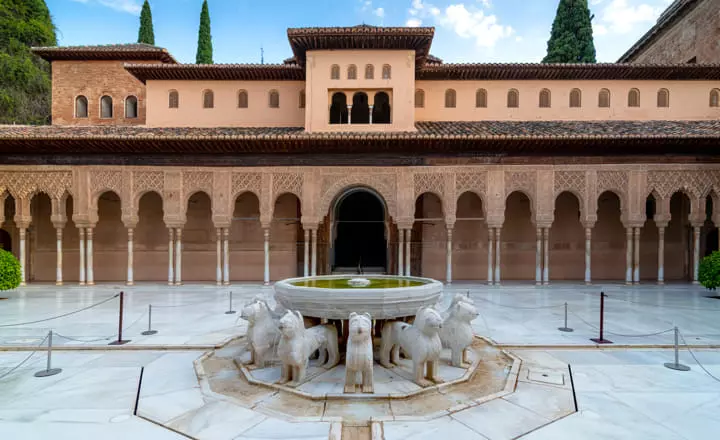
One artwork to sit with: The Court of the Lions, Alhambra, Granada — not a portable artwork, but an architectural space that must be visited to be understood. Twelve marble lions support a central fountain. The columns of the surrounding arcade are so slender they seem impossibly fragile, yet they have stood for seven centuries. The carved stucco above them depicts a forest of palm trees and stalactites in stone — a garden frozen into architecture. Stand in the center and look up at the ceiling of the central pavilion. Then consider that the people who built this knew, as they built it, that it might be the last thing of this kind they would ever create. The knowledge is in the building. So is the defiance.
Next: Post 16 — Tuscany: Beauty, Banking, and the Birth of the Modern World
![Life | Greece Sanctuary] Skiathos #Escape](https://storage.ghost.io/c/2a/9e/2a9e2b04-30f6-4166-8010-a3730d2eb719/content/images/size/w720/2026/09/Skiathos.jpg)
![Life] What is your comfort food?](https://storage.ghost.io/c/2a/9e/2a9e2b04-30f6-4166-8010-a3730d2eb719/content/images/size/w720/2026/09/WhatsApp-Image-2026-09-18-at-10.11.32.jpeg)
![Life | London Sanctuary] The Grove: Place of Restoration #Retreat](https://storage.ghost.io/c/2a/9e/2a9e2b04-30f6-4166-8010-a3730d2eb719/content/images/size/w720/2026/08/WhatsApp-Image-2026-08-07-at-21.51.41.jpeg)
Comments ()