Art] What Cities Make of Us: Art, Power & the Human Condition Across Europe | What Cities Make of Us: A Final Reflection (22/22)
On everything this journey taught about power, beauty, impermanence, and the things worth building
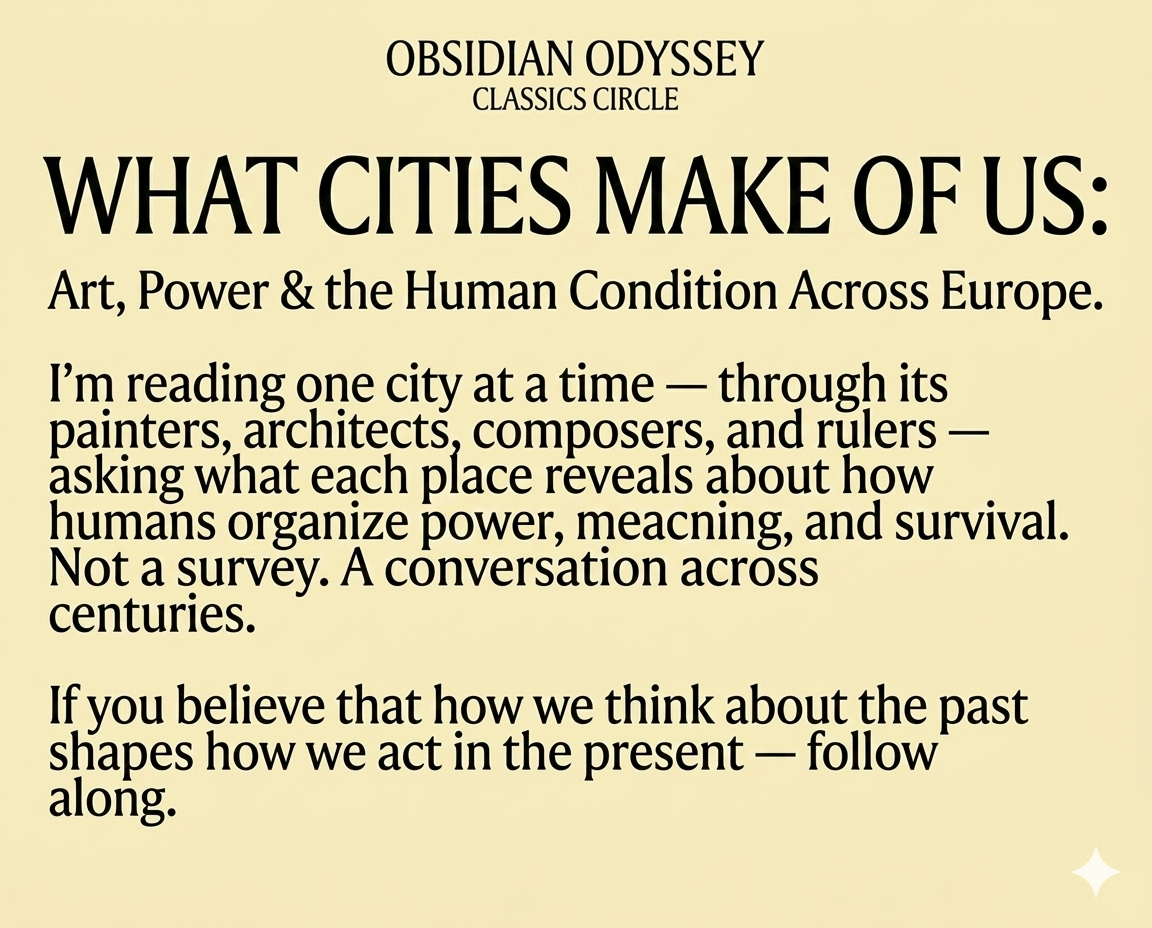
![Art] What Cities Make of Us: Art, Power & the Human Condition Across Europe | What Cities Make of Us: A Final Reflection (22/22)](https://storage.ghost.io/c/2a/9e/2a9e2b04-30f6-4166-8010-a3730d2eb719/content/images/size/w1200/2026/03/Gemini_Generated_Image_sbowymsbowymsbow.png)
What Cities Make of Us: Art, Power & the Human Condition Across Europe | Post 22 of 22
On everything this journey taught about power, beauty, impermanence, and the things worth building
| Series | What Cities Make of Us — Post 22 of 22 |
| Reading Time | 8 minutes |
| Scope | Europe & New York — the full journey |
| Era | Ancient – Present |
| Key Themes | Power & beauty, outsider vision, the lag of recognition, what endures |
| Core Argument | After twenty-two cities, four patterns keep repeating — and they say more about how human civilization actually works than any single history book |
A journey that began in London — with Turner watching Parliament burn, with Elizabeth I managing her image from a position of existential vulnerability, with Hogarth documenting the moral costs of a society organized entirely around the extraction of value — ends in New York, where Rothko tried to trap you in a room with a painting that asks nothing of you except your presence.
Twenty-two cities. Roughly five centuries of Western civilization. Several hundred artists, writers, composers, architects, and rulers. And underneath all of it, recurring with a persistence that geography and century and medium cannot alter, the same handful of questions.
This is the final post. It is not a summary. Summaries flatten the things they summarize, and what this series has tried to do — following the cities, following the artists, following the decisions that shaped what got built and what got burned — does not survive flattening. What I want to do instead is name the questions that kept returning, and offer them to you as tools.
What Power Needs From Beauty
The most consistent theme across twenty-two posts is the relationship between power and culture — the ways in which political authority has always required aesthetic legitimation, and the complicated ethics of the art that provides it.
The Habsburgs built the Ringstrasse. Lorenzo de' Medici maintained a Platonic academy. Elizabeth I controlled her portraits. Augustus decorated Rome. The CIA funded Abstract Expressionism. Every major power center in the history of Western civilization has understood, at some level, that force alone is insufficient — that legitimacy requires a story, and that the most durable stories are the ones embedded in beautiful things.
This is not cynical. The Sistine Chapel ceiling is one of the most extraordinary things a human being has ever made. That it was commissioned by a Pope who was simultaneously embroiled in the politics of the Counter-Reformation, and who threatened Michelangelo with violence when he moved too slowly, does not diminish the ceiling. It contextualizes it. The beauty is real. The context is real. Both are part of the story.
What changes, across this history, is not the fundamental dynamic but the specific forms it takes. The question for anyone in a position of institutional authority today — whether in finance, policy, or the organizations that shape culture — is not whether they are participating in this relationship between power and beauty. They almost certainly are. The question is whether they are doing so with the honesty and intentionality that the relationship requires.
What the Outsider Sees
The most interesting perspective in almost every chapter of this series belongs to someone who is not quite at the center.
Monet saw London's fog more clearly than any Londoner. Chopin understood Poland most profoundly after he could no longer return to it. The Dutch masters — Calvinist merchants' painters — produced a visual philosophy of ordinary life more profound than the court painters of Versailles. Kafka documented the Habsburg bureaucracy with a clarity available only to someone who was both inside and outside it simultaneously. Basquiat brought to the New York art world a perspective that its insiders could not have supplied from within.
The outsider position is not comfortable. It is not chosen, in most of these cases. But it produces a quality of perception — the ability to see the assumptions that insiders cannot see, to notice the gaps between the performance and the reality — that has generated, repeatedly, the work that reshapes fields.
This has implications that are not purely academic. Every organization contains outsiders — people whose background, whose perspective, whose experience of the institution differs from the dominant internal narrative. The question is whether the institution treats that difference as a problem to be resolved or a resource to be used. The history of innovation suggests strongly that the most valuable perspective is the one that the dominant culture is most reflexively inclined to dismiss.
The Lag Between Doing and Recognition
Turner was dismissed by his queen. Van Gogh sold one painting. Vermeer was forgotten for two centuries. Bach was known only to specialists for eighty years after his death.
The lag between the production of genuinely original work and its recognition is one of the most consistent patterns in the history of ideas. It is consistent because it has a consistent cause: the evaluative frameworks that allow a field to recognize excellence are developed by examining existing excellence, and genuinely new work requires a framework that does not yet exist.
This is not primarily a story about injustice, though injustice is part of it. It is primarily a story about the structural limitations of how any field processes genuine novelty. The institutions are not malicious. They are using the tools they have. The tools are not adequate to the task.
The implication — for investors, for researchers, for policymakers, for anyone whose work involves the early identification of value — is not that you should simply trust your own judgment over institutional consensus. The institutions are right about most things, most of the time. The implication is that you should build, alongside the analytical frameworks your field has developed, a capacity for a different kind of attention — a willingness to sit with things that do not immediately resolve, to spend time with work that is not immediately legible, to ask whether your failure to understand something might be the interesting part.
Beauty as an Argument
The most provocative claim that this series has, implicitly, been making is that beauty is not decoration. It is a form of argument.
Michelangelo's ceiling is an argument about the relationship between the human and the divine. Vermeer's milkmaid is an argument about the dignity of ordinary labor. Goya's Third of May is an argument about the dehumanization that violence requires. The Alhambra is an argument — made in stone and water and carved plaster — about what civilization can look like when it takes both the physical world and the inner life with equal seriousness.
These arguments do not work the way verbal arguments work. They cannot be refuted by pointing out a logical flaw. They cannot be dismissed by noting that the premises are contestable. They work by producing in the viewer a direct experience of the thing being claimed — the dignity, the violence, the possibility, the beauty — that bypasses the intellectual defenses that make verbal arguments susceptible to resistance.
This is why the most sophisticated practitioners of power have always invested in beauty. Not because they were aesthetes, though some were. Because they understood that the arguments embedded in beautiful things are the most durable and the most difficult to answer.
It is also why the most serious moral witnesses — Goya, Caravaggio, Kollwitz, Shostakovich — have always worked in beauty's medium. Not because they were unaware of the danger of that complicity. But because they understood that the only available way to say the things that needed to be said was to use the same tools that power uses, and to say something different with them.
What Endures
The political entities that commissioned most of this work are gone. The Habsburg Empire. The Venetian Republic. The courts of the German princes. The patronage systems that sustained Titian and Haydn and Rubens dissolved into other forms. The buildings in which the music was first performed have burned or been bombed or been repurposed into hotels and restaurants and government ministries.
The work remains.
This is not inevitable. Most of what was made is gone — lost to fire, flood, neglect, and the sheer volume of human making. What survives is the fraction that was valued enough, at enough different moments, by enough different people, to be worth the effort of preservation. That survival is itself a form of argument: about what mattered, what was found useful or beautiful or necessary by the people who kept it.
St. Paul's Cathedral survived the Blitz. The St. Matthew Passion survived Bach's death and two centuries of neglect. The Alhambra survived the Reconquista. Rembrandt's late self-portraits survived his bankruptcy and his obscurity. They survived because people found them worth preserving — found in them something that the political and financial circumstances of the moment could not supply.
This is, perhaps, the deepest argument for culture: not that it is pleasant, not that it is uplifting, not that it builds social cohesion or economic value or national identity — though it does all of these things. The deepest argument is that it creates objects and experiences that outlast the conditions of their creation and continue to be useful to people who live in conditions the creator could not have imagined.
A Final Question
This series has been addressed, from the beginning, to people in finance, policy, politics, academia, and the arts — people who spend their working lives inside the institutions that shape how the world operates. People who are, in various ways and at various levels, responsible for what gets built and what gets preserved and what gets torn down.
The cities we have traveled through built things that outlasted their political moments. They also destroyed things — burned libraries, expelled communities, demolished buildings, executed artists, silenced composers. The record of Western civilization is not a story of progress toward some achieved state of cultural wisdom. It is a record of recurring choices, made under pressure, about what mattered enough to protect.
Those choices are still being made. You are making them, in the decisions of your working life, in the institutions you participate in, in the stories you tell about what you do and why it matters.
The Grand Tour was built on the conviction that certain things could only be learned by going — by standing in front of the thing itself, in the place where it was made, in the full complexity of its context. That conviction was right. There are things that cannot be learned at second hand.
What cannot be conveyed in a series of essays, no matter how long, is the experience of standing in the Contarelli Chapel and waiting for your eyes to adjust to the darkness until the Caravaggios appear. Of sitting in a near-empty concert hall and hearing the first bars of the St. Matthew Passion. Of walking into the Rijksmuseum and turning the corner and finding the Night Watch filling the end of the gallery, enormous and alive, six hundred million pixels of human reality compressed into oil and canvas.
Go. Take the time. Give the works what they require.
What they require, in the end, is simply what every serious human encounter requires: the willingness to stop, to look, and to be changed by what you find.
What will you go and see — not read about, not stream, not visit on Google Arts & Culture, but actually go and stand in front of?
A final work to sit with: The journey itself. Close this essay. Open a map of Europe. Pick one city from these twenty-two. Book the flight. Walk into one museum, one church, one concert hall. Stand in front of one work for ten minutes longer than feels comfortable. Notice what happens. That is the whole argument, stated in experience rather than words. Everything else in these pages was preparation for that moment.
"What Cities Make of Us: Art, Power & the Human Condition Across Europe" — a 22-post series
Post 0: The Grand Tour Post 1: London Post 2: Scotland Post 3: Normandy Post 4: Paris 1 Post 5: Paris 2 Post 6: Provence Post 7: Weimar & Leipzig Post 8: Berlin & Hamburg Post 9: Rhine & Bavaria Post 10: Amsterdam & Brussels Post 11: Vienna 1 Post 12: Vienna 2 Post 13: Bohemia Post 14: Madrid & Barcelona Post 15: Andalusia Post 16: Tuscany Post 17: Venice Post 18: Rome & Naples Post 19: Scandinavia Post 20: Moscow & St. Petersburg Post 21: New York Post 22: Final Reflection
![Life | Greece Sanctuary] Skiathos #Escape](https://storage.ghost.io/c/2a/9e/2a9e2b04-30f6-4166-8010-a3730d2eb719/content/images/size/w720/2026/09/Skiathos.jpg)
![Life] What is your comfort food?](https://storage.ghost.io/c/2a/9e/2a9e2b04-30f6-4166-8010-a3730d2eb719/content/images/size/w720/2026/09/WhatsApp-Image-2026-09-18-at-10.11.32.jpeg)
![Life | London Sanctuary] The Grove: Place of Restoration #Retreat](https://storage.ghost.io/c/2a/9e/2a9e2b04-30f6-4166-8010-a3730d2eb719/content/images/size/w720/2026/08/WhatsApp-Image-2026-08-07-at-21.51.41.jpeg)
Comments ()