Art] What Cities Make of Us: Art, Power & the Human Condition Across Europe | Vienna 2: Yesterday's World, Today's Anxiety (12/22)
On the civilization that produced Freud and Klimt and Wittgenstein — and what it tells us about the art that flourishes at the edge of an abyss
![Art] What Cities Make of Us: Art, Power & the Human Condition Across Europe | Vienna 2: Yesterday's World, Today's Anxiety (12/22)](https://storage.ghost.io/c/2a/9e/2a9e2b04-30f6-4166-8010-a3730d2eb719/content/images/size/w1200/2026/03/Gemini_Generated_Image_sbowymsbowymsbow-17.png)
What Cities Make of Us: Art, Power & the Human Condition Across Europe | Post 12 of 22
On the civilization that produced Freud and Klimt and Wittgenstein — and what it tells us about the art that flourishes at the edge of an abyss
| Series | What Cities Make of Us — Post 12 of 22 |
| Reading Time | 8 minutes |
| City | Vienna, Austria |
| Era | 1890s – 1938 |
| Key Figures | Klimt, Schiele, Freud, Mahler, Wittgenstein, Herzl |
| Core Argument | In 1900, Vienna was the most intellectually productive city in the world — and it was completely failing to notice the catastrophe building around it |
Stefan Zweig was born in Vienna in 1881 and died in Brazil in 1942. In between, he was one of the most widely read authors in the world, a man who had known virtually every major cultural figure in Europe, a writer whose work had been translated into more languages than almost any of his contemporaries. He and his wife took their own lives in a rented room in Petrópolis, having fled first from Vienna, then from London, then from New York, always one step ahead of the darkness that was consuming everything he had known.
He had finished his memoir, The World of Yesterday, shortly before his death. It is an account of the Vienna of his youth — the coffeehouse culture, the intellectual richness, the extraordinary confidence of a civilization that believed it had arrived at a permanent condition of progress and refinement — and an elegy for everything that confidence had failed to protect against.
It is also, among other things, the most precise account ever written of what it feels like to watch a civilization lose its bearings from the inside.
The Vienna of 1900: A Civilization at Its Peak
The decades around 1900 were, by almost any conventional measure, a golden age for Vienna. The empire was large, wealthy, and at peace. The Ringstrasse was new and magnificent. The opera was the finest in Europe. The cafés hummed with conversation that crossed disciplines with a freedom that formal institutions would never permit.
In those cafés — the Landtmann, the Central, the Griensteidl — you might find Freud discussing his new theories of the unconscious with Arthur Schnitzler, who was writing plays that dramatized exactly the sexual repression Freud was analyzing. Around the corner, Gustav Klimt was painting canvases in which desire and death were so thoroughly entwined that they shocked the Vienna Secession's own exhibitions. At the university, Ludwig Wittgenstein was beginning the work that would transform the philosophy of language. In the concert halls, Gustav Mahler was conducting symphonies of such length and emotional intensity that audiences were not always sure whether they were being elevated or tormented.
What these people shared — Freud, Klimt, Mahler, Schoenberg, Wittgenstein, Loos, Musil, Kraus — was a sense that the surfaces of their civilization, however beautiful, concealed something that was not being addressed. The ornamental excess of the Ringstrasse style, the comforting historical citations of the neo-Gothic and neo-Renaissance buildings, the elaborate social rituals of Viennese public life — all of this, they sensed, was a performance of stability that was becoming more elaborate precisely because the stability itself was becoming less certain.
Freud's entire theoretical edifice rests on this insight: that the civilized surface of human behavior is maintained by the active suppression of forces that are more powerful than the civilization acknowledges. The neurotic symptoms he documented in his patients — the paralyses, the obsessions, the inexplicable anxieties — were, in his analysis, the return of the repressed: the eruption into the surface of life of forces that had been denied acknowledgment.
This was not merely a theory of individual psychology. It was a theory of civilization.
Klimt: Beauty as a Form of Honesty
Gustav Klimt is the most accessible entry point into Viennese Fin-de-siècle art because the beauty is so immediately overwhelming. The gold leaf, the mosaic surfaces, the extraordinarily sensual human figures — Klimt produces a response that precedes analysis, that gets inside the visual system before the critical mind has time to engage.
But the beauty is not escapism. It is, on close examination, a form of extreme honesty.
His ceiling paintings for the University of Vienna — commissioned by the institution in 1894 and eventually rejected with expressions of scandalized outrage — depicted Philosophy, Medicine, and Jurisprudence as figures of ambiguity, darkness, and barely restrained chaos rather than the confident representatives of rational progress that the commission had anticipated. Philosophy was a swirl of bodies in the void, with a face of profound uncertainty at its center. Medicine was a column of naked human forms — sick, dying, entangled — with the goddess of healing cold and remote above them. Jurisprudence showed justice as the helpless captive of punishment rather than its master.
The university committee had wanted allegories of progress. Klimt gave them allegories of the human condition as it actually presented itself to anyone who looked without the consolation of institutional mythology. They were furious. He was furious. He bought the paintings back and kept them.
They were destroyed in the final days of the Second World War, when retreating SS troops burned the castle where they were stored. We know them only from photographs and Klimt's preparatory drawings. This feels appropriate in a way that is almost unbearably literary.
Freud's Couch: The City's Unconscious
Freud's apartment at Berggasse 19 is now a museum. His consulting room — the famous couch, the objects he collected obsessively, the multiple images of ancient civilization that covered every surface — has been partially reconstructed from photographs.
What is striking about the room, even in reconstruction, is the degree to which it embodied its owner's theory. Freud surrounded himself with antiquities — Egyptian figurines, Greek vases, Roman sculptures, a Chinese jade carving of heavenly horses. He was, in his consulting room, staging a visual argument: that what we find buried in the individual unconscious is as old as civilization itself, that the drives and desires and fears he was excavating in his patients were not modern pathologies but ancient human inheritances that civilization had buried without eliminating.
The objects also told a secondary story. Freud was a Jew practicing in a city that was developing, in his lifetime, one of the most virulent strains of modern anti-Semitism. Vienna elected Karl Lueger — who campaigned explicitly on antisemitism — as mayor in 1897, an election Freud followed with horror. The young Adolf Hitler lived in Vienna between 1907 and 1913, absorbing the political atmosphere with consequences that need no elaboration.
Freud understood what was happening and, initially, refused to leave. He had built his life and work in Vienna over forty years. He understood, intellectually, the danger. He could not make himself respond to it with the urgency it required until 1938, when the Gestapo came to his apartment, interrogated his family, and made the alternative to flight literal.
He died in London in September 1939, one week after the war he had seen coming for decades finally began.
The blindness of brilliant people to threats they have intellectually identified but emotionally cannot process is one of the recurring themes of the Viennese story. It is not a failure of intelligence. It is a failure of something harder to name — the capacity to act on conclusions that are unbearable.
Mahler: The Symphony as Total World
Gustav Mahler conducted the Vienna Court Opera from 1897 to 1907, transforming it into the greatest opera company in Europe through a combination of artistic intensity and personal intransigence that made him simultaneously indispensable and impossible. He then resigned under pressure, took the position of principal conductor of the New York Philharmonic, and died in Vienna in 1911 at fifty years old, his heart failing under the accumulated stress of a life lived at maximum intensity.
His symphonies are vast — most run to sixty or seventy minutes, the Eighth to ninety, the unfinished Ninth to eighty. They are not vast because Mahler could not edit himself. They are vast because the question he was asking required vast space. The question was, essentially, the same question the Vienna of his time was asking at every level: how do you hold together, in a single coherent form, the contradictory experiences of modern life — joy and grief, the sacred and the vulgar, the intimate and the cosmic, the desire for transcendence and the knowledge of death?
The late symphonies — above all the Ninth — answer the question honestly. You don't hold it together. You let the contradictions stand. You allow the music to fall apart and rebuild and fall apart again, not because the composer has failed to find a resolution but because there is no resolution to find. The Ninth Symphony ends not with triumph or tragedy but with a long, slow, nearly inaudible dissolution — the sound of acceptance.
Mahler died before he could complete the Tenth. Somewhere in Vienna, in the late autumn of 1911, a finished symphony sat unplayed because the man who wrote it was in the ground. The century continued without him, in directions he had partly foreseen.
The World of Yesterday and the Risk of Complacency
Stefan Zweig's Vienna was a city of extraordinary intellectual achievement built on a foundation of willful complacency about its own fragility. The coffee houses debated everything except the political conditions that made the coffee houses possible. The artists examined every dimension of the human psyche except the collective capacity for organized barbarism that was gathering force in the streets outside.
This is the most chilling aspect of the Viennese story, and the most directly relevant to anyone working in finance, policy, or institutional leadership today. The people who failed to respond adequately to the crises of the early 20th century were not, for the most part, stupid people or ignorant people. They were the most educated, most sophisticated, most culturally refined people in Europe. Their sophistication had become, in some respects, an obstacle — it gave them frameworks for analyzing the world that were too refined to register the crudeness of what was actually happening.
Zweig understood this about himself in retrospect, which is part of what makes his memoir so painful to read. He could see, from Brazil in 1942, exactly where the complacency had been, and he had no comfort to offer about it.
The Question It Leaves Behind
The Vienna of 1900 was, simultaneously, one of the most sophisticated civilizations in human history and a civilization that was walking toward an abyss with its eyes partially open and its feet still moving forward.
The art it produced in those decades — Klimt's golden anxieties, Mahler's vast contradictions, Freud's maps of the buried self — was so extraordinary precisely because it was made by people who sensed the abyss without being able to stop their own approach toward it.
What are the things that your own intellectual sophistication makes it harder rather than easier to see? What are the crudely obvious things that the complexity of your analytical frameworks might be obscuring?
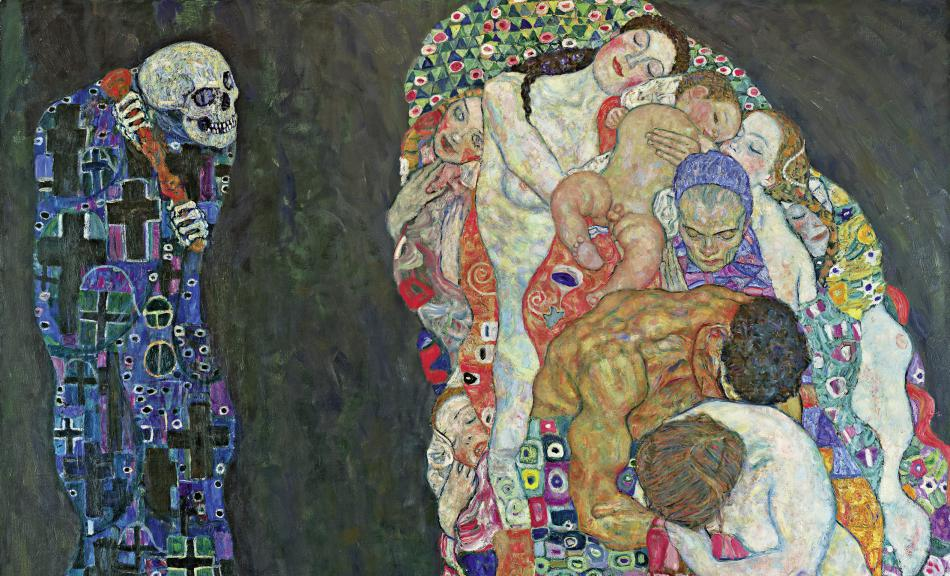
One artwork to sit with: Gustav Klimt, Death and Life (1910-15), Leopold Museum, Vienna — on the left, a grinning skull decorated with crosses and geometric symbols, representing Death. On the right, a mass of intertwined human figures, eyes closed, pressed together in sleep or love or both, representing Life. They do not look at each other. They face in opposite directions, as if unaware of each other's presence. But they are the same painting. They have always been the same painting. Klimt is telling you something that the Ringstrasse, for all its magnificence, preferred not to say.
Next: Post 13 — Bohemia: Longing, Exile, and the Music of Homesickness
![Life | Greece Sanctuary] Skiathos #Escape](https://storage.ghost.io/c/2a/9e/2a9e2b04-30f6-4166-8010-a3730d2eb719/content/images/size/w720/2026/09/Skiathos.jpg)
![Life] What is your comfort food?](https://storage.ghost.io/c/2a/9e/2a9e2b04-30f6-4166-8010-a3730d2eb719/content/images/size/w720/2026/09/WhatsApp-Image-2026-09-18-at-10.11.32.jpeg)
![Life | London Sanctuary] The Grove: Place of Restoration #Retreat](https://storage.ghost.io/c/2a/9e/2a9e2b04-30f6-4166-8010-a3730d2eb719/content/images/size/w720/2026/08/WhatsApp-Image-2026-08-07-at-21.51.41.jpeg)
Comments ()