Art] What Cities Make of Us: Art, Power & the Human Condition Across Europe | Venice: Trade, Empire, and the Art of Surviving by Being Indispensable (17/22)
How a city built on water outlasted every empire of its age — and what a thousand years of strategic neutrality can teach us about institutional survival
![Art] What Cities Make of Us: Art, Power & the Human Condition Across Europe | Venice: Trade, Empire, and the Art of Surviving by Being Indispensable (17/22)](https://storage.ghost.io/c/2a/9e/2a9e2b04-30f6-4166-8010-a3730d2eb719/content/images/size/w1200/2026/03/Gemini_Generated_Image_sbowymsbowymsbow-22.png)
What Cities Make of Us: Art, Power & the Human Condition Across Europe | Post 17 of 22
How a city built on water outlasted every empire of its age — and what a thousand years of strategic neutrality can teach us about institutional survival
| Series | What Cities Make of Us — Post 18 of 22 |
| Reading Time | 8 minutes |
| Cities | Rome & Naples, Italy |
| Era | Ancient – 1800s |
| Key Figures | Caravaggio, Bernini, Raphael, Keats, Goethe |
| Core Argument | Rome teaches the one lesson all great powers resist: that decline is not failure but the necessary condition of everything that comes after |
Venice should not exist. It was built in a lagoon, on a series of small mudflats and islands, by refugees fleeing the mainland invasions that accompanied the collapse of the Roman Empire in the 5th century. The earliest settlers drove wooden piles into the soft mud to create foundations, built on those foundations, sank, drove more piles, built again. The city they created over the next several centuries was entirely dependent for fresh water on rain, entirely dependent for food on trade, entirely dependent for survival on a naval capacity that could be built only by an extraordinarily disciplined collective effort.
The result was a city-state that survived, as an independent republic, for more than a thousand years — from 697 to 1797, when Napoleon dissolved it. It outlasted the Byzantine Empire, the Holy Roman Empire, the Ottoman Empire, the Papal States, and every other major political entity in medieval and early modern Europe. It did this not by being the most powerful — it never had the resources for that — but by being the most indispensable.
This is the Venetian strategy, and it is one of the most instructive case studies in institutional survival in the historical record.
The Republic and Its Machinery
The Venetian Republic was governed by a system of extraordinary constitutional sophistication — developed over centuries to solve the single most persistent problem of republican governance: how do you prevent the concentration of power in the hands of an individual or a faction without creating the paralysis of permanent committee rule?
The Doge — the elected head of state — was, in theory, enormously powerful. In practice, the Venetian constitution surrounded him with restrictions that reduced his actual authority to something closer to a ceremonial head with specific executive functions. He could not leave Venice without permission. He could not receive foreign ambassadors alone. His correspondence was read by state officials. Members of his family were excluded from most significant government positions.
The Great Council, the Senate, the Council of Ten, the Council of Three — layer upon layer of overlapping authority, term limits, elaborate selection procedures that combined election and lottery to prevent both corruption and incompetence — all of these mechanisms were designed to ensure that no individual, no family, and no faction could accumulate enough power to override the collective judgment of the patriciate.
It worked. For a thousand years, the Republic of Venice did not produce a single successful autocrat — remarkable in an era when autocracy was the default condition of every other major political entity in Europe. The constitutional machinery was imperfect, the patrician class was self-serving, and the system excluded the majority of the population from any political voice. But on the specific problem it was designed to solve — the prevention of one-man rule — it performed with extraordinary consistency.
For anyone thinking about institutional design, the Venetian constitution is worth studying. Not because it is replicable in its specifics, but because it thought more seriously than most constitutions about the mechanisms through which power concentration occurs and the countermeasures that can prevent it.
Titian: Fifty Years at the Center of the World
Tiziano Vecellio — known in English as Titian — was born in the mountains of the Veneto around 1488 and died in Venice in 1576, at an age somewhere between eighty-eight and ninety-eight. For most of his adult life, he was the most sought-after painter in Europe.
His career was an exercise in the management of maximum demand. The Holy Roman Emperor Charles V commissioned him and, in a gesture of extraordinary social elevation, was said to have picked up a brush that Titian had dropped, telling the assembled courtiers that an emperor could serve a Titian because Titans were created by nature but emperors by chance. Philip II of Spain kept him occupied for decades. The Pope commissioned him. Every major court in Europe wanted him.
Titian managed this demand with the skill of a modern financial institution managing a wealthy client list — differentiating his attention, pricing his time accordingly, and never allowing any single patron to believe they had an exclusive claim. The result was that his work is now spread across the major museums of the world in a way that ensures a certain omnipresence: Titian is in the Uffizi, in the Prado, in the Louvre, in the National Gallery, in the Kunsthistorisches Museum in Vienna, in the Hermitage.
What he understood, and communicated through his work with a directness that his predecessors had not quite achieved, was the physical reality of flesh. His nudes are not idealized forms. They are bodies — warm, present, particular, specific to a moment in light and time. When he painted Venus, he painted a woman who is actually there in the room with you. The painting maintains the mythological reference but insists on the human fact.
This insistence on presence — on the painting as an encounter rather than a symbol — is why his work has retained its power through five centuries of changing aesthetic fashion. You do not need to know anything about Venetian painting to respond to a Titian. You only need to look.
Vivaldi and the Orphanage
Antonio Vivaldi was a violin teacher at the Ospedale della Pietà — a charitable institution for orphaned, illegitimate, and abandoned girls in Venice. He held this position, with interruptions, for most of his working life, and the job required him to compose, perform, and teach music to a standard that maintained the institution's reputation as one of the finest musical establishments in Europe.
The Four Seasons, the five hundred-plus concertos, the forty-six operas — much of this output was produced as a function of an institutional position. Vivaldi needed new material for his students to perform. He provided it. The productivity was, in part, simply the output of a professional obligation fulfilled over decades.
This does not diminish the achievement. It contextualizes it. The conditions that produced the Four Seasons were not the conditions of inspired leisure or artistic freedom — they were the conditions of a working musician employed by a welfare institution, writing music that had to be good enough to maintain the institution's charitable income, week after week, for thirty-five years.
Great work and functional institutional service are not always in opposition. Sometimes the institution provides the discipline that genius requires.
The Ghetto: Isolation as Inadvertent Preservation
Venice established the first Jewish ghetto in Europe in 1516 — a specific area of the city (the name comes from the Venetian word for the foundry that had previously occupied the site) to which Jews were required to return each night, behind locked gates, watched by guards.
The ghetto was a form of enforced segregation that was simultaneously a protection — within its walls, Venice's Jewish community was legally recognized, relatively secure from the periodic violence that Jewish communities experienced elsewhere in Europe, and able to maintain religious and cultural practices that were suppressed in other jurisdictions.
Over the following centuries, the Venetian ghetto became one of the most culturally productive Jewish communities in Europe — printing houses, philosophical academies, the synthesis of Kabbalistic thought with Renaissance Neoplatonism, the careers of figures like Leon Modena and Sara Copia Sullam who moved between the Jewish and Christian intellectual worlds with a fluency that was only possible because of Venice's particular institutional arrangements.
The ghetto produced cultural richness precisely because the community it enclosed was forced, by its circumstances, to maintain its distinctiveness. Isolation that was intended as a form of control became, in an irony that is not entirely uncommon in the history of minority cultures, a condition of cultural preservation.
The City That Knows It Is Finite
Venice is sinking. The aquifer beneath the lagoon, pumped for industrial use in the 20th century, has caused the land to subside. Rising sea levels compound the problem. The acqua alta — the high water — floods the city with increasing frequency and increasing depth. The Piazza San Marco, the lowest point in the city, floods dozens of times a year.
There are engineering solutions under discussion and partially under construction. But the fundamental problem — a city built on mud in a lagoon, in a century of rising seas — has no clean technical resolution.
And yet Venice continues. Tourism — seventeen million visitors a year to a city with a permanent population of around 50,000 — has created its own set of problems, but it has also created the economic basis for maintaining a built environment of extraordinary complexity and fragility. The city persists because enough people find it irreplaceable to ensure that its maintenance remains economically viable.
What Venice has that other cities don't is a clarity about its own impermanence that most cities avoid. It has been accommodating the possibility of its own disappearance for centuries. This accommodation has not produced fatalism — the MOSE flood barrier project is one of the most expensive engineering undertakings in European history — but it has produced a particular quality of attention to what exists now, a refusal to take the present for granted that is written into the city's character.
The things that know they are finite tend to be attended to more carefully than the things that assume permanence.
The Question It Leaves Behind
Venice survived a thousand years not because it was the strongest power in its neighborhood but because it made itself so useful to so many parties that none of them could afford to eliminate it. It traded with Muslims and Christians alike, supplied both sides in conflicts it preferred to avoid, and maintained a studied pragmatism about ideology that its more doctrinaire neighbors found alternately admirable and infuriating.
This is a strategy with obvious moral limitations — a city-state that trades with whoever can pay is a city-state that has largely outsourced its moral commitments to its balance sheet. But as a description of how institutions survive in environments where they are structurally vulnerable to more powerful players, it has considerable practical instructiveness.
What makes you, or your institution, genuinely indispensable — not merely useful, not merely efficient, but irreplaceable in a way that would make your disappearance costly to multiple parties? And are you actively managing that indispensability, or assuming it will persist?
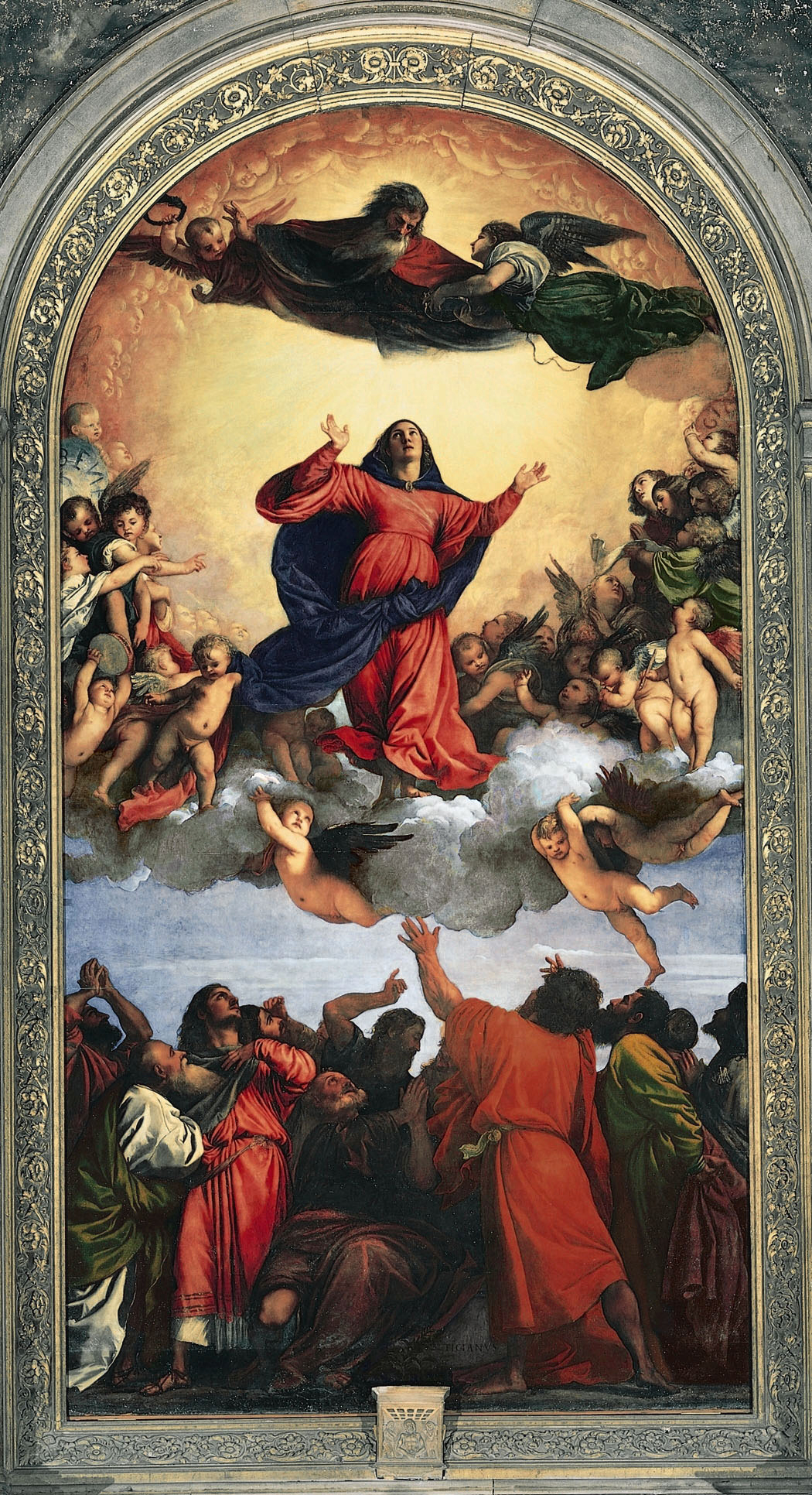
One artwork to sit with: Titian, Assumption of the Virgin (1516-18), Basilica di Santa Maria Gloriosa dei Frari, Venice — the largest altarpiece in Venice, still in the church for which it was painted. The Virgin ascends in a blaze of red and gold, her arms raised, surrounded by angels. Below, the apostles reach upward, unable to follow. Above, God the Father reaches downward to receive her. The painting fills the apse of the church. Stand at the far end of the nave and look down the length of the building toward it. The distance and the scale work together to produce exactly the experience Titian intended: the sense of something enormous happening at the boundary between the human and the divine, visible but unreachable. Then consider that this painting has been in this position, in this light, for five hundred years.
Next: Post 18 — Rome & Naples: The Weight of Ruins and the Art of Living Anyway
![Life | Greece Sanctuary] Skiathos #Escape](https://storage.ghost.io/c/2a/9e/2a9e2b04-30f6-4166-8010-a3730d2eb719/content/images/size/w720/2026/09/Skiathos.jpg)
![Life] What is your comfort food?](https://storage.ghost.io/c/2a/9e/2a9e2b04-30f6-4166-8010-a3730d2eb719/content/images/size/w720/2026/09/WhatsApp-Image-2026-09-18-at-10.11.32.jpeg)
![Life | London Sanctuary] The Grove: Place of Restoration #Retreat](https://storage.ghost.io/c/2a/9e/2a9e2b04-30f6-4166-8010-a3730d2eb719/content/images/size/w720/2026/08/WhatsApp-Image-2026-08-07-at-21.51.41.jpeg)
Comments ()