Art] What Cities Make of Us: Art, Power & the Human Condition Across Europe | Tuscany: Beauty, Banking, and the Birth of the Modern World (16/22)
How the Medici turned money into civilization — and what the Renaissance teaches us about the relationship between financial power and cultural legacy
![Art] What Cities Make of Us: Art, Power & the Human Condition Across Europe | Tuscany: Beauty, Banking, and the Birth of the Modern World (16/22)](https://storage.ghost.io/c/2a/9e/2a9e2b04-30f6-4166-8010-a3730d2eb719/content/images/size/w1200/2026/03/Gemini_Generated_Image_sbowymsbowymsbow-21.png)
What Cities Make of Us: Art, Power & the Human Condition Across Europe | Post 16 of 22
How the Medici turned money into civilization — and what the Renaissance teaches us about the relationship between financial power and cultural legacy
| Series | What Cities Make of Us — Post 16 of 22 |
| Reading Time | 8 minutes |
| Region | Tuscany, Italy |
| Era | 1300s – 1527 |
| Key Figures | Leonardo, Michelangelo, Botticelli, the Medici, Machiavelli, Dante |
| Core Argument | The Florentine Renaissance was not a flowering of idealism — it was funded by bankers, managed by political operators, and the art reflects every contradiction of that arrangement |
In 1401, the Arte di Calimala — the guild of wool merchants in Florence — held a competition to design a new set of bronze doors for the city's Baptistery. The prize was the most prestigious public commission in Florence, and the competition attracted the leading sculptors of the age. After months of judging, the committee declared the result a draw between two young artists: Lorenzo Ghiberti and Filippo Brunelleschi. They offered to split the commission.
Brunelleschi refused. He left Florence for Rome, where he spent the next decade measuring and studying every major ancient building he could access, developing in the process a systematic theory of perspective and a practical understanding of structural engineering that would make him the most important architect of the 15th century. When he returned to Florence, he designed the dome of the Cathedral of Santa Maria del Fiore — the largest masonry dome ever built, constructed without scaffolding using techniques he had essentially invented — and changed the history of architecture.
Ghiberti spent the same years making the doors. They are extraordinary — so extraordinary that Michelangelo, a century later, said they were worthy to be the Gates of Paradise.
Florence produced both of them. It produced both because it had the wealth to commission the work, the civic culture to make that work a matter of collective pride, and the competitive environment that pushes individuals beyond what comfort would allow.
The Medici: Banking as a Form of Civilization
The Medici were not, by origin, artists or intellectuals. They were bankers. Giovanni di Bicci de' Medici founded the family bank in 1397 and built it, through a combination of financial innovation and shrewd political networking, into the most powerful banking operation in Europe. By the time his son Cosimo assumed control in the 1430s, the Medici Bank had branches in Rome, Venice, Bruges, London, and Geneva, and its primary client was the papacy — which made it, effectively, the financial institution through which the Catholic Church's enormous economic flows passed.
This was the foundation on which the Florentine Renaissance was built. Not a philosophical commitment to art and learning — though Cosimo had genuine intellectual interests — but the enormous surplus generated by a banking operation that had effectively monopolized the most lucrative financial relationship in medieval Europe.
What the Medici did with that surplus is one of the most consequential decisions in cultural history. They could have bought political power directly, as others did. They could have consolidated wealth across generations in a more conventional fashion. Instead — and this was partly strategic, partly genuine taste, and partly the particular genius of Cosimo's grandson Lorenzo — they invested in cultural production on a scale that had no precedent in civic history.
Lorenzo de' Medici — il Magnifico, the Magnificent — maintained in his household a Platonic academy where the leading philosophers of his age debated, supported the young Michelangelo who ate at his table, commissioned works from Botticelli and Ghirlandaio and Verrocchio, and filled the Medici palace with ancient sculptures, manuscripts, and objects of art gathered from across the known world.
He was not simply decorating. He was building a form of cultural legitimacy that, unlike the political legitimacy that elections and armies could provide, was essentially indestructible. Political power is always contestable. Cultural legacy is much harder to take away.
Leonardo: The Mind That Could Not Stop
Leonardo da Vinci was born in 1452 in Vinci, a small town in the Florentine hills, the illegitimate son of a notary and a peasant woman. He was apprenticed at fourteen to Verrocchio's workshop in Florence, where he met the full range of the city's cultural production and quickly demonstrated abilities that exceeded his teacher's.
He is remembered primarily as a painter — the Mona Lisa and The Last Supper are among the most famous images in the world — but painting represented a small fraction of his actual intellectual activity. His notebooks contain designs for flying machines, armored vehicles, hydraulic systems, urban planning proposals, anatomical studies of unprecedented accuracy, botanical investigations, geological theories, and optical experiments. He dissected more than thirty human corpses to understand how the body worked. He designed a mechanical lute, a solar energy concentrator, and a rudimentary robot.
Almost none of this was ever built or published. The notebooks sat in private collections for centuries, gradually dispersed across Europe. Many are still being studied for practical ideas that are only now being recognized as technically feasible.
This is the paradox of Leonardo: the most comprehensively gifted human mind in the Western record, and one of the most prolific non-finishers in the same record. His patrons complained, repeatedly, about his failure to complete commissions. The Adoration of the Magi, the St. Jerome, the equestrian statue of Francesco Sforza — all left incomplete, not from lack of skill or vision but from an unwillingness to let the executed work close off the possibilities that the process of creating it continued to open.
He was interested in discovery rather than production. The work was, for him, the act of thinking rather than the thing that the thinking made. This is a recognizable type — the researcher who generates ideas at a rate that execution cannot follow, the analyst whose investigation continuously outpaces the reports it was supposed to produce — and it is a type that institutions have always found both indispensable and infuriating.
Michelangelo: The Body as Theology
Michelangelo Buonarroti was, in his own view, primarily a sculptor. The Sistine Chapel ceiling — which he painted over four years at Pope Julius II's insistence, on scaffolding that injured his neck and ruined his eyesight — was, from his perspective, a distraction from the marble work that was his real vocation.
The result is the largest single painting by one artist in Western history and the most concentrated statement of the Renaissance's central conviction: that the human body, understood deeply enough, reveals the divine.
Michelangelo was a Neoplatonist who believed, with intellectual conviction and religious intensity, that the physical form contained within it an ideal form that the artist's task was to liberate. His famous claim that the sculpture was already present in the marble — that his job was simply to remove what was not sculpture — was not false modesty. It was a statement of his actual theology.
The Sistine ceiling enacts this theology at the scale of architectural space. The human figures — Adam and God on the central panel, the prophets and sibyls on the margins, the ancestors of Christ in the lunettes — are depicted with a physical intensity that insists on the body as the locus of spiritual significance. God, in Michelangelo's vision, is most clearly understood through a perfected human body reaching across an almost-closed gap.
The gap is the part that most people overlook. The famous image — God's finger reaching toward Adam's — is defined by the space between them: the tiny distance that is simultaneously the distance between the human and the divine and the distance that the divine is in the act of closing. It is not a gap of absence. It is a gap of imminence. Something is about to happen. It has been about to happen for five hundred years.
Dante's Florence: The Poet as Political Exile
Before the visual Renaissance, before the Medici, before Brunelleschi's dome, Florence produced the greatest literary work in the Italian language and one of the supreme achievements of world literature: the Divine Comedy of Dante Alighieri.
Dante was born in Florence in 1265, entered politics as a young man in the perpetual factional warfare of the Florentine city-state, and was exiled from the city in 1302 on charges of corruption that were, by the standards of Florentine politics, somewhat selective in their application. He was sentenced to death if he returned. He never returned.
He spent the rest of his life in exile, moving between courts, writing the Comedy that described his journey through Hell, Purgatory, and Paradise. Hell is full of Florentines — many of them his political enemies, placed in torments that Dante has chosen with evident satisfaction. The poem is simultaneously the most comprehensive vision of the medieval Christian universe and the most pointed political pamphlet written in the Italian Middle Ages. Dante settled his scores with eternity as his court.
He died in Ravenna in 1321. Florence eventually asked for his bones. Ravenna refused. They are still there, in a small tomb in Ravenna, while a cenotaph — an empty tomb — stands in his honor in the Santa Croce church in Florence, surrounded by the monuments of Michelangelo and Galileo and Machiavelli. Florence has been apologizing for the exile ever since.
What Dante understood about the relationship between the personal and the political — between the individual moral life and the collective arrangements of power that shape it — remains as clear and as unsparing as anything written since. His Hell is not populated by monsters. It is populated by recognizable human types making the same choices that recognizable human types make in every era.
The Question It Leaves Behind
The Florentine Renaissance was funded by money made in ways that the Church officially condemned — usury, speculative trading, the management of enormous financial flows between institutions that needed each other's services and chose not to examine the ethical foundations of the relationship too closely.
Lorenzo de' Medici and his family built some of the most beautiful things in human history on a foundation that included methods that were, at minimum, morally ambiguous. The beauty is real. The foundation is real. Both are part of the same story.
What is the equivalent in your own field — the beauty that depends on a foundation you would prefer not to examine too closely? And what would honesty about that foundation actually require?
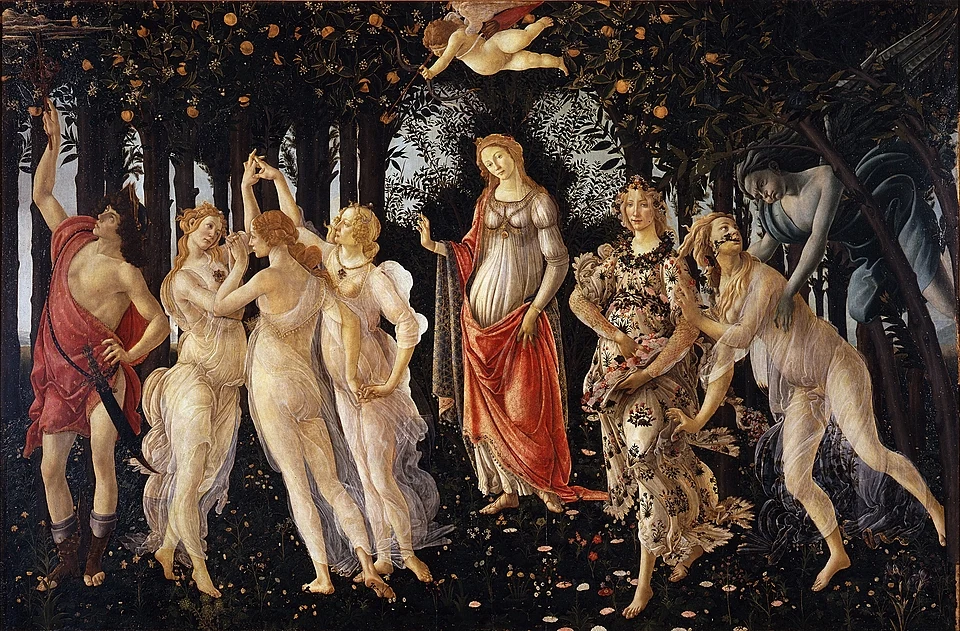
One artwork to sit with: Sandro Botticelli, Primavera (c. 1477-82), Uffizi Gallery, Florence — Spring, personified by a procession of figures in an orange grove. The Three Graces dance. Mercury disperses clouds. Flora scatters flowers. The central figure — Venus, or the Virgin, or an ideal of feminine grace that deliberately conflates the sacred and the erotic — looks out at you with an expression that is neither invitation nor refusal but something more complicated than either. This painting was made for Lorenzo de' Medici's cousin as a wedding gift. It hangs in the Uffizi, which is built around what was once the Medici administrative offices. Stand in front of it and consider the chain of patronage, money, love, politics, and artistic genius that had to align precisely for this thing to exist — and then consider how improbable it is that it still exists at all.
Next: Post 17 — Venice: Trade, Empire, and the Art of Surviving by Being Indispensable
![Life | Greece Sanctuary] Skiathos #Escape](https://storage.ghost.io/c/2a/9e/2a9e2b04-30f6-4166-8010-a3730d2eb719/content/images/size/w720/2026/09/Skiathos.jpg)
![Life] What is your comfort food?](https://storage.ghost.io/c/2a/9e/2a9e2b04-30f6-4166-8010-a3730d2eb719/content/images/size/w720/2026/09/WhatsApp-Image-2026-09-18-at-10.11.32.jpeg)
![Life | London Sanctuary] The Grove: Place of Restoration #Retreat](https://storage.ghost.io/c/2a/9e/2a9e2b04-30f6-4166-8010-a3730d2eb719/content/images/size/w720/2026/08/WhatsApp-Image-2026-08-07-at-21.51.41.jpeg)
Comments ()