Art] What Cities Make of Us: Art, Power & the Human Condition Across Europe | Scandinavia: Darkness, Silence, and the Art of Looking Inward (19/22)
What Munch, Ibsen, and Sibelius teach us about conscience, solitude, and the political philosophy that emerges from a culture of radical self-examination
![Art] What Cities Make of Us: Art, Power & the Human Condition Across Europe | Scandinavia: Darkness, Silence, and the Art of Looking Inward (19/22)](https://storage.ghost.io/c/2a/9e/2a9e2b04-30f6-4166-8010-a3730d2eb719/content/images/size/w1200/2026/03/Gemini_Generated_Image_sbowymsbowymsbow-3.png)
What Cities Make of Us: Art, Power & the Human Condition Across Europe | Post 19 of 22
What Munch, Ibsen, and Sibelius teach us about conscience, solitude, and the political philosophy that emerges from a culture of radical self-examination
| Series | What Cities Make of Us — Post 19 of 22 |
| Reading Time | 7 minutes |
| Region | Scandinavia (Norway, Finland, Sweden, Denmark) |
| Era | 1860s – 1950s |
| Key Figures | Munch, Ibsen, Sibelius, Grieg, Strindberg |
| Core Argument | The Nordic countries built their modern identity on the willingness to look unflinchingly at darkness — and their art is proof that honesty about suffering is not pessimism but a precondition of resilience |
On a January evening in Oslo — then called Christiania — in 1891, Henrik Ibsen attended a gathering at which one of his plays was discussed. The conversation turned contentious. Someone criticized his work as too dark, too uncompromising, too unwilling to offer the audience the resolution it needed. Ibsen, then sixty-three years old and universally regarded as the greatest living playwright in Europe, listened for a while. Then he said: "I merely ask the questions. It is not my business to answer them."
This is the Scandinavian artistic position in miniature. Not the consolation of answers. The discipline of honest questions.
Ibsen's plays — A Doll's House, Hedda Gabler, The Wild Duck, An Enemy of the People, Ghosts — are, with Shakespeare's tragedies, the most performed plays in the world. They achieve this universality through a method that is, in some respects, deeply culturally specific: the ruthless examination of the gap between how people present themselves and what they are actually doing, between the social performance of virtue and the private reality of compromise, fear, and self-deception.
This is not comfortable theatre. It was not meant to be. Ibsen believed that the stage's primary function was not entertainment but diagnosis — that a society that could not look honestly at itself was a society in the process of making decisions that would eventually destroy it.
He was writing in a specific cultural context. But the diagnosis has proved to be without expiry date.
The Nordic Light: What Winter Does to Art
Scandinavia's geography is the foundation of its particular artistic sensibility. The winters are genuinely extreme — not merely cold but dark, with the polar night in the far north producing weeks of total darkness, and even in the southerly capitals producing a quality of winter light that is unlike anything in the Mediterranean world. The light comes low to the horizon, even at midday, casting long shadows and giving ordinary objects and landscapes a quality of emphasis — a visual weight — that the direct overhead light of the south dissolves.
Artists formed by this light develop different habits of attention than artists formed by Mediterranean brilliance. The Nordic light makes you slow down. It makes shadows matter. It gives interiors — where people spend most of their winter time — a significance that outdoor-oriented cultures do not develop to the same degree.
The result is an artistic tradition particularly attuned to interiority: to the quality of a room, to the expression on a face in low light, to the inner life of individuals navigating circumstances that cannot be resolved by sunlight and movement. Vermeer had some of this quality, in the grey-lit Netherlands. But the Scandinavians developed it as the primary mode of a whole tradition.
Edvard Munch's The Scream — the most reproduced artwork in the world after the Mona Lisa — is a product of a specific evening on a specific Oslo fjord, painted by a specific man in a specific psychological state. But it is also the most successful expression of modern existential anxiety ever produced. It works because Munch was trained, by his culture and his climate, to see the inner state as landscape — to make subjective experience as visually overwhelming as the physical world.
Ibsen's Characters: Leadership Cases in Costume
A remarkable number of Ibsen's plays are, at their core, examinations of institutional behavior and the failure of leadership. The costumes are 19th-century Norwegian bourgeoisie. The dynamics are timeless.
An Enemy of the People — which Ibsen wrote in 1882, partly in response to the hostile reception of Ghosts — is about Dr. Thomas Stockmann, who discovers that the water supply of his town's profitable spa is contaminated. He reports this finding. The town, whose economy depends on the spa, does not want the finding to be true. His brother, the mayor, pressures him to suppress the report. The press, which had supported him, turns against him when it becomes clear that reporting the truth will cost too much. The democratic majority, convened in a public meeting, votes to brand him an enemy of the people.
Stockmann is not the most sympathetic character. He has a self-righteousness that makes him difficult to defend on purely personal grounds. Ibsen was too honest a writer to make the truth-teller simply virtuous — he understood that the people who make institutions uncomfortable are often personally uncomfortable too.
But the institutional dynamic is exact. The mechanism by which an organization suppresses inconvenient information — not through explicit conspiracy but through the accumulated pressure of people protecting their interests while believing themselves to be serving the common good — is described with a precision that makes the play feel like it was written about whatever institution you happen to be in.
Every major regulatory failure of the past century has an Enemy of the People structure: a whistleblower, an institution under pressure to disbelieve, a public more concerned with the disruption of the revelation than the reality of the danger. The play was written as a warning. It has functioned, repeatedly, as a description.
Munch: The Inner as Landscape
Edvard Munch was not a stable person. He was the child of a deeply religious, intermittently disturbed father, the brother of a sister who was institutionalized for schizophrenia, a man who struggled with alcohol and psychological crises throughout his life. He spent eight months in a psychiatric clinic in 1908. He lived, after that, in voluntary semi-isolation in Norway, attended by a housekeeper and his work, for the remaining forty years of his life.
What he produced from this material is one of the most sustained explorations of psychological suffering in visual art. The Frieze of Life — his cycle of paintings organized around themes of love, anxiety, and death — is the visual equivalent of Ibsen's drama: unsparing, specific, refusing consolation.
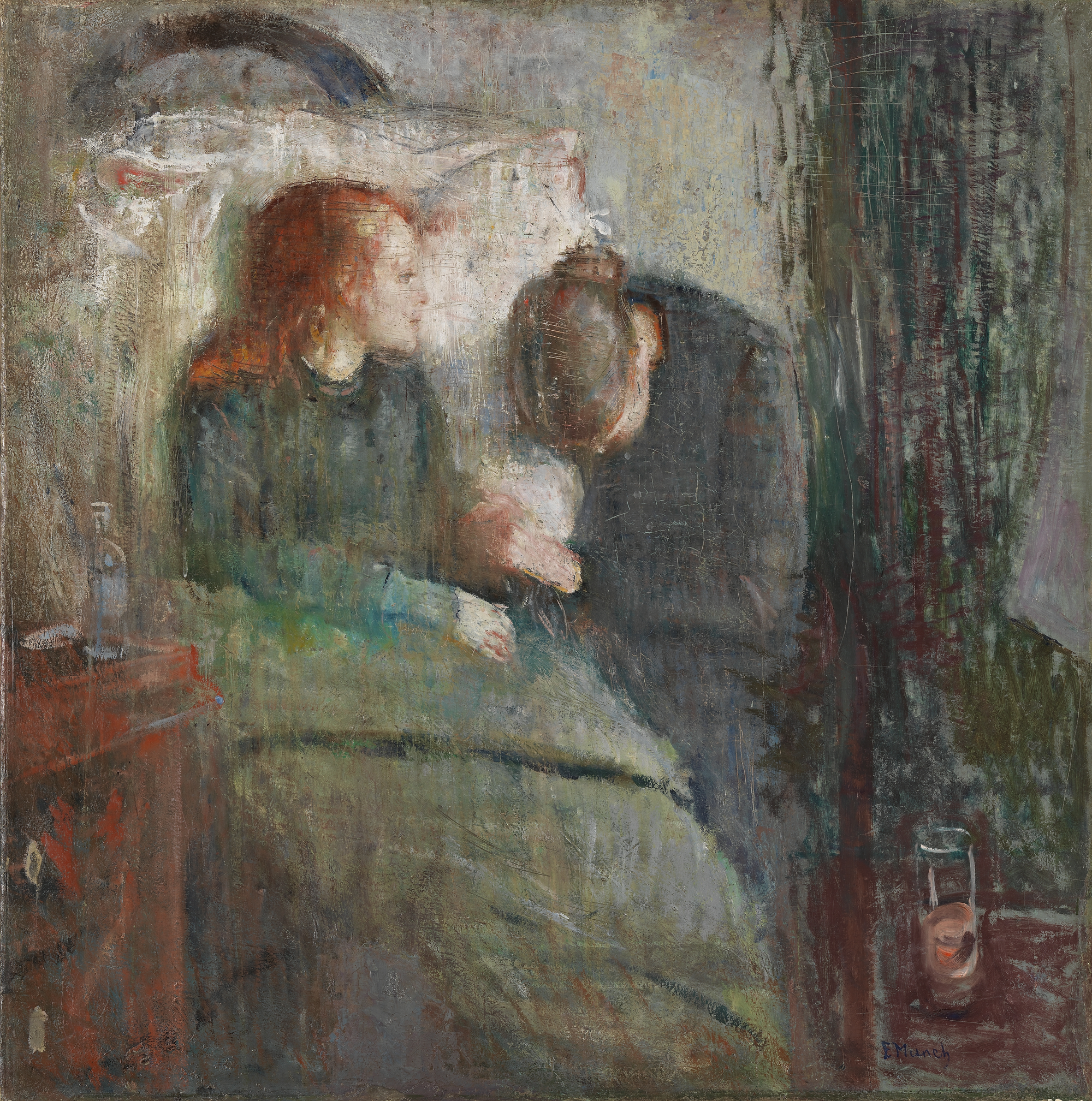
The Scream is the most famous image from this cycle, but it is not necessarily the most interesting. Anxiety, showing a crowd of figures crossing the same bridge in the same lurid sunset, their faces mask-like, each one alone in their private horror despite being surrounded by people. The Sick Child, painted from the memory of his sister Sophie's death from tuberculosis when Munch was fourteen. Melancholy, showing a single figure on a shore, the color of the sky making the whole world feel like a symptom.
What Munch understood — and it is the insight that gives his work its peculiar contemporary relevance — is that psychological suffering is not aberrant. It is structurally human. The existential anxieties he painted are not the pathologies of a disturbed individual. They are the experiences of a person who has removed the social anesthesia that most people use to avoid confronting what existence actually involves.
The Scream sells on coffee mugs because it is recognizable. It is recognizable because Munch painted something real.
Sibelius and the Silence Inside the Music
Jean Sibelius was Finnish rather than Norwegian or Swedish, but he belongs to the Scandinavian sensibility — the composer who most completely translated the Nordic landscape into musical form.
He was also, for the last thirty years of his life, silent. He wrote his Seventh Symphony in 1924, the symphonic poem Tapiola in 1926, and then — in perfect health, living in his house in the Finnish forest, surrounded by the landscape that had inspired everything he had written — he stopped. He lived until 1957 without producing another major work, outliving most of his contemporaries and watching his early work become the canonical expression of Finnish national identity.
Scholars have speculated about the silence for decades. Mental block, self-criticism, alcoholism, perfectionism, the awareness that his musical language had been overtaken by modernist developments in which he had no interest. There is evidence for all of these. None of them is entirely convincing, and Sibelius left no explanation.
What is striking is that the silence was evidently chosen. He had a symphony — the Eighth — in various states of completion. He burned it. He had other sketches. He did not develop them. At some point, he appears to have decided that what he had to say had been said, and that to continue for the sake of continuing would produce something less than what had come before.
This is the rarest form of artistic self-knowledge: the awareness of one's own completion. Most artists cannot stop. Most institutions cannot stop. The capacity to recognize when you have done the essential work and then to maintain the silence that follows it is almost without parallel.
The Nordic Model and Its Cultural Roots
The Scandinavian welfare states — the systems of social democracy that have produced, by most measures, the most consistently high quality of life for their citizens of any political model in the world — did not emerge from nothing. They emerged from a specific cultural context with specific values: the Lutheran emphasis on individual conscience, the egalitarian traditions of Nordic peasant culture, the Protestant suspicion of displays of wealth and hierarchy, and the philosophical commitment to transparency and honest self-examination that shows up in Ibsen and Munch as much as in the political institutions.
This connection is not deterministic — culture does not automatically produce political systems — but it is real. The Scandinavian countries are not particularly easy places to lie in. The cultural norms around directness and transparency make social performance more difficult and more costly than it is in cultures that have developed more elaborate conventions of politeness and indirection. This makes certain kinds of corruption harder, certain kinds of cover-up more socially expensive, certain kinds of institutional dishonesty more visible.
It also makes certain kinds of difficult conversation more possible. The Scandinavians are, as a general cultural matter, better at having the conversation that everyone in the room is aware needs to happen but that the cultural norms of other countries would prevent from being raised directly.
This is not an accident. It is the political application of the same commitment to honest examination that produced A Doll's House.
The Question It Leaves Behind
Ibsen's Nora, at the end of A Doll's House, closes the door of the family home behind her and walks out. She is leaving a marriage, a role, a social performance that has become incompatible with being an honest person. She does not know what she is walking toward. She knows only what she is walking away from.
The door closing is one of the most famous sounds in theater history. Ibsen called it "the door slam heard around the world."
What door in your own life, or in your own institution, do you know needs to close — but that you are keeping open because the alternative is too uncertain?
One artwork to sit with: Edvard Munch, The Sick Child (1885-86), National Gallery, Oslo — a young girl sits up in bed, her face turned toward the light from the window, her expression holding, somehow simultaneously, resignation and fierce awareness. Beside her, a woman — her mother or her aunt — sits with her head bowed, unable to look. Munch repainted this image six times over his career, returning to it obsessively. The first version was painted when he was twenty-one, from the memory of his sister's death seven years earlier. The paint surface is worked and reworked, scraped and repainted, as if the act of making the image was itself a form of grieving that could not be completed. Look at it for a while. Then ask yourself what memories are still unprocessed enough to require returning to.
Next: Post 20 — Moscow & St. Petersburg: Art Under Autocracy, Beauty Under Terror
![Life | Greece Sanctuary] Skiathos #Escape](https://storage.ghost.io/c/2a/9e/2a9e2b04-30f6-4166-8010-a3730d2eb719/content/images/size/w720/2026/09/Skiathos.jpg)
![Life] What is your comfort food?](https://storage.ghost.io/c/2a/9e/2a9e2b04-30f6-4166-8010-a3730d2eb719/content/images/size/w720/2026/09/WhatsApp-Image-2026-09-18-at-10.11.32.jpeg)
![Life | London Sanctuary] The Grove: Place of Restoration #Retreat](https://storage.ghost.io/c/2a/9e/2a9e2b04-30f6-4166-8010-a3730d2eb719/content/images/size/w720/2026/08/WhatsApp-Image-2026-08-07-at-21.51.41.jpeg)
Comments ()