Art] What Cities Make of Us: Art, Power & the Human Condition Across Europe | Rhine & Bavaria: Myth, Wagner, and the Danger of Beautiful Lies (09/22)
On the seductive power of romantic nationalism, the weaponization of beauty, and what happens when a king builds castles in the air
![Art] What Cities Make of Us: Art, Power & the Human Condition Across Europe | Rhine & Bavaria: Myth, Wagner, and the Danger of Beautiful Lies (09/22)](https://storage.ghost.io/c/2a/9e/2a9e2b04-30f6-4166-8010-a3730d2eb719/content/images/size/w1200/2026/03/Gemini_Generated_Image_sbowymsbowymsbow-14.png)
What Cities Make of Us: Art, Power & the Human Condition Across Europe | Post 9 of 22
On the seductive power of romantic nationalism, the weaponization of beauty, and what happens when a king builds castles in the air
| Series | What Cities Make of Us — Post 9 of 22 |
| Reading Time | 7 minutes |
| Region | Rhine Valley & Bavaria, Germany |
| Era | 1400s – 1880s |
| Key Figures | Wagner, Ludwig II, Dürer, the Brothers Grimm |
| Core Argument | The same landscape that produced Dürer's rational humanism also produced Wagner's mythological nationalism — beauty does not purify the politics that surrounds it |
Neuschwanstein Castle sits on a cliff edge in the Bavarian Alps, its white towers rising from the forest in a configuration so perfectly cinematic that it looks less like a real building than like someone's idea of what a real building should look like. It was the template for the Disney castle. Seventeen million people visit it every year. It is Bavaria's single greatest tourist attraction.
It was built by a king who was declared insane, removed from power, and found dead in a lake under circumstances that have never been fully explained. It was never finished. It nearly bankrupted the Bavarian state. At the time of its construction, most of Ludwig II's subjects and advisors thought he was wasting resources that should have been spent on roads, schools, and the machinery of modern governance.
They were right. And so was he. And the tension between those two correct things is one of the more interesting paradoxes in the history of what we now call leadership.
Wagner and the Total Work of Art
To understand Ludwig II, you need to understand Richard Wagner. To understand Wagner, you need to sit with the discomfort of the fact that the greatest composer of the 19th century was also an anti-Semite of vicious conviction, a serial financial predator, a man of spectacular personal arrogance, and the artist most directly implicated — through no choice of his own, but implication nonetheless — in the cultural apparatus of the Third Reich.
Wagner believed that music should not merely entertain. It should transform. It should produce in its audience a state of total immersion — a condition he called Gesamtkunstwerk, the total work of art — in which music, drama, poetry, staging, and architecture combined to overwhelm the individual consciousness and induce a state of collective transcendence.
His operas — above all the Ring Cycle, four operas performed over four evenings based on Norse and German mythology — are still, by almost universal agreement, among the most powerful experiences in Western art. They are overwhelming. They are exhausting. They demand a kind of surrender from their audience that almost no other art form requests. And they deliver, to those willing to make that surrender, something that is very difficult to describe in terms that don't sound ridiculous outside the opera house.
The problem is the politics.
The myths Wagner chose — the heroic German warrior, the redemptive death, the purified race, the corrupt and rootless enemy — were not neutral myths. They were myths with a particular political valence in 19th-century Germany, a country in the process of inventing itself as a nation and reaching for a usable past to justify that invention. Wagner was not creating these myths from nothing. He was selecting, shaping, and amplifying myths that were already circulating — myths about who the Germans were, where they came from, and what made them different from their neighbors.
The Nazis did not corrupt Wagner. They recognized, with the political intelligence that authoritarian movements often bring to the exploitation of cultural material, that the emotional infrastructure Wagner had built was exactly what they needed. The capacity he had developed in his audiences — to surrender individual critical consciousness to a collective emotional experience — was, for the purposes of mass political mobilization, extraordinarily useful.
This is not an argument that great art is dangerous. It is an argument that great art is powerful — which is to say, that its power can be directed in multiple ways, not all of them benign. Any serious person in politics, policy, or institutional leadership needs to understand this. The emotional technologies that make art compelling are not neutral instruments. They work on human beings in ways that bypass rational evaluation, and they can be pointed at almost any target.
Ludwig II: Vision Without Accountability
Ludwig II of Bavaria became king at eighteen, in 1864, when his father died unexpectedly. He was tall, good-looking, painfully shy, and almost completely uninterested in the actual business of governance. What he was interested in — with an intensity that consumed everything else — was art, music, and the construction of buildings.
He had encountered Wagner's operas as a teenager and been transformed by them. When he became king, one of his first acts was to summon Wagner to Munich, pay his considerable debts, and offer him royal patronage. For a period in the 1860s, Ludwig was the only reason Wagner was able to work — the composer was in such severe financial difficulties that without royal support, the Ring Cycle might never have been completed.
The buildings came later. Neuschwanstein was the most famous, but Ludwig also built Linderhof and Herrenchiemsee — a Versailles-scale palace on an island in a Bavarian lake, which he visited exactly seven times. He was not building for others. He was building for himself, for the world he preferred to the real one — a world of fairy-tale medievalism, of Wagnerian heroism, of a Germany that existed in myth rather than in the coal-smoke reality of Bismarck's Prussia.
The Bavarian ministers who eventually had him declared incompetent and removed from power were not wrong. He was spending public money at a rate that was genuinely unsustainable. He was making decisions — or refusing to make decisions — that left the country without effective governance. He had retreated into a private world so completely that his ministers sometimes went weeks without being able to consult him.
But there is something in the ruthlessness of his removal that deserves examination. Ludwig was not harming anyone. He was building beautiful things in the mountains, financing the greatest composer of his century, and refusing to be the kind of king that a modernizing industrial state required. The incompetence charge was almost certainly a pretext — the real issue was that the Bavarian political establishment had lost patience with a king who simply did not share their priorities.
He was found dead in a lake two days later. The official verdict was suicide. Almost nobody then or since has been entirely convinced.
The question of what to do with a visionary leader who cannot be managed — who produces things of extraordinary value while creating institutional chaos — is not merely a 19th-century Bavarian problem. It appears in every organization that has ever employed a person of genuine original gifts and discovered that those gifts and those governance requirements are not always compatible.
The Romantics on the Rhine
Long before Wagner and Ludwig, the Rhine had been doing something to the European imagination that was out of proportion to its status as a river.
The Romantics — German, English, and French — arrived on the Rhine in the late 18th century and found exactly what they were looking for: a landscape of such dramatic beauty, so saturated with medieval ruins and Teutonic legend, that it seemed to confirm their conviction that the modern world had lost something essential, something that could only be recovered by going back — to the medieval, to the natural, to the mythological.
Turner painted the Rhine. Byron wrote about it. Heine wrote the Loreley — the legend of the river siren who lured sailors to their deaths with her beauty — and it became one of the most widely reprinted poems of the 19th century, a piece of mythological invention so successful that most people assumed it was an ancient legend rather than a poem written in 1824.
This is what Romanticism was: a movement that invented the myths it claimed to be recovering. The medieval Germany of the Romantics' imagination was largely their own creation — a reaction against Enlightenment rationalism, against industrial modernity, against the French Revolution's insistence that human society could be reorganized on rational principles. The Romantics said: reason is not enough. There are dimensions of human experience — the sublime, the irrational, the mythological, the natural — that reason cannot account for and should not attempt to govern.
They were not wrong about this. The Enlightenment's confidence in pure reason was genuinely incomplete. But the reaction against it — the full investment in myth, nature, and collective identity — carried its own dangers. A politics built on myth rather than reason is one in which evidence and argument can always be overruled by the claim that they miss something essential about who we really are.
Dürer and the Protestant North
Before the Romantics, before Wagner, the Rhine valley produced a different kind of greatness. Albrecht Dürer — born in Nuremberg in 1471, the son of a goldsmith — was the first German artist to fully absorb the lessons of the Italian Renaissance and translate them into a northern idiom. His self-portraits are among the most extraordinary in the history of art: a man looking at himself with a clarity that was, in the 15th century, almost shocking in its refusal to flatter.
Dürer travelled to Italy — as part of the tradition that would eventually become the Grand Tour — and returned with a technique refined by his encounter with Leonardo's perspective and Bellini's color. But what he made with that technique was distinctly northern: more detailed, more introspective, more alert to the texture of surfaces and the specificity of individual faces.
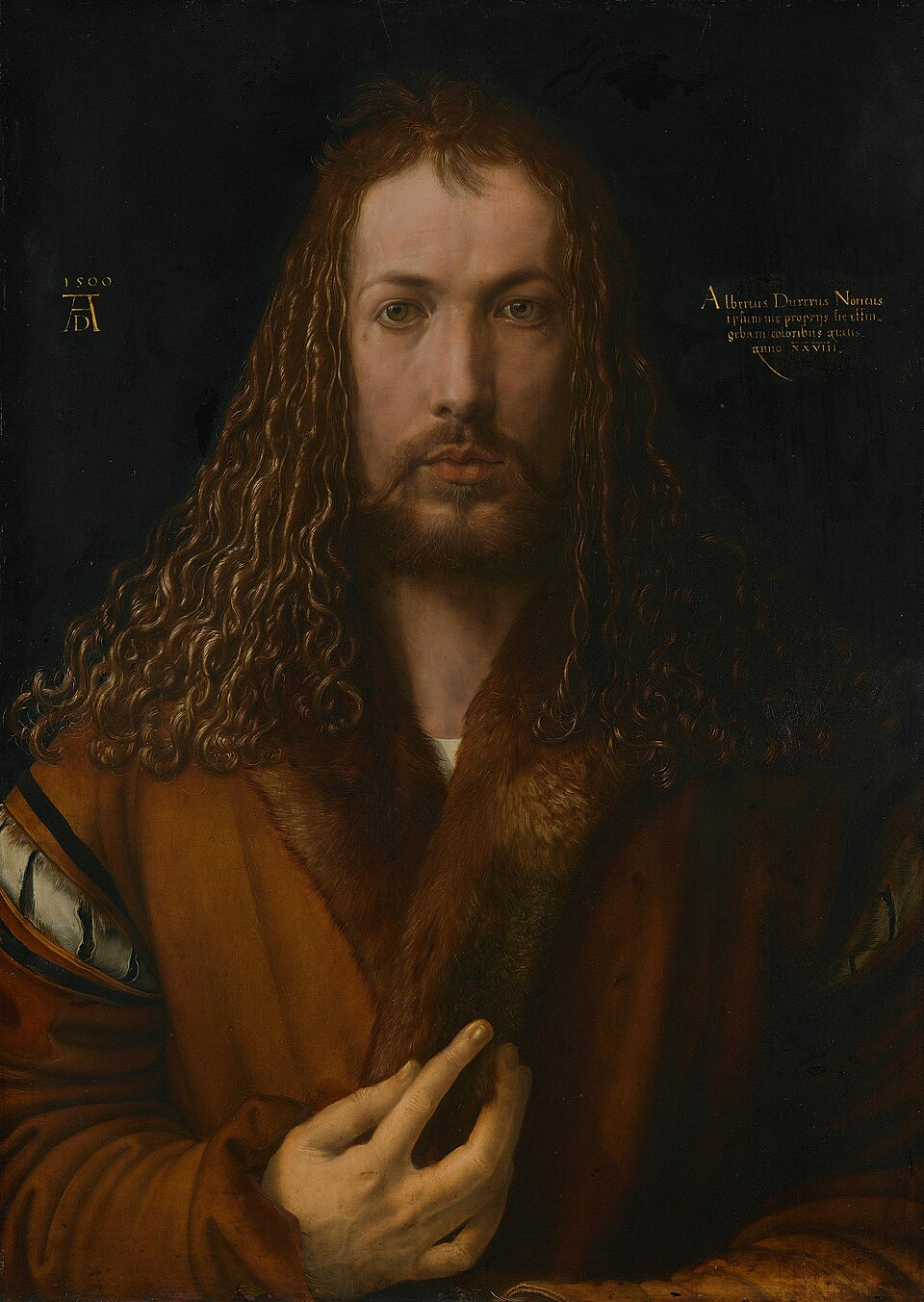
His 1500 self-portrait — in which he depicted himself in full frontal view, in the pose conventionally reserved for images of Christ — is the most audacious act of self-creation in Renaissance painting. He was not claiming divinity. He was claiming something subtler and in its way more radical: that the artist's gaze, applied with sufficient intensity and intelligence, had a dignity equivalent to the sacred.
The Protestant north, which Dürer's work inhabited, understood this differently than the Catholic south. In a tradition that removed the saints and the elaborate iconographic programs from its churches, the individual conscience — the self directly confronting its own nature — became the primary subject of art. Dürer's self-portrait is the first great image in that tradition.
The Question It Leaves Behind
The Rhine and Bavaria gave Europe some of its most beautiful things and some of its most dangerous myths. The same landscape, the same cultural tradition, produced both Dürer's rational humanism and Wagner's mythological nationalism, both the fairy-tale castle and the death camps.
This is not a comfortable thing to hold. It is also true. And the discomfort is precisely the point — the reminder that beauty does not purify the politics that surrounds it, that sublime art does not immunize a culture against barbarism, that the same emotional capacities that respond to greatness can be exploited for catastrophe.
What beautiful story are you telling yourself — about your institution, your country, your profession — that may be obscuring a reality that is less heroic and more complicated than the story allows?
One artwork to sit with: Albrecht Dürer, Self-Portrait at Twenty-Eight (1500), Alte Pinakothek, Munich — the frontal pose, the long hair, the hand raised as if in blessing. Dürer is looking at you with absolute steadiness. He is not asking for your approval. He is simply presenting himself as he is — not as a craftsman or a tradesman, not as a servant of a patron's vanity, but as a man of full human dignity, entitled to be looked at directly. It was a revolutionary act in 1500. It remains a useful reminder that the claim to full humanity has always had to be made before it could be recognized.
Next: Post 10 — Amsterdam & Brussels: Commerce, Calvinism, and the Art of the Everyday
![Life | Greece Sanctuary] Skiathos #Escape](https://storage.ghost.io/c/2a/9e/2a9e2b04-30f6-4166-8010-a3730d2eb719/content/images/size/w720/2026/09/Skiathos.jpg)
![Life] What is your comfort food?](https://storage.ghost.io/c/2a/9e/2a9e2b04-30f6-4166-8010-a3730d2eb719/content/images/size/w720/2026/09/WhatsApp-Image-2026-09-18-at-10.11.32.jpeg)
![Life | London Sanctuary] The Grove: Place of Restoration #Retreat](https://storage.ghost.io/c/2a/9e/2a9e2b04-30f6-4166-8010-a3730d2eb719/content/images/size/w720/2026/08/WhatsApp-Image-2026-08-07-at-21.51.41.jpeg)
Comments ()