Art] What Cities Make of Us: Art, Power & the Human Condition Across Europe | Provence: Place as Muse, Obsession as Method (06/22)
Van Gogh, Cézanne, and what happens when a landscape finds a painter who is ready to receive it
![Art] What Cities Make of Us: Art, Power & the Human Condition Across Europe | Provence: Place as Muse, Obsession as Method (06/22)](https://storage.ghost.io/c/2a/9e/2a9e2b04-30f6-4166-8010-a3730d2eb719/content/images/size/w1200/2026/03/Gemini_Generated_Image_sbowymsbowymsbow-5.png)
What Cities Make of Us: Art, Power & the Human Condition Across Europe | Post 6 of 22
Van Gogh, Cézanne, and what happens when a landscape finds a painter who is ready to receive it
| Series | What Cities Make of Us — Post 6 of 22 |
| Reading Time | 8 minutes |
| Region | Provence, France |
| Era | 1880s – 1906 |
| Key Figures | Van Gogh, Cézanne, Renoir, Matisse, Gauguin, Chagall |
| Core Argument | Van Gogh sold one painting in his lifetime; his works now sell for $100M — the market's hundred-year lag on genuine originality is not an accident |
On the morning of February 20, 1888, Vincent van Gogh stepped off a train in Arles after a sixteen-hour journey from Paris. It was snowing — unexpected, covering the terracotta rooftops and the Roman ruins in a thin white layer that made everything strange and new. He had left Paris without telling his brother Théo where he was going. He had been heading south, away from the grey skies and the cramped studio and the relationships that always seemed to end in rupture.
He was thirty-four years old. He had been painting seriously for eight years. He had not yet made a single work that is now considered a masterpiece.
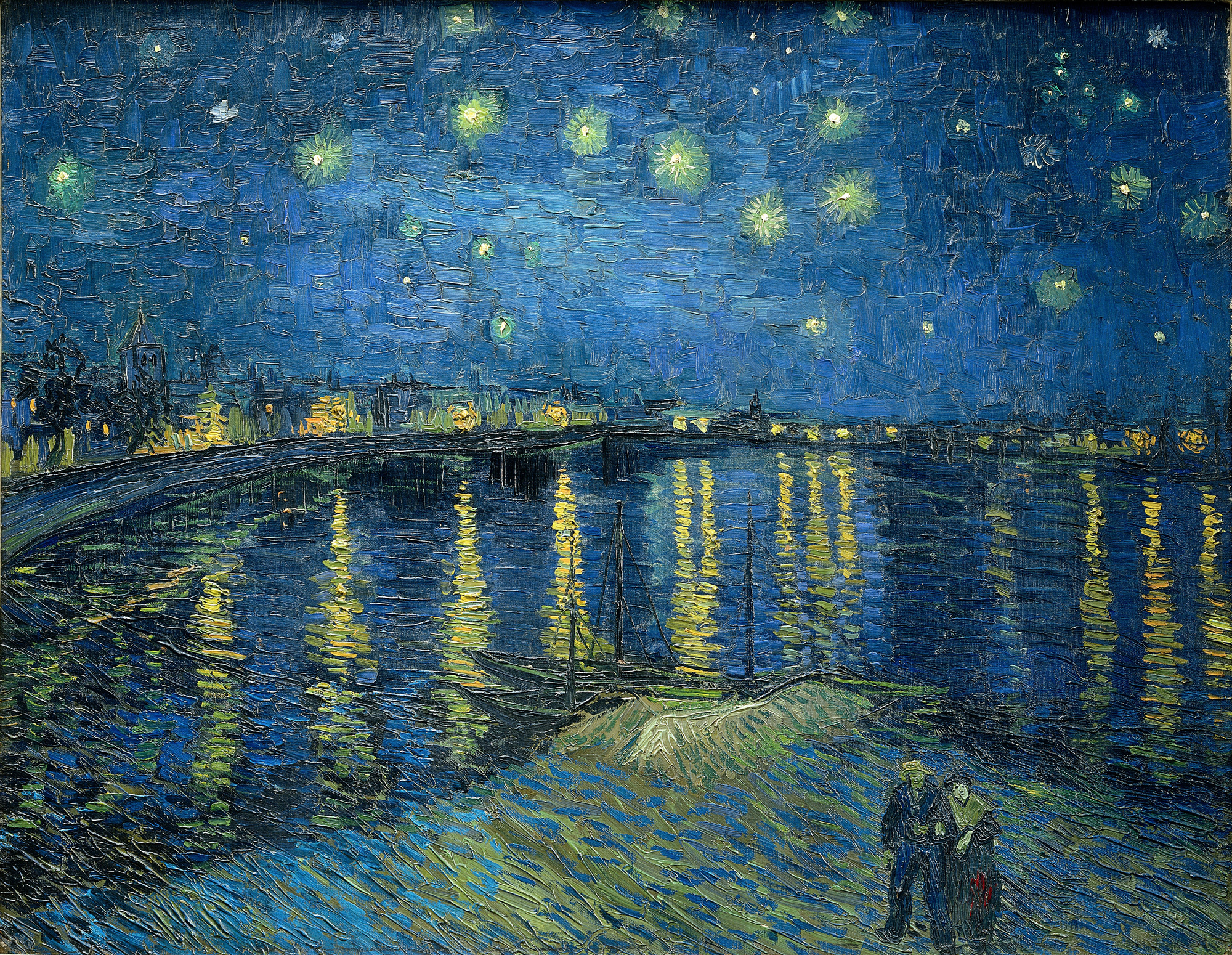
Within six months, he would produce the Night Café, the Bedroom at Arles, the Starry Night over the Rhône, the Sower, the Sunflowers, and more than two hundred other canvases. He had found something in the Provençal light — in the particular quality of the southern sun on the ochre landscape, the violent blue of the sky, the dark green of the cypress trees — that unlocked something in him that northern Europe had kept closed.
He would be dead within two and a half years. But those two and a half years produced an artistic legacy that has not stopped reverberating.
What the South Did
Provence is not subtle. The light there is aggressive — hard-edged, high contrast, burning colors into a clarity that has no equivalent in northern Europe. The shadows are dark and precise. The colors are primary in a way that can seem almost violent after the soft gradations of the Atlantic coast.
For a painter trained on the muted palette of Dutch and Belgian art, arriving in Provence in the spring was something like having your visual system reset. The impressionists had taught Van Gogh to see color as light, but the north had given him limited material to work with. Provence gave him everything at once.
What happened to his technique in Arles was not simply a brightening of his palette. It was a fundamental change in how he used paint. The thick, swirling brushstrokes that define his mature work — those short, emphatic marks that seem to pulse with energy on the canvas — emerged in response to the specific quality of the Provençal landscape. The light moved fast. The mistral wind bent the cypresses into contorted shapes. The whole landscape seemed to be in motion, animated by a force that had nothing to do with human intention.
Van Gogh painted the energy he felt rather than the forms he saw. This is what makes his mature work so immediately, viscerally communicative — you do not analyze it, you feel it, because it records feeling rather than observation. And it is what made the painting of his contemporaries suddenly look, by comparison, like documentation.
Cézanne's Mountain: The Virtue of Returning
While Van Gogh found his transformation through emotional intensity, Paul Cézanne found his through something like the opposite: radical patience.
Cézanne was born in Aix-en-Provence. He left for Paris as a young man, failed to find the recognition he needed, and eventually returned to his hometown — where he spent the rest of his life painting the landscape he had grown up in, above all the mountain that dominated the skyline east of Aix, the Mont Sainte-Victoire.
He painted it more than eighty times over twenty years. The early versions are relatively conventional — a recognizable mountain in a recognizable landscape, competently if not brilliantly rendered. But as the series progresses, something changes. The mountain becomes less a thing in space and more a set of relationships — between forms, between color masses, between the surface of the canvas and the illusion of depth. By the final canvases, painted in the last years of his life, the mountain has become something close to abstract: a structure of colored planes that you have to work to resolve into a recognizable landscape.
Cézanne was not painting worse as he aged. He was painting more honestly — stripping away the conventions that he had inherited about what a painting should look like and arriving at something closer to what the act of seeing actually involves. We do not see the world as a photograph. We see it as a series of partial impressions, assembled by the brain into a coherent image through a process we do not fully understand. Cézanne's late canvases record that process rather than its product.
This is why he is the hinge figure between the 19th and 20th centuries — why Picasso and Matisse and virtually every major modernist cited him as the essential precedent. He did not invent a new style. He asked a more fundamental question: what is a painting actually trying to do?
Twenty years on the same mountain. Eighty versions of the same question. And from that sustained, patient, apparently repetitive work, the whole of modern art follows.
Van Gogh and Gauguin: The Impossibility of Creative Partnership
In October 1888, Paul Gauguin arrived in Arles to join Van Gogh in what Van Gogh had imagined would be a community of artists — a southern studio, a collaboration of equals, a creative partnership that would sustain both of them through the financial and emotional difficulties of making art that nobody was buying.
Gauguin was, by temperament, almost perfectly designed to make this impossible. He was convinced — with some justification — of his own genius. He had strong views about what painting should be and little patience for views that differed from his. He found Van Gogh's method — painting fast, from direct emotion, with a physical energy that left the studio looking like a battlefield — vulgar and undisciplined. Van Gogh found Gauguin's authority suffocating and his criticism devastating.
Within nine weeks, Gauguin was packing his bags to leave. On the night of December 23rd, Van Gogh confronted him in the street. What happened in the following hours is not entirely clear. What is clear is that Van Gogh returned to the studio alone, cut off part of his own ear, wrapped it in newspaper, and delivered it to a woman at a local brothel.
The incident is famous enough to have become almost meaningless through repetition. What gets lost in the notoriety is the precise nature of the failure. Van Gogh had built his entire emotional life around the idea of connection — with his brother, with the artists he admired, with the community he imagined. Gauguin's departure was not merely the end of a collaboration. It was the demolition of Van Gogh's theory of how creative life could be sustained.
The insight it offers is uncomfortable but important. Some people are not able to collaborate — not because of personal failing, but because the intensity of their individual vision is simply incompatible with the compromises that collaboration requires. Van Gogh needed Théo, not Gauguin. He needed a relationship of support and witness, not a relationship of creative equals. He never understood this about himself, and it cost him dearly.
Knowing which relationships you need — and which ones you are seeking for the wrong reasons — is a form of self-knowledge that has practical consequences far beyond the art studio.
The Market's Hundred-Year Lag
Van Gogh sold one painting in his lifetime. One. The Red Vineyard at Arles, purchased by a Belgian artist for 400 francs in 1890, four months before his death.
His canvases now sell, when they appear at auction, for between fifty and one hundred million dollars. The Portrait of Dr. Gachet sold in 1990 for $82.5 million — at the time the most expensive painting ever sold at auction.
This is not merely an interesting biographical footnote. It is a data point about how markets price genuine originality.
The market is, in general, a reasonably efficient mechanism for pricing things that fit existing categories. It struggles profoundly with things that require new categories to be appreciated. Van Gogh's work required a new category — one that the art market of 1888 did not have and could not quickly develop. By the time the market had caught up, the artist had been dead for decades.
The financial parallel is precise. The most genuinely innovative ideas in any field — the ones that eventually reshape the landscape — are almost never the ones that attract capital or recognition in the moment of their emergence. They look, to the existing market, like inferior versions of existing products. It takes time for the market to develop the evaluative framework that allows it to understand what it is actually looking at.
This is cold comfort to the person living the Van Gogh story in real time. But it is useful information for anyone trying to evaluate early-stage ideas — in companies, in research, in policy design — that do not fit comfortable existing templates.
The Question It Leaves Behind
Cézanne returned to the same mountain for twenty years. Van Gogh painted two hundred canvases in a year. Renoir, dying of arthritis so severe that the brush had to be tied to his hand, was still painting the morning he died.
All of them, in their different ways, were following something that mattered more to them than comfort, recognition, or financial reward. This is admirable and also, in some cases, catastrophic. The question is not whether to follow what matters to you. The question is whether you are honest with yourself about what you are sacrificing in the process — and whether the people in your life have consented to those sacrifices too.
What are you pursuing with an intensity that may be costing others more than you have acknowledged? And what would it mean to be honest about that?
One artwork to sit with: Vincent van Gogh, The Starry Night over the Rhône (1888), Musée d'Orsay, Paris — not the more famous Starry Night painted in the asylum, but the earlier, calmer version painted in Arles. The river reflects the lights of the town. The Great Bear hangs enormous in the sky. Two figures walk by the water. Everything is still and luminous and connected — the heavens and the earth, the light and its reflection, the human figures small but present. This is Van Gogh at his most stable, his most certain that painting is a form of love. Look at it before the other, harder paintings. Then look at both together and notice what the nine months between them contained.
Next: Post 7 — Weimar & Leipzig: When a Small City Shapes a Whole Civilization
![Life | Greece Sanctuary] Skiathos #Escape](https://storage.ghost.io/c/2a/9e/2a9e2b04-30f6-4166-8010-a3730d2eb719/content/images/size/w720/2026/09/Skiathos.jpg)
![Life] What is your comfort food?](https://storage.ghost.io/c/2a/9e/2a9e2b04-30f6-4166-8010-a3730d2eb719/content/images/size/w720/2026/09/WhatsApp-Image-2026-09-18-at-10.11.32.jpeg)
![Life | London Sanctuary] The Grove: Place of Restoration #Retreat](https://storage.ghost.io/c/2a/9e/2a9e2b04-30f6-4166-8010-a3730d2eb719/content/images/size/w720/2026/08/WhatsApp-Image-2026-08-07-at-21.51.41.jpeg)
Comments ()