Art] What Cities Make of Us: Art, Power & the Human Condition Across Europe | Paris 2: The Café, the Salon, and the Infrastructure of Ideas (05/22)
What the golden age of Montmartre can teach us about how creative ecosystems actually work — and what we lose when we move everything online
![Art] What Cities Make of Us: Art, Power & the Human Condition Across Europe | Paris 2: The Café, the Salon, and the Infrastructure of Ideas (05/22)](https://storage.ghost.io/c/2a/9e/2a9e2b04-30f6-4166-8010-a3730d2eb719/content/images/size/w1200/2026/03/Gemini_Generated_Image_sbowymsbowymsbow-7.png)
What Cities Make of Us: Art, Power & the Human Condition Across Europe | Post 5 of 22
What the golden age of Montmartre can teach us about how creative ecosystems actually work — and what we lose when we move everything online
| Series | What Cities Make of Us — Post 5 of 22 |
| Reading Time | 7 minutes |
| City | Paris, France — Montmartre |
| Era | 1880s – 1914 |
| Key Figures | Toulouse-Lautrec, Degas, Picasso, Braque, Apollinaire |
| Core Argument | The café was not where Parisian artists relaxed — it was the infrastructure that made the work possible, and we have not found an adequate replacement |
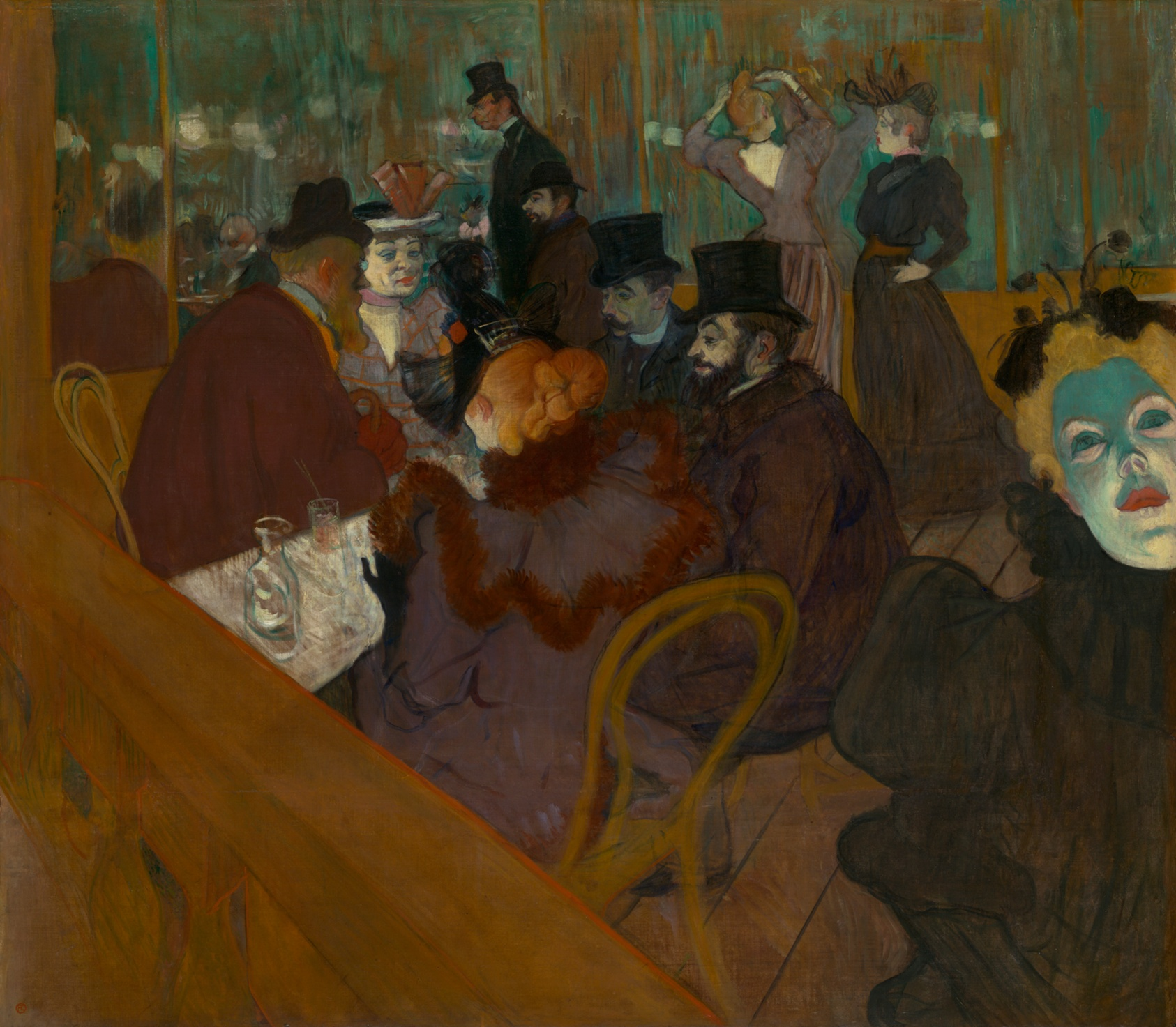
In the winter of 1899, Henri de Toulouse-Lautrec arrived at the Moulin Rouge carrying his own personal bar — a hollow walking stick filled with cognac, because the establishment's drinks, he had decided, were not strong enough. He was thirty-five years old, about to enter an asylum, and had already produced some of the most original graphic art of the 19th century. He had also been a fixture at the Moulin Rouge for nearly a decade — not just as a patron but as a resident visual chronicler, occupying a private table, watching the dancers and the audience with an eye that missed nothing.
The Moulin Rouge gave Toulouse-Lautrec his subjects. Toulouse-Lautrec gave the Moulin Rouge its visual identity. The relationship between artist and place was so entangled that it is now impossible to think of one without the other. The posters he made for the cabaret — designed to be pasted on the walls of Paris, seen at night in the lamplight by people walking past — invented a new visual language that runs in a direct line to every piece of graphic design produced in the 20th century.
This is how creative ecosystems actually work. Not as individual geniuses producing work in isolation, but as dense networks of people and places where ideas, techniques, and provocations move back and forth with a speed and informality that formal institutions cannot replicate.
The Geography of Bohemia
By the 1880s, Paris had developed a specific geography of creative life. The right bank, particularly around the Opéra and the grands boulevards, was the city of money and respectability — the banks, the department stores, the fashionable restaurants where the bourgeoisie conducted its social life. The left bank, around the Latin Quarter and Saint-Germain, was the city of ideas — the universities, the political journals, the bookshops, the cafés where students argued about Proudhon and Hegel until the proprietor gave up and went home.
And Montmartre — the hill in the north of the city, technically outside Paris until 1860, still village-like in its character, dotted with windmills and artists' studios and cheap bars — was the city of art. Renoir had painted there. Van Gogh had lived there. By 1900, Picasso had arrived from Barcelona. By 1904, he was installed at the Bateau-Lavoir — a ramshackle studio building named for its resemblance to a laundry boat — along with Braque, Apollinaire, Max Jacob, and the shifting population of young artists and poets who were, in that building and in those years, inventing Cubism.
What the Bateau-Lavoir had was not resources. It had no heat in winter. The building swayed in the wind. Several people shared a single water tap. What it had was proximity — the physical closeness of people working on adjacent problems, the ability to walk across a hallway and show someone what you had just done and hear immediately what was wrong with it.
The Salon System: Gatekeeping as Infrastructure
For all its creativity, Paris also had one of the most elaborate systems of institutional gatekeeping in the history of Western art. And understanding how that system worked — and how it eventually failed — tells you something important about how all systems of quality control operate.
The Salon was not simply conservative. At its best, it was something more interesting: a system for distinguishing between novelty and genuine innovation. The problem is that these two things are, in the moment, almost impossible to tell apart. Genuine innovation always looks like mere novelty to the gatekeepers who have not yet developed the conceptual vocabulary to understand what makes it different.
The Académie rejected the Impressionists because their work genuinely did not fit the existing framework for evaluating painting. They were not wrong that it was different. They were wrong about what different meant. And by the time the establishment had developed the vocabulary to appreciate what the Impressionists were doing, it was already fifty years too late and the Impressionists had long since established their own institutions.
This pattern repeats, with extraordinary regularity, across every field that has a gatekeeping infrastructure. Peer review, grant committees, investment committees, editorial boards — all of these systems are good at recognizing excellence within existing frameworks and structurally bad at recognizing excellence that requires a new framework to be properly evaluated.
The question is not how to eliminate gatekeeping — unfiltered output is mostly noise — but how to build gatekeeping systems that are capable of updating their frameworks before the innovators have already moved on without them.
Degas, Toulouse-Lautrec, and the Ethics of Observation
Two of the greatest visual chroniclers of Parisian life — Degas and Toulouse-Lautrec — shared a particular quality that set them apart from their contemporaries: they were interested in people in the act of not performing.
Degas painted ballet dancers, but not in performance. He painted them backstage, stretching, adjusting their shoes, waiting in the wings, exhausted after rehearsal. He was interested in the gap between the performed self — the dancer en pointe, lit and costumed for an audience — and the actual self, the body doing the brutal physical labor that the performance required.
Toulouse-Lautrec did the same thing at the Moulin Rouge. His most interesting images are not the main act. They are the performers backstage, the audience in the dark, the relationships between the dancers and their managers, the social transactions that surrounded the performance and were never meant to be seen.
Both men were outsiders in their social worlds — Degas because of his misanthropy and failing eyesight, Toulouse-Lautrec because of the physical disability that had marked him from childhood. The outsider position gave them something: an observer's detachment, a willingness to look at what was happening rather than what was being presented as happening.
This is a skill that is systematically undervalued in professional life. The ability to watch carefully — to notice what people do rather than what they say, to see the backstage behavior that reveals more than the performance — is among the most practically useful capacities a person in any leadership role can develop. It is also one that our professional cultures tend to suppress, because it is uncomfortable to be seen watching, and because the people being watched often sense it and object.
Picasso and the Productive Misreading
One of the founding moments of Cubism — the movement that more than any other defined 20th-century art — was a misreading.
In 1907, Picasso visited the Trocadéro ethnographic museum in Paris and encountered African and Iberian masks for the first time. He was, by his own later account, overwhelmed — not by aesthetic appreciation but by something more unsettling, a feeling that these objects were doing something to space and representation that his own tradition had not attempted.
He took what he saw — or rather, what he felt — and misapplied it. He did not try to understand African visual art on its own terms. He used it as a provocation to break open his own tradition. The masks gave him permission to distort the face, to show multiple perspectives simultaneously, to abandon the single viewpoint that Western painting had taken as foundational since the Renaissance.
The result was Les Demoiselles d'Avignon, which Braque — who would become his closest collaborator — saw and described as an act of insanity. Then spent the next five years helping to develop into Cubism.
The productive misreading — encountering something from outside your tradition, misunderstanding it in a generative way, and using that misunderstanding to break open your own assumptions — is one of the most reliable mechanisms for genuine innovation that intellectual history records. It requires a particular combination of openness and confidence: open enough to be genuinely affected by what you encounter, confident enough to use it rather than merely appreciate it.
What the Café Was Actually For
The cafés of Montmartre and Saint-Germain — the Lapin Agile, the Deux Magots, the Café de Flore — were not merely social spaces. They were the connective tissue of an intellectual ecosystem.
In a café, a conversation that starts between two people can expand to include whoever happens to be sitting nearby. An argument about painting can turn into an argument about philosophy, which turns into an argument about politics, which turns into, an hour later, a new way of thinking about all three. The informality is structural — you cannot prevent the conversation from going where it wants to go, because there is no agenda, no facilitator, no outcome to be managed.
This is almost exactly what contemporary knowledge work has made increasingly difficult to replicate. The open-plan office, the Slack channel, the Zoom call — all of these are improvements on some dimensions and regressions on others. What they struggle to replicate is the productive serendipity of physical proximity — the overheard conversation, the accidental collision, the hour spent in the company of people working on problems adjacent to your own.
The irony is that the most economically valuable industry of our time — technology — built its early ecosystems on exactly the same physical-proximity logic that the Montmartre cafés embodied. Silicon Valley in the 1970s was a version of the Bateau-Lavoir: a small geographic area, cheap enough for people without institutional backing, dense enough for ideas to move fast. The moment it became expensive, it started losing the quality that had made it generative.
The Question It Leaves Behind
The golden age of Montmartre lasted roughly from 1880 to 1914. It ended, as most golden ages end, not with a decision but with an event — the First World War, which scattered the community, killed some of its members, and made the lightness of the pre-war years feel permanently out of reach.
The people who lived through it knew, in retrospect, that they had been present at something rare. Picasso, Matisse, Apollinaire — they all described it later with the particular quality of nostalgia that attaches to a time when everything felt possible and nobody yet knew the cost.
What would it mean to build the conditions for that kind of creative density in your own life — deliberately, rather than waiting for the city to do it for you?
One artwork to sit with: Henri de Toulouse-Lautrec, At the Moulin Rouge (1892-95), Art Institute of Chicago — a large canvas showing a group of people at a table in the foreground, and behind them the green-lit space of the cabaret. The faces are not beautiful. They are specific — tired, calculating, amused, bored. In the right foreground, a woman's face is cut by the edge of the canvas, her skin lit from below in an almost ghoulish green. She is looking directly at you. Notice how uncomfortable that is. Toulouse-Lautrec is making you part of the scene — not a viewer but a participant in whatever is being transacted in this room.
https://www.artic.edu/artworks/61128/at-the-moulin-rouge
Next: Post 6 — Provence: Place as Muse, Obsession as Method
![Life | Greece Sanctuary] Skiathos #Escape](https://storage.ghost.io/c/2a/9e/2a9e2b04-30f6-4166-8010-a3730d2eb719/content/images/size/w720/2026/09/Skiathos.jpg)
![Life] What is your comfort food?](https://storage.ghost.io/c/2a/9e/2a9e2b04-30f6-4166-8010-a3730d2eb719/content/images/size/w720/2026/09/WhatsApp-Image-2026-09-18-at-10.11.32.jpeg)
![Life | London Sanctuary] The Grove: Place of Restoration #Retreat](https://storage.ghost.io/c/2a/9e/2a9e2b04-30f6-4166-8010-a3730d2eb719/content/images/size/w720/2026/08/WhatsApp-Image-2026-08-07-at-21.51.41.jpeg)
Comments ()