Art] What Cities Make of Us: Art, Power & the Human Condition Across Europe | Paris 1: Revolution, Romanticism, and the Art of Righteous Anger (04/22)
How a city in permanent political crisis became the creative capital of the modern world — and what chaos actually unlocks in us
![Art] What Cities Make of Us: Art, Power & the Human Condition Across Europe | Paris 1: Revolution, Romanticism, and the Art of Righteous Anger (04/22)](https://storage.ghost.io/c/2a/9e/2a9e2b04-30f6-4166-8010-a3730d2eb719/content/images/size/w1200/2026/03/Gemini_Generated_Image_sbowymsbowymsbow-8.png)
What Cities Make of Us: Art, Power & the Human Condition Across Europe | Post 4 of 22
How a city in permanent political crisis became the creative capital of the modern world — and what chaos actually unlocks in us
| Series | What Cities Make of Us — Post 4 of 22 |
| Reading Time | 7 minutes |
| City | Paris, France |
| Era | 1830s – 1850s |
| Key Figures | Delacroix, Chopin, Victor Hugo, Balzac, Géricault |
| Core Argument | Paris in permanent political crisis produced its greatest art — which suggests that stability and creativity are not as related as we like to assume |
In 1830, Eugène Delacroix painted a woman leading a crowd over a barricade. She is bare-breasted, wearing a Phrygian cap, holding a musket in one hand and the tricolor in the other. At her feet, bodies. Around her, the faces of Paris — a top-hatted student, a grimy street child with pistols, wounded men still struggling forward. Behind her, the towers of Notre-Dame emerge through the smoke.
The painting is called Liberty Leading the People. It was not painted as allegory. It was painted as journalism. The July Revolution of 1830 had just toppled Charles X. Parisians had built barricades in the streets and fought the royal troops with whatever they had. Delacroix had watched from his window. Then he painted what he felt.
Victor Hugo saw the finished canvas and wrote the barricade scene in Les Misérables. The image became the face of the French Republic. It appeared on the franc note. It became the visual DNA for the Marianne figure on every French government building. A painting made in a few weeks of furious energy, from a scene witnessed through a window, defined the symbolic language of a nation for two centuries.
This is what Paris does. It turns political energy into cultural form with a speed and intensity that no other city has ever matched.
The City That Ran on Productive Instability
Between 1789 and 1871 — a period of roughly eighty years — Paris experienced the Revolution, the Terror, the Directory, the Consulate, the Empire, the Restoration, the July Monarchy, the Revolution of 1848, the Second Republic, the Second Empire, and the Commune. That is ten fundamental changes of political regime in eight decades. The government of France changed its basic character, on average, every eight years.
By any conventional measure of what cities need to produce great culture — stability, continuity, secure patronage, a reliable middle class — Paris should have been a disaster. Instead it produced Delacroix, Géricault, Hugo, Balzac, Chopin, Berlioz, Flaubert, Baudelaire, and Courbet, in roughly that order, all within a few decades.
The instability was not incidental to the creativity. It was structural to it.
When political order is provisional — when everyone knows that the government might change again next year, that the censors who suppress you today might be overthrown tomorrow, that the patrons who support you are themselves one bad electoral season from irrelevance — art becomes urgent in a way it rarely is in settled times. The question of what should be said, what can be said, what must be said before the window closes — these questions produce a particular intensity that comfort cannot replicate.
This is counterintuitive for people who manage institutions and budgets. We tend to assume that stability and security are prerequisites for creative output. Paris in the 1830s and 1840s suggests the opposite: that a certain amount of productive instability — enough to make complacency impossible, not so much as to make survival impossible — may be one of the conditions under which humans produce their most urgent work.
Delacroix and the Argument an Image Can Make
Delacroix's Liberty works as propaganda — it has been used as propaganda, repeatedly — but it works for a deeper reason than its political content. It works because Delacroix understood something about how images communicate that words cannot.
The woman at the center is not a real woman. She is simultaneously a specific Parisian and an allegorical figure, simultaneously flesh and symbol, simultaneously dead and alive in the way that mythological figures are alive. The bodies at her feet are painted with the specificity of journalism. The sky behind her has the quality of a vision. She holds both registers at once — the real and the ideal, the historical and the eternal — and the tension between them is what makes the painting impossible to look away from.
This double register — concrete particular and universal principle simultaneously present in the same image — is the highest thing visual art can achieve. And it is, not coincidentally, what the best political communication also attempts. The speech or the policy document that merely states a principle is forgettable. The one that makes the principle visible in a specific human face, a specific story, a specific moment of decision — that is the one that changes minds.
Every political strategist and communications director working today is attempting some version of what Delacroix achieved. Almost none of them achieve it, because achieving it requires both the analytical clarity to identify the principle and the artistic intelligence to find the concrete image that makes it live. Those two capacities rarely appear in the same person. When they do, the results tend to be remembered for centuries.
Chopin in Exile: What Displacement Does to a Creative Mind
While Delacroix was painting revolutions, Frédéric Chopin was playing salons. He had arrived in Paris in 1831, a young Polish pianist of extraordinary gifts, fleeing the failed uprising against Russian occupation in Warsaw. He would never return to Poland. He would live in Paris for the remaining eighteen years of his life, performing in the drawing rooms of the aristocracy, teaching the children of the wealthy, conducting a famously difficult love affair with George Sand, and writing music of such refined melancholy that it seems to carry an entire nation's grief inside it.
The nocturnes and mazurkas Chopin wrote in Paris are suffused with a longing for a home he knew he could never return to. The mazurka — a Polish folk dance form — appears in his work as a kind of recurring signature, a gesture toward an identity that exile was making daily more abstract. He was not writing music about Poland. He was writing music from the experience of having lost it.
There is a well-documented psychological phenomenon — sometimes called the immigrant's paradox, sometimes the exile's gift — whereby people who are removed from their cultural home often develop a more acute, more conscious relationship to that culture than those who remained. Distance creates perspective. Loss creates attention. The thing you cannot take for granted is the thing you examine most carefully.
This appears not just in the arts but in intellectual life broadly. The most incisive analyses of a culture are frequently written by its outsiders — emigrants, exiles, or simply people who grew up adjacent to the mainstream rather than inside it. They see the assumptions that insiders cannot see because they have never had the option of taking them for granted.
The question for anyone who has spent a long time inside a single institution or a single field is whether they have developed something like Chopin's exile — whether they have found a way to see their own context from outside it, with the clarity that distance enforces.
The Café as Infrastructure for Ideas
Paris in the 1840s had something that we tend to underestimate as a driver of creative output: a physical infrastructure for the collision of ideas across disciplinary boundaries.
The café was not merely a place to drink coffee. It was a place where a painter, a novelist, a political theorist, a musician, and a journalist could occupy the same table for an entire afternoon, arguing about everything, overhearing each other's conversations, and finding unexpected connections across fields that formal institutions kept rigidly separate. Delacroix knew Chopin. Hugo knew Berlioz. Baudelaire knew everyone. These were not incidental social connections — they were structural to how the ideas developed.
The Romantics believed, as a matter of explicit principle, that the boundaries between the arts were artificial and limiting. Music should aspire to the condition of poetry. Painting should aspire to the condition of music. Literature should aspire to the totality of human experience. These were not merely aesthetic positions. They were intellectual claims about the nature of understanding — that the deepest truths are best approached obliquely, from multiple directions at once, rather than through the focused methodology of any single discipline.
Modern institutions have moved almost entirely in the opposite direction. Specialization is rewarded. Cross-disciplinary work is admired in principle and funded reluctantly in practice. The people who are most institutionally successful are those who have gone deepest within a single field. The people who occasionally reshape fields are often those who have spent time in the café — who have access to multiple frameworks simultaneously and can see connections that specialists cannot.
The Question It Leaves Behind
Paris in the 1840s was, simultaneously, the cultural capital of the world and a city in genuine political distress — censorship, inequality, street violence, epidemic, economic uncertainty. The artists who worked there were not sheltered from these conditions. They were formed by them.
Balzac wrote ninety novels documenting a society in accelerating moral decay. Flaubert diagnosed the romantic illusions of the provincial middle class with the precision of a pathologist. Hugo made the case for human dignity in the midst of a system designed to grind it down.
None of them were comfortable. All of them were productive. There may be a connection.
What would you make if the conditions were never going to be quite right? What are you waiting for that you may be waiting for indefinitely?
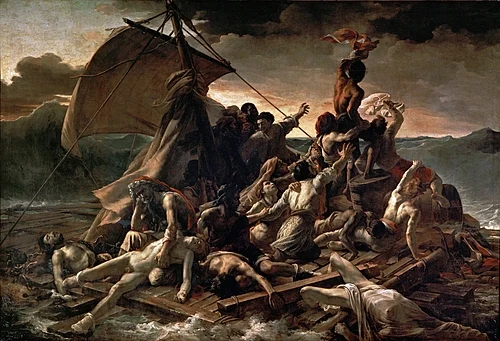
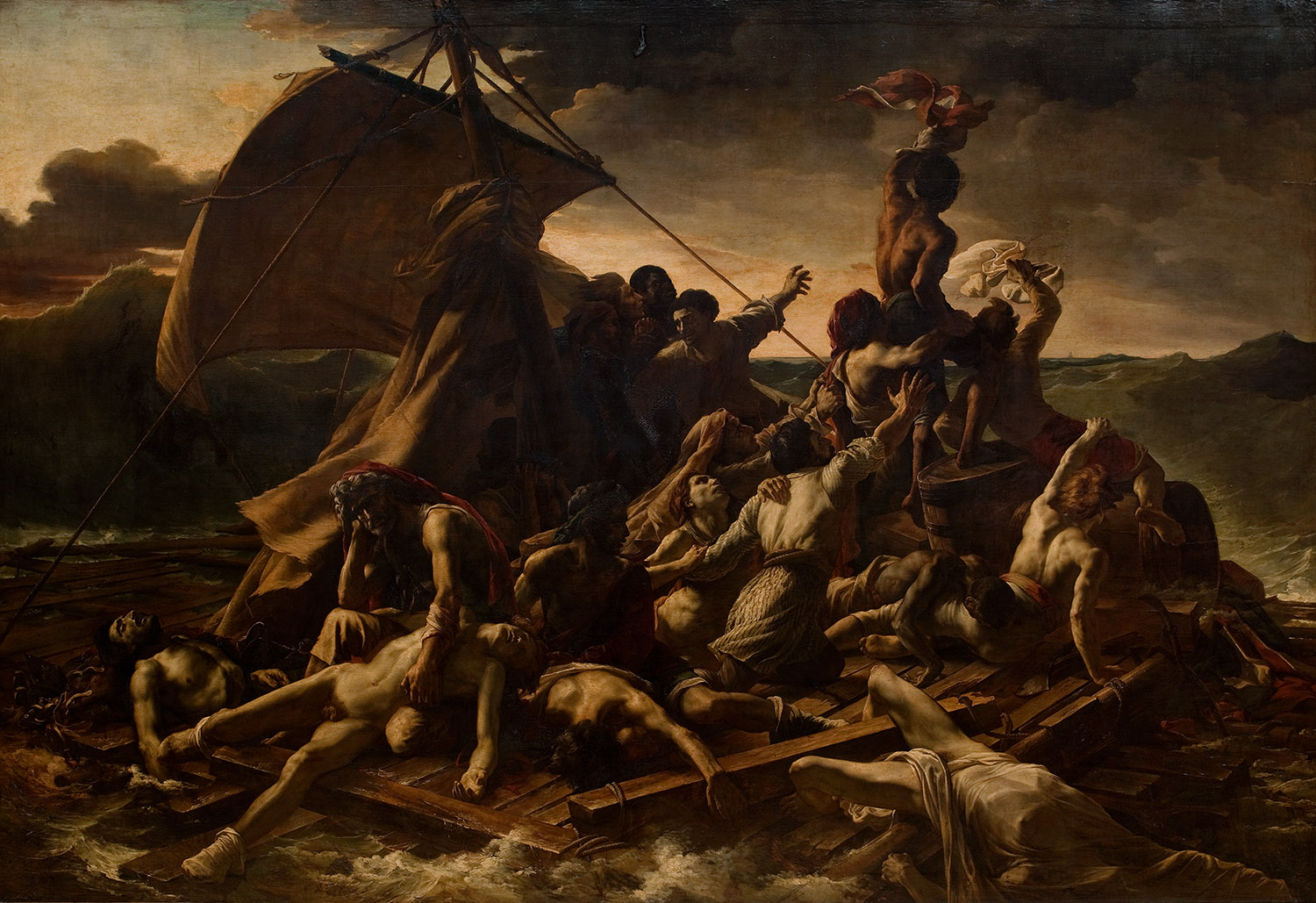
One artwork to sit with: Théodore Géricault, The Raft of the Medusa (1818-19), Musée du Louvre, Paris — shipwreck survivors on a raft, some dead, some dying, a few still desperately signaling a ship on the horizon that may not see them. The painting is enormous — nearly five meters wide — and based on a real disaster that the French government tried to cover up. Géricault interviewed survivors, visited morgues, and kept severed limbs in his studio to get the color of dying flesh exactly right. It is the most committed act of journalistic painting in history. Stand in front of it and feel the scale. Then ask yourself what you would be willing to do to get something exactly right.

Next: Post 5 — Paris 2: The Café, the Salon, and the Infrastructure of Ideas
![Life | Greece Sanctuary] Skiathos #Escape](https://storage.ghost.io/c/2a/9e/2a9e2b04-30f6-4166-8010-a3730d2eb719/content/images/size/w720/2026/09/Skiathos.jpg)
![Life] What is your comfort food?](https://storage.ghost.io/c/2a/9e/2a9e2b04-30f6-4166-8010-a3730d2eb719/content/images/size/w720/2026/09/WhatsApp-Image-2026-09-18-at-10.11.32.jpeg)
![Life | London Sanctuary] The Grove: Place of Restoration #Retreat](https://storage.ghost.io/c/2a/9e/2a9e2b04-30f6-4166-8010-a3730d2eb719/content/images/size/w720/2026/08/WhatsApp-Image-2026-08-07-at-21.51.41.jpeg)
Comments ()