Art] What Cities Make of Us: Art, Power & the Human Condition Across Europe | New York: When the Center of the World Moves (21/22)
On Abstract Expressionism, the CIA, Warhol's prophecy, and what it means when the art world — and the center of power — shifts from the old world to the new
![Art] What Cities Make of Us: Art, Power & the Human Condition Across Europe | New York: When the Center of the World Moves (21/22)](https://storage.ghost.io/c/2a/9e/2a9e2b04-30f6-4166-8010-a3730d2eb719/content/images/size/w1200/2026/03/Gemini_Generated_Image_sbowymsbowymsbow-1.png)
What Cities Make of Us: Art, Power & the Human Condition Across Europe | Post 21 of 22
On Abstract Expressionism, the CIA, Warhol's prophecy, and what it means when the art world — and the center of power — shifts from the old world to the new
| Series | What Cities Make of Us — Post 21 of 22 |
| Reading Time | 8 minutes |
| City | New York, USA |
| Era | 1940s – 1970s |
| Key Figures | Pollock, de Kooning, Rothko, Warhol, Basquiat, Bernstein |
| Core Argument | New York did not steal the center of the art world from Paris — it was handed it by a war, and what it built with that inheritance tells us everything about how cultural power actually transfers |
In the winter of 1943, Peggy Guggenheim opened a gallery on 57th Street in Manhattan called Art of This Century. It was designed by Frederick Kiesler as an experience rather than a conventional gallery — curved walls, works mounted on suspended brackets rather than hung flat, lighting that changed during the viewing experience. Its opening night was attended by Marcel Duchamp, Piet Mondrian, Max Ernst (who was, briefly, Guggenheim's husband), and a young, little-known American painter named Jackson Pollock.
Guggenheim gave Pollock his first solo show. She gave him a monthly stipend. She introduced his work to the critics and collectors who would eventually make him the most famous painter in America. Without Peggy Guggenheim, there is probably no Jackson Pollock — at least not in the form that Pollock took, not in the moment when his work became the defining statement of a new American art.
The gallery operated for only four years. In those four years, it helped establish New York as the center of the world's contemporary art market, a position the city had not previously held and has not relinquished since.
This is how centers move. Not through announcement or official transfer of authority. Through the presence of a few individuals with resources, vision, and an early intuition about where the energy is.
The Abstract Expressionists: Painting as Existential Act
The Abstract Expressionists — Pollock, de Kooning, Rothko, Franz Kline, Lee Krasner, Joan Mitchell, Helen Frankenthaler — were, as a group, the first generation of American artists to produce work that Europe took seriously on its own terms rather than as an interesting provincial variation on European themes.
What they were doing was, in significant measure, a response to the European modernism that had emigrated to New York before and during the Second World War. Mondrian, Léger, Duchamp, Ernst, Chagall — the war had driven a generation of European artists across the Atlantic, and their presence in New York created a transfer of sophistication and vocabulary that the American scene had not previously had access to.
The Americans absorbed what the Europeans brought and then did something unexpected with it. They made it large — the scale of the canvases is one of the first things you notice, in person, that reproductions cannot convey. Pollock's full-scale drip paintings are the size of walls. Rothko's color field paintings are designed to fill your visual field completely, so that the experience of standing in front of one becomes something close to being inside it.
They made it physical — the drip paintings, the gestural brushwork of de Kooning, the staining techniques of Frankenthaler were all forms of direct bodily engagement with the canvas that had no precedent in European modernism's cerebral refinement. And they made it existential — the claim, which Pollock and Rothko articulated in different ways, that the act of painting was itself the subject of the painting, that the gesture recorded on the canvas was the authentic expression of an encounter with existence at its most unmediated.
This was the late 1940s. Hiroshima had happened. The Holocaust had happened. The old European order — the culture that had produced the Impressionists and the Cubists and the Vienna Secession — had collapsed in the most catastrophic failure of civilized self-governance in human history. The Abstract Expressionists were not painting in ignorance of this. They were painting in full knowledge of it, with an American directness that the traumatized European tradition could not quite muster.
The CIA and the Abstract Expressionists
In 1995, Frances Stonor Saunders published a detailed investigation of a remarkable cultural history. The CIA, during the Cold War, had covertly funded and promoted Abstract Expressionism as a tool of ideological competition with the Soviet Union.
The mechanism was indirect — operated through front organizations like the Congress for Cultural Freedom, which funded exhibitions, publications, and cultural events without disclosing the source of the money. The argument within the CIA was that Abstract Expressionism — with its emphasis on individual expression, its freedom from representational constraint, its rejection of the ideological art that the Soviet Union required of its artists — was the perfect cultural weapon. It demonstrated, in purely visual terms, what American freedom looked like: chaotic, individual, undirected by any authority.
The irony was not lost on subsequent commentators. The most aggressively anti-authoritarian art movement in American history — artists who were, many of them, genuinely politically radical, who would have been horrified by the use being made of their work — was being promoted by the national intelligence service of the United States government as evidence of American cultural superiority.
This is the deepest ambiguity of art in the service of power. The Abstract Expressionists were not collaborators. They did not know they were being used. The work was genuine — its radical freedom was real, its expressive force was earned — and it was simultaneously an instrument of cultural policy. Both things were true. The authenticity did not protect it from the instrumentalization, and the instrumentalization did not corrupt the authenticity.
Any cultural institution, any media organization, any intellectual who has ever found their genuine work being cited approvingly by a powerful interest that they would not themselves endorse has encountered some version of this problem. The work does not control its reception. The meaning cannot be quarantined from the use.
Rothko's Rooms: The Art That Refuses to Be Viewed Quickly
Mark Rothko arrived in America from Latvia at the age of ten, spent his career in New York, and became, in his late work, one of the most philosophically serious painters the 20th century produced. His color field paintings — large rectangles of color, layered and vibrated against each other — appear, at first glance, to be nearly empty. They are not.
Rothko was explicit about what his paintings required. They needed to be seen in proximity — close enough that the color occupied your entire visual field. They needed sustained time — not a glance but a presence, an investment of ten or fifteen minutes minimum. And they needed a quality of attention that was more like meditation than analysis — a willingness to stop thinking about the painting and begin to simply be in front of it.
What happens, when you comply with these requirements, is difficult to describe. The colors begin to breathe. The relationships between the rectangles become dynamic rather than static. Something that appeared flat reveals depth. The paintings begin to perform the emotional and philosophical propositions that Rothko was making — that color can access states of consciousness that figurative art, with its inevitable narrative pull, forecloses.
He was furious when he discovered that the Seagram Building restaurant he had designed a series of murals for — the owners had wanted sophisticated decoration for their luxury dining rooms — was to be a destination for the wealthy and celebrated. He withdrew the commission and gave the paintings to the Tate Modern in London. He wanted his paintings to trap people in a room with them, to prevent the easy exit that a restaurant provides.
He died by his own hand in 1970. The paintings he left behind require a stillness from their viewers that the 21st century has made increasingly difficult to supply. This may be why they feel, to those who manage to comply, more necessary with every passing year.
Warhol: The Prophet of the Attention Economy
Andy Warhol was the most accurate prophet of the late 20th and early 21st centuries that American culture produced. He saw what was coming — the collapse of the boundary between art and commerce, the transformation of celebrity into a self-sustaining economic system, the logic of repetition and reproduction as aesthetic principle — and he built his career on it before the rest of the culture had understood what he was describing.
In the future, everyone will be world-famous for fifteen minutes. The phrase is so well-known that it has become a cliché. Clichés become clichés because they are persistently true. Warhol said it in 1968. He was describing a world that would take fifty years to fully arrive — the world of viral content, of social media followers, of the attention economy in which fame is the primary currency and the mechanism of its production has become automated and available to anyone.
What Warhol understood — and what his art systematically explored — was that the distinction between high art and popular culture, between the authentic and the commercial, between the individual and the reproduced, was collapsing. His Campbell's Soup cans were not ironic. They were descriptive. In a world where the image of a soup can was as familiar, as culturally saturated, as any Rembrandt portrait, the distinction between "serious" subject matter and "commercial" subject matter had already ceased to have meaning.
He also understood that the artist, in this new world, was a brand. The Factory, his studio, was also a media operation — a machine for producing Warhol content, Warhol personality, Warhol image at scale. He managed his public persona with the same deliberateness that he applied to his silkscreens. The enigmatic statements, the silver wig, the Polaroid camera always at hand — these were not personality traits. They were design decisions.
Every institution that manages a public identity — every political leader, every major company, every cultural institution — is navigating some version of the problem Warhol identified. The question of how to be authentic in a media environment that rewards performance, how to maintain genuine substance while managing the image that surrounds it, is one that Warhol diagnosed decades before the tools that made it universal were available.
His diagnosis was not comforting. His prescription — essentially, to embrace the logic of the image rather than resist it — remains genuinely controversial. But the accuracy of his observation is now simply a feature of the world we live in.
Basquiat: The Outsider as Center
Jean-Michel Basquiat was born in Brooklyn in 1960, the son of a Haitian father and a Puerto Rican mother, began his career as a graffiti artist under the tag SAMO, sold postcards on the street, and within five years was selling paintings to major collectors for tens of thousands of dollars. He died of a heroin overdose at twenty-seven. A painting he made at nineteen sold in 2017 for $110.5 million — at the time the highest auction price ever achieved for an American artist.
Basquiat's work is built from text, symbol, and image in a way that resists the clean reading that the art market prefers. It is angry — about race, about exploitation, about the ways in which Black culture is consumed and celebrated while Black people are surveilled and imprisoned. It is also exuberant, formally inventive, aesthetically complex.
His trajectory through the New York art world of the early 1980s — from homeless teenager to international art star in approximately four years — is both a testament to the genuine openness of New York as a social system and a parable about what that system does to the people it elevates. Basquiat was celebrated and exploited simultaneously, often by the same people. He understood this and painted about it. The paintings are, among other things, a record of someone watching themselves be consumed by a system he could not have survived without and could not have survived within.
The question his life poses — how do you maintain the perspective that makes your work valuable while being inside the system that values it? — is one that applies far beyond the art world.
The Question It Leaves Behind
This series began in London — the trading city that became a world capital through commercial energy and institutional invention — and ends in New York, which inherited the same role through the same combination of immigration, commerce, cultural diversity, and financial power.
The Grand Tour began in England and ended in Rome, the summit of classical civilization. The journey of this series begins in the same place and ends in America — which has no ruins, no ancient temples, no multi-layered history of successive civilizations. What it has is the energy of arrival, the unfinishedness of a civilization that is still in the process of becoming what it will be.
Every civilization discussed in these twenty-two posts believed, at its peak, that it had arrived at something durable. The Habsburgs. The Venetian Republic. The Roman Empire. The courts of Louis XIV. None of them were wrong that they had achieved something extraordinary. All of them were wrong about the durability.
What does the history of how centers move — from Rome to Venice to Florence to Paris to London to New York — suggest about where the center of cultural and economic gravity is moving now? And what does it mean for the work you are doing in the present to build something that matters?
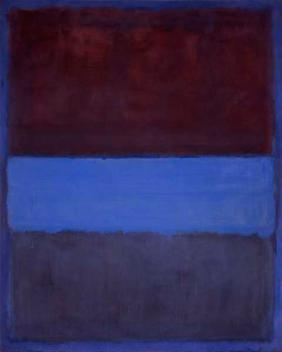
One artwork to sit with: Mark Rothko, No. 61 (Rust and Blue) (1953), Museum of Contemporary Art, Los Angeles — a large canvas in deep rust and blue, the rectangles breathing against each other. Find this painting or one of its companions and stand close — closer than you think is appropriate, closer than the museum guards usually prefer. Five minutes minimum. If the painting begins to feel like it is containing you rather than you containing it, Rothko has done what he intended. Then consider what it means that a man who grew up in poverty, fled Latvia as a refugee, struggled for decades without recognition, and died having destroyed his most important commercial commission, left behind rooms like this one — rooms that give other people access to a quality of experience they could not have found any other way.
Next: Post 22 — What Cities Make of Us: A Final Reflection
![Life | Greece Sanctuary] Skiathos #Escape](https://storage.ghost.io/c/2a/9e/2a9e2b04-30f6-4166-8010-a3730d2eb719/content/images/size/w720/2026/09/Skiathos.jpg)
![Life] What is your comfort food?](https://storage.ghost.io/c/2a/9e/2a9e2b04-30f6-4166-8010-a3730d2eb719/content/images/size/w720/2026/09/WhatsApp-Image-2026-09-18-at-10.11.32.jpeg)
![Life | London Sanctuary] The Grove: Place of Restoration #Retreat](https://storage.ghost.io/c/2a/9e/2a9e2b04-30f6-4166-8010-a3730d2eb719/content/images/size/w720/2026/08/WhatsApp-Image-2026-08-07-at-21.51.41.jpeg)
Comments ()