Art] What Cities Make of Us: Art, Power & the Human Condition Across Europe | Moscow & St. Petersburg: Art Under Autocracy, Beauty Under Terror (20/22)
On Dostoevsky, Shostakovich, the Hermitage, and the impossible ethics of making great work when the state controls your survival
![Art] What Cities Make of Us: Art, Power & the Human Condition Across Europe | Moscow & St. Petersburg: Art Under Autocracy, Beauty Under Terror (20/22)](https://storage.ghost.io/c/2a/9e/2a9e2b04-30f6-4166-8010-a3730d2eb719/content/images/size/w1200/2026/03/Gemini_Generated_Image_sbowymsbowymsbow-2.png)
What Cities Make of Us: Art, Power & the Human Condition Across Europe | Post 20 of 22
On Dostoevsky, Shostakovich, the Hermitage, and the impossible ethics of making great work when the state controls your survival
| Series | What Cities Make of Us — Post 20 of 22 |
| Reading Time | 8 minutes |
| Cities | Moscow & St. Petersburg, Russia |
| Era | 1700s – 1970s |
| Key Figures | Shostakovich, Tolstoy, Kandinsky, Chekhov, Peter the Great, Stalin |
| Core Argument | Russian artists under autocracy found ways to say true things without being permitted to say them — and their techniques deserve more study than they get |
In 1849, Fyodor Dostoevsky was led before a firing squad in the Semyonovsky Square in St. Petersburg. He was twenty-eight years old. He had been arrested eight months earlier for attending meetings of a socialist discussion circle, a crime serious enough, in Nicholas I's Russia, to warrant the death penalty. He was bound, hooded, and positioned for execution alongside two other men. The guns were raised.
Then a messenger arrived on horseback with a reprieve from the Tsar. The execution was a staged performance — a psychological punishment designed to produce maximum terror without the waste of killing a promising young writer. Dostoevsky was shipped to Siberia for four years of hard labor, followed by five years of compulsory military service.
He came back from Siberia a different man. The shallow progressive optimism of his early career was gone. In its place was something harder and stranger and more profound — the understanding of human nature that could only have come from the specific experience of standing at the edge of death, of surviving Siberia's extremity, of sharing prison barracks with murderers and thieves and dissidents and discovering, in that reduced condition, what human beings actually are when the social layer is stripped away.
Crime and Punishment, The Idiot, The Possessed, The Brothers Karamazov — the four great novels came from this man, this knowledge, this encounter with the extremity of human experience. They are among the deepest investigations of moral psychology in world literature. They could not have been written by someone who had not been to Siberia.
This is the Russian cultural paradox that recurs throughout its history: the conditions that produce the most extraordinary art are also conditions of extraordinary suffering. The creative richness and the political horror are not separable. They are the same thing, seen from different angles.
Catherine the Great and the Hermitage: Empire Building Through Culture
In 1764, Catherine II of Russia purchased a collection of 225 paintings from a Berlin merchant named Johann Ernst Gotzkowsky, who had originally assembled them for Frederick the Great of Prussia before Frederick's treasury was depleted by war. The collection was installed in a small building adjacent to the Winter Palace in St. Petersburg.
This was the beginning of the Hermitage. Over the following decades, Catherine purchased, with the systematic aggression she brought to all her projects, virtually every major collection that came onto the European market. The Walpole collection from England. The Thoms collection from Paris. Works from the Crozat collection, the Baudouin collection, the Cobenzl collection. By the end of her reign, the Hermitage contained more than 38,000 objects, making it one of the largest art collections in the world.
She was not, primarily, motivated by aesthetic pleasure, though she had genuine visual sensibility. She was motivated by political strategy. Russia, in the European imagination of the 18th century, was a semi-barbaric eastern power — vast, cold, and culturally marginal. Catherine understood that the possession of European art at the highest level was the fastest available route to cultural parity — that owning what Europe considered its own highest achievements was a form of soft-power assertion that military success alone could not provide.
The Hermitage was, from the beginning, a statement: We have arrived. We are part of civilization. We have bought its most prized possessions. The purchasing of art as cultural legitimacy is a logic that has been repeated by sovereign wealth funds, by the cultural institutions of rising powers, and by the newly wealthy in every era. Catherine did it first, most systematically, and most effectively.
Tchaikovsky and the Performance of Russian Identity
Peter Ilyich Tchaikovsky occupies a unique position in the Russian musical tradition: he is both the most internationally beloved Russian composer and the one whose work has been most used to represent Russia to audiences who know nothing else about it.
The ballets — Swan Lake, The Nutcracker, Sleeping Beauty — are the works through which most people in the world have their primary encounter with Russian music. They are performed everywhere, used as the default musical backdrop for Christmas festivities, broadcast constantly. They are, in a meaningful sense, the face of Russian culture for the global popular imagination.
What is less visible in this reception is the complexity of the man who wrote them. Tchaikovsky was homosexual in a society that criminalized homosexuality, deeply religious in a philosophical environment that was becoming militantly secular, personally fragile in a professional context that demanded public confidence. He managed these contradictions through the music — through an emotional directness that was socially unavailable in his personal life, through the ability to express in orchestral color the inner life that his social performance was required to conceal.
His death — in 1893, at fifty-three, apparently from cholera contracted by drinking unboiled water, nine days after the premiere of his Sixth Symphony, the Pathétique, which ends in slow, inexorable dissolution — has been the subject of speculation and debate for over a century. The rumors that his death was, in some sense, not accidental — that he was forced by a court of honor among his former classmates to choose between public exposure and a private suicide, to protect the reputation of an aristocratic family whose son he had been in correspondence with — have never been definitively resolved.
The Pathétique ends in the slow movement — unprecedented for a symphony, which traditionally ends with something energetic and upward-moving. The final bars are the sound of something being relinquished. If Tchaikovsky knew he was dying when he wrote it, the music is among the most extraordinary acts of artistic self-awareness ever recorded. If he did not know, the coincidence is of the kind that makes it difficult to believe in coincidence.
Shostakovich: The Artist as Hostage
Dmitri Shostakovich was born in St. Petersburg in 1906, had composed his First Symphony by the age of nineteen, and spent the next fifty years navigating the most dangerous institutional environment a major artist has ever faced.
Stalin's relationship with Shostakovich was one of sustained, mutual, asymmetric terror. In 1936, Stalin attended a performance of Shostakovich's opera Lady Macbeth of the Mtsensk District and walked out. The next day, Pravda published an unsigned editorial — widely understood to have been written or dictated by Stalin — titled "Muddle Instead of Music," which denounced the opera as "chaos" and "formalism." This was not a critical review. It was a death threat.
Shostakovich was thirty years old. Friends and colleagues had been arrested, sent to camps, shot. He had already prepared a small bag of essential items to take with him when the knock came at the night. He waited for it.
The knock did not come. Instead, Stalin allowed him to survive — and survive in a condition of extreme, permanent uncertainty. Shostakovich's subsequent career was a negotiation between artistic integrity and the survival imperatives of living inside a totalitarian system that could destroy him at any moment and chose, for its own reasons, not to. He wrote symphonies that satisfied the official requirement for optimistic socialist content. He also embedded in those symphonies coded languages of irony and subversion that audiences who shared his situation understood and that his official interpreters did not.
His Fifth Symphony — written in 1937 as a response to the criticism, described by him in terms that sound like capitulation — was received as triumphant. The finale builds to a huge, seemingly victorious climax. Soviet critics celebrated. Audiences who had experienced the Terror wept, and not from joy. The triumph sounds, if you listen with full attention, hollow — a forced performance of optimism that the music itself cannot quite sustain. The ambiguity was deliberate, and it was the most dangerous thing Shostakovich ever did.
Solomon Volkov's memoir Testimony — purportedly based on conversations with Shostakovich in his final years — contains the composer's own description of the Fifth: "The rejoicing is forced, created under threat, as in Gogol's story about the troika. It's as if someone were beating you with a stick and saying, 'Your business is rejoicing, your business is rejoicing,' and you rise, shaky, and go marching off muttering, 'Our business is rejoicing, our business is rejoicing.'"
Whether Shostakovich actually said this is disputed. Whether it is true of the music is not.
Tolstoy's Conscience and the Weight of Privilege
Leo Tolstoy was born into the Russian aristocracy, inherited a large estate called Yasnaya Polyana, wrote two of the greatest novels in world literature (War and Peace and Anna Karenina), and then spent the last three decades of his life in increasing conflict with the class to which he belonged, the institution of the Orthodox Church, and the entire social apparatus of his own wealth and privilege.
He began dressing as a peasant. He refused the Nobel Prize for Literature on multiple occasions. He gave away the rights to his later works so that they could be freely reproduced. He advocated for nonviolent resistance to authority — an influence that Gandhi acknowledged directly, and through Gandhi, the entire tradition of nonviolent civil disobedience that shaped the 20th century's most important political movements.
He died in 1910 at a small railway station in Astapovo, having left home at eighty-two to live more simply, having collapsed with pneumonia on a train that was traveling — nobody is certain where. His wife, from whom he had fled, was kept at the station while he died by followers who feared she would disturb his final peace.
Tolstoy's trajectory is one of the most extreme examples in intellectual history of a person following his convictions to conclusions that destroyed his domestic life and confused everyone who admired his work. He had arrived, through logic and moral seriousness, at positions that were genuinely incompatible with the life he was actually living. He could not resolve this contradiction. He could not stop trying to resolve it. The attempt to live in accordance with what you believe is always admirable and sometimes catastrophic, and Tolstoy is the supreme example of both.
The Question It Leaves Behind
The Russian creative tradition — Dostoevsky, Tolstoy, Tchaikovsky, Shostakovich, Akhmatova, Bulgakov, Pasternak — was formed in an environment of sustained political pressure. The best of what it produced does not simply record suffering. It transforms suffering into insight — finds in extreme experience an access to the depths of human nature that comfortable circumstances cannot provide.
This is not an argument for suffering as a prerequisite for great work. It is an observation that the people who have been most honestly tested — who have faced, without the option of comfortable avoidance, the fundamental questions about human nature, moral choice, and the relationship between the individual and power — tend to produce work of a depth that untested comfort rarely matches.
What has been the most genuinely difficult experience of your professional or personal life? And what access has it given you to an understanding that you would not have reached any other way?
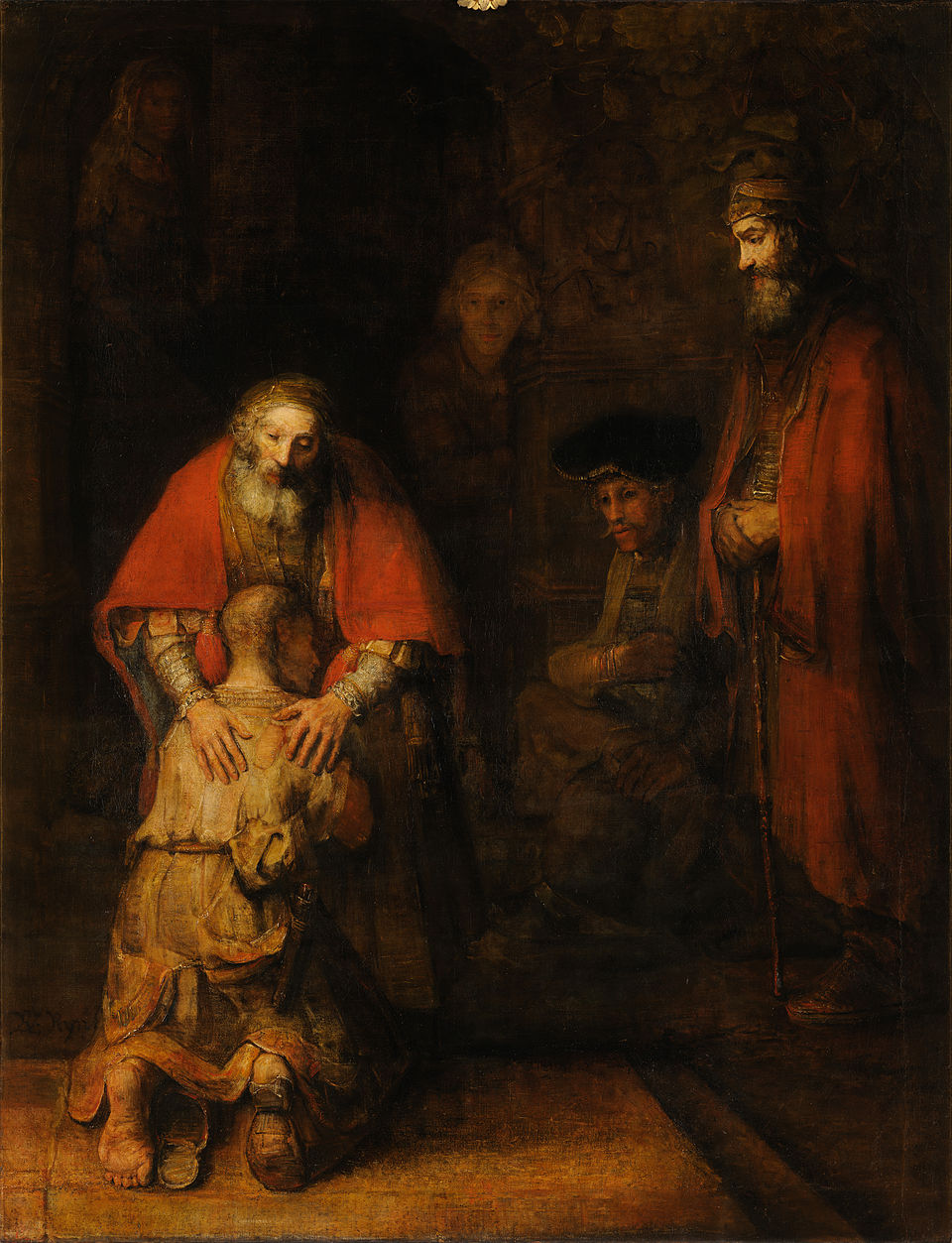
One artwork to sit with: Rembrandt van Rijn, Return of the Prodigal Son (c. 1668), State Hermitage Museum, St. Petersburg — painted in the last years of Rembrandt's life, after his bankruptcy, after the deaths of his wife and son, when he had outlived his reputation and most of his audience. A father kneels to embrace a son who has returned in rags. The son's face is buried in the father's shoulder — we cannot see his expression. The father's hands rest on the son's back with a tenderness so specific and so real that it is difficult to look at for very long. This painting is in the Hermitage. Catherine bought it. It is one of the reasons the journey to St. Petersburg is worth making. Stand in front of it and consider what it means to create an image of unconditional forgiveness when you have experienced very little of it yourself.
Next: Post 21 — New York: When the Center of the World Moves
![Life | Greece Sanctuary] Skiathos #Escape](https://storage.ghost.io/c/2a/9e/2a9e2b04-30f6-4166-8010-a3730d2eb719/content/images/size/w720/2026/09/Skiathos.jpg)
![Life] What is your comfort food?](https://storage.ghost.io/c/2a/9e/2a9e2b04-30f6-4166-8010-a3730d2eb719/content/images/size/w720/2026/09/WhatsApp-Image-2026-09-18-at-10.11.32.jpeg)
![Life | London Sanctuary] The Grove: Place of Restoration #Retreat](https://storage.ghost.io/c/2a/9e/2a9e2b04-30f6-4166-8010-a3730d2eb719/content/images/size/w720/2026/08/WhatsApp-Image-2026-08-07-at-21.51.41.jpeg)
Comments ()