Art] What Cities Make of Us: Art, Power & the Human Condition Across Europe | Hamburg: Destruction, Reinvention, and the Art of Starting Over (08/22)
What the world's most politically saturated city can teach us about resilience, identity, and what survives catastrophe
![Art] What Cities Make of Us: Art, Power & the Human Condition Across Europe | Hamburg: Destruction, Reinvention, and the Art of Starting Over (08/22)](https://storage.ghost.io/c/2a/9e/2a9e2b04-30f6-4166-8010-a3730d2eb719/content/images/size/w1200/2026/03/Gemini_Generated_Image_sbowymsbowymsbow-9.png)
What Cities Make of Us: Art, Power & the Human Condition Across Europe | Post 8 of 22
What the world's most politically saturated city can teach us about resilience, identity, and what survives catastrophe
| Series | What Cities Make of Us — Post 8 of 22 |
| Reading Time | 8 minutes |
| Cities | Berlin & Hamburg, Germany |
| Era | 1920s – 2000s |
| Key Figures | Brecht, Käthe Kollwitz, Brahms, George Grosz |
| Core Argument | Berlin has been destroyed and rebuilt more times than any Western city — and its refusal to paper over its own history is the most honest thing about it |
There is a photograph taken in Berlin in 1945 that is, in its way, one of the most striking documents of the 20th century. It shows a street in the city center — or rather, it shows where a street used to be. On both sides, the facades of buildings stand more or less intact. But they are facades only — the interiors have been gutted by fire, the roofs are gone, the windows are empty. The street itself is a canyon of rubble. And in the middle of this, a woman is clearing debris with a bucket. Just one woman, in the ruins of a city, with a bucket.
The Germans have a word for these women: Trümmerfrauen, rubble women. Hundreds of thousands of them, in the immediate aftermath of the war, clearing the ruins of their cities by hand — stone by stone, brick by brick — stacking the salvageable material to be reused. It was the first act of reconstruction in a country that had destroyed itself and much of the world around it.
Berlin has been destroyed and rebuilt more times than any major Western city. It has been bombed, divided, walled, reunified, and gentrified within the span of a single lifetime. It is, as a result, the most historically legible city in Europe — a place where the evidence of catastrophe and recovery is embedded in the physical fabric of every street, visible to anyone who knows how to look.
The City That Cannot Forget
Most cities age relatively gracefully — the old layers accumulate slowly enough that the transitions are soft, the ruptures healed over by time. Berlin ages violently. The transitions are hard and visible: Baroque beside Brutalist beside Postmodern beside the preserved ruins of something that was deliberately left standing as testimony.
The Kaiser Wilhelm Memorial Church in the center of the city is the most explicit example. Bombed in 1943, its spire reduced to a jagged stump, it was left unrestored after the war as a permanent reminder of what destruction looks like. A new, modern church was built beside it. The ruin and the reconstruction stand together — the wound and the response to it, permanently conjoined.
This is a philosophical position as much as an architectural one. Most societies, given the choice, prefer to restore — to smooth over the evidence of rupture, to present a continuous and relatively undamaged face to the world. Berlin made the opposite choice. It decided that some ruptures are too significant to paper over, that the attempt to restore continuity after certain events would itself be a form of dishonesty.
For institutions that have been through crises — financial, reputational, organizational — there is a question here that is worth sitting with. When is restoration the right response to catastrophe? And when does restoration become a form of denial that prevents the deeper reckoning that genuine recovery requires?
Brecht and the Art of Productive Discomfort
Bertolt Brecht was born in Augsburg and moved to Berlin in 1924. He was twenty-six years old and had already written Baal, Drums in the Night, and In the Jungle of Cities — plays of such startling originality and moral violence that Berlin, then in the wild creative ferment of the Weimar Republic, was the only city in Germany capable of receiving them.
What Brecht developed in Berlin — and what made him the most influential theatre practitioner of the 20th century — was a theory of art as a form of productive discomfort. He was opposed, systematically and on principle, to the idea that art should make audiences feel understood, consoled, or emotionally resolved. The German theatrical tradition — above all the Wagnerian tradition of Gesamtkunstwerk, the total work of art that overwhelmed the audience into a state of transported identification — was, in Brecht's analysis, not merely aesthetically conservative but politically dangerous.
An audience that has been moved to tears, that has identified completely with a character on stage, that has been emotionally transported, is an audience that is not thinking. And an audience that is not thinking can be led almost anywhere — a point that the political movements of the 1920s and 1930s demonstrated with appalling efficiency.
Brecht's response was the Verfremdungseffekt — the alienation effect. He wanted audiences to remain aware that they were watching a performance, to maintain the critical distance that emotional identification destroys. He broke the fourth wall. He had actors announce what was going to happen before it happened. He used songs to interrupt the drama at moments of highest tension. He was, deliberately and systematically, preventing his audience from losing themselves in the story.
The relevance to any field where analytical clarity matters — finance, policy, academic research — is not subtle. The most dangerous moments in any institutional decision-making process are not the moments of ignorance but the moments of narrative capture — the moments when a compelling story has so thoroughly colonized the room that nobody is asking the questions the story does not want asked. Brecht was trying to build a theatre that immunized its audience against narrative capture. The principle extends well beyond the stage.
The Wall: Art in a Divided City
From 1961 to 1989, Berlin was a city with a wall through its middle. Families were divided. Neighborhoods were cut in half. People were shot trying to cross a hundred meters of concrete and wire between one part of their own city and another.
The Wall generated art with an intensity that peaceful cities rarely achieve. On the Western side, it became a continuous canvas — covered in graffiti, murals, political statements, and the particular visual language of a generation that had grown up in the shadow of a structure that embodied, in concrete and razor wire, the fundamental political question of the 20th century: whether human beings could organize their lives freely, or whether they required the management of an authoritarian state.
On the Eastern side, the Wall was blank. The East German government maintained a death strip, a hundred meters of cleared ground on its side of the Wall, patrolled and surveilled. The blank Wall was not the absence of artistic response — it was the artistic response, the most eloquent possible statement of what life under a system that fears its own citizens actually looks like.
When the Wall came down in November 1989, the first thing people did — before the politicians made speeches, before the economists calculated the cost of reunification — was dance on it. Then they began to chip pieces off with hammers. Within weeks, sections of the Wall were being sold as souvenirs. Pieces of it are now in museums and corporate lobbies around the world, including in the offices of companies that would not have been able to operate in the country that built it.
The Wall's afterlife is a parable about how symbols of oppression get metabolized by the market. The question it raises is whether that metabolization is liberation or amnesia.
Hamburg and Brahms: The Cost of Leaving Home
Johannes Brahms was born in Hamburg in 1833, the son of a double-bass player in the city's taverns and dance halls. He spent his early career trying to win the appointment that would have confirmed his status in the city that formed him — principal conductor of the Hamburg Philharmonic — and was passed over, repeatedly, in favor of lesser men.
He left for Vienna. He became the most celebrated German composer of his generation. He never forgot that Hamburg had not wanted him.
Years later, when the city finally offered him its highest civic honor, he wrote back accepting it and expressing, with exquisite restraint, the observation that the recognition might have come at a somewhat more useful point in his career.
The Brahms-Hamburg story is one version of a pattern that recurs throughout the history of creative and intellectual life: the person whose gifts are most visible in retrospect is frequently the person whom local institutions, for reasons that seemed reasonable at the time, declined to support. The hometown committee rarely sees the genius it is sitting next to — partly because familiarity diminishes perceived novelty, partly because local politics introduce considerations that have nothing to do with merit, and partly because the most genuinely original work tends to exceed the evaluative frameworks that local institutions have developed.
Vienna, with less at stake in Brahms's particular story, could see him more clearly. It gave him what Hamburg had withheld. And he gave Vienna his four symphonies, his two piano concertos, his German Requiem, and a chamber music legacy of such depth and richness that the city has been dining out on it for a hundred and fifty years.
The Creative Economy of Cheap Cities
Post-reunification Berlin developed, in the 1990s and 2000s, something that economists and urban theorists have spent considerable energy trying to understand and even more energy trying to replicate. The collapse of East German industry left vast stretches of the city empty — industrial buildings, derelict apartments, stretches of the former death strip, entire neighborhoods that had been depopulated by the Wall and its aftermath.
Into this vacuum — cheap, spacious, centrally located, and administratively confused enough that nobody was enforcing the rules particularly strenuously — moved artists, musicians, club promoters, designers, filmmakers, and the entire supporting ecology of the creative economy. Berlin became, within a decade, the most creatively vital city in Europe.
The mechanism is worth understanding precisely because it has been misunderstood by every city that has tried to replicate it. The creative density of 1990s Berlin was not the product of a cultural policy. It was the product of affordable space — which is to say, it was the product of Berlin's economic failure. The moment the city became successful enough that rents rose to European levels, the creative ecosystem began to migrate to wherever space was cheaper.
The lesson is not that cities should maintain economic failure to sustain creative cultures — a proposal nobody has seriously advanced. The lesson is that the relationship between economic prosperity and cultural vitality is more complicated than it appears. Prosperity creates audiences and patrons. It also raises the cost of entry to the point where the most genuinely experimental work — which almost never pays its own way in the short term — can no longer afford to exist.
The Question It Leaves Behind
Berlin has been, in the 20th century alone, the capital of the German Empire, the Weimar Republic, the Third Reich, a divided city, and a reunified democratic republic. It has been bombed to rubble and rebuilt. It has been walled and unwalled. It has been, simultaneously, the site of some of the worst atrocities in human history and some of the most remarkable cultural creativity.
It is still there. Still building. Still arguing with its own past.
What does it mean to live and work in the aftermath of catastrophe? And what can be learned from a city that has refused, repeatedly, to pretend that its history was other than it was?
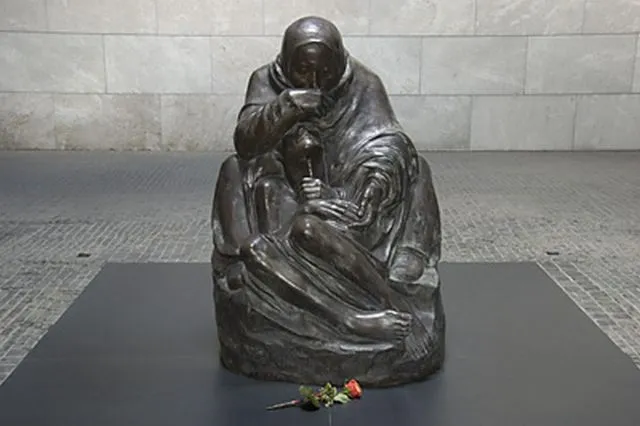
One artwork to sit with: Käthe Kollwitz, Mother with her Dead Son (1937-38), Neue Wache, Berlin — an enlarged cast of a small sculpture by Kollwitz, now the sole object in the Neue Wache, Germany's central memorial to the victims of war. A mother holds her dead son across her lap — a deliberate echo of the Pietà, transposed from the sacred to the particular. The room is open to the sky; rain falls on the sculpture. Kollwitz lost her son in the First World War and her grandson in the Second. She made this to say something that language cannot say. Stand in that room, in whatever weather Berlin offers that day, and let it say it.
Next: Post 9 — Rhine & Bavaria: Myth, Wagner, and the Danger of Beautiful Lies
![Life | Greece Sanctuary] Skiathos #Escape](https://storage.ghost.io/c/2a/9e/2a9e2b04-30f6-4166-8010-a3730d2eb719/content/images/size/w720/2026/09/Skiathos.jpg)
![Life] What is your comfort food?](https://storage.ghost.io/c/2a/9e/2a9e2b04-30f6-4166-8010-a3730d2eb719/content/images/size/w720/2026/09/WhatsApp-Image-2026-09-18-at-10.11.32.jpeg)
![Life | London Sanctuary] The Grove: Place of Restoration #Retreat](https://storage.ghost.io/c/2a/9e/2a9e2b04-30f6-4166-8010-a3730d2eb719/content/images/size/w720/2026/08/WhatsApp-Image-2026-08-07-at-21.51.41.jpeg)
Comments ()