Art] What Cities Make of Us: Art, Power & the Human Condition Across Europe | Amsterdam & Brussels: Commerce, Calvinism, and the Art of the Everyday (10/22)
How a merchant republic with no kings, no saints, and no appetite for flattery produced the most honest art in Western history
![Art] What Cities Make of Us: Art, Power & the Human Condition Across Europe | Amsterdam & Brussels: Commerce, Calvinism, and the Art of the Everyday (10/22)](https://storage.ghost.io/c/2a/9e/2a9e2b04-30f6-4166-8010-a3730d2eb719/content/images/size/w1200/2026/03/Gemini_Generated_Image_sbowymsbowymsbow-15.png)
What Cities Make of Us: Art, Power & the Human Condition Across Europe | Post 10 of 22
How a merchant republic with no kings, no saints, and no appetite for flattery produced the most honest art in Western history
| Series | What Cities Make of Us — Post 10 of 22 |
| Reading Time | 8 minutes |
| Cities | Amsterdam & Brussels |
| Era | 1400s – 1950s |
| Key Figures | Rembrandt, Vermeer, Van Eyck, Rubens, Van Dyck, Magritte |
| Core Argument | The Dutch painted merchants and maids instead of gods and kings — and in doing so produced the most honest philosophy of ordinary human life in Western art |
In 1669, Rembrandt van Rijn died in Amsterdam. He was sixty-three years old, bankrupt, living in a rented house in the Jewish quarter, having outlived his wife, his common-law partner, and his only surviving son. His estate, when it was inventoried, contained almost nothing of value. His paintings — most of them — were by then dispersed across Europe in the collections of people who had paid very little for them.
Among his effects was a late self-portrait, probably unfinished. He had been painting himself throughout his career — more than eighty self-portraits over forty years, an obsessive running record of his own face from ambitious young man to ruined old one. In the last portraits, he did not flinch. He painted the ruin of his face with the same unsparing attention he had brought to the faces of his prosperous merchant clients in the years when they were still hiring him. He was not a victim seeking sympathy. He was a witness. He was watching himself the way he watched everything else, with the clinical curiosity of a man for whom looking was the primary moral act.
No other artist in Western history was so consistently honest about what time does to a human face.
What a Republic Paints
The Dutch Golden Age — roughly the 17th century, during which Amsterdam was the center of the world's commercial economy — produced a kind of art that had no real precedent and has no real successor. It was art made for merchants rather than monarchs, for the walls of private houses rather than the ceilings of palaces, for people whose theology told them that God's favor was expressed through diligent work and honest dealing rather than through the intercession of saints and the patronage of popes.
What Calvinist merchants wanted on their walls was not mythology. It was not the suffering of martyrs or the glory of kings. It was reality — specifically, the reality of their own world: the goods they traded (still lifes of fish, bread, gleaming silverware, half-peeled lemons), the activities of their households (women reading letters, servants pouring milk), the landscapes they occupied (flat, grey, luminous, with vast skies and herds of cattle and church spires in the distance), and their own faces, recorded with a specificity that insisted on individual human dignity without requiring the subject to be noble or beautiful or heroic.
This was a radical democratization of the art subject. And it was driven not by progressive political ideology but by the commercial logic of a market economy. In a society without a royal court to commission mythological paintings and without a Catholic church to commission altarpieces, artists had to find buyers among the middle class. The middle class wanted to see itself.
The result was the most sustained investigation of ordinary life as a subject for serious art that Western civilization has yet produced.
Rembrandt's Bankruptcy and the Limits of Genius
Rembrandt was, for a period in the 1630s and 1640s, the most successful portrait painter in Amsterdam. He commanded high prices. He maintained a large studio of assistants and pupils. He had a beautiful house on the Breestraat, which he filled with an extraordinary collection of objects — shells, plaster casts, weapons, fabrics, stuffed animals, prints and drawings by every major artist he could find — that he used as props and sources of visual inspiration.
He also spent significantly more than he earned, borrowed against the house, failed to repay, and was declared insolvent in 1656. The house and everything in it were sold at auction. He moved to a rented house. His companion Hendrickje and his son Titus set up an art-dealing business specifically designed to employ Rembrandt as their agent, so that his creditors could not attach his earnings.
The bankruptcy destroyed his social standing. Commissions dried up. His late work — the paintings that are now considered his greatest — were made in the context of total professional and financial failure, for an audience that had largely moved on to other painters.
What this produced, paradoxically, was freedom. The late Rembrandt had nothing left to protect, no patrons to please, no reputation to maintain. He painted what interested him, in the way that interested him, without the inhibitions that success imposes. The brushwork loosened. The psychological depth increased. The faces became more human and less decorous.
The relationship between professional failure and creative liberation is not a comfortable one to discuss in contexts where financial success is treated as a proxy for quality. But it is real, and Rembrandt is its most documented example. The question is not whether to seek failure — nobody should — but whether to understand that the conditions that produce the most commercially successful work are not always the same as the conditions that produce the most honest work.
Vermeer's 37 Paintings and the Slow Art of Attention
Where Rembrandt was prolific, dramatic, and ultimately catastrophic, Johannes Vermeer was quiet, precise, and almost invisible. He lived his entire life in Delft, a small city thirty kilometers from Amsterdam. He produced, as far as anyone can determine, thirty-seven paintings. He left almost no written record. He died in 1675, leaving eleven children and substantial debts.
His work was largely forgotten for nearly two centuries — known to specialists, ignored by the general public — until the 19th century, when a French critic named Thoré-Bürger essentially rediscovered him and made the case that he was among the greatest painters who had ever lived.
The case has not required revision.
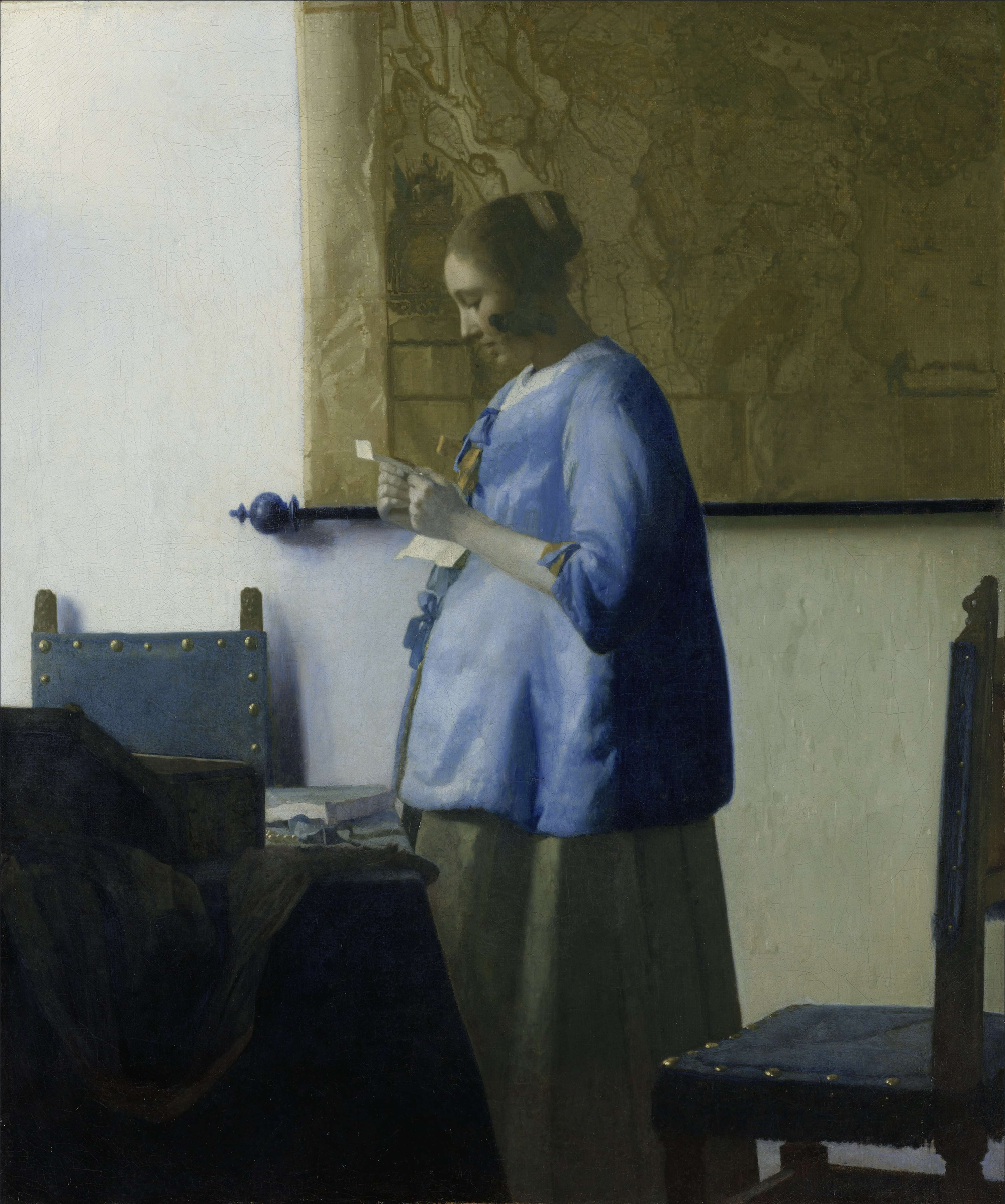
What Vermeer did — in those thirty-seven paintings, in the same rooms of the same house in the same provincial city for twenty years — was investigate a single question with an intensity that feels, in retrospect, almost scientific. The question was: what does light do to the surfaces of everyday objects and to the human face? Not dramatic light, not theatrical light, but the ordinary north light of a Delft interior on an ordinary morning, coming through a window with small panes of glass, falling on a woman reading a letter.
He did not paint important people or important events. He painted the quality of a particular moment's light on a blue cloth and a white wall and the absorbed face of a woman who does not know she is being watched.
Every painting by Vermeer asks the same question: what would it mean to give this moment your full attention? And every painting answers it in a slightly different way, finding in the familiar and the overlooked a depth that sustained looking always reveals.
In a professional culture that rewards speed and productivity and the demonstration of busyness, Vermeer's thirty-seven paintings are a counter-argument of enormous quiet force.
The Dutch Financial System and What Tulips Tell Us
In the 1630s, the Dutch Republic experienced the world's first fully documented speculative bubble. The subject was tulips.
Tulip bulbs had been introduced to the Netherlands from the Ottoman Empire in the late 16th century, and they became a prestige commodity with unusual properties: each bulb could produce a flower of unpredictable characteristics, the most prized being a particular pattern of flame-like streaks caused (though nobody knew this at the time) by a mosaic virus. The rarest varieties commanded extraordinary prices. A single bulb of Semper Augustus — the most sought-after variety — traded at the peak for the equivalent of several years' wages for a skilled craftsman, or roughly ten times the annual income of a prosperous merchant.
Contracts for future delivery of bulbs were traded in the taverns. Prices rose. More people entered the market. Prices rose further. Then, in February 1637, the market collapsed with spectacular speed. Prices fell to a fraction of their peak values. People who had contracted to buy bulbs at peak prices were ruined. The economy absorbed the shock relatively quickly — the bubble was real but smaller than legend suggests — but the cultural memory of it lasted for generations.
Tulip mania is the ancestor of every financial bubble that has followed it. The mechanism — an asset with genuine underlying value, an exponential price increase driven by the expectation of further increase, the entry of buyers motivated purely by price momentum rather than underlying value, and then a collapse when the last buyer arrives and there is nobody left to sell to — has replicated itself with remarkable consistency across four centuries of financial history.
What Rembrandt's near-contemporary Jan Brueghel the Younger did was paint the whole thing as satire: monkeys in a tavern, speculating on tulip prices, some counting their gains, others weeping over their losses. The moral commentary is embedded in the image. The monkeys are us. They always have been.
Rubens, Van Dyck, and the Art of Magnificence
While the northern Dutch Republic was producing its art of quiet domestic observation, the southern Netherlands — what is now Belgium — remained under Habsburg Catholic rule and produced something entirely different: the most magnificent Baroque painting in northern Europe.
Rubens, born in Antwerp in 1577, was everything the Dutch masters were not: enormous in scale, operatic in emotion, lush in color, and systematically committed to the proposition that painting should overwhelm. His canvases are populated by writhing figures, churning clouds, muscular angels, and saints in the throes of ecstasy or martyrdom. They are designed to produce a physical response — to make you feel, in your chest and your gut, the reality of the divine drama they depict.
He was also the most sophisticated political operator among major artists. He served as a diplomat for the Spanish Habsburg court, negotiating between the great powers of Europe with a fluency and social intelligence that made him genuinely valuable beyond his paintbrush. He understood power — how it displayed itself, how it justified itself, what it needed from art — with a precision that most artists lack because most artists have never been in the room where power actually operates.
His assistant and successor Anthony van Dyck took this to its logical conclusion: he became the supreme court portraitist of 17th-century Europe, creating the definitive visual language of aristocratic elegance. The elongated figures, the casual mastery of pose, the sense of people inhabiting their power so completely that it does not require demonstration — this was Van Dyck's invention, and it shaped portrait painting for two centuries.
Between them, Rubens and Van Dyck defined one answer to the question of what art is for: it is for the display and legitimation of power. The Dutch masters defined the opposite answer: it is for the honest recording of human reality. Both traditions were producing great art simultaneously, in the same small patch of northern Europe. The tension between them is still unresolved.
The Question It Leaves Behind
Vermeer's milkmaid is not a significant person. She is a servant doing ordinary work in an ordinary kitchen. Vermeer gave her the same quality of attention that Renaissance painters gave to saints and monarchs — the same careful light, the same moral seriousness, the same implicit claim that this subject is worthy of your sustained regard.
The claim is a philosophical position. It says that the sacred is not located in the exceptional, the powerful, or the famous. It is located in the ordinary, attended to with sufficient care.
Who in your professional life is doing important, difficult work that you have not attended to with the care it deserves? And what would change if you looked at them the way Vermeer looked at his milkmaid?
One artwork to sit with: Johannes Vermeer, Woman Reading a Letter (c. 1663), Rijksmuseum, Amsterdam — a woman stands by a window, reading. She may be pregnant. The light falls on her face from the left. She is entirely absorbed. There is a map on the wall behind her — perhaps the map shows where the letter came from, or where the letter-writer is. We do not know what the letter says. We do not need to. What Vermeer has captured is the quality of total absorption in something that matters to you — the way the rest of the world falls away. Stand in front of this painting in the Rijksmuseum and notice when you last felt that absorbed by anything.
Next: Post 11 — Vienna 1: Empire, Splendor, and the Art of Soft Power
![Life | Greece Sanctuary] Skiathos #Escape](https://storage.ghost.io/c/2a/9e/2a9e2b04-30f6-4166-8010-a3730d2eb719/content/images/size/w720/2026/09/Skiathos.jpg)
![Life] What is your comfort food?](https://storage.ghost.io/c/2a/9e/2a9e2b04-30f6-4166-8010-a3730d2eb719/content/images/size/w720/2026/09/WhatsApp-Image-2026-09-18-at-10.11.32.jpeg)
![Life | London Sanctuary] The Grove: Place of Restoration #Retreat](https://storage.ghost.io/c/2a/9e/2a9e2b04-30f6-4166-8010-a3730d2eb719/content/images/size/w720/2026/08/WhatsApp-Image-2026-08-07-at-21.51.41.jpeg)
Comments ()