Obsidian Essay] On Finding Maria — and Finally Finding Words for a Childhood I Didn't Know How to Name
Personal Essay: Reading Maria Shriver's I Am Maria in 2025 made me understand something about my own upbringing that I hadn't been able to see before. This is that reflection.
![Obsidian Essay] On Finding Maria — and Finally Finding Words for a Childhood I Didn't Know How to Name](/content/images/size/w1200/2026/04/I-am-maria-1.webp)
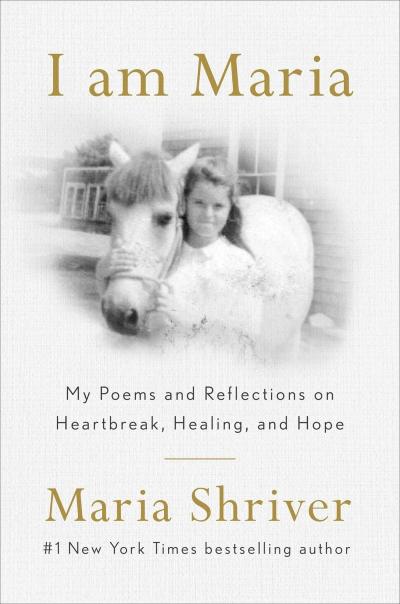
I didn't go looking for Maria Shriver. She surfaced on my radar in 2025 — sideways, through a book tour clip, a title that stopped me mid-scroll. I Am Maria. Something in those three words landed before I had fully read them. An assertion. A correction. A woman saying her own name back to a world that kept asking her to be something else. That is a boundary. That is a self-acknowledgement. Awareness.
She had grown up being asked "which Kennedy are you?" — and when she answered "I'm Maria," people looked past her. Where is Caroline? Where are Bobby's kids? As if "I am Maria" was not sufficient. As if the name she was born with was not the right answer to the question of who she was.
I am not a Kennedy. I did not grow up in Camelot. The scale of her family's place in American life has no precise equivalent in my own story. But I recognized something in the shape of that experience — the particular loneliness of a child who exists, in other people's eyes, primarily as an extension of something larger. Who answers a question about herself and watches the conversation move past her to the institution she represents. Who learns, early and without being taught, that her own name is both everything and, in certain rooms, not quite enough.
I recognized the monologue. The one you play inside your head for decades, in the absence of anyone to play it with.
Before the book, there was a television series.
I watched The Diplomat the way you watch something that knows you — with the particular unease of recognition. The show follows a woman navigating the classified, pressure-filled world of diplomacy — a world where what cannot be said shapes everything, where even the people closest to you operate on information you are not cleared to receive, where the household itself runs according to protocols that have nothing to do with ordinary life.
I watched it and I thought: this is the first time I have seen my childhood on a screen!
My father was a diplomat. A special envoy — specifically on the North Korea file, one of the most sensitive geopolitical assignments a Korean official could hold. I grew up inside a world of security protocols and confidential information and careful silences. There were things I could not say. People I could not tell. My background I learned to withhold — not out of shame, but out of something that functioned like operational security, absorbed young, never fully explained.
No adult sat me down and told me why.
That is the part that takes the longest to understand: not the weight of the world I was born into, but the silence around it. The information withheld from the child who was living inside it. The protocols handed down without context, the gravity without explanation, the sense that something large and serious was organized around me and yet somehow I was not entitled to know what it was or why it mattered or what I was supposed to do with it.
Children are remarkable adapters. I adapted. I learned to carry it without naming it, to navigate without a map, to feel the shape of something enormous through walls I was not permitted to look behind. What I did not learn — what no one taught me, because no one thought to — was how to understand what I was carrying, or what to do with the weight once the protocols no longer applied.
So at fourteen, I left.
Top US boarding school had been the plan. But the departure happened in four months, rushed and unplanned, and there was no time for the SSAT, no time for applications, no time for any of the preparation that would have placed me among other children who understood this kind of life from the inside. So I arrived somewhere else entirely, without that cushion, without that context.
Canada first, then New York, alone in the way that very few fourteen-year-olds are actually alone — not just without family, but without context, without explanation. The departure had happened so quickly that I arrived somewhere new without the scaffolding that was supposed to come with me. Just confused. Just a girl in an unfamiliar world, without any framework for why everything felt slightly off, slightly wrong, like I was living adjacent to a life that was supposed to make sense but didn't.
I left for anonymity. But I also left because I had seen enough of what power does inside — the parts that don't make it into the official record, the parts that run underneath the public story like a current you learn to feel without being able to name — and I wanted no part of it. I wanted to build something that was entirely, provably, uncomplicatedly mine. No association. No obligation to a world whose terms I had not agreed to and whose costs I had already begun to understand.
I did not tell people about my family. I did not tell them about my parents. I built a self that was deliberately unanchored from the one I had been born into — and I mistook that unanchoring for freedom, for a long time, because the alternative was to admit that I didn't understand what I had left behind.
What I was actually doing, I think now, was trying to become legible to myself. In the absence of any explanation from the world I came from, I would go somewhere else and construct a version of myself that made sense. I would earn my place openly, prove my competence visibly, occupy rooms on terms I had chosen rather than inherited.
It worked, in the ways that matter. And it cost what it cost.
Maria Shriver wrote I Am Maria as a roadmap for anyone trying to shed the labels, layers, and armor that holds them back from creating a wildly authentic and meaningful life. That is the marketing language, and it is not wrong, but it is also not what the book gave me.
What the book gave me was simpler and more specific. It gave me a woman — a woman from a family whose significance dwarfs most human institutions, a woman who has been First Lady of California and NBC News anchor and Kennedy niece and Alzheimer's advocate — who was still, at her age, doing the work of figuring out who she was underneath all of that. Who said, plainly, that she knew she couldn't stay inside the preordained path of her family and survive. Who had spent her life asking: why am I here? How am I different from this group of people?
I could see myself in her poems. Not in the details — not in the Kennedy funerals or the California Governor's mansion or the public divorce — but in the texture of the interior experience. The secret and the silence that a child carries when she belongs to a family whose significance she cannot fully claim or explain. The particular labor of constructing an identity when the one you were born into is both enormous and, in certain ways, inaccessible. The monologue that runs underneath everything, for years, for decades, unspoken because there is no one who would understand it without the context you have been forbidden to provide.
She said she started writing poems because the words began to flow out of her — raw, guttural — in the aftermath of a life turned upside down. What started as a private form of healing turned into something far more universal: an offering to anyone who has ever felt invisible, overwhelmed, or simply in need of a moment of reflection.
I received it as exactly that. An offering. From a woman who had found language for something I had been living wordlessly for nearly four decades.
And here is what struck me most: she did not flee the name. She did not disown the family or pretend the inheritance was clean or simple. She stayed inside it and did the harder thing — she found herself within it, alongside it, separate from it, all at once. She built something that was recognizably, irreducibly hers. And she did it not by erasing where she came from, but by finally, honestly, looking at it.
I am Maria. Not which Kennedy. Not Schwarzenegger's wife. Not the niece, the anchor, the First Lady. Maria. Just Maria. The person underneath all the roles that had been fitted around her before she had any say in the matter.
I am still learning what my equivalent of that sentence is. I am still finding the words for what is mine and mine alone — separate from the lineage, separate from the protocols, separate from the silences I carried across an ocean at fourteen without understanding why.
But I am closer than I was. And 2025, of all years, is when the distance finally began to close.
That feels like enough, for now. That feels like somewhere to stand.
What a perfect Easter revelation in 2026!
![Obsidian Essay] On Bloodlines, Borrowed Lives, and Tatiana Schlossberg](/content/images/size/w720/2026/04/Tatiana-Schlossberg.webp)
![Obsidian Memo] The Rockefeller System: How One Man's Business Method Became the Architecture of Modern Capitalism](/content/images/size/w720/2026/04/family_1916.jpg)
![Obsidian Memo] The Morgan Standard: How J.P. Morgan Turned Personal Credibility Into Financial Infrastructure](https://images.unsplash.com/photo-1570830511551-cf51ad7e20d5?crop=entropy&cs=tinysrgb&fit=max&fm=jpg&ixid=M3wxMTc3M3wwfDF8c2VhcmNofDYwfHxtb3JnYW58ZW58MHx8fHwxNzc0OTI3NzQ3fDA&ixlib=rb-4.1.0&q=80&w=720)
Comments ()