Obsidian Essay] On Bloodlines, Borrowed Lives, and Tatiana Schlossberg
The death of Tatiana Schlossberg at 35 coincided with the time when I stopped running. A personal essay on inherited identity, the weight of bloodlines, and what it means to become yourself inside a story that was written before you arrived.
![Obsidian Essay] On Bloodlines, Borrowed Lives, and Tatiana Schlossberg](/content/images/size/w1200/2026/04/Tatiana-Schlossberg.webp)
I didn't know Tatiana Schlossberg personally. I doubt she would have known me. And yet when the news broke on December 30, 2025, that she had died — at 35, from acute myeloid leukemia, a granddaughter of the 35th president of the United States (JFK), a journalist and author, a mother of two very young children — I felt something loosen in my chest. Not grief exactly. More like recognition. I, too, understand the weight of the bloodlines she must have endured throughout her life or perhaps, the spiritual cleansing and the invisible balancing act of her internal battle - literally and figuratively - her battle with her own blood. She might have taken onboard the role of a chainbreaker for the lineage on hehalf of people who came before her. I wonder if she transmuted her ancestors' negativity, silence, and dark sererts through her body.
I had come to her late. As we often do with people whose significance only sharpens once they are gone. She had written a final essay 'A Battle with my Blood' for The New Yorker just weeks before she died, chronicling her diagnosis — discovered hours after she gave birth to her second child — and the reality of facing a terminal illness while her children were still small enough to need her in the most elemental ways. In that essay she did something I found almost unbearably brave: she wrote about trying to preserve herself in her son's memory not as a sick person, but as a writer. As someone who cared about the planet. As a person whose life had dimension and purpose, independent of the tragedy now consuming it.
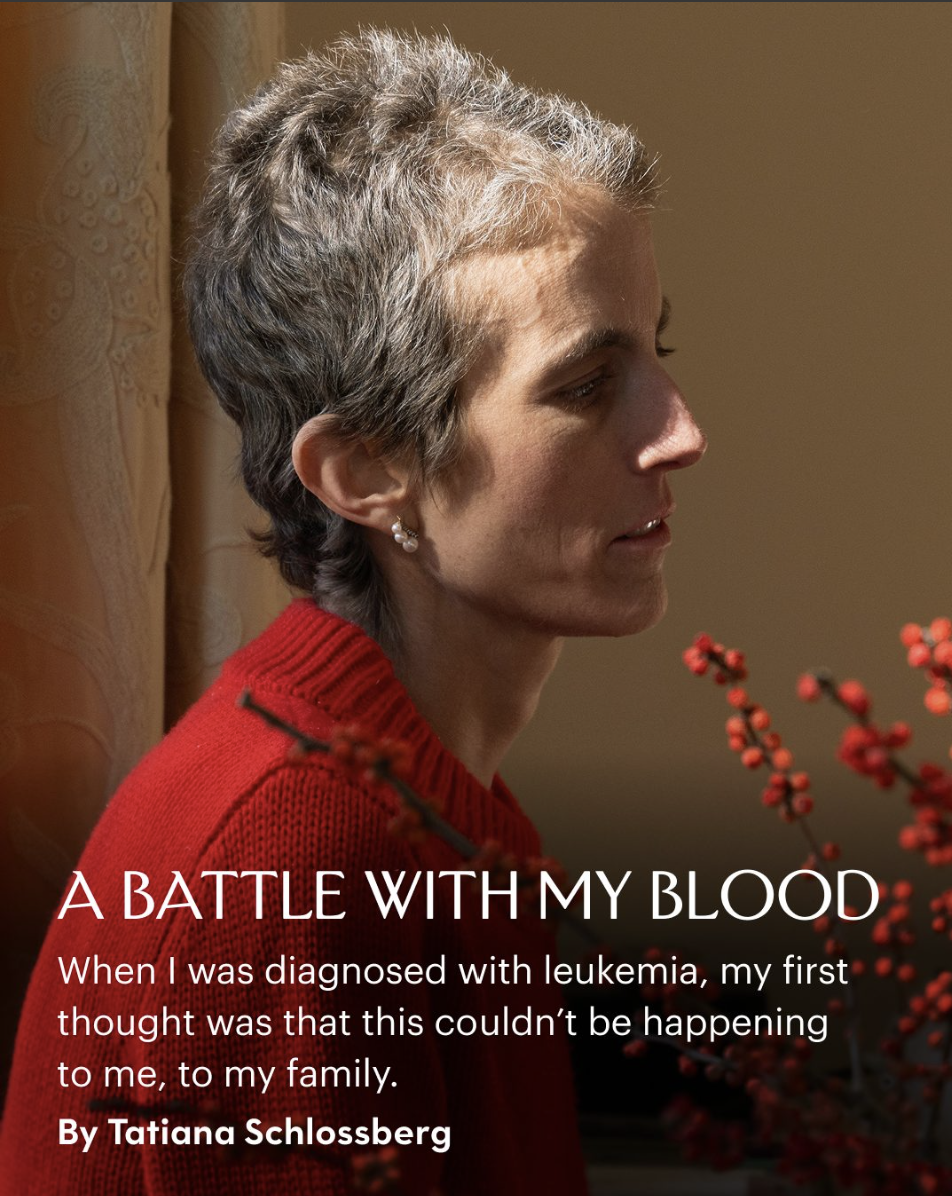
She was described by those who knew her as "a grounded, graceful and genuine soul, who had an expansive voice on the page." And that word — grounded — is the one I keep returning to. Because groundedness, for someone born into the gravity of a name like hers, is not a given. It is a daily negotiation with forces much older than yourself.
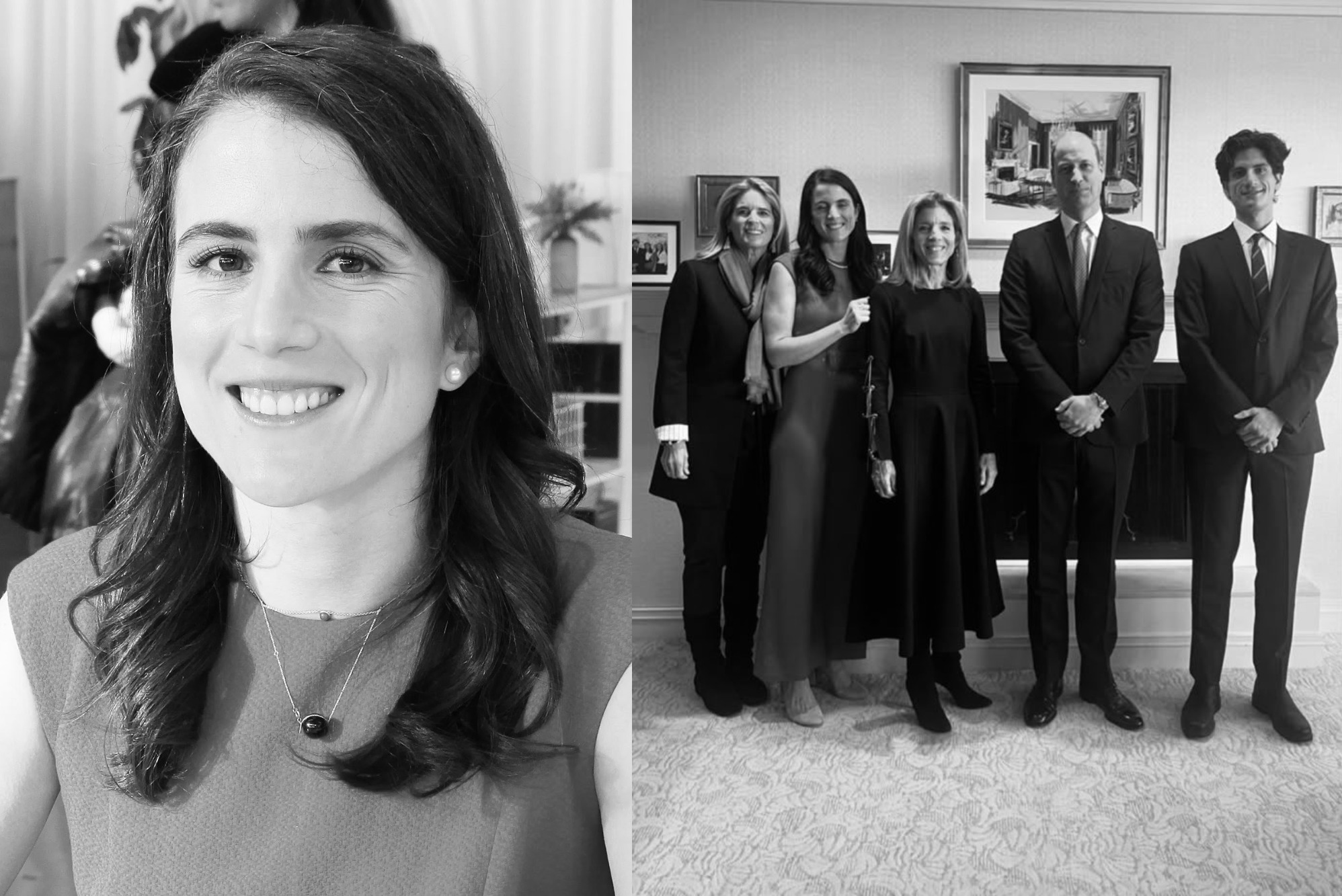
Tatiana Schlossberg was, by birth, a Kennedy. The granddaughter of a martyred president. The daughter of Caroline Kennedy — diplomat, custodian of an impossible legacy. She carried a name that in America is less a family name than a national mythology. And yet she built her career as a respected environmental journalist, reporting for The New York Times, contributing to The Atlantic and The Washington Post, and publishing a book about the hidden environmental costs of modern life. She chose to stand for something beyond the name. To earn her place in the world on terms she selected herself.
I recognize that particular project. Not the Kennedy name, not the American context — but the interior labor of it. The lifelong, quietly exhausting work of trying to become a person rather than simply an heir.
I left South Korea at fourteen. Alone.
Looking back, I told myself and others various versions of why — opportunity, education, the future. I went to Canada first, then New York, and I threw myself into the work of becoming someone 'self-made', someone whose place in any room was earned rather than inherited, someone who did not need to invoke what she came from. But the more honest answer, the one it has taken me nearly four decades to be able to speak plainly, is that I was running. Not from my family exactly, but from the shape my life was already assuming inside it. From a role I could feel being fitted around me before I had any say in the matter.
After all, I am the daugther of two public figures. My father - a former special envoy, vice minister, a diplomat. My mother - a former model and a business woman. And there are my ancestors; my grandparents - a prominent self-made business man, a government official and philathropists, great great grandparents and beyond.
What I understand now, in hindsight, is that I was also trying to prove something. To a family, to a society, to a culture steeped in Confucian values where the hierarchy of who gets to speak, lead, and be taken seriously has been understood for centuries to run along very particular lines — men were simply superior to women; and a woman's competence is something that must be demonstrated repeatedly, in ways a man's simply does not. Not any more, but when I was little in South Korea, that is how the world was like. It was nearly four decades ago now and the modern contemporary Korean society looks much different from then. Back then though, I knew, in some wordless way, that I had a rightful seat at the table. I just kept finding myself in rooms where that right was not assumed on my behalf.
So I left. I crossed an ocean to carve out space that felt like mine. And I worked, and I studied, and I built, and I proved. And somewhere in all of that striving — somewhere across all those years in cities far from home — I became, without fully realizing it, exactly the kind of woman the bloodline had been producing all along.
I should say something about that bloodline. I find I am reluctant to, even now. There is a particular discomfort in this — writing about one's own lineage without sounding like you are announcing something, claiming something, placing yourself at the center of a story far larger than one person should occupy. For most of my life I have coped with this discomfort by doing the opposite: by hiding it. Not telling others about my family, keeping it as a secret. For those who knew about my family, insisting to anyone who would listen that I am nobody. That the ancestors are ancestors, not me. That the past is past.
But the past has a way of insisting.
On my father's side, I am of the Pyeongsan Shin clan. The line traces back to Shin Seung Gyeon — a 9th century general, one of the founding figures of Goryeo, the kingdom from which Korea takes its name. He died in battle, sacrificing himself to protect the king — to secure a dynasty, to make possible everything that would come after. It is the kind of story that becomes myth, and then becomes a name carried forward for a thousand years, through every rupture the peninsula has endured.
What strikes me about this lineage — and what I have only recently allowed myself to sit with — is that it also gave rise, centuries later, to Shin Saimdang. A 16th century artist, calligrapher, and poet of the Joseon era. A woman so singular that her face is on the 50,000 won note today. She did not arrive despite the Confucian society of her time. She arrived inside it, worked within its constraints, and still produced something so enduring that it has outlasted almost every man of her era. From a founding general, across centuries of Confucian patriarchy, somehow — a woman like that. There is a thread there that I am only beginning to trace.
On my mother's side, the line goes further back still. The Gwangsan Kim clan, tracing its roots to the royal family of Silla — a kingdom founded in 57 BC, predating much of what the Western world considers ancient history. Two rivers, then, meeting in one person. A general who helped build a nation. A royal bloodline that preceded it by nearly a thousand years. And somewhere between them, across all those centuries, a painter-poet who refused to be silenced and small.
What makes all of this knowable — what makes Korea unusual in the world in this particular way — is that the records exist. Korea was never colonized by a Western power in the way that so many ancient civilizations were, their archives destroyed, their continuities severed, their people left with only fragments of what came before. The Japanese occupation from 1910 to 1945 was a profound and violent rupture, an attempt to suppress Korean identity at its roots. And yet the depth of what survived is remarkable. Five thousand years of recorded history, relatively unbroken. Genealogical records — jokbo — kept with an almost sacred seriousness across dynasty after dynasty, allowing a Korean family to trace its line back through centuries in documents that still exist, that can still be read. This is not common in the world. It may be singular.
Which means the weight of the bloodline is not metaphorical, in Korea. It is legible. It is archived. It sits in libraries and clan halls, waiting. There is no comfortable amnesia available.
And knowing your ancestors is one thing. Learning to live inside what they left you is another entirely.
For most of my life, I did not know how to hold this. The weight of a lineage like that does not announce itself cleanly. It arrives in smaller, stranger ways — in the way your parents look at you when you make a choice they did not expect. In the rooms you are brought into too young, and the expectations that fill those rooms like furniture you did not choose. In the sense, constant and low-grade, that your life is being narrated by something older and larger than you — that you are not entirely its author.
You exist, in some fundamental way, as a representative. Of the family. Of the line. Of everything that was sacrificed and built so that you could stand where you stand. And yet — and this is the part no one warns you about — simply being born into the lineage does not automatically grant you the position within it. You still have to prove yourself. To the family. To the society that watches the family. To the invisible court of ancestors whose expectations outlast their lives by centuries.
That is an uncomfortable place to inhabit. To carry a name that commands a kind of gravity, and yet to find yourself still auditioning for your own inheritance — still being measured against a standard no living person would dare articulate plainly, but everyone seems to share. To be simultaneously overdetermined and, somehow, still insufficient.
It took me nearly four decades to be able to say that clearly. To acknowledge it, accept it, and begin — I am careful with the word "begin" — to reconcile with it.
And once I had that reckoning with myself, people like Tatiana Schlossberg started to come onto my radar.
Not because our circumstances were identical — they were not. Not because our cultures share more than a passing resemblance — Confucian Korea and American political royalty are worlds apart in their textures and their demands. But because I recognized something in the shape of her life. The choice to build something meaningful within the frame of an enormous name. The decision to care publicly, vocally, about things that mattered — the planet, the truth, the record of what is actually happening to the world we are handing to our children. And the refusal, quiet but absolute, to be merely ornamental to a dynasty.
She wrote, in her final essay, about the environmental reporting she would never get to do — the stories left unwritten, the memories she was trying to preserve for children too young to hold them yet. She wrote about her family staying by her side through treatment, about trying to remain present while knowing the present was running out. She faced it all with a clarity and honesty that I can only describe as hard-won — the kind that comes from spending years building a self that is genuinely yours, so that when everything else is stripped away, there is still something solid remaining.
That is what I recognized in her. Not the famous family. Not the tragedy of dying young. But the specific, private work of becoming a person inside an enormous inheritance — and the particular courage of insisting, despite everything, on being known as yourself.
I am still doing that work. I left at fourteen to escape a weight I didn't know how to carry. I spent decades in other countries proving I could stand without it. And I am only now, at nearly forty, beginning to turn back toward it — not to be crushed by it, but to understand it. To see the general and the queen and the painter-poet and the diplomat and, running through all of them, some thread that also runs through me.
Whether I am worthy of it is not a question I can answer. Whether it is mine regardless — that, I am slowly learning to say yes to.
People like Tatiana Schlossberg have helped me find that yes.
She lived thirty-five years. She made her work matter. She was her own person inside a story that could have swallowed her whole. She left the world better than she found it.
That is not nothing. In any dynasty, in any century, in any language — that is never nothing.
![Obsidian Memo] The Rockefeller System: How One Man's Business Method Became the Architecture of Modern Capitalism](/content/images/size/w720/2026/04/family_1916.jpg)
![Obsidian Memo] The Morgan Standard: How J.P. Morgan Turned Personal Credibility Into Financial Infrastructure](https://images.unsplash.com/photo-1570830511551-cf51ad7e20d5?crop=entropy&cs=tinysrgb&fit=max&fm=jpg&ixid=M3wxMTc3M3wwfDF8c2VhcmNofDYwfHxtb3JnYW58ZW58MHx8fHwxNzc0OTI3NzQ3fDA&ixlib=rb-4.1.0&q=80&w=720)
![Obsidian Memo] The Rothschild Blueprint: How One Family Built a Financial Dynasty That Has Lasted 280 Years](/content/images/size/w720/2026/03/Great_coat_of_arms_of_Rothschild_family.svg.png)
Comments ()