Leadership] The Extreme Ownership Playbook: What Marc Andreessen, Jamie Dimon, and the Navy SEALs/Delta Forces Agree On, ft. Mark Andreessen interview
Marc Andreessen, Jamie Dimon, and Jocko Willink share one leadership philosophy. Here's what extreme ownership really means in finance — and why it works.
![Leadership] The Extreme Ownership Playbook: What Marc Andreessen, Jamie Dimon, and the Navy SEALs/Delta Forces Agree On, ft. Mark Andreessen interview](https://images.unsplash.com/photo-1508530786855-dfea35260b8d?crop=entropy&cs=tinysrgb&fit=max&fm=jpg&ixid=M3wxMTc3M3wwfDF8c2VhcmNofDJ8fG5hdnklMjBzZWFsfGVufDB8fHx8MTc3NTk0MDM1M3ww&ixlib=rb-4.1.0&q=80&w=1200)
Personal Note
Hi All,
Extreme ownership. The military mindset. The philosophy I absorbed through years of studying Delta Force operators and US Navy SEALs — as a genuine self-management and operating system. It's how I've led every team, made every career decision, and weathered every setback. When things go wrong, I don't look for someone to blame. I look in the mirror.
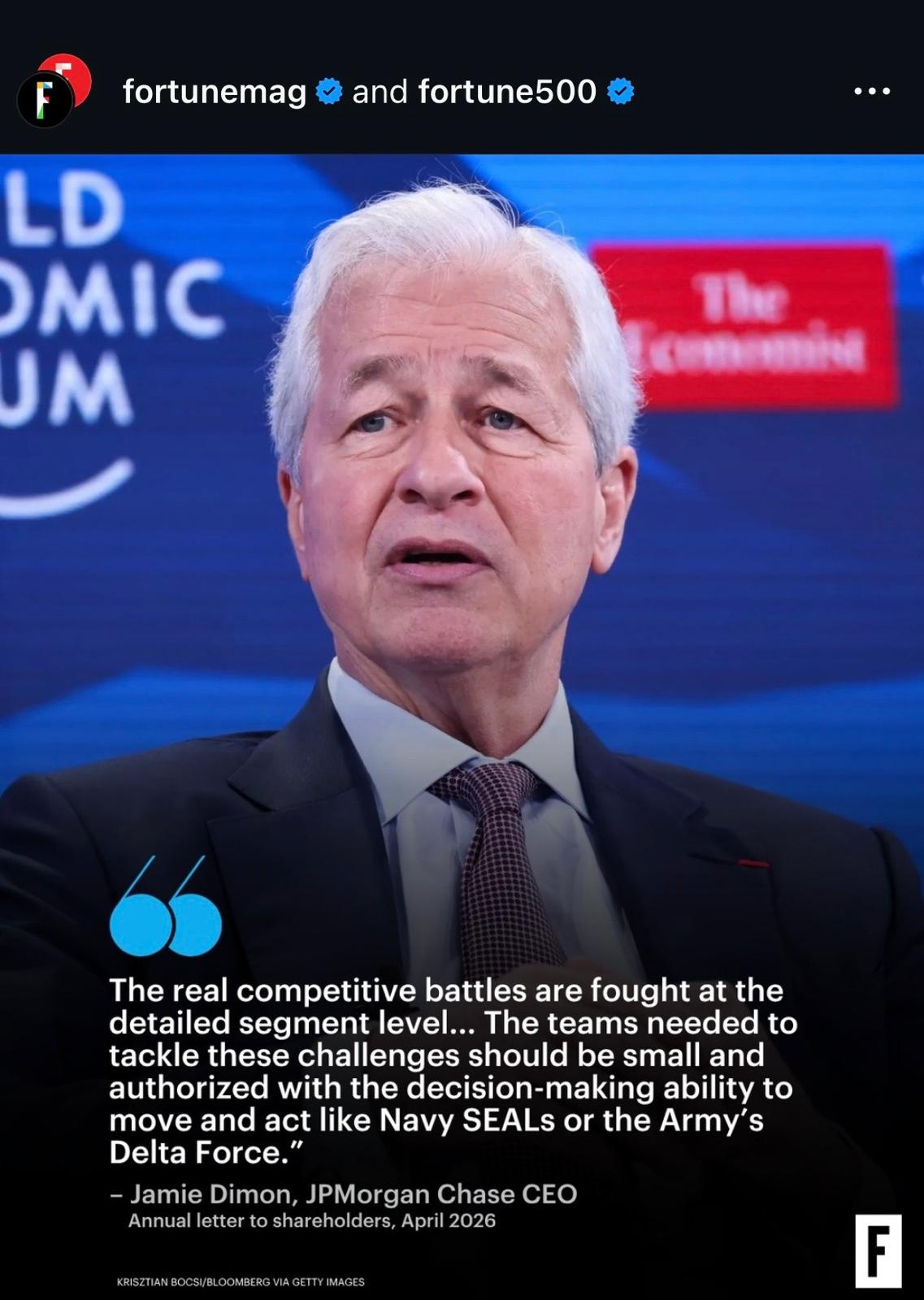
"The real competitive battles are fought at the detailed segment level...The teams needed to tackle these challenges should be small and authorized with the decision-making ability to move and act like Navy SEALs or the Army's Delta Force." - Jamie Dimon
So when Jamie Dimon used that exact phrase recently, my ears perked up. The feeling of: You TOO? For Dimon, it is a management philosophy. And when you see the CEO of the most systemically important bank in the world reaching for the same language as a Navy SEAL, something is being confirmed.
Then I came across this Marc Andreessen interview.
Andreessen — co-founder of Netscape, the man who helped build the internet, and the architect behind a16z, one of the greatest venture capital firms ever assembled with over $90 billion under management — spent over an hour sharing the mental models behind his decisions. And I kept stopping the playback.
Because he was speaking my language too. Below is the summary of the podcast above.
Enjoy!
I. The Operating System: Extreme Ownership
Andreessen cites Jocko Willink directly — former Navy SEAL commander, combat veteran, and author of Extreme Ownership. His distillation is clean:
Life gets a lot simpler when you just assume everything is your own fault.
If an LP didn't invest, that's your fault. If a founder didn't take your term sheet, that's your fault. If a partnership went sideways, that's your fault. Not because it's literally true in every case — but because that framing gives you agency. It gives you something to work on. And critically, it drains away resentment. You can't be bitter about someone else's actions if you've already claimed ownership of the outcome.
Andreessen describes this as shifting from extrinsic to intrinsic motivation. Not competing for a prize, a league table, or a net worth milestone. Competing with your previous self. Asking every morning: am I the best version of what I can be right now?
He says he tries to maintain this psychology every day. He also admits it isn't easy.
I've lived this. The moments where extreme ownership felt most counterintuitive — where it would have been so easy to point outward — were precisely the moments where it mattered most. Because that's when the temptation to lose the thread is highest. And losing the thread, even briefly, is expensive.
II. What Andreessen Taught Me About the Finance Mindset
Beyond the personal philosophy, the interview is a masterclass in how elite investors actually think. Here are the principles that stood out most sharply.
1. Fear the mistake you never made
In venture capital — and I'd argue across most high-upside investing — the mistake of omission dwarfs the mistake of commission.
Losing $10 million on a failed startup is painful. Not investing in Google is catastrophic. The opportunity cost of inaction, of caution, of pattern-matching yourself out of the next great company because of a scar from the last one — that is the real career killer.
Andreessen runs his firm around this idea. He and Ben Horowitz actively work to remind partners when their instincts are being driven by an emotional wound rather than analysis. "You're no longer paying for that sin," he tells them. "Let it go."
This matters enormously for anyone in a capital allocation role. Audit your no's as hard as you audit your yes's.
2. The scalded stove trap
The flip side of learning from mistakes is being haunted by them. Andreessen calls it the "scalded stove" phenomenon — you touch a hot stove, you get burned, you learn. But then the next great opportunity arrives in a similar shape, and your nervous system fires before your judgment does.
He uses AI as the example. From 1945 to roughly 2017, AI was one of the best ways to lose money in venture capital. It went through multiple boom-and-bust cycles. Every serious computer scientist in the 1980s knew the field was dead. Anyone who learned from that history — really internalized it — was structurally set up to miss the most important investment wave of the 21st century.
The question isn't whether to learn from experience. It's whether you can distinguish between wisdom and scar tissue.
3. Overfunding is as dangerous as underfunding
This is the piece of advice Andreessen says he has never — not once — successfully communicated to a founder. Yet he keeps trying.
The Don Valentine principle: more companies die from indigestion than starvation. When you raise too much money at too high a valuation, you set a bar that the next round has to clear. No investor wants to do a down round in someone else's company. The employees hate it, the other investors hate it, the founders end up hating the new investor for being rational. The math is punishing and the politics are worse.
The lesson for finance professionals is broader than venture: discipline at the moment of abundance is harder than discipline at the moment of scarcity — and more consequential.
4. Only do diamonds
Andreessen's firm has a saying: don't do diamonds in the rough. Only do diamonds.
The fantasy of finding the hidden gem — the company nobody else has spotted, the insight the crowd has missed — is mostly ego dressed up as edge. In practice, if a deal has genuine venture-scale merit, there are dozens of brilliant, hungry investors who have already found it. The diamond in the rough usually has a structural problem baked in: wrong location, founder who's burned every relationship, cap table that's already a mess.
There are exceptions. Peter Thiel finds them. But Andreessen's honest advice is: you are probably not Peter Thiel. Neither am I. Back the obvious great thing and execute better, rather than hunting for cleverness.
III. What Makes a Great Founder (And a Great Leader)
This section of the interview is applicable far beyond venture capital. Andreessen's framework for identifying exceptional people is one of the sharpest I've heard.
Three non-negotiables:
- IQ — not intelligence for its own sake, but the kind of intelligence that makes you want to take notes when they're talking. If you're not learning, they're probably not exceptional. This is table stakes.
- Courage — what Ben Horowitz calls it, what the Navy SEALs call "embrace the suck." The absolute determination to confront problems directly, to keep moving when everything is terrible. Founders specifically — and leaders generally — often have nobody to confide in. The team needs confidence, the investors need confidence, the candidates need confidence. You carry the weight alone. You need a mechanism for that.
- Primal drive — not just problem-solving, but a deep need to build something. A history of creating things from a young age, not a credential ladder. Andreessen looks for people where the pattern is: at 14, they built this. At 17, they built that. At 20, they did this. The compulsion predates the opportunity.
He's careful not to reduce this to trauma — Zuckerberg and Gates both grew up in stable, supportive households and were demonstrably driven from adolescence. Some people are just born that way. But whatever the origin, you need to see the evidence of it in the background, not just hear it in the pitch.
IV. The Macro Picture: Why AI Changes Everything
Two views from the interview that should inform how any finance professional is thinking about the next decade.
- AI is the most hyperdemocratic technology ever built: The best AI in the world is an app you download for $20 a month — or for free. The historical pattern with transformative technologies (electricity, the internet, smartphones) is that roughly 99% of the economic value accrues to users as consumer surplus, not to the companies building the infrastructure. Apple and Google together capture perhaps 1% of the total value created by the smartphone. Andreessen believes AI follows the same curve — maybe even more extreme. This doesn't make the foundation model companies bad investments. It means the overall size of the value creation is almost incomprehensibly large.
- Silicon Valley is more concentrated than ever, not less: Despite the optimism of 2020–2021 about remote work and geographic decentralization, AI has reversed the trend sharply. Andreessen estimates that something close to 100% of genuinely valuable AI companies sit within a 20-mile radius of where he's sitting. If you're allocating capital, advising founders, or building in this space, geography has reasserted itself as a real factor.
V. The Books He Recommends
If you take one thing from Andreessen's reading recommendations, make it the first one.
- Extreme Ownership by Jocko Willink — Andreessen's highest personal endorsement. He tried to push it to every founder at a16z. Ben Horowitz pushed back, arguing their founders already carry too much. That tension itself is instructive: extreme ownership is a superpower in the right hands and a burden in the wrong ones. For leaders and investors who need agency over outcomes, it's foundational.
- The Draghi Report (2024) by Mario Draghi — For anyone thinking seriously about Europe's competitiveness or global capital flows, Andreessen says all the answers are already in this report. The problem isn't diagnosis. It's political will. Required reading if Europe is part of your investment thesis or your geography.
- Schumpeter on Creative Destruction — Andreessen references a paper applying Schumpeterian economics to AI, making the case that transformative technologies deliver the overwhelming majority of their value as consumer surplus rather than producer profit. It reframes how to think about both the ceiling on AI company valuations and the floor on AI's broader economic impact.
VI. The Line I Keep Coming Back To
Near the end of the interview, Andreessen is asked what he would want his children to be most proud of. He talks about the idea of consumer surplus — the uncredited impact of things he helped build now running all over the world, improving lives nobody is tallying. And then he says something else:
The number of people I've been able to help, support, or teach — who've gone on to be very successful. As time passes, it's more of that second category.
That's extreme ownership too, in a different register. Not just owning the failures. Owning the responsibility to build people up. Owning the legacy of what you leave behind.
Jamie Dimon talks about it. Jocko Willink built a philosophy around it. Marc Andreessen, it turns out, has been living it for thirty years.
I was surprised to find people who speak my language.
I shouldn't have been.
Sources: Marc Andreessen interview transcript, "The Future of VC: Will a16z Go Public & Why Introspection is Dangerous?" — YouTube. Extreme Ownership, Jocko Willink & Leif Babin. The Draghi Report on European Competitiveness, 2024.
Other recommended podcast
![Leadership] What Rick Rieder Taught Me About Global FI Markets/Macro, ft. Hard Lessons interview: The Market Doesn't Care If You're Right](/content/images/size/w720/2026/04/Rick-Reider.jpg)
![Personal Finance | Obsidian Memo] Closing the Circle: The Family Legacy Conversation We Are Not Having Enough - Family Office Example](https://images.unsplash.com/photo-1564679477577-15a98abb4ee8?crop=entropy&cs=tinysrgb&fit=max&fm=jpg&ixid=M3wxMTc3M3wwfDF8c2VhcmNofDl8fGNpcmNsZXxlbnwwfHx8fDE3NzU5MDI4NjV8MA&ixlib=rb-4.1.0&q=80&w=720)
![Obsidian Essay | Cooking] My Easter Table: A British & New England Tradition](https://images.unsplash.com/photo-1618418359809-0758e4cc4f3f?crop=entropy&cs=tinysrgb&fit=max&fm=jpg&ixid=M3wxMTc3M3wwfDF8c2VhcmNofDN8fGVhc3RlcnxlbnwwfHx8fDE3NzU0Mjk4NzB8MA&ixlib=rb-4.1.0&q=80&w=720)
Comments ()