Obsidian Memo] Leadership Lessons for Founders: Building “You, Inc.” Without Burning It Down
Most founders overestimate what they can do in 2 years and underestimate 10 years. Learn the leadership lessons from APR's $1B journey—and how to run your life like a sustainable company.
![Obsidian Memo] Leadership Lessons for Founders: Building “You, Inc.” Without Burning It Down](https://images.unsplash.com/photo-1474917518260-23f84bd71c75?crop=entropy&cs=tinysrgb&fit=max&fm=jpg&ixid=M3wxMTc3M3wwfDF8c2VhcmNofDQyfHxzYWlsaW5nfGVufDB8fHx8MTc3MDkyODg3Mnww&ixlib=rb-4.1.0&q=80&w=1200)
"We always overestimate the change that will occur in the next two years and underestimate the change that will occur in the next ten." - The Gates's Law
2023 marked my industry anniversary of 10 years. Naturally, I had to take stock: Am I on the right track? Have my "mission" and "vision" been fulfilled?
I had to have an honest talk with myself, because I was operating across jurisdictions and the multicultural enterprise of my life—personally for 20 years and professionally for a decade. That reflection took a lot longer than expected. Three years later, I'm finally having an a-ha moment.
That's when I came across a keynote by Kim Byung-hoon, CEO of APR.
For my entire life, I've been treating myself as a company. EJ Elena Shin Inc. has been an Obsidian Odyssey journey of entrepreneurial experience—using me and myself as the main character and experiment subject, navigating the world.
Not metaphorically. Practically.
Since kindergarten, my internal operating system ran like a company: objectives, time blocks, execution cadence, performance reviews (often harsh), and a constant belief that if I managed the inputs tightly enough, I could bend outcomes.
At my most extreme, I managed my life by the minute. It looked like discipline from the outside—but internally it was closer to control. Over time, I had to learn a more sustainable leadership posture: hold the North Star with precision, but run the day-to-day with flexibility.
That recalibration crystallized when I watched Kim's keynote. He leads APR—the Korean beauty-tech company behind Medicube and the AGE-R devices. APR scaled from scrappy startup to a KOSPI-listed beauty-tech unicorn, hitting approximately $1.05 billion USD (£840 million GBP) in revenue in 2025, with around 80% coming from overseas markets. Their AGE-R device sales surpassed 6 million units globally as of early 2026.
Why does this story matter? Because APR defied gravity—overtaking legacy beauty incumbents in Korea by market cap within roughly a decade, then scaling globally from a non-English-speaking market. Kim's story isn't about luck or timing. It's about a founder's operating system that compounds over a 10-year horizon.
But the point isn't "copy APR." The point is: their cadence reveals a leadership pattern that applies to any entrepreneur or business owner playing a 10-year game.
Kim's keynote wasn't motivational fluff. It was founder-real: built from repeated failure, compounding execution, and a deep understanding of how "luck" actually works in business. Three ideas from his talk have stayed with me—and they're reshaping how I run EJ Elena Shin Inc.
Idea #1: The "$1 Billion Promise" (Resilience on Demand)
Kim describes a simple mental mechanism for surviving adversity:
Imagine a "deal" with God/universe where if you show up relentlessly—daily, for a decade—your outcome is guaranteed.
Not guaranteed success in the way you originally envisioned it. But guaranteed that something transformational happens if you endure and iterate for 10 years.
Whether you frame it as faith, psychology, or self-leadership, it's a powerful tool because it removes emotional negotiation from hard seasons. You stop asking, "Is this worth it?" and start asking, "What does today's work require?"
In practice, it's not about grinding. It's about building an inner certainty that prevents you from quitting when the middle gets ugly.
My version: The contract with myself
I don't need a literal promise from God or the universe. I need a contract with myself:
- I will keep the target intact.
- I will adapt tactics aggressively.
- I will protect the machine (my body, mind, spirit) so I can keep compounding.
This is the difference between refusing to quit and refusing to adapt. Kim is blunt about this: you can't keep doing the same thing for 10 years and call it perseverance if nothing changes. You need endurance and iteration.
Keep the mission. Rotate the method.
When reality says "no," treat it as a design constraint—not a verdict.
Idea #2: Success Is a Moving Horizon (And That's the Point)
Kim lands on something founders rarely say out loud: your definition of success changes as you grow.
At the beginning, success might be survival. Then product-market fit. Then margin discipline. Then global distribution. Then talent density. Then a mission that expands because your capacity expanded.
This isn't mission drift. It's compounding impact.
The success equation he describes—Endure → Grow → Meet "Luck"—isn't a one-time loop. It compounds. Each cycle raises your baseline. Your early "impossible goal" becomes your new operating floor.
The question I'm holding (and offering you):
What is your definition of success for the next 12 months—and what do you suspect it becomes in 10 years?
For example:
12 months: Build a profitable, repeatable system that generates impact and revenue without requiring constant presence in every decision.
10 years: Lead a platform or ecosystem that changes how a specific community approaches their craft—and be the kind of operator others want on their side.
Notice the shift: one is operational. The other is positional and relational.
Both matter. But I had to define the 12-month version first—because without a measurable near-term win, the 10-year vision stays poetic instead of compounding.
One measurable win beats five poetic intentions.
Idea #3: The Success Equation (And Why It Actually Works)
Kim's core equation is simple and brutal (he also noted everyone's succcess equation is different and you need to find your own that works - but this is one way he found):
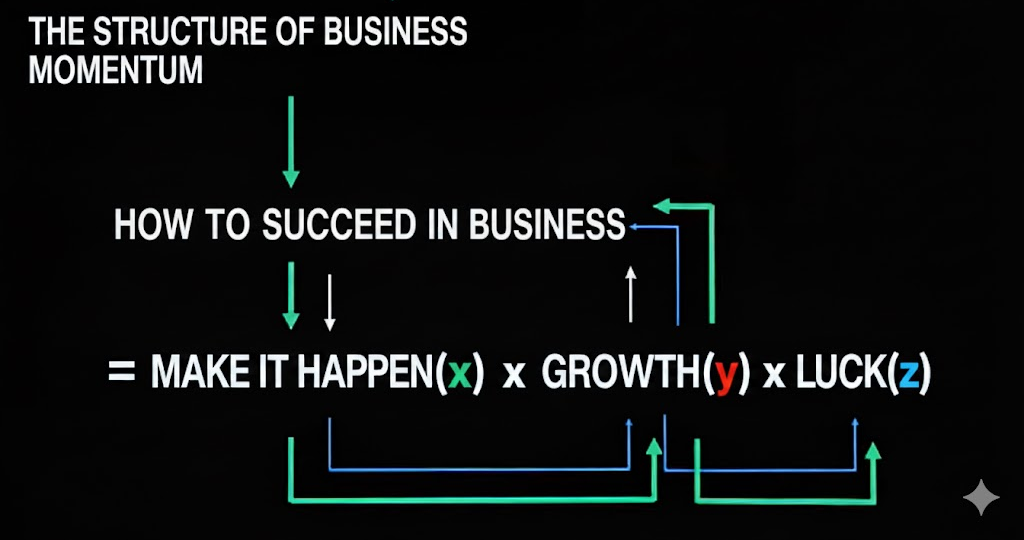
Endure → Grow → Meet "Luck" (shown up in the form of right people)
And then it loops, compounding into bigger goals.
Here's how I translate that into an operator's language:
1) Endure (but don't cling)
Endurance isn't stubbornness. It's refusing to quit while refusing to stay the same.
If the current method won't break through, you pivot the method—not the mission.
Kim calls this "seeing it through": achieve the result by any means necessary—not recklessly, but creatively, relentlessly, and without being bullied by "industry norms."
He also narrows the definition of "success" to raise the probability of impact. Founders overload the goal: "I'll succeed with this person, with this product, in this timeline, changing the world…" That's too many simultaneous dependencies.
Narrow the target to raise the odds. Then iterate.
2) Grow (the founder is the ceiling)
Here's one of the sharpest lines from the keynote: the organization grows to the level of the founder.
Your company can't sustainably outrun your capability. Strategy, judgment, hiring standards, decision quality—these are all reflections of the operator at the center.
Delegation matters—but you still need deep competence in the work that matters most, or you can't judge talent and decisions correctly.
And here's the subtle truth: a founder at the top 0.1% hiring top 0.01% is lethal. A founder at top 40% hiring top 30% isn't automatically strong—because the ceiling is still low.
Raise your baseline. Then recruit altitude.
So "growth" is not motivational. It's operational.
Kim calls business "a domain of belief," because there will be seasons where nobody believes in you—sometimes people actively want you to fail. Data runs the dashboard. Belief runs the engine.
3) "Luck" is usually a person (and it's reciprocal)
In business, "luck" often shows up as a key relationship—a customer, partner, mentor, distributor, investor, or hire.
Kim defines business luck as the right people—people inside and outside the company who change the trajectory. But the relationship is mutual: you meet "luck" when you're also someone's "luck."
The best "luck" arrives when you've become someone (and built something) worth betting on.
Become the kind of operator others want on their side.
My Personal Leadership Lesson: Switching Modes Without Losing the Thread
This is the part I had to learn the hard way as EJ Elena Shin Inc.:
If you're always in war-room mode, you burn out.
If you're always in restoration mode, you drift.
Leadership is the ability to switch modes on purpose.
I know how to run execution war-room mode: intense sprints, narrow focus, zero distractions. It works—until it becomes your identity. Then you start treating rest like betrayal, and your nervous system like a machine.
What I'm learning is: elite performance requires two forms of leadership:
- Operator leadership: ship, decide, execute
- Steward leadership: recover, renew, protect the asset (you)
If you're the founder, you are the primary asset.
My current model is a balanced operating system:
- SWAT / War-room windows: decisive shipping, hard conversations, execution sprints
- Strategy windows: review the scoreboard, refine the thesis, cut noise
- Restoration windows: nervous system, sleep, training, nature, silence—true recovery
- North Star continuity: one long-term aim that doesn't change every time the week gets emotional
The win is not "perfect balance." The win is keeping the target intact while you modulate intensity.
A Practical Weekly Template (for founders who run hot)
If you want something immediately usable:
- 2 SWAT Days: deep work, revenue/product, hard decisions
- 2 Build Days: systems, hiring, process, partnerships
- 1 Visibility Day: customer calls, distribution, content, community
- 1 Recovery Day: body, sleep, relationships, creative refill
- 1 White Space Day: unstructured thinking (often where breakthroughs land)
The goal is not "balance" as softness. It's balance as durability.
There's a well-known idea that people overestimate what they can do in a year and underestimate what they can do in a decade. Kim challenges founders to invest 10 years into changing their world.
Emotional volatility is expensive. Time horizon is power.
The Real Leadership Flex
For years, I thought leadership meant tighter control: more tracking, more precision, more intensity.
Now I think the real flex is this:
Hold the target. Relax the grip. Keep moving.
Endure, iterate, grow—and let the right people find you when you're ready for them.
That's not just founder advice. That's a life strategy.
Try This This Week
1. Write your 10-year contract (one paragraph).
"If I show up consistently for 10 years, I will build ________. My job today is ________."
2. Define success in two timeframes:
- 12 months: measurable, specific
- 10 years: directional, expansive
3. Audit your mode-switching:
- Where are you stuck—over-execution or over-recovery?
- What's one boundary you can set this week to fix it?
Because in the end, the 10-year game doesn't reward intensity.
It rewards consistency, adaptation, and leadership stamina.
And if you're building something that matters—your next decade is going to be bigger than your next year.
What's your definition of success right now?
![Obsidian Memo] The Rothschild Blueprint: How One Family Built a Financial Dynasty That Has Lasted 280 Years](/content/images/size/w720/2026/03/Great_coat_of_arms_of_Rothschild_family.svg.png)
![Obsidian Memo] Leadership Lessons from Alexander the Great: The Visionary](/content/images/size/w720/2026/03/colosseo_alexander_gold.jpg)
![Obsidian Memo] Leadership Ground Truth: What Cuba, Puerto Rico, and Hawai'i Taught Me About Capital and Resilience](/content/images/size/w720/2026/02/Bad-Bunny.jpg)
Comments ()