Book] Leadership | Classics Circle: Meditations - Marcus Aurelius
![Book] Leadership | Classics Circle: Meditations - Marcus Aurelius](/content/images/size/w1200/2026/02/Gemini_Generated_Image_y2o2o5y2o2o5y2o2.png)
A Conversation Across Centuries
Reading Time: 12 minutes
Classical Period: 170-180 CE (Roman Empire)
Core Philosophy: Control what you can control. Accept what you cannot. Lead from inner peace.
Why I'm Reading This (And Why With You)
I'm working through Meditations with Claude as my thinking partner—not to extract productivity hacks from a dead emperor, but because I'm trying to figure out how to stay human while working in high-stakes environments.
This isn't a literature review. It's me sitting with a 2,000-year-old journal, asking: How did someone with impossible responsibility stay sane? How did he reconcile power with ethics? How did he keep going when everything around him was falling apart?
I'm sharing this process publicly because I'm tired of superficial quotes with no evidence anyone actually wrestled with the text. I want to show what it looks like to actually read the classics—with confusion, resistance, breakthroughs, and Claude helping me think through the hard parts.
Here's what drew me to this book right now (it is my favorite classic as well): Marcus Aurelius, writing from a military camp, dealing with plague and betrayal and the exhaustion of empire.
I opened it randomly. Book IV, Passage 3: "If you are distressed by anything external, the pain is not due to the thing itself, but to your estimate of it; and this you have the power to revoke at any moment."
When things don't go as I planned or hoped, I try to remind myself: the situation was what it was. My ego was bruised. But my sense of purpose—trying to do meaningful work—was untouched.
So here we are. Let's think through this together.
Part I: The Text and Its Time
Historical Context
- When & Why Written: Composed during the last decade of Marcus Aurelius's reign (170-180 CE), likely during military campaigns against Germanic tribes and amid the devastating Antonine Plague. These were private notes—never meant for publication—written in Greek (the language of philosophy), not Latin (the language of power).
- Original Audience: Himself. This is the ultimate private journal. A Roman emperor's real-time processing of how to stay sane while the empire crumbled around him.
- What Made It Radical: In an age obsessed with public glory and conquest, Marcus turned inward. His radical act? Insisting that true power comes from mastering yourself, not dominating others.
The Core Argument (As I Understand It)
Full disclosure: I'm reading this as an investor in 2025, not as a classicist. So take my interpretation with a grain of salt. But here's what I think Marcus is saying:
Meditations isn't a systematic philosophy—it's a survival manual for people drowning in responsibility. Marcus faced plague, war, betrayal by generals he trusted, and the weight of an empire. His answer? Build an "inner citadel" that no external force can breach.
The central thesis is deceptively simple: We don't control events. We control our responses.
This isn't passive resignation—it's the most active form of leadership possible. By releasing the illusion of total control, we gain the clarity to act on what truly matters.
Marcus draws on three Stoic principles (I learned these from reading commentary, not from the text itself, which assumes you already know this stuff):
- The Dichotomy of Control: Distinguish between what's "up to us" (our judgments, intentions, actions) and what isn't (market crashes, other people's opinions, whether the deal closes). Pour energy only into the former.
- Amor Fati (Love of Fate): Don't just accept reality—embrace it. The setback you didn't choose? That's the raw material for your next move. This isn't toxic positivity—it's radical resourcefulness.
- Memento Mori (Remember Death): You're going to die. Everyone you love will die. Your achievements will be forgotten. This isn't morbid—it's liberating. If nothing is permanent, what's worth getting hysterical about? And paradoxically, what becomes worth fighting for with total commitment?
For someone allocating capital in 2025—where AI models move billions in milliseconds, where a tweet can tank a sector, where "impact investing" is both mission-critical and politically weaponized—Marcus offers an antidote to reactivity.
He's teaching me the discipline of response-ability.
Part II: Seven Questions I'm Bringing to This Text
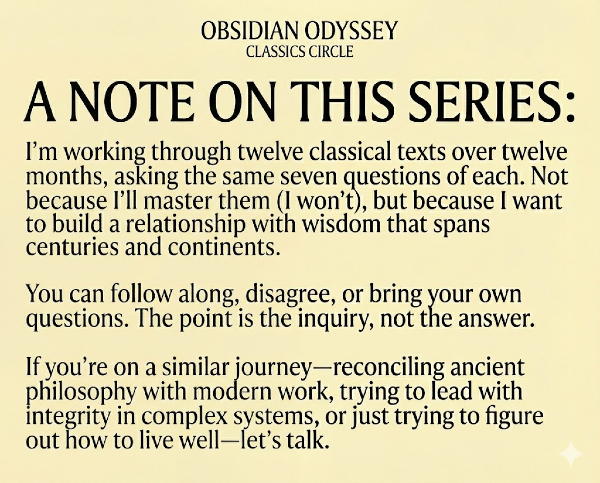
Note: These are the same seven questions I'll ask of every book in this series. Not because they're the "right" questions, but because they're my questions—the ones that keep me up at night. You might have different ones. That's the point.
Q1: What does this text teach about staying grounded when everything is uncertain?
What Marcus Seems to Say:
"You have power over your mind—not outside events. Realize this, and you will find strength." (Book V, 16)
How I'm Translating This to 2025:
In a world of algorithmic complexity and cascading systemic risks, the illusion of predictive control can be problematic. I can't forecast every scenario (no one can). But I can think about building a personal decision architecture rooted in principles rather than panic.
When unexpected events disrupt plans—new regulations, supply chain issues, changes in leadership—the question I'm learning to ask isn't "How could I have prevented this?" but "How do I respond with integrity now that it's happened?"
Before important meetings, I've been asking myself: "What here is actually within my control?" Macro conditions? No. Other people's decisions? No. But my own preparation, my analytical rigor, my willingness to walk away from something that doesn't feel right—those are mine.
What I'm Trying to Practice:
I'm working on distinguishing between productive concern and unproductive worry. When I catch myself spiraling about hypothetical scenarios I can't control, I try to come back to Marcus's question: That's not in your control. What is?
This is hard work. My ego wants to control outcomes. Some days I succeed at this reframing. Some days I'm a mess.
The practice is in noticing the difference and being honest with myself about it.
Q2: How does this work inform thinking about the ethics of capital—where money goes and why?
What Marcus Seems to Say:
"Waste no more time arguing what a good man should be. Be one." (Book X, 16)
How I'm Translating This to 2025:
Marcus would likely be skeptical of ESG scorecards if they're performative. The Stoics believed virtue was action, not rhetoric. "The good" wasn't abstract—it was choosing justice in the messy particulars of daily life.
I'm thinking about how this applies to capital allocation: What does it mean to claim you're investing for social good while your decision chain doesn't reflect it? These are the tensions I'm sitting with:
- How do you navigate deals with compelling financial metrics but questionable labor practices?
- What do you do when stakeholders pressure you to prioritize optics over substance?
- How do you think about accepting that integrity sometimes means accepting lower returns—and being at peace with that trade-off?
Here's the thing Marcus helped me see: I can't be perfect, but I can stop pretending. He ran an empire built on slavery. He wrote about universal brotherhood while benefiting from vast inequality. He was complicit. So am I.
Index exposure likely includes problematic practices. Supply chains are complex and often opaque. Technology platforms create unintended harms.
I can't fix all of it. But I can keep asking myself: "Where am I complicit? What can I examine more carefully today?"
What I'm Trying to Practice:
I keep a personal "decisions ledger." When I'm thinking through an opportunity, I write:
- The Financial Analysis: What are the expected returns? What are the risks?
- The Personal Integrity Check: Does this feel aligned with how I want to practice? How do I know? What am I willing to potentially sacrifice (return-wise) to stay aligned with my values?
This is my personal framework—not a recommendation for others. Everyone has to figure out their own approach.
Recently, I was looking at an opportunity that would've delivered strong returns. The extraction process raised questions about community consent. I passed. It was my choice, based on my values. Someone else might have evaluated it differently.
Marcus's test for me personally: Can I defend this decision to myself later? If not, I don't make it.
Q3: What does it reveal about power—how it's gained, wielded, and when to walk away?
What Marcus Seems to Say:
"The best revenge is to be unlike him who performed the injury." (Book VI, 6)
How I'm Translating This to 2025:
In institutional finance, you're navigating political minefields daily: boards with competing agendas, external managers lobbying for allocations, media scrutinizing every move. The Stoic approach? Don't play their game.
Marcus ruled Rome but wrote constantly about staying uncorrupted by power. He knew flattery was poison, that cruelty compounds, that reactivity makes you predictable (and therefore manipulable).
I'm learning: When someone tries to pressure me ("everyone else is in on this deal"), I respond with patient silence. Let them fill the void. The truth emerges.
When someone leaks to undermine me, I don't retaliate. I outperform. Let the work speak.
When my ego screams for credit, I remember: I'm a steward, not an owner. The capital isn't mine.
What I'm Trying to Practice:
Last year, a counterparty tried to change terms after we'd done extensive work—a classic negotiating tactic. Old me would've fought or folded. Instead, I said, "I understand your concerns. Here's what works for us. If that doesn't work for you, I completely respect that and wish you well."
They came back within days. Not because I was aggressive—because I was genuinely indifferent to the outcome. That's the paradox Marcus teaches: When you stop needing something desperately, you often operate from a position of clarity.
Still learning this. Some days I'm attached to outcomes. Some days I'm free. The practice is noticing the difference.
Q4: How does it address playing the long game when the world rewards short-term thinking?
What Marcus Seems to Say:
"Confine yourself to the present." (Book VII, 29)
How I'm Translating This to 2025:
Wait—this sounds contradictory. How can you think 100 years ahead while staying present?
Here's how I think Marcus resolves it: The long view is built from disciplined todays.
Endowments and sovereign funds are designed to outlast us. But humans are wired for quarterly thinking. We catastrophize short-term volatility. We confuse a bad year with a failed strategy.
Marcus's antidote: Process over outcomes.
If your investment thesis is sound—backed by rigorous analysis, aligned with values, stress-tested for tail risk—then a drawdown isn't a crisis. It's noise.
Your job is to execute today's work with full presence: the diligence call, the asset allocation rebalance, the difficult conversation with an underperforming manager.
The long view isn't about prediction. It's about compounding good decisions, one present moment at a time.
What I'm Trying to Practice:
After a challenging quarter in markets (the kind that tests everyone's resolve), I created what I call a "Resilience Ritual" for myself.
Every Monday morning, I reflect in writing:
- What did I do well last week, regardless of market movements? (Did I honor my personal process? Did I act with integrity?)
- What's one thing I can control today? (Not "fix everything," but maybe "have that difficult conversation I've been avoiding.")
- In 10 years, will this week matter? (Usually: no.)
This personal practice has helped me become more patient with things outside my control while staying urgent about building relationships and capabilities that endure.
Different people need different practices. This is just what I'm experimenting with.
Q5: What wisdom does it offer about identity—especially for those of us who don't fit neatly into one box?
What Marcus Seems to Say:
"Everywhere and at all times, it is in your power to accept reverently your present condition, to behave justly to those about you, and to exert your skill to control your thoughts." (Book VII, 54)
How I'm Translating This to 2025:
Marcus was ethnically Spanish, culturally Roman, philosophically Greek, ruling a multicultural empire from Britain to Egypt. He knew existential displacement—the sense of not quite belonging anywhere.
For those of us who've lived and worked across multiple countries and cultures, this resonates. The temptation is to code-switch constantly: Be the version of yourself you think each room wants to see.
Marcus says: Stop. Your identity is not your background. It's your character in action.
The Stoics called it kosmopolitês: citizen of the cosmos. You're not rootless. You're universally rooted.
What I'm Trying to Practice:
I used to spend enormous energy trying to "fit in" differently depending on the context. It was exhausting.
Then I read Marcus. He didn't solve identity—he dissolved it. "I am a human being. Nothing human is alien to me."
Now I try to ask in any professional setting: "Am I being just? Am I being curious? Am I being useful?" If yes, I belong. The rest is performance.
This mindset has been transformative. It can turn perceived "outsider status" into an advantage—seeing patterns others might miss because you're not locked into one cultural lens.
But honestly? Some days I'm still tired of navigating multiple contexts. The practice is remembering: I'm not straddling worlds. I'm standing in my own.
Q6: How does it challenge our relationship with time and what we leave behind?
What Marcus Seems to Say:
"Think of yourself as dead. You have lived your life. Now take what's left and live it properly." (Book VII, 56)
How I'm Translating This to 2025:
Marcus was one of the most powerful humans who ever lived. His statues dotted the empire. And yet, he wrote constantly about the futility of posthumous fame.
"Soon you'll be ashes or bones. A mere name—or not even a name." (Book V, 33)
This isn't nihilism. It's radical prioritization. If legacy is a mirage, what's left? The work itself. The integrity of the act. The person you help today, who'll never remember your name.
For someone building a portfolio, chasing unicorns, hoping for that Financial Times profile—this is ice water. Will any of this matter in 200 years?
No.
So why do it? Because it's the right thing to do now. Full stop.
What I'm Trying to Practice:
I used to think a lot about legacy and recognition. Then my father got sick. Suddenly: None of that matters to him. What matters? That I call. That I listen to his stories one more time. That I'm present.
Now I try to approach my work the same way. Yes, I want to do work that matters. Yes, I want strong outcomes. But not for external validation.
Someone somewhere today might benefit from capital allocated thoughtfully and patiently. That's enough.
Marcus: "The fruit of this life is good character and acts for the common good." Not plaques. Just this: Did you show up? Did you help?
Q7: What does it teach about the inner life—the part of leadership no one sees?
What Marcus Seems to Say:
"No one can keep you from living as your nature requires. Nothing can happen to you that is not natural." (Book X, 3)
How I'm Translating This to 2025:
Marcus journaled daily. Not for productivity—for survival. The inner life isn't a luxury; it's infrastructure.
You can't allocate billions wisely if your mind is chaos. You can't inspire teams if you're performing composure while internally spiraling.
Leadership is an inside-out game.
What I'm Trying to Practice:
My non-negotiables for maintaining mental clarity:
- Early morning journaling: Stream-of-consciousness writing. I process anxieties on paper, then reframe them ("What here is in my control?")
- Weekly contemplative practice: Time set aside for meditation or reflection. When I step away and return to work, decisions are often clearer.
- Monthly mortality reflection: I write honestly about what would matter to me if time were short. What's missing from my current life? What would I regret? Then I try to address one of those things that month.
This isn't productivity optimization. It's maintenance of my capacity to think clearly under pressure. The leaders I respect most—they all have versions of this. They've learned: You can't sustain high-stakes work on adrenaline alone. You need a practice.
Some days I skip it. Some days I resent it. But when I'm consistent, I'm different. Steadier. More generous. Less reactive.
Marcus modeled it 2,000 years ago. I'm just catching up.
Part III: Five Things I'm Taking From This
(And One Thing I'm Leaving Behind)
Taking #1: Stoicism Is Strategy, Not Passivity
Marcus was a warrior-emperor. He fought. He governed. He made hard calls. But he did it from groundedness, not reactivity.
In investing, this means aggressive execution with emotional equanimity. I don't stop pushing for strong returns—I stop tying my self-worth to whether I hit them.
Question I'm sitting with: Where am I confusing "detachment from outcomes" with "lowering standards"?
Taking #2: Your Reputation Is Not Your Asset
"I have often wondered how it is that every man loves himself more than all the rest of men, but yet sets less value on his own opinion of himself than on the opinion of others." (Book XII, 4)
The Financial Times profile feels great. The awards feel validating. But if my leadership depends on external validation, I'm brittle.
Marcus built his "inner citadel" to be acclaim-proof—and criticism-proof.
Question I'm sitting with: What decision am I avoiding because I'm afraid of what people will think?
Taking #3: No One Leads Alone
Marcus constantly thanks his mentors: "From Apollonius, I learned freedom of will and undeviating steadiness of purpose." (Book I)
In finance, your returns are your team's returns. Am I investing as much in their growth as I am in due diligence? Marcus-style leadership means making gratitude explicit.
Question I'm sitting with: Who on my team needs acknowledgment today—and what's stopping me from giving it?
Taking #4: Amor Fati in Drawdowns
"A blazing fire makes flame and brightness out of everything that is thrown into it." (Book X, 31)
Market volatility isn't a bug—it's revealing weak theses and strengthening conviction. The LPs who fled? They're clarifying who your true partners are.
Marcus would say: This is the job. If you wanted stability, you'd be in index funds.
Question I'm sitting with: What current "crisis" is actually a gift in disguise?
Taking #5: Daily Death Practice Clarifies Life
"You could leave life right now. Let that determine what you do and say and think." (Book II, 11)
If this were my last year in finance, what would I do differently? Marcus used mortality to cut through noise.
For me: Would I chase incremental fee negotiations, or would I double down on the climate equity fund that might take a decade to prove out?
Question I'm sitting with: If I died tomorrow, what would I regret not having started?
Leaving Behind: The Blind Spots of Empire
Let's be clear: Marcus Aurelius ran a slave empire. For all his philosophical brilliance, he never questioned the fundamental injustice of his system. He wrote about the "brotherhood of man" while benefiting from vast inequality.
This is the uncomfortable truth: Every text is compromised. Marcus had blind spots the size of continents—gender, slavery, imperial violence.
So why read him? Not for moral perfection (he didn't achieve it), but for method. His relentless self-interrogation—"Am I being just?"—is what I need, even when his answers were flawed.
I'm also embedded in systems of exploitation: fossil fuels in my index exposure, cobalt supply chains with child labor, tech platforms that harm mental health.
Marcus won't absolve me. But he teaches me to stay awake to the contradictions, to keep asking, "Where am I complicit? What can I change today?"
The Stoic practice isn't achieving purity. It's not stopping trying.
Part IV: How I'm Working With This (The Transparent Part)
My Co-Writing Process with Claude
I read Meditations by hand first, with a pen. I marked passages that stopped me, that confused me, that made me uncomfortable.
Then I brought those passages and my half-formed thoughts to Claude. We went back and forth—I pushed on interpretations, Claude pushed back with historical context, we explored tangents. This essay is the result of that conversation, heavily edited by me to reflect what I actually think.
I'm being transparent about this because I want peers to see: working with AI doesn't mean outsourcing thinking. It means having a tireless thinking partner who won't judge your half-baked ideas.
The classics are hard. The language is dense. The historical context is vast. I need help. That's okay.
What Claude adds: Historical context, connections between ideas, pushback on my lazy readings.
What I add: The questions that matter to me. The lived experience. The willingness to sit with discomfort.
Integration Experiments (What I'm Actually Trying)
In the Next 30 Days:
Before every big decision, I'll open Meditations to a random page and read one passage. Then ask: "Is this choice aligned with who I want to be?"
In the Next Crisis:
When the panic email lands, I'll pause. Read Book IV, Passage 3. Breathe. Then respond—not react.
In My Next Reflection:
Journal prompt: "If I could only work on one thing this quarter—something that would matter whether or not it showed up in returns—what would it be? How do I start today?"
Closing: A Note to My Future Self
Dear Future Me,
You're reading this years from now. Maybe you've taken on significant responsibility. Maybe you've changed direction entirely. Maybe you're doing something that would surprise current-me.
Do you remember the night you read Meditations after something important fell apart? Marcus taught you: control the controllable.
That night, you made a promise to yourself: "I will not work to prove I was smart. I will work in a way I can defend to myself later."
Whatever you're doing now—this commitment to alignment over achievement—started there.
There were probably years of doubt. Times when you wondered if you were principled or just naive. Marcus got you through. "Waste no more time arguing what a good person should be. Be one."
The younger you, scared and hopeful and reaching for ancient wisdom—she's proud. Not because you succeeded in conventional terms, but because you kept asking the hard questions.
Keep going.
With amor fati,
Your Older Self
If You're Reading This Too
Where to Start:
Get the Gregory Hays translation (Modern Library, 2002). It's the most readable. Don't try to read it straight through—it's a journal, not a book. Open to any page. Read one passage. Sit with it.
Read Next:
- Letters from a Stoic by Seneca (more accessible, bite-sized)
- The Obstacle Is the Way by Ryan Holiday (modern Stoicism applied to life)
Pair With:
- Podcast: "The Daily Stoic" by Ryan Holiday
- Film: Gladiator (2000)—not historically accurate, but captures the Roman ethos
- Music: Arvo Pärt's Spiegel im Spiegel—the sonic version of Stoic calm
Questions I'm Still Sitting With
- How do you balance "control what you can control" with the need to shape systems? Sometimes accepting reality feels like complicity. When do you push for change vs. practice acceptance?
- Can Stoicism work for collective action, or is it inherently individualistic? Marcus focused on personal virtue. But what about structural injustice? Can you meditate your way through that?
- Is the "inner citadel" a fortress or a prison? When does emotional resilience become emotional numbness? How do you stay human while building walls against pain?
Published in: Obsidian Odyssey
Series: Classics Circle
Next in Series: Tao Te Ching by Lao Tzu – "The Water Way: Leading Without Force"
"Dwell on the beauty of life. Watch the stars, and see yourself running with them."
— Marcus Aurelius, Meditations, Book VII, 47
IMPORTANT DISCLAIMER
Personal Reflections Only: This essay represents my personal intellectual exploration and learning journey. Nothing herein constitutes investment advice, financial recommendations, or professional guidance of any kind.
No Investment Advice: Any references to investment decisions, portfolio construction, capital allocation, or financial strategies are illustrative examples of personal thought processes only. They do not constitute recommendations to buy, sell, or hold any securities or pursue any investment strategy.
Not Representative of Employer: All views expressed are strictly my own and do not represent the views, opinions, or investment strategies of any current or former employer, client, limited partner, or affiliated entity.
Use of AI Tools: This content was developed with the assistance of AI (Claude by Anthropic) as a thinking and writing partner. All final judgments, interpretations, and opinions remain my own.
Educational Purpose: This series explores classical philosophical texts for personal growth and intellectual development. It is not intended as professional development training or as a framework for institutional decision-making.
No Offer or Solicitation: Nothing in this essay constitutes an offer to sell, or a solicitation to buy, any securities or investment products. No investment decisions should be made based on this content.
Consult Professionals: Readers should consult qualified financial, legal, and tax professionals before making any investment or financial decisions.
![Obsidian Memo] Leadership Ground Truth: What Cuba, Puerto Rico, and Hawai'i Taught Me About Capital and Resilience](/content/images/size/w720/2026/02/Bad-Bunny.jpg)
![Obsidian Memo] Leadership Lessons for Founders: Building “You, Inc.” Without Burning It Down](https://images.unsplash.com/photo-1474917518260-23f84bd71c75?crop=entropy&cs=tinysrgb&fit=max&fm=jpg&ixid=M3wxMTc3M3wwfDF8c2VhcmNofDQyfHxzYWlsaW5nfGVufDB8fHx8MTc3MDkyODg3Mnww&ixlib=rb-4.1.0&q=80&w=720)
![Book] Leadership | Markets Are Made by People: Reading Ken Fisher's 100 Minds That Made the Market](https://images.unsplash.com/photo-1623524713064-257294b0e34b?crop=entropy&cs=tinysrgb&fit=max&fm=jpg&ixid=M3wxMTc3M3wwfDF8c2VhcmNofDN8fHdhbGwlMjBzdHJlZXR8ZW58MHx8fHwxNzcwOTM4MzYzfDA&ixlib=rb-4.1.0&q=80&w=720)
Comments ()