Obsidian Essay] Essay Collection: Recordings from Seoul (Summer 2025) - Love letters to my female ancestors
![Obsidian Essay] Essay Collection: Recordings from Seoul (Summer 2025) - Love letters to my female ancestors](https://storage.ghost.io/c/2a/9e/2a9e2b04-30f6-4166-8010-a3730d2eb719/content/images/size/w1200/2026/05/WhatsApp-Image-2026-05-30-at-13.32.17.jpeg)
*The introduction has been updated in September 2025, and again in May 2026 with the audio version.
Hi everyone — it's here.
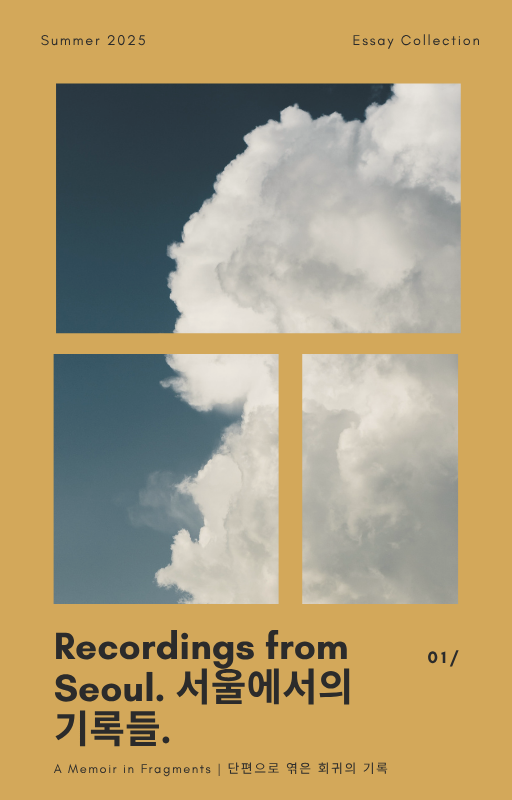
I'm grateful to share Recordings from Seoul — a new collection of essays I wrote during a recent trip to South Korea. What began as reflective notes on memory evolved into something more layered: a written homecoming across time, identity, and legacy.
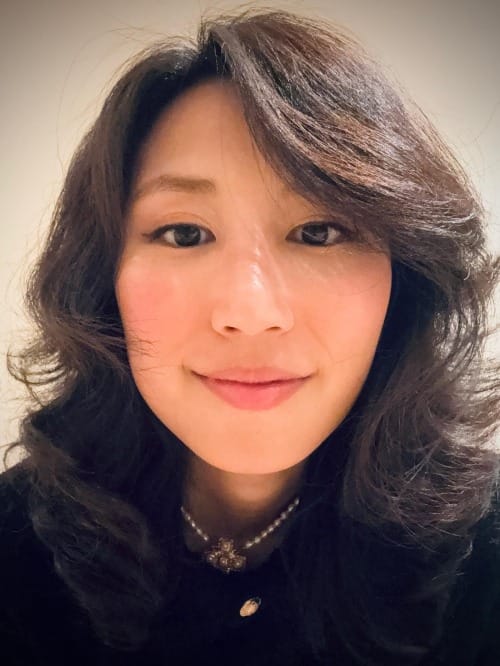
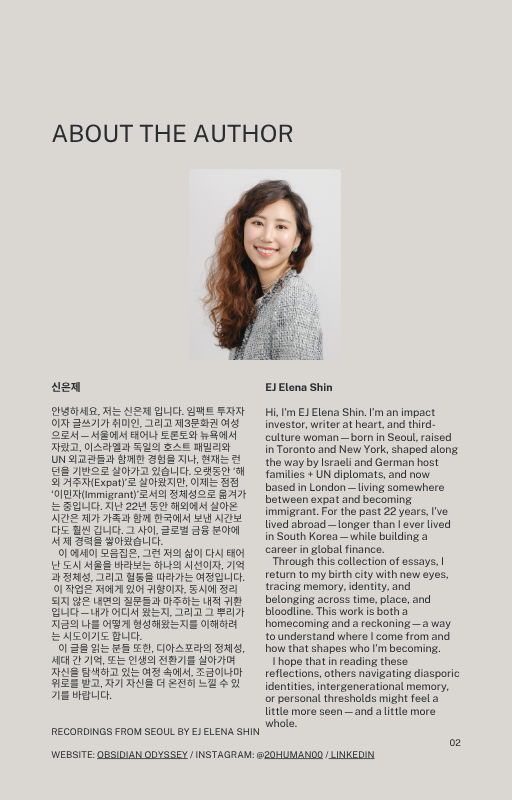
I'm EJ Elena Shin — an impact investor and writer at heart. I was born in Seoul, grew up in Toronto and New York with German and Israeli host families. I now live in London. Over the past two decades, I built a global life and career in finance independently while distancing myself from anything that was Korea related.
I know it sounds bad, but Korea used to represent something more than a country for me. I left Seoul at 14, on my own. I didn't know back then, but it was the beginning of a major declaration of independence. A pivotal and necessary move away from rigid hierarchies and expectations, especially for women. For years, I kept my distance from the Korean language and customs — not out of indifference, but as a way to protect and redefine myself. I didn't fully understand what was going on, but two decades later, I can now see things clearly.
I come from a lineage of women who had to bite their tongues to keep peace in the family. Their lives were never their own — but ones of duty and responsibility for the family name and for the dynasties. If you were to ask them "what do you want for yourself?" they would probably be startled and blush like girls (if you think about it - such cute, pure, and gentle souls!) — they would have a hard time articulating themselves, because no one had asked that question before. Of course, they had their own dreams, wishes and hopes, but from the moment of birth, their life path was predetermined — as a daughter, as a wife, and hopefully as a mother. Somehow, they had to find a way to make peace with that life - life with no choice or freedom. So, until recently, when people asked me about Korea purely out of curiosity, or for travel and K-pop recommendations, I used to get triggered like a sting. I would get shaken to the core. I had been disconnected for 22 years! and yet somehow, I seem to exist as a representative of this Korean culture and heritage to others. For me, Korea was not a place of light entertainment but of sorrow, silence, and bittersweet emotions. The place of confinement.
Part of that pain is historical. Korea has a rich history spanning 5,000 years. However, with the arrival of Confucianism in the late 13th century, women's rights were systematically dismantled - more from the 17th century: inheritance, property, education, and divorce rights were stripped away. Women's existence was reduced to bearing sons to continue the lineage (yes — your husband was allowed to take other wives (although technically, only one wife was allowed legally) if you could not produce one, or worse, you could be cast out of your marital family with nowhere to return, since your own family would not take you back; to be disowned by your husband was a shame on the family name). Their voices were suppressed, and violence was normalized to the point of saying "wives and dogs should be beaten every three days." Powerful men lived their lives as they wished, while their wives remained behind the curtain like shadows. During wars, life went on — fleeting on foot, holding your children and belongings even while fully pregnant. As a wife, as a queen, you were expected to hold the entire family, and even villages or countries, together and carry on. Yet restraint and dignity were always expected. That legacy of self-sacrifice as a virtuous woman ran deep in family, culture, and psyche. Here, I have to note and clarify, though, that things have changed so much that my understanding of Korea from 20–30 years ago no longer applies to today's Korean society. Somehow, I had been stuck in the past, frozen in a capsule, while the entire world moved on without me.
In the midst of this, there was another dimension to my cultural identity. I also came to see that I had been living in a kind of limbo — suspended between worlds. Not entirely white, not entirely Korean. When I was a teenager — just like any other adolescent trying to fit in and understand their place in the world — I tried to assimilate into Western culture, believing that erasing my Korean identity was the only way to stay relevant in Western spaces. Or should I say, to keep my independence intact. But now I realize I don't need to choose. All I ever wanted was the space and freedom to exist as myself, not bound by anyone or anything — a state of not being owned, and of not owing anyone anything. I can be both Korean and American, and also Canadian and British — carrying the fullness of my identity without apology.
During the pandemic, something shifted. I began reconnecting with Korean food, community, and stories. Slowly, shame loosened its hold. On this recent visit, the healing accelerated. I realized I had always carried deeply Korean values within me — the principles of my ancestors, even of Joseon queens — but frozen in time, out of sync with a culture that had evolved in my absence. Writing became a way to bridge that distance.
This collection marks a turning point — a reconciliation.
It is not just a memoir. Writing here became an act of repair: reclaiming voice, body, and belonging on my own terms. For the first time, I no longer find Korea triggering. What once felt like exile now feels like re-integration — with the past, and with the parts of myself I had left behind.
This is a love letter to my ancestors — to my grandmothers and the women who came before them. (Note: My lineage stretches far: my mother's line back to 57 B.C., my father's to the 9th century.) And this is also for my future offspring.
If you've ever wrestled with diaspora, legacy, or the question of what it means to return — I hope this offers a moment of resonance. A little safer and held. A little more seen. I hope my story inspires you to be yourself and find your own voice more confidently, without asking anyone's permission, because you are worth it!
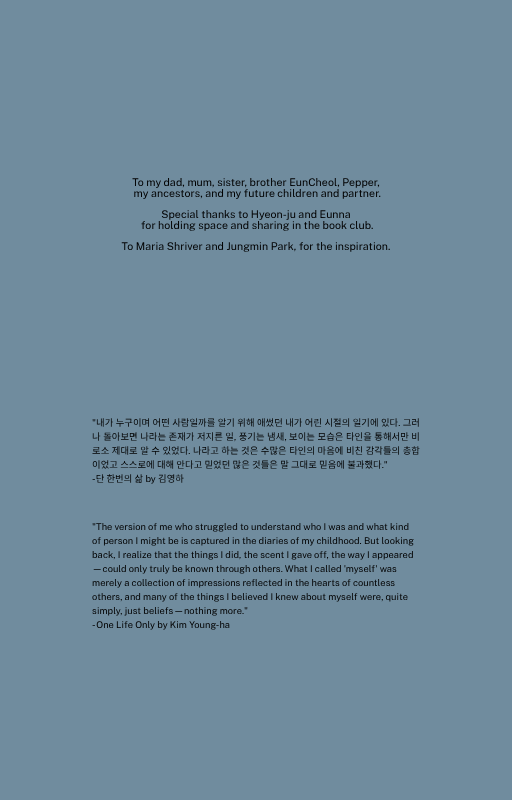
Thanks for holding space for my voice.
And when was the last time you wrote — just because?
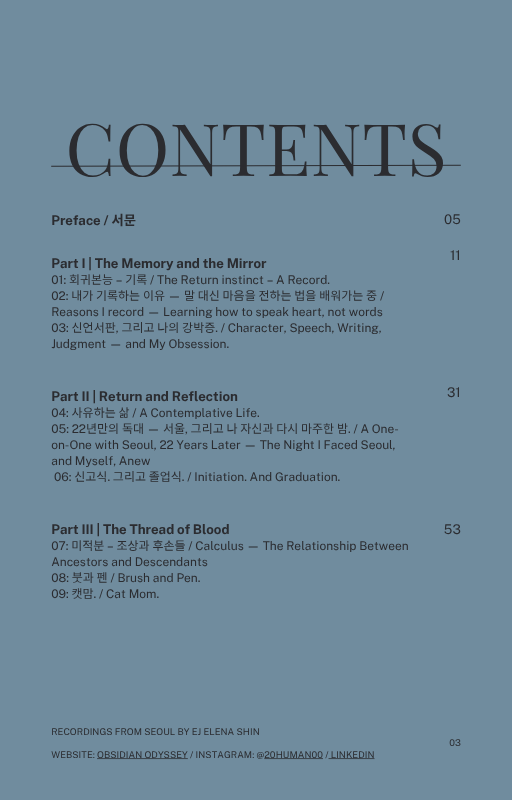
Full collection can be downloaded here (Korean / English):
![Obsidian Odyssey] Light. Brain. Heart.](https://storage.ghost.io/c/2a/9e/2a9e2b04-30f6-4166-8010-a3730d2eb719/content/images/size/w720/2026/10/nobel-prize-2026.webp)
![Obsidian Essay] Consciousness and the Universal Law...Quantum Computer](https://images.unsplash.com/photo-1614926037384-4159c33e196b?crop=entropy&cs=tinysrgb&fit=max&fm=jpg&ixid=M3wxMTc3M3wwfDF8c2VhcmNofDIzfHxnYWxheHl8ZW58MHx8fHwxNzg4NjEyNTA5fDA&ixlib=rb-4.1.0&q=80&w=720)
![Obsidian Essay] The Walk - Even Commanders Debrief ft. Admiral McRaven](https://storage.ghost.io/c/2a/9e/2a9e2b04-30f6-4166-8010-a3730d2eb719/content/images/size/w720/2026/08/wp-GettyImages-172044198_master.jpg)
Comments ()