Book] Leadership | Classics Circle: Things Fall Apart - Chinua Achebe
![Book] Leadership | Classics Circle: Things Fall Apart - Chinua Achebe](/content/images/size/w1200/2026/02/Gemini_Generated_Image_il1yatil1yatil1y.png)
A Conversation Across Centuries
Reading Time: 15 minutes
Classical Period: Published 1958 (set in 1890s colonial Nigeria)
Core Philosophy: When worlds collide, no amount of individual virtue can prevent the center from falling apart.
Why I'm Reading This
After four months of philosophy—Marcus teaching discipline, Lao Tzu teaching flow, Machiavelli teaching power, Confucius teaching relationship—I needed something that would break me open. I needed to confront what happens when all your cultivation, all your strategy, all your relational wisdom isn't enough.
Then I read Achebe's opening: "Okonkwo was well known throughout the nine villages and even beyond. His fame rested on solid personal achievements."
And I watched, over 200 pages, as Okonkwo's entire world—despite all his strength, all his success, all his adherence to his culture's values—collapsed around him. Not because he failed. Not because he was weak. But because a larger force (British colonialism) arrived and made his entire framework of meaning obsolete.
This is the first work of literature in this series—not philosophy but story. And I'm sharing it because after four months of ancient wisdom teaching me how to be better, Achebe reminds me: Sometimes being better isn't enough. Sometimes the world changes so fundamentally that all your cultivation happens in a context that no longer exists.
This hits differently when you've spent your career in financial services during multiple regime changes: the 2008 crisis that made pre-crisis assumptions obsolete, the ESG revolution that's now facing political backlash, the AI transformation that's making entire skillsets irrelevant.
How do you build identity in a world that keeps changing its rules? How do you invest in institutions when the institutional framework itself is unstable? How do you maintain integrity when the very definition of what constitutes integrity is being contested?
Achebe doesn't offer solutions. He offers witness. And sometimes that's more valuable.
Let's sit with the discomfort.
Part I: The Text and Its Time
Historical Context
- When & Why Written: Published 1958, as African nations were gaining independence from colonial powers. Achebe wrote in direct response to colonial literature (like Conrad's Heart of Darkness) that depicted Africans as primitive and without culture.
- Original Audience: Both Western readers (to show them pre-colonial African societies had sophisticated culture, not "darkness") and African readers (to reclaim their own narrative from colonial distortion).
- What Made It Radical: Achebe wrote in English (the colonizer's language) but from an Igbo perspective. He showed traditional Igbo society with complexity—neither romanticized Eden nor primitive chaos. He made the colonizers peripheral characters in an African story, reversing the usual dynamic.
The Core Argument
Things Fall Apart is set in Nigeria in the 1890s, as British colonial forces and Christian missionaries arrive in Igbo villages. The protagonist, Okonkwo, is a wealthy, respected warrior who has built his status through personal achievement in a society that values strength, masculinity, and adherence to tradition.
The novel has three parts:
- Pre-colonial life: Detailed portrait of Igbo society—its rituals, governance, gender roles, justice systems. Complex, functioning civilization.
- Collision: Christian missionaries arrive, some villagers convert, traditional authority begins eroding.
- Collapse: Colonial government consolidates power, traditional structures fall apart, Okonkwo commits suicide.
What Achebe is showing:
When two worlds collide—one with military/technological/economic dominance—the subordinated culture faces impossible choices. Resistance often leads to destruction. Accommodation feels like betrayal. There's no "right" answer.
Key insights:
- Tragedy Isn't Personal Failure: Okonkwo is strong, successful, committed to his values. He does everything his culture asks of him. He still loses—because individual virtue can't overcome systemic power imbalances.
- Culture is Fragile: Igbo society looked stable, enduring. Then British arrive with guns, government, religion, trade. Within a generation, the entire social fabric unravels. Nothing is as permanent as it seems.
- Change Exploits Existing Cracks: Christianity doesn't destroy Igbo society from the outside—it appeals to those already marginalized within it (outcasts, twins deemed cursed, younger sons with no inheritance). The system's own inequities become vectors for its dissolution.
- There's No Neutral Ground: You can't be "both Igbo and Christian" in this moment—the choice itself is impossible because each identity makes exclusive claims. The moderate position (Okonkwo's son Nwoye, who converts) feels like betrayal to both sides.
Applied to finance in 2025: We're living through multiple colliding paradigms—stakeholder vs shareholder capitalism, fossil fuel economy vs. energy transition, national sovereignty vs. global capital flows, human expertise vs. AI capability. Each collision creates impossible choices. Which side are you on? There's no neutral ground. And whatever you choose, you'll lose something essential.
Part II: Seven Questions I'm Bringing to This Text
Note: Same seven questions, but this time to literature instead of philosophy. Different texture entirely.
Q1: What does this text teach about staying grounded when everything is uncertain?
What Achebe Seems to Say: "The world has no end, and what is good among one people is an abomination with others." (Part II)
How I'm Translating This to 2025: Achebe's answer is darker than the previous four texts. Marcus said: Ground yourself in virtue. Lao Tzu said: Flow with change. Machiavelli said: Adapt ruthlessly. Confucius said: Honor relationships and roles.
Achebe says: Sometimes there is no ground. Sometimes the entire framework of meaning collapses.
Okonkwo tries to stay grounded in traditional Igbo values—strength, masculinity, adherence to ritual. But those values become irrelevant when the British arrive. His groundedness becomes rigidity. His strength becomes the instrument of his destruction.
For those of us operating across multiple cultural/professional contexts: What happens when the frameworks you've mastered become obsolete? When the skills you built your career on are suddenly less valued? When the values you were rewarded for are now criticized?
I don't think Achebe offers a solution. But he offers recognition—the experience of having your ground disappear is real, traumatic, and not your fault.
What I'm Trying to Practice:
I'm sitting with the discomfort of having no good answer.
Practically: I'm distinguishing between core identity (which I can control) and context (which I can't). The context keeps shifting—political winds, market regimes, technological disruption. But underneath, who am I regardless of context?
Still figuring this out. Achebe doesn't give me a framework. He gives me company in the confusion.
Q2: How does this work inform thinking about the ethics of capital—where money goes and why?
What Achebe Seems to Say: "The white man is very clever. He came quietly and peaceably with his religion. We were amused at his foolishness and allowed him to stay. Now he has won our brothers, and our clan can no longer act like one. He has put a knife on the things that held us together and we have fallen apart." (Part III)
How I'm Translating This to 2025: This passage haunts me because it describes almost every "impact investment" gone wrong that I've witnessed.
The pattern: External capital enters a community with good intentions ("we want to help"). The capital comes with frameworks, metrics, governance structures from elsewhere. Some community members benefit from engaging with these structures. Others feel betrayed. The community "can no longer act like one." Traditional social fabric weakens. The thing that held the community together—trust, reciprocity, shared meaning—dissolves.
Then the capital exits. The investors can leave. The community lives with the fragmentation.
Achebe is making me ask hard questions:
- When I invest in "frontier markets," am I a missionary? (Arriving with superior frameworks, assuming benefit?)
- When I require ESG compliance, whose standards am I imposing?
- When I advocate for "professionalizing" family businesses, what am I destroying in the name of improvement?
This doesn't mean: "Don't invest." It means: "Be honest about the power dynamics and cultural disruption you're introducing."
What I'm Trying to Practice:
Before deploying capital into contexts culturally distant from my own, I'm asking:
- What social fabric currently holds this community together?
- How might my capital/frameworks disrupt that fabric?
- Am I prepared for the unintended consequences?
- Who benefits from this disruption? Who loses? Am I listening to those who'll lose?
Q3: What does it reveal about power—how it's gained, wielded, and when to walk away?
What Achebe Seems to Say: "That man was one of the greatest men in Umuofia. You drove him to kill himself; and now he will be buried like a dog..." (Part III)
How I'm Translating This to 2025: Okonkwo commits suicide—the ultimate abomination in Igbo culture. The British district commissioner plans to write a book called "The Pacification of the Primitive Tribes of the Lower Niger," in which Okonkwo will merit "perhaps not a whole chapter but a reasonable paragraph."
This is power at its most brutal: The colonizers don't even understand what they've destroyed. They genuinely believe they've "pacified" and "civilized." Okonkwo's entire complex life, his society's sophisticated culture—reduced to a paragraph in someone else's narrative.
For institutional power dynamics: This is what it feels like to be on the losing side of a regime change. Your entire framework of value becomes irrelevant. The victors write the history. Your side gets "a reasonable paragraph."
I've watched this happen in organizations: A new executive arrives, imposes their framework, dismisses institutional knowledge as "how things used to work," and people who built the place become footnotes. The new leader genuinely believes they're improving things. The casualties disappear from the narrative.
What I'm Trying to Practice: When I'm in a position of relative power (which as an investor, I often am), I'm asking:
- Whose knowledge am I dismissing as obsolete?
- What am I calling "modernization" that's actually cultural disruption?
- If I succeed on my terms, who gets reduced to "a reasonable paragraph"?
And crucially: I'm learning to recognize when I'm on the losing side of a paradigm shift. When the ground is actually disappearing. When resistance isn't noble—it's Okonkwo's suicide.
Achebe shows: Sometimes walking away isn't surrender. Sometimes it's survival.
Q4: How does it address playing the long game when the world rewards short-term thinking?
What Achebe Seems to Say: "He has put a knife on the things that held us together and we have fallen apart."
How I'm Translating This to 2025: The long game assumes continuity of context. But what happens when the context itself ruptures?
Igbo elders cultivated wisdom over generations. They built institutions, refined traditions, passed down knowledge. All predicated on continuity—the assumption that their children's world would resemble theirs.
Then the British arrived. All that cultivation suddenly operated in a void. The wisdom was still valuable—but the world it addressed no longer existed.
For long-term capital: This is the terrifying question. We're building institutions meant to last decades or centuries. But what if the fundamental context shifts so dramatically that our institutions become obsolete?
Climate change. AI transformation. Geopolitical realignment. Any of these could render our current frameworks as irrelevant as Igbo governance became under British colonialism.
What I'm Trying to Practice:
I'm trying to distinguish between principles (which might transcend context) and practices (which are always context-dependent).
Example: The principle "steward capital responsibly for future generations" might endure. The practice "invest in this particular asset class with these governance structures" is context-dependent.
I'm holding principles more tightly and practices more loosely. Being prepared for the possibility that the world my work assumes might not be the world my successors inherit.
This is uncomfortable. It means acknowledging: I might be building for a world that won't exist.
Q5: What wisdom does it offer about identity—especially for those of us who don't fit neatly into one box?
What Achebe Seems to Say: Nwoye (Okonkwo's son) converts to Christianity and takes the name Isaac. His father disowns him. Nwoye/Isaac doesn't fully belong in either world—he's too Igbo for the Christians, too Christian for the Igbo.
How I'm Translating This to 2025: This is the most personally painful part of the book for me. Because I am Nwoye.
Not literally—I didn't convert to Christianity and my parents didn't disown me. But I've made choices that feel like betrayal to parts of my identity:
- Left Seoul → "Not Korean enough"
- Adopted Western norms → "Lost my heritage culture partially"
- Advocate for ESG while working in capitalism → "work in progress"
Achebe shows: There's no comfortable position when worlds collide. Okonkwo's resistance leads to suicide. Nwoye's accommodation leads to alienation. The moderate position (trying to hold both) is available to neither.
What I'm learning: You don't resolve this tension. You live in it.
What I'm Trying to Practice: I'm stopping the search for "authentic integrated identity" where everything fits neatly. Instead, I'm accepting: I contain multitudes, some contradictory. That's not failure of integration—that's reality of living across colliding worlds.
Practically: When I feel the pull of "pick a side" (be more Korean, be more Western, be more finance, be more activist), I'm naming it as the colonial logic Achebe describes: "You must be one thing."
No. I can be many things, even contradictory things, even things that don't make sense together. The discomfort is the point. The discomfort is honesty.
Q6: How does it challenge our relationship with time and what we leave behind?
What Achebe Seems to Say: The District Commissioner at the end plans his book: "One could almost write a whole chapter on him. Perhaps not a whole chapter but a reasonable paragraph, at any rate."
How I'm Translating This to 2025: The cruelty of this ending: Okonkwo's entire life, his community's entire civilization, will be reduced to colonial footnote. The victors write history. The losers get paragraphs.
For legacy-building: This is the nightmare scenario. You build something meaningful, something complex, something that matters to your community—and then the paradigm shifts, and future historians don't even have the framework to understand what you built.
Or worse: They understand it within their framework, which fundamentally misrepresents what it was. (Like the Commissioner calling colonization "pacification.")
What I'm Trying to Practice: I'm releasing attachment to legacy as being understood.
You can't control how you'll be remembered. You can't control whether future generations will have the context to appreciate what you built. You certainly can't control whether you'll be reduced to "a reasonable paragraph" in someone else's narrative.
What you can control: Did you act with integrity in your context? Did you tend the relationships and responsibilities you actually had? Did you do your work as well as you could within the frameworks available?
If yes, that has to be enough. Even if history forgets, even if history misunderstands, even if history frames your entire life as a footnote in someone else's progress narrative.
This is bleak. But also weirdly liberating. If legacy is uncertain anyway, you're free to focus on the work itself.
Q7: What does it teach about the inner life—the part of leadership no one sees?
What Achebe Seems to Say: "Okonkwo was deeply grieved. And it was not just a personal grief. He mourned for the clan, which he saw breaking up and falling apart."
How I'm Translating This to 2025: Okonkwo sees clearly what's happening—his entire world is dissolving—but he has no language, no framework, no tools to process that grief. So it comes out as rage. Then violence. Then suicide.
For those of us living through institutional collapse (whether that's a company, an industry, a profession, or a worldview): We need practices for metabolizing systemic grief.
Marcus's stoicism helps with personal loss. Lao Tzu's flow helps with adaptation. But neither addresses: What do you do when the entire context you've mastered is becoming obsolete? When your expertise is increasingly irrelevant? When the values you built your life around are being actively contested?
You need to grieve. Not just personally (I'm sad) but civilizationally (the world I knew is dying).
What I'm Trying to Practice: I'm creating space for what I'm calling "paradigm grief."
Practically: Once a month, I write without agenda about what I'm losing as the world changes:
- Modes of work I loved that AI is making obsolete
- Professional relationships that mattered in old frameworks
- Values that were rewarded before but are now liabilities
- Identities I cultivated that no longer fit
Not to wallow—to acknowledge. To witness. To honor what was valuable even as it becomes irrelevant.
Achebe shows: If you don't process this grief consciously, it comes out sideways. Better to feel it directly.
Part III: Five Things I'm Taking From This
(And One Thing I'm Leaving Behind)
Taking #1: Tragedy Isn't Always Personal Failure
Okonkwo does everything right by his culture's standards—and still loses. Because structural forces overwhelm individual virtue.
This is important for me to remember in professional failures: Sometimes you make all the right calls and still lose. Not because you're incompetent, but because the game changed underneath you.
Taking from this: Be less harsh in self-judgment when things fall apart. Sometimes things just fall apart.
Question I'm sitting with: How do you distinguish "this failed because of forces beyond my control" from "this failed because I screwed up"? Both are true sometimes.
Taking #2: Change Exploits Existing Inequities
Christianity didn't destroy Igbo society from outside—it appealed to those already marginalized within it. The system's own cracks became entry points for dissolution.
For institutional change: If your system has internal inequities, those will be the vectors through which disruption enters. You can't just defend against external threats—you have to address internal weaknesses.
Taking from this: Pay attention to who's marginalized in current frameworks. They're either your future reformers or your future defectors.
Question I'm sitting with: Does fixing internal inequities make systems more resilient, or does it just delay inevitable disruption?
Taking #3: No One Is the Villain of Their Own Story
The British missionaries genuinely believe they're helping. They don't see themselves as destroyers—they see themselves as civilizers, bringers of truth and light.
For self-awareness: When I'm pushing change (new investment frameworks, governance reforms, "best practices"), am I the missionary? Do I see myself as helpful while others experience me as destructive?
Taking from this: Greater humility about my own certainty. When I'm sure I'm right, I'm probably about to break something I don't understand.
Question I'm sitting with: Can you ever know if you're the protagonist or the colonizer in someone else's story?
Taking #4: Culture Is More Fragile Than It Appears
Igbo society seemed stable, enduring, resilient. Then within a generation, it fractured. The things that held it together—shared meaning, ritual, kinship—dissolved faster than anyone expected.
For institutional culture: What looks solid can shatter quickly. Don't take organizational culture for granted. It requires constant tending.
Taking from this: Invest more in culture maintenance. The soft stuff is actually the foundation. When it goes, everything goes.
Question I'm sitting with: Can you strengthen culture against future disruption, or is fragility inherent to all human systems?
Taking #5: Witness Matters Even Without Solutions
Achebe doesn't offer a solution to cultural collision. He offers witness—"This happened. It was complex. People suffered. The suffering wasn't simple."
For my writing: Not everything needs a takeaway. Sometimes the work is just saying: "I see this. It's complicated. I don't have answers."
Taking from this: Permission to sit with complexity without rushing to resolution.
Question I'm sitting with: Is witness without action enough? Or is it just sophisticated passivity?
Leaving Behind: The Romance of Resistance
There's a temptation to read Okonkwo as a tragic hero—noble in his resistance to colonial forces.
But Achebe shows: Okonkwo was also rigid, violent, abusive to his family, unable to adapt. His resistance wasn't pure. His world wasn't Eden. Igbo society had its own cruelties (killing of twins, treatment of outcasts, rigid gender roles).
I'm leaving behind: The notion that everything old is good and everything new is destructive. Both old and new contain both beauty and harm. Change is more morally complex than "good vs. evil."
The work is: Discern what's worth preserving and what's worth releasing, even when that's uncomfortable.
Part IV: How I'm Working With This (The Transparent Part)
My Co-Writing Process with Claude
This was harder than the philosophy texts. Things Fall Apart is literature—layered, ambiguous, working through story not argument. You can't just extract "key insights."
I read the novel slowly, twice. First time for story. Second time taking notes on themes, images, moments that hit me. Then I brought those fragments to Claude and we explored: What is Achebe actually saying? What am I projecting onto it?
We wrestled with: Am I appropriating African literature for my own "global nomad" identity work? Is it okay to see myself in Nwoye when our contexts are so different? How do I engage with colonial literature without repeating colonial reading practices?
This essay is my attempt. I'm sure I've misread things. Literature is slippery that way.
What Claude adds: Historical context on colonialism and Igbo society. Literary analysis of structure and symbolism. Pushback when I'm making the story too much about me.
What I add: The visceral recognition of not belonging anywhere fully. The experience of living between paradigms. The grief of watching worlds I participated in become obsolete.
Integration Experiments
In the Next 30 Days: When I feel the pull to "pick a side" in any binary, I'll pause and ask: "What's the Nwoye position here? The uncomfortable middle that belongs to neither?"
In the Next Crisis: When things fall apart, resist the urge to find personal fault. Ask instead: "What systemic forces am I caught in?"
In My Next Reflection: Journal prompt: "What world am I mourning? What am I grieving that's becoming obsolete? Can I witness that grief without trying to fix it?"
If You're Reading This Too
Where to Start:
Just read it. It's a novel, not a treatise. The Anchor Books edition (1994) is standard. Read it fast first (it's short), then slowly to catch everything you missed.
Read Next:
- No Longer at Ease by Chinua Achebe (sequel, follows Okonkwo's grandson)
- Half of a Yellow Sun by Chimamanda Ngozi Adichie (Nigerian civil war)
- The Famished Road by Ben Okri (magical realism, post-colonial Nigeria)
Pair With:
- Film: Black Panther (2018)—What if colonization had never succeeded?
- Essay: "An Image of Africa" by Chinua Achebe (his critique of Conrad)
- Podcast: Postcolonial podcast series
Questions I'm Still Sitting With
- Can you ever fully understand a world you're not from? Am I reading Achebe from my immigrant experience or am I just appropriating his story?
- Is there ever a "good" way to bring capital/ideas/frameworks from one world into another? Or is all cultural contact some form of violence?
- What's the difference between adaptation (healthy) and accommodation (capitulation)? Where's the line between Nwoye's survival and Nwoye's betrayal?
- If things are falling apart, what's your responsibility? Resist? Adapt? Witness? Build something new? All of the above?
- How do you grieve something (a world, a framework, an identity) while it's still partially alive? How do you mourn and act simultaneously?
Published in: Obsidian Odyssey
Series: Classics Circle (#5 of 12)
Previous in Series: The Analects by Confucius – "The Architecture of Relationship"
Next in Series: One Hundred Years of Solitude by Gabriel García Márquez – "The Burden of Circular Time"
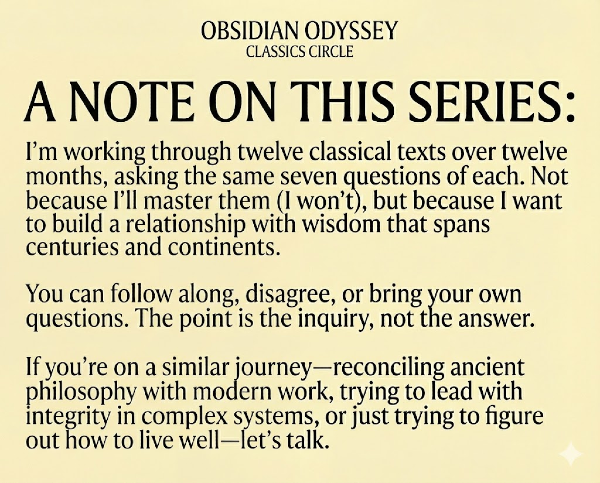
A Note on This Series:
Five months in, and I'm shifting from philosophy to literature. Philosophy gives you frameworks. Literature gives you recognition—"Yes, someone else has felt this too."
After five months of learning how to be better:
- Marcus: Cultivate inner virtue
- Lao Tzu: Flow with change
- Machiavelli: Understand power
- Confucius: Tend relationships
- Achebe: Sometimes none of that is enough. Things fall apart anyway.
This isn't nihilism. It's realism. The work continues, but with more humility about what work can achieve.
Next month: García Márquez on families, history, and the weight of repetition. After Achebe showed me what happens when worlds collide, I need to understand what happens when nothing ever really changes—when the same patterns repeat across generations, and time becomes a circle rather than an arrow.
The reading continues. The not-knowing deepens.
"The world has no end, and what is good among one people is an abomination with others."
— Chinua Achebe, Things Fall Apart
IMPORTANT DISCLAIMER
Personal Reflections Only: This essay represents my personal intellectual exploration and learning journey. Nothing herein constitutes investment advice, financial recommendations, or professional guidance of any kind.
No Investment Advice: Any references to investment decisions, portfolio construction, capital allocation, or financial strategies are illustrative examples of personal thought processes only. They do not constitute recommendations to buy, sell, or hold any securities or pursue any investment strategy.
Not Representative of Employer: All views expressed are strictly my own and do not represent the views, opinions, or investment strategies of any current or former employer, client, limited partner, or affiliated entity.
Use of AI Tools: This content was developed with the assistance of AI (Claude by Anthropic) as a thinking and writing partner. All final judgments, interpretations, and opinions remain my own.
Educational Purpose: This series explores classical philosophical texts for personal growth and intellectual development. It is not intended as professional development training or as a framework for institutional decision-making.
No Offer or Solicitation: Nothing in this essay constitutes an offer to sell, or a solicitation to buy, any securities or investment products. No investment decisions should be made based on this content.
Consult Professionals: Readers should consult qualified financial, legal, and tax professionals before making any investment or financial decisions.
![Obsidian Memo] Leadership Ground Truth: What Cuba, Puerto Rico, and Hawai'i Taught Me About Capital and Resilience](/content/images/size/w720/2026/02/Bad-Bunny.jpg)
![Obsidian Memo] Leadership Lessons for Founders: Building “You, Inc.” Without Burning It Down](https://images.unsplash.com/photo-1474917518260-23f84bd71c75?crop=entropy&cs=tinysrgb&fit=max&fm=jpg&ixid=M3wxMTc3M3wwfDF8c2VhcmNofDQyfHxzYWlsaW5nfGVufDB8fHx8MTc3MDkyODg3Mnww&ixlib=rb-4.1.0&q=80&w=720)
![Book] Leadership | Markets Are Made by People: Reading Ken Fisher's 100 Minds That Made the Market](https://images.unsplash.com/photo-1623524713064-257294b0e34b?crop=entropy&cs=tinysrgb&fit=max&fm=jpg&ixid=M3wxMTc3M3wwfDF8c2VhcmNofDN8fHdhbGwlMjBzdHJlZXR8ZW58MHx8fHwxNzcwOTM4MzYzfDA&ixlib=rb-4.1.0&q=80&w=720)
Comments ()