Book] Leadership | Classics Circle: The Republic - Plato
![Book] Leadership | Classics Circle: The Republic - Plato](/content/images/size/w1200/2026/02/test.jpg)
A Conversation Across Centuries
Reading Time: 16 minutes
Classical Period: ~380 BCE (Ancient Greece, Socratic dialogue)
Core Philosophy: Justice is harmony. The philosopher must return to the cave. The examined life is the only life worth living.
Why I'm Reading This
Final month. Twelve months of reading classics, and I'm returning to the beginning—to the text that started Western philosophy, to Socrates asking the fundamental questions: What is justice? How should we live? What is the good society?
I'm reading The Republic in the same chair where I read Marcus Aurelius twelve months ago. The year has changed me. I've traveled through:
- Stoic discipline (Marcus)
- Taoist flow (Lao Tzu)
- Machiavellian realism (Machiavelli)
- Confucian relationships (Confucius)
- Collapsing worlds (Achebe)
- Cyclical patterns (García Márquez)
- Meaning-making (Frankl)
- Strategic wisdom (Sun Tzu)
- Epic journeys (Homer)
- Divine beauty (Tagore)
- Temporal urgency (Seneca)
Now Plato asks: What will you do with what you've learned? Will you stay in contemplation, or will you return to engage with the world?
The allegory of the cave—Book VII of The Republic—describes prisoners chained in a cave, watching shadows on the wall, believing shadows are reality. One prisoner escapes, sees the sun, understands true reality. Then comes the crucial moment: He must return to the cave to help free others.
The freed prisoner doesn't want to return. It's uncomfortable, dangerous. The other prisoners will mock him, might kill him (they killed Socrates). But Plato insists: If you've seen truth, beauty, justice—you have obligation to return and help others see it.
This hits differently after a year of reading. I've been "outside the cave"—engaged with wisdom across centuries, questioning assumptions, examining life. It's been transformative. And now?
I must return. To finance, to institutions, to daily work. Not to forget what I've learned, but to apply it. Not to retreat into contemplation, but to engage more effectively because of contemplation.
I'm sharing this because this is the final integration. After twelve months of learning, Plato asks: What's your obligation? Having examined life, how will you live it? Having seen beyond the cave, how will you help others see?
This isn't abstract philosophy. It's the most practical question: Now what?
Let's explore what it means to return to the cave transformed.
Part I: The Text and Its Time
Historical Context
- When & Why Written: Written ~380 BCE by Plato, recording (or creating) dialogues with his teacher Socrates. Athens was recovering from loss in Peloponnesian War and the trauma of Socrates's execution (399 BCE). Plato was asking: How do we create a just society after everything went wrong?
- Original Audience: Plato's Academy in Athens—students learning philosophy, politics, mathematics. The text was both philosophical treatise and political manifesto.
- What Made It Radical: Plato argued that philosophers should rule (or rulers should philosophize). He challenged democracy as mob rule. He designed entire ideal society from first principles. He insisted examined life is the only life worth living.
The Core Argument
The Republic is long (10 books), complex, and covers everything from justice to education to poetry to metaphysics. It's not one argument but interwoven investigations.
I'm reading Allan Bloom's translation (Basic Books, 1968), which scholars praise for literal accuracy. I've also consulted G.M.A. Grube's translation (Hackett) for comparison.
Full disclosure: I'm reading this after eleven months of other texts. I'm not approaching it fresh. Everything I've read is in conversation with Plato—because he started the conversation.
What Plato is arguing (as I understand it):
Justice is harmony—in the soul (reason, spirit, appetite in right relationship) and in society (guardians, auxiliaries, producers in right relationship). The just person and just city mirror each other. The philosopher who sees truth must reluctantly return to govern, because only those who don't seek power should have it.
Key concepts:
- Justice as Harmony: In the soul, justice means reason ruling spirit and appetite. In the city, justice means each class doing what it's suited for without interfering with others.
- The Tripartite Soul: Humans have three parts—reason (rational calculation), spirit (emotion, honor), appetite (desire, pleasure). Justice means these three in proper hierarchy.
- The Philosopher-King: Only philosophers should rule—not because they want to (they don't), but because they've seen the Good and can guide society toward it. Rule by those who'd rather contemplate.
- The Allegory of the Cave: Humans live in cave of illusion, taking shadows for reality. Philosophy is ascending from cave to see the sun (truth, beauty, goodness). But the philosopher must return to help others ascend.
- Education as Turning: Education isn't putting knowledge in—it's turning the soul toward truth. It's reorienting from shadows to sun.
- The Form of the Good: The highest reality—source of truth, beauty, justice. Everything else participates in the Good. The philosopher ascends to glimpse it, then must apply it in cave.
Applied to professional life in 2025: Plato would ask:
- Are you living in the cave (unexamined assumptions, conventional wisdom, shadows of reality)?
- Have you attempted to ascend (philosophical examination, questioning foundations, seeking truth)?
- If you've glimpsed anything beyond the cave—will you return to help others see, or will you stay comfortable in contemplation?
For institutional leadership: Plato insists the best leaders are reluctant. They lead because they must, not because they want to. Those who seek power shouldn't have it. Those who'd rather study should (reluctantly) govern.
This is radical challenge to ambition-driven culture.
Part II: Seven Questions I'm Bringing to This Text
Note: Final month. These questions now integrate twelve months of inquiry.
Q1: What does this text teach about staying grounded when everything is uncertain?
What Plato Seems to Say:
"The unexamined life is not worth living." (From Apology, but foundational to Republic)
How I'm Translating This to 2025:
Plato's answer to uncertainty: Examine your life. Question your assumptions. Seek truth beyond shadows. That examination is the ground.
After twelve months, I understand this differently than January. The examination isn't one-time event. It's continuous practice—daily asking:
- What am I assuming?
- What might I be wrong about?
- What shadows am I mistaking for reality?
- What's actually true versus what's comfortable to believe?
For navigating uncertainty: The ground isn't having answers. The ground is commitment to questioning, to examining, to seeking truth even when uncomfortable.
What I'm Trying to Practice:
Daily examination practice (synthesizing all twelve months):
- Marcus: What did I do well/poorly today? (virtue examination)
- Lao Tzu: Where did I force instead of flow? (strategic examination)
- Machiavelli: Where did idealism blind me to reality? (power examination)
- Confucius: How did I honor/dishonor relationships? (relational examination)
- Achebe: What's collapsing that I'm not seeing? (structural examination)
- García Márquez: What patterns am I repeating unconsciously? (cyclical examination)
- Frankl: What meaning did I create today? (existential examination)
- Sun Tzu: Where did I engage unwisely? (strategic examination)
- Homer: Am I moving toward home (integrity)? (directional examination)
- Tagore: What beauty did I witness? (aesthetic examination)
- Seneca: Did I live today or just exist? (temporal examination)
- Plato: What assumptions did I question today? (epistemological examination)
This daily examination—pulling from all twelve texts—is the practice of staying grounded.
Q2: How does this work inform thinking about the ethics of capital—where money goes and why?
What Plato Seems to Say: "Wealth is the parent of luxury and indolence, and poverty of meanness and viciousness, and both of discontent." (Book IV)
How I'm Translating This to 2025: Plato distrusts wealth—both excess and poverty breed injustice. The ideal city would have moderate means for all, eliminating wealth-driven corruption and poverty-driven desperation.
This is radical critique of capitalism: Extreme wealth inequality creates injustice inevitably. Not as moral failing of individuals, but as structural reality. Massive wealth corrupts those who have it (luxury, indolence) and embitters those who don't (meanness, viciousness).
For capital allocation: Plato would ask uncomfortable questions:
- Does your work increase or decrease wealth inequality?
- Are you channeling capital toward justice (harmony, right relationships) or toward further concentration?
- Can you allocate capital justly within unjust system, or does that require self-deception?
I don't have clean answers. But Plato forces the question.
What I'm Trying to Practice:
Before investments, I now ask: "Does this move toward or away from Plato's vision of justice?"
Justice = harmony = right relationships = each person/entity doing what they're suited for.
Concrete application:
- Investments that create good jobs (people doing meaningful work) = toward justice
- Investments that extract value while destabilizing communities = away from justice
- Investments that concentrate wealth in hands of already-wealthy = away from justice
- Investments that build wealth for workers/communities = toward justice
This doesn't mean only investing in non-profits. It means asking: Does this particular deployment of capital move toward or away from harmony, right relationships, people flourishing?
Q3: What does it reveal about power—how it's gained, wielded, and when to walk away?
What Plato Seems to Say: "Unless philosophers become kings... or those now called kings genuinely and adequately philosophize... there can be no rest from evils for cities, nor I think for human kind." (Book V)
How I'm Translating This to 2025: Plato's power principle: Only those who don't want power should have it. Philosopher-kings lead reluctantly, preferring contemplation but governing because they must.
This completely inverts modern leadership culture:
- We reward ambition, hunger for power
- We celebrate those who seek leadership
- We're suspicious of reluctant leaders ("lack of drive")
Plato says: You have it backwards. Ambitious leaders seek power for themselves. Reluctant philosopher-leaders serve because they've seen the Good and feel obligated.
For institutional governance: The best leaders are those who:
- Would rather be doing something else (studying, creating, contemplating)
- Lead because someone must and they're capable
- Don't identify with the role (they're temporary stewards)
- Will gladly step aside when appropriate
What I'm Trying to Practice:
I'm embracing "reluctant leadership"—taking responsibility where needed but not seeking power for its own sake.
Concrete shifts:
- Stepped back from positions that were about status rather than service
- Accepted roles I didn't seek but where I could genuinely contribute
- Leading by making myself dispensable (training successors, distributing authority)
- Remembering: I'm temporary steward, not permanent ruler
Plato: Those who seek power most shouldn't have it. Those who'd rather study should (reluctantly) govern.
Q4: How does it address playing the long game when the world rewards short-term thinking?
What Plato Seems to Say: "The true lover of learning must from youth on strive for all truth... Such a man will love truth and hate falsehood, and will be interested in bodily pleasures only for the sake of health." (Book VI)
How I'm Translating This to 2025: Plato's temporal frame: Lifelong learning and truth-seeking. Education never ends. The philosopher is always student.
For long-term thinking: This year of reading classics is Platonic practice—continuous education, examination, truth-seeking. But Plato says: Don't stop. This is lifelong work.
The "long game" isn't building institutions that last (though maybe). It's becoming the kind of person who can see truth, who can distinguish reality from shadows, who can help others ascend.
That becoming takes lifetime. You don't "finish" education. You don't "complete" philosophical examination. You practice until you die.
What I'm Trying to Practice:
I'm committing to continuous philosophical education—this series was beginning, not completion.
Post-series commitments:
- Annual 12-month reading program (new set of classics each year)
- Weekly philosophical discussion (with peers doing similar work)
- Daily examination practice (pulling from year's wisdom)
- Teaching/mentoring (helping others engage with classics)
Plato: Education is turning the soul toward truth. That turning is never finished. You practice daily until death.
Seneca's urgency (you'll die soon) plus Plato's patience (becoming takes lifetime) equals: Practice daily, knowing you won't finish, doing it anyway.
Q5: What wisdom does it offer about identity—especially for those of us who don't fit neatly into one box?
What Plato Seems to Say: The soul has three parts (reason, spirit, appetite). Justice means proper harmony—not eliminating any part, but right relationship among parts.
How I'm Translating This to 2025: Plato's identity framework: You're not one thing. You're three-part soul seeking harmony.
Your rational part wants truth, knowledge, wisdom. Your spirited part wants honor, courage, recognition. Your appetitive part wants pleasure, comfort, satisfaction.
All three are legitimate. All three are you. Justice (in the soul) means proper ordering—reason guiding spirit and appetite, not tyrannizing them.
For identity integration: Stop trying to be purely rational (ignoring emotion and desire). Stop being purely appetitive (ignoring reason and honor). Find the harmony.
Different texts emphasized different parts:
- Marcus/Seneca/Plato: Reason should rule
- Confucius: Spirit (honor, propriety) matters
- Lao Tzu/Tagore: Don't suppress appetite (flow, beauty, pleasure)
Plato's synthesis: All three, properly ordered. Reason discerns what's good. Spirit provides courage to pursue it. Appetite provides energy and pleasure in achievement.
What I'm Trying to Practice:
Monthly "soul audit"—assessing harmony among three parts:
Reason: Am I thinking clearly? Questioning assumptions? Seeking truth? (Reading, reflection, examination)
Spirit: Am I acting honorably? Courageously? Am I engaged with meaningful challenges? (Taking stands, difficult decisions, defending values)
Appetite: Am I experiencing beauty, pleasure, comfort? Am I tending my body? (Exercise, good food, aesthetic experience, rest)
When one dominates others, rebalance:
- Too much reason → reconnect with spirit (courage) and appetite (pleasure)
- Too much spirit → return to reason (examination) and appetite (rest)
- Too much appetite → engage reason (discipline) and spirit (challenge)
Justice in the soul = dynamic harmony, not static resolution.
Q6: How does it challenge our relationship with time and what we leave behind?
What Plato Seems to Say: The Forms are eternal. The Good is unchanging. What participates in the eternal matters; what's merely temporal doesn't.
How I'm Translating This to 2025: Plato's temporal philosophy: Direct your effort toward what's eternal (truth, beauty, justice, love) rather than what's temporary (wealth, fame, power).
For legacy: The institutions I'm building will eventually fail. The money I'm allocating will eventually be spent or lost. The achievements I'm pursuing will be forgotten.
But if my work participates in truth, beauty, justice—if it embodies these eternal Forms even temporarily—then it matters regardless of duration.
Plato would ask not "Will this last?" but "Does this participate in the Good? Does it point toward truth, beauty, justice?"
What I'm Trying to Practice:
Evaluating work by whether it participates in eternal Forms:
Truth: Does this work seek/embody truth? Or is it built on convenient fictions?
Beauty: Does this work create/recognize beauty? Or is it merely functional?
Justice: Does this work move toward harmony and right relationships? Or does it create discord?
Love: Does this work express genuine care for others' flourishing? Or is it purely transactional?
Q7: What does it teach about the inner life—the part of leadership no one sees?
What Plato Seems to Say: The philosopher reluctantly returns to the cave. Having seen the sun, returning to shadows is painful, disorienting, dangerous. But it's obligatory.
How I'm Translating This to 2025: This is the crucial teaching for inner life: Having examined life, having glimpsed truth beyond the cave, you must return to engage with those still in shadows. Not to feel superior, but to help them ascend.
For me after twelve months: I've been "outside the cave"—reading classics, examining assumptions, questioning foundations. It's been transformative, enriching, beautiful.
Now comes the hard part: Return to daily work. To finance. To institutions that don't reward philosophical examination. To colleagues who think this year was indulgence. To pressures that make examination difficult.
The temptation is staying "outside"—continuing to read, reflect, examine without engaging messy reality of work. That's comfortable.
Plato says: No. You must return. Having seen beyond shadows, you're obligated to help others see. That's the work.
What I'm Trying to Practice:
I'm accepting "return to cave" as my obligation.
Concrete commitments:
Teaching: Running workshops helping colleagues engage with philosophical questions in professional context. Bringing wisdom from this year into daily work.
Writing: Continuing to publish these essays. Making the learning accessible to others on similar journeys.
Mentoring: Working with junior investors, helping them examine assumptions, question foundations, seek truth beyond conventional wisdom.
Institutional change: Using positions I hold to ask better questions, create space for examination, challenge shadows mistaken for reality.
This is uncomfortable. People will mock ("why is she talking about Plato in investment meetings?"). Some will resist ("we don't have time for philosophy").
But Plato insists: If you've seen beyond the cave, you must return and help others see. That's the obligation of the examined life.
Part III: Five Things I'm Taking From This
(And One Thing I'm Leaving Behind)
Taking #1: The Examined Life Is the Only Life Worth Living
Plato's foundation: Question assumptions. Seek truth. Examine constantly.
Taking from this: The practice continues. This year was beginning. The examination is lifelong.
Daily practice: What did I assume today? What might I be wrong about? What shadow did I mistake for reality?
Question I'm sitting with: Can you examine without becoming paralyzed by uncertainty?
Taking #2: Justice Is Harmony
In soul (reason, spirit, appetite in right relationship) and society (each person doing what they're suited for).
Taking from this: Seeking harmony in all contexts—internal balance, right relationships, everyone contributing according to capacity.
Not equality (Plato doesn't argue for that) but each person flourishing in their proper role.
Question I'm sitting with: Who decides what's "proper role"? Doesn't this risk justifying hierarchy?
Taking #3: The Philosopher Must Return to the Cave
Having seen truth, you're obligated to help others see it. Can't stay comfortable in contemplation.
Taking from this: Accepting obligation to engage, teach, mentor, lead—even when I'd rather just read and think.
This year outside the cave. Now must return transformed.
Question I'm sitting with: How do you return without becoming discouraged by those who reject truth?
Taking #4: Only Reluctant Leaders Should Lead
Those who seek power shouldn't have it. Those who'd rather study should (reluctantly) govern.
Taking from this: Embracing reluctant leadership. Leading where needed while not seeking power for its own sake.
Question I'm sitting with: But doesn't someone need to want to lead? Is reluctance sustainable?
Taking #5: Direct Effort Toward the Eternal
Forms (truth, beauty, justice, love) are eternal. Participate in these rather than chasing temporary achievements.
Taking from this: Evaluating work by whether it participates in eternal Forms, not just financial metrics or career advancement.
Question I'm sitting with: Is this escapism? Can temporal work genuinely participate in eternal Forms?
Leaving Behind: The Ideal City Fantasy
Plato designs entire ideal society. It's authoritarian, eliminates family for guardians, bans poetry, controls breeding.
I'm leaving behind: The notion that you can design perfect system from first principles. Plato's ideal city is dystopian.
Taking instead: The method (examining justice, questioning assumptions) not the conclusion (specific ideal city).
Reality is messier than philosophical ideals. That's okay.
Part IV: How I'm Working With This (The Transparent Part)
My Co-Writing Process with Claude
The Republic is dense, long (300+ pages), and sprawling. I read Books I, IV, VI, VII, and X carefully. Skimmed others. Focused on:
- What is justice? (Books I-IV)
- The allegory of the cave (Book VII)
- The philosopher's obligation to return (Book VII)
- The tripartite soul (Book IV)
- Education as turning (Book VII)
Claude helped me:
- Navigate complex arguments
- Understand historical context
- Connect to entire year's reading
- Identify what's applicable vs. what's cultural artifact (Plato's views on women, poetry, etc.)
This was hardest text to integrate because it's foundational—everything else either builds on or reacts to Plato.
What Claude adds: Scholarly interpretation, connections across twelve months, structural analysis.
What I add: The lived question—having spent year examining life, what's my obligation to return to cave?
Integration Experiments (What I'm Actually Trying)
In the Next 30 Days:
Create curriculum for teaching classics to finance professionals. Return to cave = bring wisdom into daily work.
In the Next Crisis:
When tempted to retreat into contemplation (comfortable), remember: Must return to cave. Obligation to engage.
In My Next Reflection:
Journal prompt: "How am I living the examined life? What shadows am I still mistaking for reality? Where must I return to help others ascend?"
Closing: A Letter to My Future Self After the Year-Long Journey
Dear Future Me,
Twelve months. Twelve texts. A year of examination.
You started with Marcus Aurelius asking how to build inner fortress of virtue. You're ending with Plato asking what you'll do with what you've learned.
This year transformed you:
January (Marcus): Learned discipline, inner virtue, self-examination February (Lao Tzu): Learned flow, non-force, strategic patience
March (Machiavelli): Learned power realism, political sophistication April (Confucius): Learned relational cultivation, ritual as respect May (Achebe): Witnessed worlds collapsing, cultural collision June (García Márquez): Recognized cyclical patterns, inherited scripts July (Frankl): Found meaning-making in extremity, response-ability August (Sun Tzu): Gained strategic wisdom, winning without fighting September (Homer): Understood the long journey home, integration challenge October (Tagore): Witnessed beauty as knowledge, sacred in ordinary November (Seneca): Felt temporal urgency, stop wasting time December (Plato): Accepted obligation to return to cave, examined life imperative
Now the question: What will you do with this?
Plato is clear: You must return. Having examined life, having glimpsed truth, you're obligated to help others examine, to help others glimpse truth.
This means:
In your work: Bring philosophical examination into capital allocation. Ask better questions. Challenge shadows mistaken for reality. Build institutions that participate in truth, beauty, justice.
In your relationships: Practice Confucian cultivation, Tagorian witness, Homeric patience. Tend connections with people across time (classics) and space (relationships).
In your leadership: Lead reluctantly but responsibly. Be philosopher-king in the best sense—serving because you must, not because you seek power.
In your daily life: Practice Seneca's urgency (you'll die soon) with Plato's patience (becoming takes lifetime). Live each day (Seneca) while examining life (Plato). Witness beauty (Tagore) while creating meaning (Frankl). Flow strategically (Lao Tzu/Sun Tzu) while maintaining integrity (Marcus/Confucius).
In your continued learning: This was year one. Commit to continuous examination. Annual reading programs. Daily philosophical practice. Lifelong truth-seeking.
You won't do this perfectly. You'll:
- Return to busy-ness (forgetting Seneca)
- Force instead of flow (forgetting Lao Tzu)
- Chase achievement instead of beauty (forgetting Tagore)
- Forget to examine assumptions (forgetting Plato)
- React instead of choosing response (forgetting Frankl)
That's human. The practice is returning—to examination, to texts, to wisdom across centuries.
The twelve months taught you: The examined life isn't one achievement but continuous practice. The cave-return isn't one event but daily obligation. The integration isn't final synthesis but ongoing work.
You're better than you were twelve months ago. Not perfect. Not "done." But more examined, more integrated, more capable of seeing truth beyond shadows.
The year-long journey is complete.
The lifetime journey continues.
With gratitude for wisdom across centuries,
Your Transformed Self
If You're Reading This Too
Where to Start:
The Republic is long. Don't read cover-to-cover. Read:
- Book I (What is justice?)
- Book IV (The tripartite soul)
- Book VII (Cave allegory, philosopher's return)
- Book X (Myth of Er)
Allan Bloom translation (Basic Books) is excellent. G.M.A. Grube (Hackett) is more accessible.
Read Next:
If you've done this year-long journey with me:
- Repeat the cycle with new texts
- Go deeper with commentaries
- Start teaching others
If you're just starting:
- Begin with Marcus Aurelius Meditations
- Follow this series' structure (12 texts, 12 months)
- Commit to the examination
Pair With:
- Practice: The cave exercise—what assumptions are you making? What's shadow vs. reality in your field?
- Community: Find others examining life. Philosophy isn't solo endeavor.
- Teaching: The best way to integrate is teaching others.
Final Questions for the Examined Life
- Having examined life, what's your obligation? Plato says: Return to cave and help others. Do you accept this?
- What shadows are you still mistaking for reality? In your work, relationships, self-understanding—what haven't you examined?
- Will you continue the practice? The examined life isn't one year. It's lifetime commitment. Will you commit?
- How will you return to the cave? Specifically, concretely—how will you bring wisdom into daily engagement?
- What's your next 12-month reading program? The journey continues. What texts will you tackle next year?
Published in: Obsidian Odyssey
Series: Classics Circle (#12 of 12 - COMPLETE)
Previous in Series: On the Shortness of Life by Seneca – "Time and Mortality"
Final Note on This Year-Long Series:
Twelve months complete. The examined life continues.
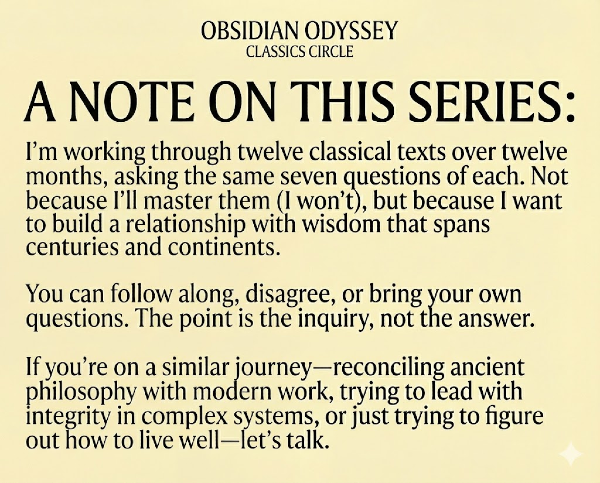
This wasn't about mastering classics (impossible). It was about building relationship with wisdom across time, learning to examine life, integrating multiple perspectives, becoming person capable of returning to cave and helping others ascend.
If you've read along: Thank you. I hope you found company in the inquiry.
If you're just discovering this: Welcome. The texts are waiting. Start anywhere. The examination is the point.
If you're considering your own year-long journey: Do it. Pick twelve texts. Ask your questions. Examine your life. You'll be transformed.
The classics don't give answers. They give questions worth asking.
The examined life doesn't give certainty. It gives wisdom worth seeking.
The cave-return doesn't give comfort. It gives obligation worth accepting.
This series ends.
The practice continues.
The cave awaits our return.
With gratitude for the journey and commitment to return,
EJ Elena Shin
"The unexamined life is not worth living."
— Socrates (via Plato), The Republic
Epilogue: What Comes After
The twelve-month journey is complete. But Plato teaches: Having examined life, you must return to the cave.
For me, this means:
Professional return: Bringing philosophical examination into capital allocation, institutional governance, mentoring next generation.
Intellectual return: Teaching these texts to others, creating space for examination in professional contexts.
Personal return: Continuous practice—daily examination, annual reading programs, lifetime commitment to truth-seeking.
Public return: These essays as trail markers for others on similar journeys. Making the cave-return visible, so others know it's possible.
The year transformed me from person who reads classics occasionally to person for whom philosophical examination is core practice.
Not because I'm special. Because the texts are powerful. Because examination matters. Because the cave needs people willing to return.
If this series helped you: Return to your cave. Help others ascend. That's the obligation we share.
The examined life is worth living.
The cave-return is worth attempting.
The wisdom across centuries is worth seeking.
See you in the cave.
— End of Obsidian Odyssey: Classics Circle S1 —
IMPORTANT DISCLAIMER
Personal Reflections Only: This essay represents my personal intellectual exploration and learning journey. Nothing herein constitutes investment advice, financial recommendations, or professional guidance of any kind.
No Investment Advice: Any references to investment decisions, portfolio construction, capital allocation, or financial strategies are illustrative examples of personal thought processes only. They do not constitute recommendations to buy, sell, or hold any securities or pursue any investment strategy.
Not Representative of Employer: All views expressed are strictly my own and do not represent the views, opinions, or investment strategies of any current or former employer, client, limited partner, or affiliated entity.
Use of AI Tools: This content was developed with the assistance of AI (Claude by Anthropic) as a thinking and writing partner. All final judgments, interpretations, and opinions remain my own.
Educational Purpose: This series explores classical philosophical texts for personal growth and intellectual development. It is not intended as professional development training or as a framework for institutional decision-making.
No Offer or Solicitation: Nothing in this essay constitutes an offer to sell, or a solicitation to buy, any securities or investment products. No investment decisions should be made based on this content.
Consult Professionals: Readers should consult qualified financial, legal, and tax professionals before making any investment or financial decisions.
![Obsidian Memo] Leadership Ground Truth: What Cuba, Puerto Rico, and Hawai'i Taught Me About Capital and Resilience](/content/images/size/w720/2026/02/Bad-Bunny.jpg)
![Obsidian Memo] Leadership Lessons for Founders: Building “You, Inc.” Without Burning It Down](https://images.unsplash.com/photo-1474917518260-23f84bd71c75?crop=entropy&cs=tinysrgb&fit=max&fm=jpg&ixid=M3wxMTc3M3wwfDF8c2VhcmNofDQyfHxzYWlsaW5nfGVufDB8fHx8MTc3MDkyODg3Mnww&ixlib=rb-4.1.0&q=80&w=720)
![Book] Leadership | Markets Are Made by People: Reading Ken Fisher's 100 Minds That Made the Market](https://images.unsplash.com/photo-1623524713064-257294b0e34b?crop=entropy&cs=tinysrgb&fit=max&fm=jpg&ixid=M3wxMTc3M3wwfDF8c2VhcmNofDN8fHdhbGwlMjBzdHJlZXR8ZW58MHx8fHwxNzcwOTM4MzYzfDA&ixlib=rb-4.1.0&q=80&w=720)
Comments ()