Book] Leadership | Classics Circle: The Prince - Niccolò Machiavelli
![Book] Leadership | Classics Circle: The Prince - Niccolò Machiavelli](/content/images/size/w1200/2026/02/Gemini_Generated_Image_tq8wcbtq8wcbtq8w.png)
A Conversation Across Centuries
Reading Time: 14 minutes
Classical Period: 1513 CE (Renaissance Italy)
Core Philosophy: Better to be feared than loved. Power is amoral. Idealism without realism is suicide.
Why I'm Reading This
After two months of virtue ethics—Marcus Aurelius teaching me to build an inner fortress of integrity, Lao Tzu teaching me to flow like water—I knew I needed the counterargument. I needed someone to tell me I was being naive.
Enter Machiavelli.
Politicis is a common feature in any organisation regardless of the industry. I opened Machiavelli to Chapter 15: "Many have imagined republics and principalities that have never been seen or known to exist in reality; for there is such a gap between how one lives and how one ought to live that anyone who abandons what is done for what ought to be done learns his ruin rather than his preservation."
In other words: Your virtue ethics are beautiful. Your Taoist patience is poetic. And in the real world, while you're being principled, someone less scrupulous is taking the kingdom.
I'm sharing this exploration publicly because it's the most uncomfortable one yet. The previous two texts—Meditations and Tao Te Ching—are socially acceptable. Everyone loves quoting Marcus Aurelius and talking about "flow states."
But admitting you're reading Machiavelli? That you're thinking seriously about power, manipulation, and strategic ruthlessness? That feels dangerous. Like you're admitting you're willing to play dirty.
Here's my honest question: Is Machiavelli evil, or is he just honest about how power actually works? And if he's honest, what does that mean for those of us trying to lead with integrity in systems that don't always reward integrity?
What do people who understand power dynamics better than those who don't? I want to understand the game, even if I'm not sure I want to play it.
Let's figure out together where the line is—between strategic sophistication and moral compromise.
Part I: The Text and Its Time
Historical Context
- When & Why Written: 1513, in exile after the Medici family returned to power in Florence. Machiavelli had been a senior official in the Republic; the Medici arrested and tortured him. He wrote The Prince both as a job application (dedicating it to Lorenzo de' Medici) and as a bitter meditation on why idealistic republics fall to ruthless princes.
- Original Audience: Ostensibly Lorenzo de' Medici, but really anyone who wants to understand how power is actually gained and maintained—not how it should be, but how it is.
- What Made It Radical: Machiavelli separated politics from morality. For centuries, political philosophy had been about what makes a "good" ruler. Machiavelli asked: What makes an effective ruler? Even if effectiveness requires cruelty, deception, and violence.
The Core Argument
I'm reading the Tim Parks translation (Penguin Classics, 2009), which scholars praise for capturing Machiavelli's brutal directness. I've also consulted Harvey Mansfield's version for comparison.
Disclosure: This text makes me deeply uncomfortable, which probably means I need to engage with it seriously.
Here's what I think Machiavelli is arguing:
The world is governed by power, not virtue. To survive and succeed, you must understand this and act accordingly—even if it means doing things that would be evil in private life.
Key principles:
- The Gap Between Is and Ought: There's a massive difference between how the world should work (where virtue is rewarded) and how it actually works (where power accrues to those willing to use force and deception). Refusing to acknowledge this gap gets you destroyed.
- Feared is Safer Than Loved: "It is better to be feared than loved, if you cannot be both." (Chapter 17) Love depends on others' gratitude, which is fickle. Fear depends on dread of punishment, which is reliable.
- Ends Justify Means: "Let a prince therefore act to seize and to maintain the state; his methods will always be judged honorable and will be praised by all; for ordinary people are always deceived by appearances and by the outcome of a thing." (Chapter 18)
- Virtù vs. Fortuna: Success requires virtù (not virtue, but rather something like "capability/willingness to do what's necessary") and fortune. You can't control fortune, but you can maximize virtù by being adaptable, ruthless when needed, and never constrained by how you wish the world worked.
- Be a Fox and a Lion: "A prince must be a fox to recognize traps, and a lion to frighten wolves." You need cunning (fox) to see deception, and strength (lion) to intimidate enemies. Morality is a luxury you can't afford.
Applied to finance in 2025: Machiavelli would say that all my talk of "impact investing" and "stakeholder capitalism" is naive unless I'm simultaneously willing to play hardball with competitors, outmaneuver rivals, and do whatever is necessary to preserve and grow my influence. Nice people finish last—unless they're also ruthless.
The question I'm wrestling with: Is he right?
Part II: Seven Questions I'm Bringing to This Text
Note: Same seven questions I ask of every book. This month, they feel more dangerous.
Q1: What does this text teach about staying grounded when everything is uncertain?
What Machiavelli Seems to Say: "I conclude, therefore, that, fortune varying and men remaining fixed in their ways, they are successful so long as these ways conform to circumstances, but when they are opposed then they are unsuccessful." (Chapter 25)
How I'm Translating This to 2025: Machiavelli's answer to uncertainty is brutal: Be adaptable. Don't be so attached to your principles that you can't pivot when circumstances change.
This directly contradicts Marcus Aurelius (stay true to your principles) and Lao Tzu (flow with natural rhythms). Machiavelli says: Principles are fine until they get you killed. When the situation changes, change with it. No hesitation. No hand-wringing about integrity.
In investing, this means: Your investment thesis is only as good as current market conditions. When the regime changes (interest rates, regulations, geopolitical environment), clinging to old frameworks is suicide. The investors who survive are those who can be value investors in one decade and growth investors in the next—not because they're unprincipled, but because they're realistic.
But here's the uncomfortable part: This also means being willing to abandon ESG commitments when they become politically toxic, or scaling back diversity initiatives when they invite backlash, or pivoting away from impact if fiduciary pressure intensifies.
Is that realism or moral cowardice? I honestly don't know.
What I'm Trying to Practice: I'm asking myself: "Where am I clinging to strategies or stances because I want them to work, rather than because they do work?"
Q2: How does this work inform thinking about the ethics of capital—where money goes and why?
What Machiavelli Seems to Say: "Men have less scruple in offending one who makes himself loved than one who makes himself feared." (Chapter 17)
How I'm Translating This to 2025: Machiavelli would find the entire concept of "ethical capital" laughable. Capital is power. Power is amoral. Pretending otherwise is just effective PR.
His argument: You can appear ethical (this is useful for reputation), but you shouldn't actually be constrained by ethics when doing so would weaken your position. "A prince, and especially a new prince, cannot observe all those things for which men are held good, since he is often under a necessity, to maintain his state, of acting against faith, against charity, against humanity, against religion." (Chapter 18)
Q3: What does it reveal about power—how it's gained, wielded, and when to walk away?
What Machiavelli Seems to Say: "Upon this a question arises: whether it be better to be loved than feared or feared than loved? It may be answered that one should wish to be both, but, because it is difficult to unite them in one person, it is much safer to be feared than loved." (Chapter 17)
How I'm Translating This to 2025: This is the core provocation. Machiavelli says: If you lead through being liked, your power depends on others' goodwill—which is unreliable. If you lead through being feared (not hated, importantly—he distinguishes these), your power is your own.
In institutional settings, I see this play out constantly:
- The leader everyone loves but who can't make hard decisions → replaced when things get tough
- The leader everyone respects/fears but who delivers results → survives crisis after crisis
I've been trying to lead through being liked—being collaborative, consensus-building, generous with credit. Machiavelli would diagnose this as weakness disguised as virtue.
His prescription: Be willing to make decisions that make you unpopular. Be willing to discipline, to say no, to disappoint. Don't be cruel for cruelty's sake (he explicitly warns against this), but don't avoid necessary harshness because you want to be liked.
What I'm Trying to Practice:
I'm experimenting with what I'm calling "benevolent ruthlessness"—caring deeply about people while being willing to make hard calls that affect them.
Q4: How does it address playing the long game when the world rewards short-term thinking?
What Machiavelli Seems to Say: "Therefore, a prudent man should always follow in the path trodden by great men and imitate those who have been most excellent, so that if his own virtue does not reach that far, it is at least in the odor of it." (Chapter 6)
How I'm Translating This to 2025: Machiavelli's surprisingly long-term: Build your power base systematically. Don't take shortcuts that create enemies who will eventually destroy you. This aligns more with patient capital than you'd expect.
But his reasoning is pure realism, not virtue: Long-term thinking isn't noble—it's strategic. Quick wins that destabilize your position are foolish. Sustainable power requires building institutions, not just exploiting moments.
For capital allocation: Machiavelli would approve of long-term investing not because it's "right" but because short-termism creates vulnerabilities. If you constantly flip positions, you build no durable relationships. If you extract maximum value every cycle, you burn ecosystem goodwill you'll eventually need.
This is interesting: Machiavellian analysis can lead to patient capital, but for ruthlessly practical reasons, not ethical ones.
Q5: What wisdom does it offer about identity—especially for those of us who don't fit neatly into one box?
What Machiavelli Seems to Say: "Everyone sees what you appear to be, few touch what you are; and those few dare not oppose the opinion of the many who have the majesty of the state to defend them." (Chapter 18)
How I'm Translating This to 2025: Machiavelli says: Managing perception IS your identity, for practical purposes. It doesn't matter who you "really are" if no one perceives it. Reputation is reality.
For someone navigating multiple cultural contexts, this is both liberating and disturbing. Machiavelli would say: Stop agonizing about "authentic identity." You have a professional identity (perception management) and a private identity (who you actually are). Keep them separate. Use the former strategically. Protect the latter carefully.
This is the opposite of Lao Tzu's "emptiness" (be genuinely formless) and Marcus's "character is everything" (who you are matters more than how you appear). Machiavelli says: Appear however you need to appear. Reality is for people you trust, which should be almost no one.
Applied to code-switching: Stop feeling guilty about presenting differently in different contexts. That's not inauthenticity—that's strategic adaptation. The Korean investor persona, the Western finance persona, the impact leader persona—these aren't masks, they're tools.
But this feels deeply cynical. Am I becoming more sophisticated or just more fake?
Q6: How does it challenge our relationship with time and what we leave behind?
What Machiavelli Seems to Say: "It makes him hated above all things, as I have said, to be rapacious, and to be a violator of the property and women of his subjects, from both of which he must abstain." (Chapter 19)
How I'm Translating This to 2025: Machiavelli cares about legacy only instrumentally: Don't be remembered so terribly that it destabilizes what you built. Beyond that? Legacy is vanity.
He watched idealistic republics fall to ruthless princes repeatedly. His lesson: High-minded legacy projects (the beautiful constitution, the noble reforms) don't survive contact with power-hungry successors. What survives is durable institutional power.
For long-term capital: Don't build "The [Your Name] Foundation" and expect your values to persist. Build incentive structures, governance mechanisms, and institutional cultures that are self-reinforcing regardless of who's in charge.
This is darker than Marcus Aurelius ("do good for its own sake") or Lao Tzu ("dissolve into the work"). Machiavelli says: If you want your impact to last, embed it in power structures, not aspirational values.
What Machiavelli would say: Don't think about "what will my obituary say" and more about "what institutional mechanisms will outlast me."
Practically: When designing governance, ask: "How does this work if a bad actor takes control?" rather than "How does this work if everyone shares our values?"
This feels pessimistic. But watching institutions I respected get hollowed out by leadership changes suggests Machiavelli might be right: Design for the worst case, hope for the best.
Q7: What does it teach about the inner life—the part of leadership no one sees?
What Machiavelli Seems to Say: "A prince ought to take care that he never lets anything slip from his lips that is not replete with the above-named five qualities, that he may appear to him who sees and hears him altogether merciful, faithful, humane, upright, and religious. There is nothing more necessary to appear to have than this last quality." (Chapter 18)
How I'm Translating This to 2025: This is the most disturbing passage for me. Machiavelli explicitly says: Appear virtuous. Be skilled at seeming merciful, faithful, humane. But don't actually let these qualities constrain you when action requires their violation.
For the inner life, this suggests: Maintain enough virtue for it to be visible, but don't internalize it so deeply that it prevents necessary ruthlessness.
This is antithetical to Marcus Aurelius, who says the inner life is everything—virtue must be genuine or it's worthless. It's antithetical to Lao Tzu, who says emptiness/authenticity is the source of power.
Machiavelli says: The inner life is private practice for the public performance. Keep them separate.
I find this profoundly sad. It's a recipe for loneliness—if you can never be fully known because you're always performing, where do you actually exist?
Part III: Five Things I'm Taking From This
(And One Thing I'm Leaving Behind)
Taking #1: Idealism Without Realism is Self-Sabotage
"There is such a gap between how one lives and how one ought to live that anyone who abandons what is done for what ought to be done learns his ruin rather than his preservation." (Chapter 15)
After two months of virtue-first philosophy, Machiavelli is a necessary corrective. He's saying: Your beautiful principles mean nothing if they get you destroyed before you can enact them.
I'm learning to ask: "Is my commitment to this principle strategic, or am I just attached to feeling virtuous?" Sometimes the answer is the latter, and that's a problem.
Taking from this: Before advocating for any initiative on ethical grounds, first war-game how it will be attacked by less scrupulous actors. If I can't defend it strategically (only ethically), I probably can't defend it.
Question I'm sitting with: Is there such a thing as strategy-proof virtue? Or does all effective ethics require Machiavellian savvy?
Taking #2: Kindness Without Boundaries Invites Exploitation
"It is better to be feared than loved, if you cannot be both." (Chapter 17)
I've spent years trying to lead through consensus and kindness. Machiavelli is showing me where that's been exploited—people who interpret kindness as weakness, who push boundaries because they know I won't push back.
Not taking from this: "Be cruel." Taking from this: "Be willing to disappoint. Be willing to be unpopular when necessary."
Recent application: Setting much clearer boundaries around response times, scope of commitments, what I will and won't do. People initially pushed back. Then they adjusted. Respect (possibly mixed with fear of wasting my time) has increased.
Question I'm sitting with: Where's the line between healthy boundaries and being feared in the toxic sense?
Taking #3: Most People Judge by Outcomes, Not Process
"Let a prince therefore act to seize and to maintain the state; his methods will always be judged honorable and will be praised by all; for ordinary people are always deceived by appearances and by the outcome of a thing." (Chapter 18)
This is cynical but true: If your portfolio performs, people don't scrutinize how you got there. If it underperforms, even perfect process won't save you.
I've been over-investing in "making sure everyone knows we did this right" versus "making sure we achieve the outcome." Machiavelli says: Focus on the latter. The former follows automatically if you succeed.
This doesn't mean abandoning process—it means right-sizing process relative to outcome focus.
Question I'm sitting with: How do you maintain genuine integrity when you know most people only care about results?
Taking #4: Strategic Transparency vs. Naive Transparency
"Everyone sees what you appear to be, few touch what you are." (Chapter 18)
I've been practicing radical transparency—sharing my uncertainties, my learning process, my mistakes. Machiavelli would say: That's strategically foolish. Uncertainty is private. Competence is public.
I'm not abandoning transparency, but I'm becoming more strategic about what I'm transparent about and when. Sharing this learning journey publicly? Strategic transparency—it builds intellectual community and positions me as a thoughtful practitioner. Sharing real-time doubts about live situations? Naive transparency—it undermines confidence unnecessarily.
Question I'm sitting with: Is "strategic transparency" just manipulation? Or is it mature communication?
Taking #5: Adaptability is Survival
"Fortune varying and men remaining fixed in their ways, they are successful so long as these ways conform to circumstances, but when they are opposed then they are unsuccessful." (Chapter 25)
The investors who survive aren't the most principled—they're the most adaptable. The leaders who endure aren't the most consistent—they're the most responsive to changed conditions.
I'm working on loosening my grip on "this is how I do things" and strengthening my capacity to read situations and adjust approach accordingly.
Not abandoning core values, but distinguishing "core values" (non-negotiable) from "preferred strategies" (totally negotiable).
Question I'm sitting with: What are my actual core values versus things I just prefer? How do I know the difference?
Leaving Behind: The Performance of Virtue Without Inner Truth
"A prince ought to take care that he never lets anything slip from his lips that is not replete with [mercy, faith, humanity, uprightness, religion]... to appear to have them." (Chapter 18)
This is where Machiavelli loses me. He's advocating for virtue as performance art—look ethical, but don't be constrained by ethics when power requires otherwise.
I think this is wrong. Not strategically (it probably works), but existentially. A life of pure performance—where you're never fully known, where relationships are transactional, where virtue is just branding—that's a life I don't want.
I'm taking Machiavelli's strategic sophistication while rejecting his cynicism about human nature. I think you can be both savvy and genuine. It's harder. It might be less "effective" by his metrics. But it's the only path that doesn't lead to profound loneliness.
Part IV: How I'm Working With This
My Co-Writing Process with Claude
I read Tim Parks's translation first, which is sharp and direct. Then I consulted Harvey Mansfield's version for key passages. I brought my discomfort to Claude.
The Prince is difficult not because it's hard to understand (it's remarkably clear), but because it forces you to confront how much of "effective leadership" requires moral flexibility you might not want to have.
Claude and I debated extensively: Is Machiavelli describing how things are, or prescribing how things should be? Is he being satirical (some scholars think so)? Is there a version of Machiavellian thinking that doesn't require abandoning your soul?
This essay is heavily edited by me to capture my actual ambivalence. I'm not trying to sound wise—I'm genuinely conflicted about how much of this to integrate.
What Claude adds: Historical context (Renaissance power dynamics), philosophical pushback (where Machiavelli contradicts himself), and forcing me to articulate why certain passages disturb me.
What I add: The lived experience of being outmaneuvered by more Machiavellian actors. The desire to be effective without becoming someone I don't recognize. The question of whether ethics and effectiveness are truly incompatible.
Integration Experiments
In the Next 30 Days: Before any important negotiation or political situation, I'm asking: "What would Machiavelli do?" Not to do it, but to anticipate it—assume someone else is thinking that way, plan accordingly.
In the Next Crisis: When something goes wrong, resist the urge to be transparent about uncertainty. Project confidence publicly. Process uncertainty privately with trusted advisors only.
In My Next Reflection: Journal prompt: "Where am I being naive about power? Where am I assuming good faith when strategic skepticism is warranted?"
If You're Reading This Too
Where to Start: Tim Parks's translation (Penguin Classics, 2009) is the most modern and readable. Harvey Mansfield's (University of Chicago Press, 1998) is more literal if you want to parse Machiavelli's actual language.
WARNING: If you tell people you're reading The Prince, expect them to assume the worst about you. This text has PR problems for a reason.
Read Next:
- The Discourses by Machiavelli (his thoughts on republics, less cynical)
- The 48 Laws of Power by Robert Greene (modern Machiavellianism, even more ruthless)
- The Courtier by Baldassare Castiglione (Renaissance counter-argument: how to be virtuous AND effective)
Pair With:
- TV: House of Cards or Succession (Machiavellianism in modern contexts)
- Film: The Godfather (1972)—Don Corleone as Machiavelli's prince
- Podcast: Any episode of "Power Corrupts" by Brian Klaas
Questions I'm Still Sitting With
- Is Machiavelli describing reality or creating it? If enough people read The Prince and act accordingly, does it become a self-fulfilling prophecy? Are we making the world more Machiavellian by taking him seriously?
- Can you be Machiavellian for good ends? Using ruthless means to achieve progressive goals—is that strategy or self-deception?
- Where's the line between "understanding power" and "becoming corrupted by power"? How do you study this without internalizing it too deeply?
- Is Machiavelli right that virtue without power is useless? Or is the witness of virtue—even powerless virtue—valuable in itself?
- What would Marcus Aurelius say to Machiavelli? And who would win the argument?
Published in: Obsidian Odyssey
Series: Classics Circle (#3 of 12)
Previous in Series: Tao Te Ching by Lao Tzu – "The Water Way"
Next in Series: The Analects by Confucius – "The Architecture of Relationship"
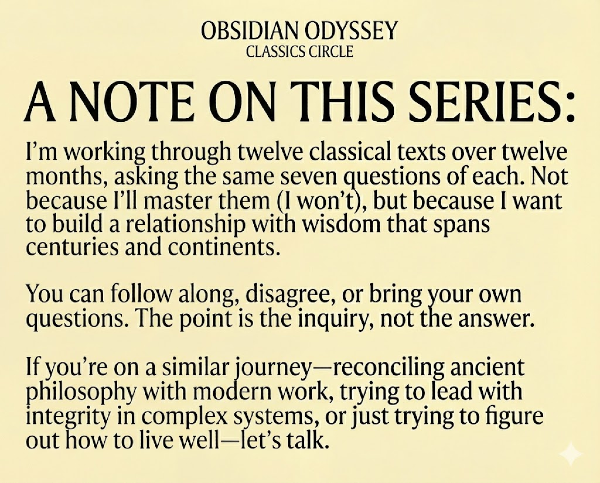
A Note on This Series:
Three months in, and the contradictions are piling up:
- Marcus: Build an inner fortress of virtue
- Lao Tzu: Be empty like water
- Machiavelli: Virtue is performance; power is reality
None of them fully answer the question: How do you lead effectively in complex systems without losing yourself?
Maybe there isn't one answer. Maybe the practice is holding multiple truths in tension, knowing when to draw from each.
Next month: Confucius on relationships, ritual, and social harmony. I suspect he'll have thoughts about Machiavelli.
If you're on this journey too—trying to be both good and effective, both ethical and powerful, both idealistic and realistic—you're not alone. It's hard. That's the point.
"It is better to be feared than loved, if you cannot be both."
— Niccolò Machiavelli, The Prince, Chapter 17
IMPORTANT DISCLAIMER
Personal Reflections Only: This essay represents my personal intellectual exploration and learning journey. Nothing herein constitutes investment advice, financial recommendations, or professional guidance of any kind.
No Investment Advice: Any references to investment decisions, portfolio construction, capital allocation, or financial strategies are illustrative examples of personal thought processes only. They do not constitute recommendations to buy, sell, or hold any securities or pursue any investment strategy.
Not Representative of Employer: All views expressed are strictly my own and do not represent the views, opinions, or investment strategies of any current or former employer, client, limited partner, or affiliated entity.
Use of AI Tools: This content was developed with the assistance of AI (Claude by Anthropic) as a thinking and writing partner. All final judgments, interpretations, and opinions remain my own.
Educational Purpose: This series explores classical philosophical texts for personal growth and intellectual development. It is not intended as professional development training or as a framework for institutional decision-making.
No Offer or Solicitation: Nothing in this essay constitutes an offer to sell, or a solicitation to buy, any securities or investment products. No investment decisions should be made based on this content.
Consult Professionals: Readers should consult qualified financial, legal, and tax professionals before making any investment or financial decisions.
![Obsidian Memo] Leadership Ground Truth: What Cuba, Puerto Rico, and Hawai'i Taught Me About Capital and Resilience](/content/images/size/w720/2026/02/Bad-Bunny.jpg)
![Obsidian Memo] Leadership Lessons for Founders: Building “You, Inc.” Without Burning It Down](https://images.unsplash.com/photo-1474917518260-23f84bd71c75?crop=entropy&cs=tinysrgb&fit=max&fm=jpg&ixid=M3wxMTc3M3wwfDF8c2VhcmNofDQyfHxzYWlsaW5nfGVufDB8fHx8MTc3MDkyODg3Mnww&ixlib=rb-4.1.0&q=80&w=720)
![Book] Leadership | Markets Are Made by People: Reading Ken Fisher's 100 Minds That Made the Market](https://images.unsplash.com/photo-1623524713064-257294b0e34b?crop=entropy&cs=tinysrgb&fit=max&fm=jpg&ixid=M3wxMTc3M3wwfDF8c2VhcmNofDN8fHdhbGwlMjBzdHJlZXR8ZW58MHx8fHwxNzcwOTM4MzYzfDA&ixlib=rb-4.1.0&q=80&w=720)
Comments ()