Book] Leadership | Classics Circle: The Odyssey - Homer
![Book] Leadership | Classics Circle: The Odyssey - Homer](/content/images/size/w1200/2026/02/Gemini_Generated_Image_b60iw3b60iw3b60i.png)
A Conversation Across Centuries
Reading Time: 14 minutes
Classical Period: ~8th century BCE (Ancient Greece, oral tradition)
Core Philosophy: The journey home is longer and more difficult than the war. You cannot return unchanged.
Why I'm Reading This
After eight months of classics—learning discipline, flow, power, relationships, meaning-making, strategy—I need to ask: What does it mean to go home? And can you even go back after you've changed?
I'm reading The Odyssey on a plane, visiting Seoul. I've been away from Seoul for 23 years (besides quick annual visits for a couple of days). The city has transformed—glittering towers, K-pop, and booming cafes and streets.
But the deeper disorientation: I've changed. The person who left Seoul decades ago doesn't exist anymore. I've been remade by Toronto, New York, London. By finance, by philosophy, by these eight months of reading.
Odysseus spends ten years fighting in Troy, then ten more years trying to get home to Ithaca. Twenty years gone. His son Telemachus, whom he left as an infant, is now a young man. His wife Penelope is besieged by suitors. His house is occupied by men eating his stores and courting his wife. His father Laertes has withdrawn in grief, believing his son dead.
When Odysseus finally returns, he can't just walk in and announce himself. Everything is wrong. He must disguise himself, test loyalties, strategize his return. And even after he defeats the suitors and reclaims his house, there's the devastating recognition: You can reclaim the place, but you can't reclaim the time.
I'm sharing this because after eight months of transformation, I'm facing my own question of return: How do you integrate what you've learned with where you came from? How do you honor your origins while acknowledging you've changed? Can there be homecoming when you're no longer the person who left?
The Odyssey doesn't offer easy answers. But it offers the journey—and recognition that the journey home is its own epic.
Let's navigate these waters together.
Part I: The Text and Its Time
Historical Context
- When & Why Written: Attributed to Homer, likely composed in 8th century BCE from much older oral traditions. Part of the "Epic Cycle" about the Trojan War and its aftermath. While the Iliad covers war itself, The Odyssey covers what happens after—the long journey home.
- Original Audience: Ancient Greeks, performed orally at festivals. The story reinforced cultural values: hospitality (xenia), loyalty, cunning intelligence (metis), glory (kleos), and proper relationships with gods and fate.
- What Made It Radical: Homer's focus on homecoming rather than glory. Unlike the Iliad (where heroes die gloriously in battle), The Odyssey asks: What comes after? How do you return? What does survival mean when everyone else is dead?
The Core Argument (As I Understand It)
The Odyssey follows Odysseus's ten-year journey home from Troy to Ithaca. The structure is non-linear—starting in medias res (middle of the story), with flashbacks filling in earlier adventures.
The journey includes:
- Monsters (Cyclops, Sirens, Scylla and Charybdis)
- Seductions (Circe, Calypso)
- Divine interference (Poseidon's wrath, Athena's aid)
- Human hospitality and betrayal
- Finally: Return to Ithaca in disguise, testing of loyalties, slaughter of suitors, reunion with family
I'm reading Robert Fagles's translation (Penguin, 1996), which scholars praise for capturing both the poetry and the narrative drive. I've also consulted Emily Wilson's recent translation (2017)—the first by a woman—which offers fresh perspective on gender dynamics.
What Homer is showing (as I understand it):
The journey home transforms you. You cannot return to who you were. The work is: integrating who you've become with who you were, honoring both, and creating space for new equilibrium. Home is not a place you return to—it's a place you remake.
Key themes:
- Metis (Cunning Intelligence): Odysseus succeeds not through strength but through cleverness—the Trojan Horse, blinding the Cyclops, resisting the Sirens. Intelligence matters more than force.
- Nostos (Homecoming): The entire epic is about return. But return isn't simple restoration—it's complex renegotiation of identity and relationships.
- Xenia (Hospitality): The sacred duty to welcome strangers. Violations of xenia (by Cyclops, by suitors) bring divine punishment. Proper hospitality enables Odysseus's survival.
- Kleos (Glory/Reputation): Odysseus's reputation precedes him—but also complicates return. He must balance revealing his identity (to claim glory) with concealing it (to survive).
- Recognition Scenes: Repeated moments where Odysseus is recognized—by his scar, by his bow, by his bed. Identity isn't self-proclaimed; it's recognized by others.
Applied to professional life in 2025: We spend years "away"—building skills, networks, credentials—then try to return to communities/families/values we left. But we've changed. They've changed. The work isn't restoring what was—it's renegotiating what can be.
Family offices face this constantly: Next generation goes away (education, careers), returns with new ideas/values, tries to integrate with family legacy. The tension isn't bad faith—it's the natural gap between the journey and home.
Part II: Seven Questions I'm Bringing to This Text
Note: Nine months in. My questions now have the weariness of the long journey.
Q1: What does this text teach about staying grounded when everything is uncertain?
What Homer Seems to Say:
"No winning words about death to me, shining Odysseus! By god, I'd rather slave on earth for another man... than rule down here over all the breathless dead."
How I'm Translating This to 2025:
This is Achilles speaking in the underworld—the greatest warrior, choosing survival over glorious death. Homer's insight: Life, even difficult life, is better than death. Stay focused on living, not glory.
For Odysseus: Despite divine seduction (Calypso offers immortality), monster attacks, crew betrayals—he stays focused on one thing: getting home alive. That clarity keeps him grounded through a decade of chaos.
For navigating uncertainty: What's your "home"—your north star? For Odysseus: Ithaca, Penelope, Telemachus. For me: Integrity, meaningful work, relationships that matter.
When everything is chaotic, return to that core: What am I trying to get back to? Not physically, but essentially?
What I'm Trying to Practice:
I've identified my "Ithaca"—the essence I'm trying to remain true to despite external chaos:
- Channeling capital toward regeneration (environmental and social)
- Building relationships based on genuine care, not transactional utility
- Maintaining integrity even when costly
- Tending family connections despite geographic distance
When decisions are ambiguous, I ask: "Which choice brings me closer to my Ithaca?"
This doesn't eliminate uncertainty—but it provides orientation.
Q2: How does this work inform thinking about the ethics of capital—where money goes and why?
What Homer Seems to Say: The suitors consume Odysseus's household without contributing, violating the sacred duty of guests. They're destroyed for this violation.
How I'm Translating This to 2025: Homer's economic ethics: Taking without reciprocity is moral violation. The suitors eat Odysseus's food, drink his wine, court his wife—all while contributing nothing. They're parasites.
For capital allocation: This challenges extraction models—taking value from companies/communities without reciprocal contribution. Private equity that loads companies with debt while extracting fees. Investors who pressure portfolio companies for returns while providing no meaningful support. Capital that extracts without building.
Homer says: This violates sacred reciprocity. And eventually, reckoning comes.
The alternative: Xenia—the sacred duty of host to guest AND guest to host. Both parties have obligations. Capital that honors xenia: brings resources, yes, but also expertise, connections, patience. Receives returns, yes, but also provides support.
Q3: What does it reveal about power—how it's gained, wielded, and when to walk away?
What Homer Seems to Say: Odysseus returns in disguise—as a beggar. He watches, tests loyalties, gathers intelligence before revealing himself and striking. He uses metis (cunning) not force.
How I'm Translating This to 2025: Homer shows: Real power often operates from apparent weakness. Odysseus has the power (he's the rightful king, he has Athena's support), but he conceals it until the moment to strike.
This synthesizes Sun Tzu (know terrain before engaging) and Machiavelli (appearance and reality differ). But Homer adds something: Sometimes you must be willing to appear powerless to assess truth.
For institutional power: The leaders who truly understand their organizations aren't those who rely on hierarchical authority. They're those who sometimes "go in disguise"—engage without revealing position, listen without power's filter, see what people say when they don't know they're talking to the boss.
Q4: How does it address playing the long game when the world rewards short-term thinking?
What Homer Seems to Say: Odysseus takes twenty years to return home. Ten years war, ten years journey. His son grows from infant to man. His wife waits. His father grieves. The timeline is generational.
How I'm Translating This to 2025: Homer's temporal frame: Meaningful journeys take longer than you think. The work requires patience beyond reasonable expectation.
For long-term capital: Twenty years is two full venture fund cycles. It's long enough for children to grow up, for technologies to mature, for entire market regimes to change. Homer normalizes this timescale—it's not failure that it takes twenty years. It's reality of difficult journeys.
But also: Homer shows cost of delay. Telemachus grows up without father. Penelope holds off suitors for years. Odysseus's household deteriorates. Long-term thinking doesn't mean consequences don't accrue—they do. The question is: Are you on the right journey even if it's long?
Q5: What wisdom does it offer about identity—especially for those of us who don't fit neatly into one box?
What Homer Seems to Say: Odysseus has many identities: King of Ithaca, son of Laertes, husband of Penelope, father of Telemachus, veteran of Troy, survivor of monsters, man favored by Athena, man cursed by Poseidon, "man of many turns."
How I'm Translating This to 2025: Homer shows: Identity is multiple and contextual. Odysseus is recognized differently by different people—by his scar, by his bow, by his bed. No single marker captures all of him.
For those of us crossing contexts: Stop trying to construct one coherent identity. You're multiple identities—daughter, investor, immigrant, student of classics, bearer of family history. The coherence comes from the journey, not from resolving the multiplicity.
Odysseus's epithet: "polytropos"—man of many turns/ways. Not criticized for inconsistency—celebrated for adaptability while maintaining core self (returns to Ithaca, to Penelope).
Q6: How does it challenge our relationship with time and what we leave behind?
What Homer Seems to Say: When Odysseus finally reveals himself, he strings the bow that only he can string—not through strength but through knowledge of how this particular bow works. The bow recognizes its master.
How I'm Translating This to 2025: Homer's insight: Legacy isn't what you proclaim—it's what recognizes you. The bow recognizes Odysseus. The bed (built around an olive tree) can't be moved—only Odysseus and Penelope know this. His dog Argos, after twenty years, recognizes him and dies content.
For legacy work: You don't control how you're remembered. You create things (relationships, institutions, knowledge) that "recognize" you—that work the way you worked, that embody your essence.
Family offices obsess over "preserving founder's vision." But Homer suggests: The founder left markers (like the unmovable bed). The work isn't preserving static vision—it's recognizing the markers and building from them.
Q7: What does it teach about the inner life—the part of leadership no one sees?
What Homer Seems to Say: In the underworld, Odysseus meets the dead—including his own mother, who died waiting for him. He tries to embrace her three times; three times, she slips through his arms like smoke.
How I'm Translating This to 2025: The inner work of the long journey: You carry the dead with you. You cannot hold them, but they accompany you.
Odysseus's mother, his crew members who died, the comrades from Troy—they're with him as memory, grief, motivation. He cannot bring them back. But they shape his journey.
For the inner life across long careers: You accumulate losses. Projects that failed, relationships that ended, versions of yourself you've outgrown. The work isn't forgetting—it's carrying them well. Learning from them. Letting them shape you without being captured by them.
Part III: Five Things I'm Taking From This
(And One Thing I'm Leaving Behind)
Taking #1: The Journey Home Takes Longer Than the War
Ten years fighting, ten years returning. Homer normalizes: The return is as epic as the achievement. Integration takes as long as transformation.
Taking from this: When I'm frustrated by how long things take—building institutions, shifting cultures, integrating learnings—remember: The Odyssey timeline is normal.
Question I'm sitting with: How do you maintain morale across decades-long journeys?
Taking #2: You Cannot Return Unchanged
Odysseus cannot walk in and announce himself. Everything has changed. The work is renegotiation, not restoration.
Taking from this: Stop trying to "get back" to some prior state. You've changed. Context has changed. The work is creating new equilibrium, not restoring old.
Question I'm sitting with: How do you honor origins while acknowledging transformation?
Taking #3: Metis Matters More Than Might
Odysseus survives through cunning, not strength. The Trojan Horse, blinding the Cyclops, resisting Sirens—all intelligence over force.
Taking from this: In competitive situations, look for clever solutions, not just forceful ones. The indirect approach often works better.
Question I'm sitting with: Can metis be taught or is it innate?
Taking #4: Hospitality Is Sacred Reciprocity
Xenia—mutual obligation of host and guest. Violations bring reckoning.
Taking from this: In all professional relationships, ask: Am I practicing xenia? Am I taking without giving? Am I expecting without offering?
Question I'm sitting with: How do you practice xenia in transactional contexts like capital markets?
Taking #5: Identity Is Recognized, Not Proclaimed
The bow recognizes Odysseus. The bed confirms him. The scar reveals him. Others recognize who you are through what you've made and how you work.
Taking from this: Stop trying to control your reputation. Make good work. The work will recognize you to those who matter.
Question I'm sitting with: But isn't there danger in not shaping your narrative? Don't others misrepresent you?
Leaving Behind: The Lone Hero Myth
Homer shows: Odysseus needed Athena's help, crew members' loyalty, strangers' hospitality, Telemachus's courage, Penelope's faithfulness. He couldn't have done it alone.
I'm leaving behind: The fantasy of the solitary achiever. Success requires crew, allies, supporters, even divine favor (luck).
The work is: Building crew, nurturing alliances, creating conditions for luck—not pretending you'll do it alone.
Part IV: How I'm Working With This (The Transparent Part)
My Co-Writing Process with Claude
The Odyssey is long (24 books), episodic, and requires cultural context I don't have. I read Robert Fagles's translation first (narrative drive). Then Emily Wilson's (fresh perspective, especially on gender). Then consulted commentaries on key passages.
Claude helped me distinguish:
- Homer's actual story
- What's meaningful for my journey questions
- What's interesting but not applicable
- What I'm projecting onto ancient text
We wrestled with: How do you honor Homer's cultural context (ancient Greek values) while extracting relevant wisdom? How do you avoid cherry-picking only comfortable parts?
What Claude adds: Classical scholarship, cultural context, comparative mythology.
What I add: The lived experience of not being able to return home unchanged. The question of integration across cultures, careers, identities.
Integration Experiments (What I'm Actually Trying)
In the Next 30 Days: Map my "Ithaca"—what am I trying to return to essentially, not physically? What's my north star?
In the Next Crisis: When feeling lost, ask: "What would Odysseus do?"—usually: gather intelligence, test loyalties, be patient, strike when ready.
In My Next Reflection:
Journal prompt: "What am I carrying from the underworld? What deaths shape my journey? How do I carry them well?"
If You're Reading This Too
Where to Start:
Choose your translation based on preference:
- Robert Fagles (Penguin, 1996): Most narrative drive
- Emily Wilson (Norton, 2017): First woman translator, fresh language
- Richmond Lattimore (Harper, 1965): Most literal, scholarly
Read it in chunks. It's episodic—perfect for serialized reading.
Read Next:
- The Iliad by Homer (the war before the return)
- Aeneid by Virgil (Roman take on similar themes)
- Ulysses by James Joyce (modernist reworking)
Pair With:
- Film: O Brother, Where Art Thou? (2000)—Odyssey set in Depression-era South
- Music: Listen while reading—makes the oral tradition feel alive
- Practice: Map your own "Odyssey"—where have you journeyed? What's your Ithaca?
Questions I'm Still Sitting With
- Can you ever truly go home? Or is that desire itself the problem?
- What do you do when home has changed beyond recognition? When the Ithaca you're returning to doesn't exist anymore?
- Is the journey the point or the return? Homer seems ambiguous. Is Odysseus heroic for returning or for surviving the journey?
- What about people who don't want to return? The Lotus Eaters, content to forget. Is that wrong?
- How do you know when you're home? Is it recognition by others? Internal feeling? Both?
Published in: Obsidian Odyssey
Series: Classics Circle (#9 of 12)
Previous in Series: The Art of War by Sun Tzu – "Winning Without Fighting"
Next in Series: Gitanjali by Rabindranath Tagore – "Songs of Divine Humanity"
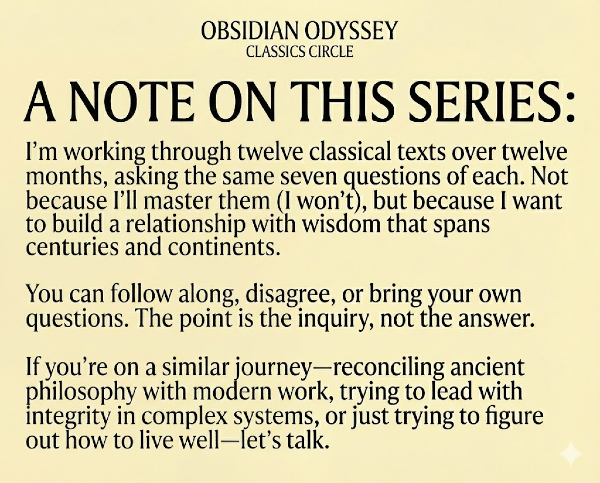
A Note on This Series:
Nine months. Three-quarters complete. The final stretch:
After learning to be better, find meaning, and operate strategically, Homer asks: How do you integrate? How do you return home transformed?
Next month: Tagore's poetry on the intersection of human and divine, self and other. After the long Odyssey journey, I need to sit with beauty, transcendence, and the possibility of union across separations.
Three months remain. The journey continues.
"Tell me, Muse, of the man of many ways, who was driven far journeys, after he had sacked Troy's sacred citadel."
— Homer, The Odyssey, Opening Lines
IMPORTANT DISCLAIMER
Personal Reflections Only: This essay represents my personal intellectual exploration and learning journey. Nothing herein constitutes investment advice, financial recommendations, or professional guidance of any kind.
No Investment Advice: Any references to investment decisions, portfolio construction, capital allocation, or financial strategies are illustrative examples of personal thought processes only. They do not constitute recommendations to buy, sell, or hold any securities or pursue any investment strategy.
Not Representative of Employer: All views expressed are strictly my own and do not represent the views, opinions, or investment strategies of any current or former employer, client, limited partner, or affiliated entity.
Use of AI Tools: This content was developed with the assistance of AI (Claude by Anthropic) as a thinking and writing partner. All final judgments, interpretations, and opinions remain my own.
Educational Purpose: This series explores classical philosophical texts for personal growth and intellectual development. It is not intended as professional development training or as a framework for institutional decision-making.
No Offer or Solicitation: Nothing in this essay constitutes an offer to sell, or a solicitation to buy, any securities or investment products. No investment decisions should be made based on this content.
Consult Professionals: Readers should consult qualified financial, legal, and tax professionals before making any investment or financial decisions.
![Obsidian Memo] Leadership Ground Truth: What Cuba, Puerto Rico, and Hawai'i Taught Me About Capital and Resilience](/content/images/size/w720/2026/02/Bad-Bunny.jpg)
![Obsidian Memo] Leadership Lessons for Founders: Building “You, Inc.” Without Burning It Down](https://images.unsplash.com/photo-1474917518260-23f84bd71c75?crop=entropy&cs=tinysrgb&fit=max&fm=jpg&ixid=M3wxMTc3M3wwfDF8c2VhcmNofDQyfHxzYWlsaW5nfGVufDB8fHx8MTc3MDkyODg3Mnww&ixlib=rb-4.1.0&q=80&w=720)
![Book] Leadership | Markets Are Made by People: Reading Ken Fisher's 100 Minds That Made the Market](https://images.unsplash.com/photo-1623524713064-257294b0e34b?crop=entropy&cs=tinysrgb&fit=max&fm=jpg&ixid=M3wxMTc3M3wwfDF8c2VhcmNofDN8fHdhbGwlMjBzdHJlZXR8ZW58MHx8fHwxNzcwOTM4MzYzfDA&ixlib=rb-4.1.0&q=80&w=720)
Comments ()