Book] Leadership | Classics Circle: The Art of War - Sun Tzu
![Book] Leadership | Classics Circle: The Art of War - Sun Tzu](/content/images/size/w1200/2026/02/Art-of-war.jpg)
A Conversation Across Centuries
Reading Time: 13 minutes
Classical Period: ~5th century BCE (Ancient China, attributed to Sun Tzu)
Core Philosophy: The supreme art of war is to subdue the enemy without fighting.
Why I'm Reading This
After Frankl taught me meaning-making in extremity, I needed something tactical. Seven months of philosophy and literature have given me frameworks for being better and finding meaning. But I operate in competitive environments—for deals, for talent, for influence, for resources.
I needed to understand: How do you operate effectively in competitive contexts while maintaining integrity? How do you win without becoming what you're fighting against?
I'm reading The Art of War over and over again when I encounter difficult negotiations. In the world of finance and politics (or everywhere else in the world), often times, multiple parties want the same opportunity. We all have legitimate claims. Someone will win. Others will lose. How do I compete without compromising the relationships and values I've spent seven months cultivating?
Then I read Sun Tzu's opening: "The supreme art of war is to subdue the enemy without fighting."
Not: "Win through superior force." Not: "Crush your opponents." But: "Achieve your objectives without direct conflict."
This synthesizes everything:
- Marcus's inner discipline → Maintain composure
- Lao Tzu's flow → Adapt to conditions
- Machiavelli's realism → Understand power
- Confucius's relationships → Preserve connections
- Frankl's meaning → Remember the purpose
Sun Tzu adds: Now use all of that strategically. Know when to advance and when to retreat. When to engage and when to avoid. When to show strength and when to appear weak. The goal isn't winning battles—it's achieving objectives with minimum cost.
I'm sharing this because financial services is saturated with war metaphors: "target" companies, "capture" market share, "win" mandates, "crush" competition, "kill" deals. We treat business as battle.
But Sun Tzu—an actual military strategist—says: War is failure. The best generals never fight.
What if we took that seriously? What if "winning" meant achieving objectives so skillfully that direct conflict never occurs?
Let's explore what strategic wisdom actually looks like—not the Hollywood version, but the ancient version where the highest skill is avoiding war entirely.
Part I: The Text and Its Time
Historical Context
- When & Why Written: Attributed to Sun Tzu (孫子), a military strategist in ancient China, likely during the Warring States period (5th-3rd century BCE). The text emerged from centuries of devastating warfare—rulers desperately needed strategic wisdom to survive.
- Original Audience: Initially for military commanders and rulers. Later became foundational text studied by strategists, politicians, and business leaders across Asia, and beyond.
- What Made It Radical: Sun Tzu didn't glorify war. He treated it as expensive, destructive, and to be avoided when possible. His focus: Information, deception, positioning, and only engaging when victory is certain. This was strategic sophistication in an era of brute force.
The Core Argument
The Art of War is 13 short chapters covering strategy, terrain, tactics, and logistics. It's compressed wisdom—every sentence carries weight.
I'm reading Thomas Cleary's translation (Shambhala, 1988) which many strategists prefer for clarity. I've also consulted Lionel Giles's older translation for comparison.
What Sun Tzu is teaching (as I understand it):
War is about information, deception, and positioning—not strength. The best victory is one where you never fight because you've already won through superior positioning. Most conflicts are decided before the first move through preparation, intelligence, and psychology.
Key principles:
- Know Yourself and Your Enemy: "If you know the enemy and know yourself, you need not fear the result of a hundred battles." Most failures come from ignorance—of your true capabilities or your opponent's.
- Win Without Fighting: "The supreme excellence is not to win a hundred battles but to subdue the enemy without fighting." Battle is expensive and risky. Superior strategy achieves objectives without direct conflict.
- Deception Is Fundamental: "All warfare is based on deception. When strong, appear weak. When weak, appear strong. When near, appear far. When far, appear near." Control what your opponent believes.
- Choose Your Battles: "The skillful general does not raise a second levy, neither does he load his supply wagons more than twice." Protracted conflict drains resources. Win quickly or don't engage.
- Terrain and Timing Matter: Victory comes from understanding context—physical terrain, political terrain, psychological terrain—and moving when conditions favor you.
- Speed and Adaptation: "Rapidity is the essence of war." Strike before the enemy can prepare. But also: Adapt to changing conditions. No plan survives contact with reality.
Applied to capital allocation in 2025: Sun Tzu would say most "investment strategies" are naive because they focus on tactics (what to buy) rather than positioning (building information advantage, understanding competitive dynamics, knowing when NOT to compete).
The best investors don't win through superior analysis of public information—everyone has that (as the world's famous HF investor Howard S. Marks famously says all the time). They win through:
- Superior information networks (knowing what others don't)
- Superior positioning (being ready when opportunity appears)
- Superior discipline (not competing when conditions don't favor them)
- Superior deception (not signaling their intentions)
This isn't about being ruthless. It's about being strategic—achieving your objectives efficiently.
Part II: Seven Questions I'm Bringing to This Text
Note: Eight months in. My questions now have battle scars.
Q1: What does this text teach about staying grounded when everything is uncertain?
What Sun Tzu Seems to Say: "If you know the enemy and know yourself, you need not fear the result of a hundred battles. If you know yourself but not the enemy, for every victory gained you will also suffer a defeat. If you know neither the enemy nor yourself, you will succumb in every battle."
How I'm Translating This to 2025: Sun Tzu's answer to uncertainty: Reduce uncertainty through intelligence and self-knowledge.
You can't eliminate uncertainty. But you can:
- Know your true capabilities (not wishful thinking)
- Know your opponent's true capabilities (through intelligence)
- Understand the terrain (context, conditions, constraints)
With this knowledge, you're not eliminating uncertainty—you're making better probability assessments.
For operating in volatile environments: Most anxiety comes from not knowing. Am I strong enough? What are they planning? What's actually happening?
Sun Tzu says: Invest in knowing. Develop information networks. Test your capabilities realistically. Understand competitive dynamics.
What I'm Trying to Practice:
Before major decisions, I now conduct "Sun Tzu assessments":
Know Myself: What are my actual capabilities? (Not what I wish they were.) What are my constraints? What am I actually willing to sacrifice?
Know Opponent: Who am I competing with? What are their capabilities? What are they likely to do? (This requires intelligence gathering—talking to people, understanding their constraints.)
Know Terrain: What are the conditions? Who has advantage? What's changing?
Recent example: Competing for a deal with several other investors.
Know myself: We can move fast, we have sector expertise, but we can't match the largest player on price.
Know opponent: Largest player is slow to decide, focused on pure financials. Smaller player has founder relationships but less capital.
Know terrain: Founder values speed and strategic support over maximum price.
Strategy: Position ourselves as "best strategic partner who can close quickly." Avoided competing on pure price (we'd lose) or pure relationships (smaller player had advantage). Won on positioning.
Q2: How does this work inform thinking about the ethics of capital—where money goes and why?
What Sun Tzu Seems to Say: "There is no instance of a country having benefited from prolonged warfare."
How I'm Translating This to 2025: Sun Tzu is pragmatic, not ethical. But his pragmatism has ethical implications: Prolonged conflict is expensive and destructive. The wise leader avoids it.
For capital allocation: "Shareholder value" strategies that treat every negotiation as war, every stakeholder as opponent—these are strategically foolish, not just ethically questionable.
Sun Tzu would say: If you're constantly battling stakeholders (employees, communities, regulators), you're doing strategy wrong. Good strategy aligns interests so direct conflict rarely occurs.
Example: Private equity firm that takes confrontational approach with portfolio company employees. Treats them as opponents to be controlled. Sun Tzu would say: This is bad strategy. You've made enemies of the people you need. Now every change requires force.
Better strategy: Align interests early. Show how employees benefit from value creation. Build information networks so you know issues before they become conflicts. Position changes as mutual benefit.
What I'm Trying to Practice:
Before conflicts escalate, I ask: "How do I achieve my objective without direct conflict?"
Often this means:
- Understanding others' actual interests (not positions)
- Finding solutions that serve multiple interests
- Building coalitions rather than forcing through opposition
Q3: What does it reveal about power—how it's gained, wielded, and when to walk away?
What Sun Tzu Seems to Say: "The supreme art of war is to subdue the enemy without fighting... Therefore the skillful leader subdues the enemy's troops without any fighting; he captures their cities without laying siege to them; he overthrows their kingdom without lengthy operations in the field."
How I'm Translating This to 2025: This is the anti-Machiavelli insight. Machiavelli says: Be feared. Be willing to use force. Sun Tzu says: If you're using force, you've already failed. Superior power is invisible—you win before anyone knows you're competing.
For institutional power: The most powerful people aren't those who win visible conflicts. They're those who shape conditions so their preferred outcomes emerge "naturally" without conflict.
I see this in organizations:
- Mediocre power: Force your agenda through voting/hierarchy
- Competent power: Build coalition before the meeting so vote is formality
- Superior power: Shape the framing so your solution is the obvious answer before discussion even starts
What I'm Trying to Practice:
I'm asking: "How do I achieve this objective without visible conflict?"
Tactics:
- Frame control: Shape how the issue is understood before decisions are discussed
- Sequencing: Resolve smaller agreements first so larger agreement becomes natural
- Coalition building: Have conversations before meetings, not during
- Making it easy: Remove obstacles so preferred outcome is path of least resistance
Q4: How does it address playing the long game when the world rewards short-term thinking?
What Sun Tzu Seems to Say: "The general who wins the battle makes many calculations in his temple before the battle is fought. The general who loses makes but few calculations beforehand."
How I'm Translating This to 2025: Sun Tzu emphasizes preparation and positioning over action. Most of the work happens before any visible move—gathering intelligence, understanding conditions, building capabilities.
This is inherently long-term thinking: You can't build information networks overnight. You can't develop capabilities in crisis. The work is continuous preparation so when opportunity appears, you're ready.
For patient capital: This aligns with long-term investing—most of the work is preparation and positioning, not transactions. Building relationships, developing expertise, understanding markets, so when the right opportunity appears, you recognize it and can move decisively.
What I'm Trying to Practice:
I'm spending more time on preparation relative to action:
- Building networks: Cultivating relationships before I need them
- Developing capabilities: Learning before there's immediate use
- Understanding terrain: Studying markets before investing in them
- Testing assumptions: Small experiments before large commitments
This doesn't show up in activity metrics (meetings held, deals closed). But Sun Tzu would say: The visible activity is less important than the invisible preparation.
Q5: What wisdom does it offer about identity—especially for those of us who don't fit neatly into one box?
What Sun Tzu Seems to Say: "Be extremely subtle, even to the point of formlessness. Be extremely mysterious, even to the point of soundlessness. Thereby you can be the director of the opponent's fate."
How I'm Translating This to 2025: Sun Tzu says: Don't let opponents fix your identity. Be formless—adaptable, unpredictable, mysterious. Let them guess wrong about who you are and what you'll do.
For someone not fitting neat categories: This is advantage, not liability. Your competitors can't pin you down. "Is she Korean or Western? Finance or activist? Collaborative or competitive?" Their uncertainty is your advantage.
Sun Tzu would say: Don't clarify. Let the ambiguity work for you. Appear weak when strong. Appear passive when active. The less they understand you, the more they'll miscalculate.
But—and this is crucial—you must know yourself clearly even as you remain mysterious to others.
What I'm Trying to Practice:
I'm being more strategic about how I present myself:
Internal clarity: I know my values, capabilities, objectives. Crystal clear to myself.
External ambiguity: I don't telegraph. I don't announce strategies. I don't fit others' categories. Let them be uncertain.
Q6: How does it challenge our relationship with time and what we leave behind?
What Sun Tzu Seems to Say: "Opportunities multiply as they are seized."
How I'm Translating This to 2025: Sun Tzu has an interesting temporal philosophy: Success compounds. Each victory creates conditions for the next. Each position captured opens new positions.
For legacy: This suggests legacy isn't one big achievement but a series of positioned victories, each creating platform for the next.
The question isn't "What's the one thing I'll be remembered for?" but "What position am I building from which future opportunities emerge?"
What I'm Trying to Practice:
I'm thinking about each move in terms of: "What does this position me for next?"
Not just: "Does this make money?" but "Does this build capability/relationships/reputation that create future opportunities?"
Q7: What does it teach about the inner life—the part of leadership no one sees?
What Sun Tzu Seems to Say: "He who knows when he can fight and when he cannot will be victorious... These five are the ways to know who will win: He who knows when to fight and when not to fight will win."
How I'm Translating This to 2025: Sun Tzu emphasizes self-knowledge and discipline. The inner work is: Knowing your true capabilities, knowing when conditions favor you, having discipline to wait when they don't.
Most people lose because they engage when they shouldn't—because of ego, because of impatience, because they can't tolerate not acting.
The inner life of strategy is: patient assessment, honest self-knowledge, discipline to wait, and confidence to strike when the moment arrives.
What I'm Trying to Practice:
Monthly "strategic review" where I assess:
- Where do I have advantage? (Double down here)
- Where am I fighting uphill? (Consider withdrawal)
- Where am I engaging out of ego rather than strategy? (Stop)
- Where am I waiting for better positioning? (Continue waiting)
This requires brutal honesty about my capabilities and the terrain. Most of my mistakes come from: engaging when I shouldn't (ego), or not engaging when I should (fear).
The inner work is calibrating that balance.
Part III: Five Things I'm Taking From This
(And One Thing I'm Leaving Behind)
Taking #1: Win Without Fighting Is the Supreme Excellence
Sun Tzu doesn't glorify battle. He treats it as expensive failure of positioning. The best victories occur without direct conflict.
Taking from this: Before any confrontation, ask: "How do I achieve my objective without fighting?" Often there's a way—it just requires more creativity than force.
Question I'm sitting with: But sometimes you do have to fight. How do you know when non-fighting crosses into avoidance?
Taking #2: Know Yourself, Know Opponent, Know Terrain
Victory comes from information, not just strength. Sun Tzu emphasizes intelligence gathering as primary strategic activity.
Taking from this: Invest more in knowing—building information networks, understanding competitive dynamics, realistic self-assessment—and less in premature action.
Question I'm sitting with: Can you ever really "know" opponent? Or is this always partial?
Taking #3: Deception Is Fundamental (But Not Dishonest)
"When strong, appear weak. When weak, appear strong." Sun Tzu isn't advocating lying—he's advocating strategic ambiguity. Don't make it easy for opponents to read you.
Taking from this: Be less transparent about strategies and capabilities. Let people underestimate or misjudge you. That's advantage.
Question I'm sitting with: Where's the line between strategic deception and dishonesty? How do I stay on right side?
Taking #4: Choose Your Battles
"The skillful general does not raise a second levy." Fight only when you can win decisively. Otherwise, don't engage.
Taking from this: Most opportunities I should pass on. Most conflicts I should avoid. The work is discerning which battles actually matter.
Question I'm sitting with: How do you avoid becoming so selective you never act?
Taking #5: Speed Matters
"Rapidity is the essence of war." When conditions favor you, move decisively. Don't give opponent time to prepare.
Taking from this: After extensive preparation, execute fast. No overthinking. Strike when the moment is right.
Question I'm sitting with: How do you balance "prepare extensively" with "strike rapidly"?
Leaving Behind: War Metaphors in Business
Sun Tzu wrote about actual war—life and death. Applying this to business/finance can make normal competition feel like existential battle.
I'm leaving behind: Treating every negotiation as war, every competitor as enemy. Sun Tzu's wisdom about strategy is valuable. The war framing is not.
Better framing: Strategic positioning and intelligent competition. Not war.
Part IV: How I'm Working With This (The Transparent Part)
My Co-Writing Process with Claude
The Art of War is extremely compressed—every sentence is dense with meaning. I read Thomas Cleary's translation twice, then consulted multiple commentaries to understand historical context and alternative interpretations.
Claude helped me distinguish between:
- What Sun Tzu actually wrote (often ambiguous)
- What military historians interpret
- What's applicable to non-military contexts
- What's just business cliché masquerading as strategy
We wrestled with: How do you apply military strategy ethically? When does "strategic positioning" become manipulation? When does "winning without fighting" become avoidance?
What Claude adds: Historical context, comparison of translations, philosophical connections to other Chinese strategists.
What I add: The practical question of how to compete effectively without compromising relationships and values built over seven months of reading.
Integration Experiments (What I'm Actually Trying)
In the Next 30 Days:
Before any competitive situation, conduct Sun Tzu assessment: Know myself, know opponent, know terrain. Then ask: "How do I achieve objective without fighting?"
In the Next Crisis:
Resist urge to act immediately. Assess: Do conditions favor me? If not, can I wait or reposition? If yes, act decisively.
In My Next Reflection:
Journal prompt: "Where am I fighting unnecessarily? Where am I avoiding necessary engagement? Where am I letting ego drive strategy?"
If You're Reading This Too
Where to Start:
Short text, easily readable in one sitting. Thomas Cleary translation (Shambhala) is clear. Samuel Griffith translation (Oxford) has more historical context.
Warning: Every business person claims to follow Sun Tzu. Most haven't read him. Read the actual text, not business book summaries.
Read Next:
- The Book of Five Rings by Miyamoto Musashi (Japanese swordsman's strategy)
- On War by Carl von Clausewitz (Western military philosophy, more systematic)
- 33 Strategies of War by Robert Greene (modern application, more ruthless)
Pair With:
- Film: Any good heist movie (e.g., Ocean's Eleven)—winning through planning, not force
- Game: Play Go or Chess studying opening theory—positioning before tactics
- Practice: Before any competition, write: Know myself, know opponent, know terrain
Questions I'm Still Sitting With
- Is there a moral limit to strategic deception? Sun Tzu says deceive opponents. Where's the line between strategy and dishonesty?
- Can you really "know yourself"? After García Márquez showed inherited patterns, do we know ourselves or just think we do?
- When does "choosing battles" become cowardice? How do you distinguish strategic retreat from fear?
- Does Sun Tzu's wisdom apply to non-zero-sum contexts? Most of my work isn't win/lose. Does his framework still help?
- What would Sun Tzu say about impact investing? When your "opponent" is structural injustice, how do you "win without fighting"?
Published in: Obsidian Odyssey
Series: Classics Circle (#8 of 12)
Previous in Series: Man's Search for Meaning by Frankl – "Finding Purpose in the Abyss"
Next in Series: The Odyssey by Homer – "The Long Journey Home"
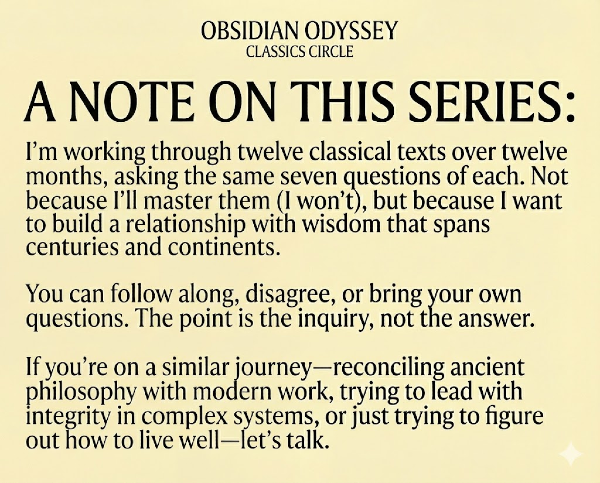
A Note on This Series:
Eight months. Two-thirds complete. The trajectory is becoming clear:
First third (1-4): Philosophy on cultivation Second third (5-7): Literature and psychology on collapse/meaning Final third (8-12): Strategy and journey
After learning to be better and find meaning, now I'm learning to operate effectively—strategically, sustainably, without losing myself in the process.
Next month: Homer's Odyssey—the archetypal journey home. After eight months of learning, I need to think about: What is home? What does return look like? Can you go back after transformation?
The reading continues. The strategy sharpens.
"The supreme art of war is to subdue the enemy without fighting."
— Sun Tzu, The Art of War
IMPORTANT DISCLAIMER
Personal Reflections Only: This essay represents my personal intellectual exploration and learning journey. Nothing herein constitutes investment advice, financial recommendations, or professional guidance of any kind.
No Investment Advice: Any references to investment decisions, portfolio construction, capital allocation, or financial strategies are illustrative examples of personal thought processes only. They do not constitute recommendations to buy, sell, or hold any securities or pursue any investment strategy.
Not Representative of Employer: All views expressed are strictly my own and do not represent the views, opinions, or investment strategies of any current or former employer, client, limited partner, or affiliated entity.
Use of AI Tools: This content was developed with the assistance of AI (Claude by Anthropic) as a thinking and writing partner. All final judgments, interpretations, and opinions remain my own.
Educational Purpose: This series explores classical philosophical texts for personal growth and intellectual development. It is not intended as professional development training or as a framework for institutional decision-making.
No Offer or Solicitation: Nothing in this essay constitutes an offer to sell, or a solicitation to buy, any securities or investment products. No investment decisions should be made based on this content.
![Obsidian Memo] Leadership Ground Truth: What Cuba, Puerto Rico, and Hawai'i Taught Me About Capital and Resilience](/content/images/size/w720/2026/02/Bad-Bunny.jpg)
![Obsidian Memo] Leadership Lessons for Founders: Building “You, Inc.” Without Burning It Down](https://images.unsplash.com/photo-1474917518260-23f84bd71c75?crop=entropy&cs=tinysrgb&fit=max&fm=jpg&ixid=M3wxMTc3M3wwfDF8c2VhcmNofDQyfHxzYWlsaW5nfGVufDB8fHx8MTc3MDkyODg3Mnww&ixlib=rb-4.1.0&q=80&w=720)
![Book] Leadership | Markets Are Made by People: Reading Ken Fisher's 100 Minds That Made the Market](https://images.unsplash.com/photo-1623524713064-257294b0e34b?crop=entropy&cs=tinysrgb&fit=max&fm=jpg&ixid=M3wxMTc3M3wwfDF8c2VhcmNofDN8fHdhbGwlMjBzdHJlZXR8ZW58MHx8fHwxNzcwOTM4MzYzfDA&ixlib=rb-4.1.0&q=80&w=720)
Comments ()