Book] Leadership | Classics Circle: The Analects - Confucius
![Book] Leadership | Classics Circle: The Analects - Confucius](/content/images/size/w1200/2026/02/Gemini_Generated_Image_724h46724h46724h.png)
A Conversation Across Centuries
Reading Time: 14 minutes
Classical Period: 5th century BCE (Ancient China, compiled by disciples)
Core Philosophy: Relationships are everything. Ritual creates harmony. Virtue is cultivated through proper conduct.
Why I'm Reading This
After last month's Machiavelli—who taught me that power is amoral and virtue is often performance—I needed the antidote. I needed someone to tell me that relationships aren't just transactional, that there's meaning in how we conduct ourselves beyond strategic advantage.
I'm reading The Analects on a flight to meet with a family office in Asia. I've been briefed on protocol: the order of greetings, who sits where, how to present my card, when to speak and when to listen. All of this would've felt performative and constraining a year ago.
But this morning, I read Book I, passage 12: "When practicing the rites, what matters most is harmony." And something clicked.
Confucius isn't teaching arbitrary rules. He's teaching that small rituals create space for big relationships. When everyone knows the protocol, no one is anxious about "doing it wrong." That freed attention can focus on substance. Ritual isn't constraint—it's scaffolding for genuine connection.
I'm sharing this exploration publicly because Confucian philosophy has an image problem in the West. We hear "Confucius" and think: rigid hierarchy, unquestioning obedience, patriarchal family structures. All the things modern liberalism rejects.
But I'm discovering something more nuanced: Confucius understood that humans are fundamentally relational beings, and that relationships require cultivation through consistent, thoughtful behavior.
In finance, we pretend we're rational actors optimizing utility. Confucius would say: That's nonsense. You're embedded in webs of relationship—with colleagues, counterparties, communities, ancestors, descendants. Those relationships are your reality. Tend them properly.
We don't exist in isolation. We exist in relationship.
Let's explore what that means.
Part I: The Text and Its Time
Historical Context
- When & Why Written: The Analects (論語, Lúnyǔ) weren't written by Confucius (551-479 BCE) but compiled by his disciples after his death. They're fragments—conversations, aphorisms, teaching moments—not a systematic treatise.
- Original Audience: Initially, Confucius's direct students. Later, anyone aspiring to be a junzi (君子)—often translated as "gentleman" but better understood as "exemplary person" or "person of virtue."
- What Made It Radical: In an era of collapsing feudal order (the "Spring and Autumn Period"), Confucius argued that social harmony didn't require force—it required cultivating virtue in leaders who would inspire virtue in others through example. Revolutionary idea: Moral leadership, not military might, creates stable society.
The Core Argument
Full disclosure: I'm reading this through multiple translations—Edward Slingerland (Hackett, 2003), which includes helpful commentary, and Simon Leys (Norton, 1997), which is more poetic. I've also consulted D.C. Lau's version for comparison.
Additional disclosure: I'm ethnically Korean, which means Confucian philosophy saturated my upbringing whether I was conscious of it or not. I'm trying to read this text freshly, but I can't pretend I'm approaching it neutrally.
Here's what I think Confucius is teaching:
Human beings are fundamentally relational. We become who we are through our relationships. Those relationships require cultivation through ritual propriety (li, 禮), humaneness (ren, 仁), and continuous self-cultivation.
Key concepts:
- Ren (仁, Humaneness/Benevolence): The core virtue. Showing genuine care for others, especially in asymmetric relationships (parent-child, ruler-subject, teacher-student). Not just "being nice"—actively cultivating others' flourishing.
- Li (禮, Ritual Propriety): The forms through which ren expresses itself. Everything from formal ceremonies to everyday manners. Ritual isn't empty—it's the choreography that allows relationships to function smoothly.
- Junzi (君子, Exemplary Person): The goal. Someone who embodies virtue and thereby transforms others through example, not coercion. Contrast with xiaoren (小人, "small person") who acts from self-interest.
- Filial Piety (孝, Xiao): The foundational relationship. How you treat parents shapes how you'll treat everyone else. This generalizes: loyalty, reciprocity, care flow outward from family to community to society.
- The Rectification of Names (正名, Zhengming): Things should correspond to their names. A ruler should actually rule justly. A father should actually be fatherly. When names and reality diverge, society collapses.
Applied to finance in 2025: Confucius would say that ESG frameworks and stakeholder capitalism are correct intuitions—but you can't achieve them through metrics and reporting alone. You need to actually cultivate virtue in leaders, actually tend relationships with communities, actually fulfill the responsibilities inherent in your role.
If you're called an "investor," what does that name demand of you? If you're called a "fiduciary," what must you become to deserve that title?
Part II: Seven Questions I'm Bringing to This Text
Note: Same seven questions. Four months in, patterns are emerging.
Q1: What does this text teach about staying grounded when everything is uncertain?
What Confucius Seems to Say: "If a person is not Good, what can ritual propriety do? If a person is not Good, what can music do?" (Book III, passage 3)
How I'm Translating This to 2025: Confucius's answer to uncertainty isn't stoic discipline (Marcus), flowing adaptation (Lao Tzu), or ruthless pragmatism (Machiavelli). It's: Return to your relationships and your role within them.
When everything is chaotic, you still know your responsibilities: to your team, your stakeholders, your community, your family. Ground yourself there. The question isn't "What should I do?" but "What does my role require of me right now?"
This is particularly powerful in institutional contexts. When markets are crashing, when political winds shift, when everything feels unstable—you still know what a good fiduciary does, what a good colleague does, what a good leader does. Those roles are your anchor.
Q2: How does this work inform thinking about the ethics of capital—where money goes and why?
What Confucius Seems to Say: "The gentleman understands rightness; the small person understands profit." (Book IV, passage 16)
How I'm Translating This to 2025: This is Confucius's direct challenge to Machiavellian thinking. He's not saying profit is evil—he's saying that if your primary orientation is profit, you'll consistently make wrong choices. The junzi asks "What's right?" first. Profit may follow, but it's not the north star.
For capital allocation: Confucius would be deeply skeptical of "maximizing shareholder value" as the sole objective. He'd ask: "What are your responsibilities to all the relationships involved?" Employees, communities, environment, future generations—these aren't "stakeholders" to be managed. They're relationships to be honored.
The Confucian approach to impact investing isn't about ESG scores or impact metrics. It's about asking: "If I deploy capital here, am I fulfilling or violating the relational responsibilities inherent in being a steward of capital?"
This is less legalistic than Western ethics (which asks "What rules must I follow?") and more relational (which asks "Am I being the kind of person this relationship requires?").
What I'm Trying to Practice:
Before significant allocations, I'm mapping the relational web:
- What relationships am I entering? (Founders, co-investors, communities)
- What relationships am I affecting? (Existing portfolios, stakeholders, ecosystems)
- What does being a good partner/steward/citizen require in each?
Q3: What does it reveal about power—how it's gained, wielded, and when to walk away?
What Confucius Seems to Say: "The virtue of the gentleman is like wind, and the virtue of the small person is like grass. When the wind blows over the grass, the grass must bend." (Book XII, passage 19)
How I'm Translating This to 2025: This is the anti-Machiavelli statement. Confucius says: Real power isn't fear—it's moral influence. When a leader genuinely embodies virtue, others naturally align. Not through coercion, but through inspiration.
Machiavelli would scoff: "That's beautiful until someone who doesn't care about virtue takes your kingdom." Fair point. But Confucius is making a different claim: Sustainable power—power that doesn't require constant vigilance and violence—comes from moral authority.
In institutional settings, I see both dynamics:
- Leaders who rule through fear/manipulation → constant politicking, exhausting, collapses when they leave
- Leaders who rule through genuine integrity → people want to follow, culture outlasts the individual
The Confucian challenge: Do you have the patience for moral leadership? It's slower. It requires you actually be virtuous, not just perform virtue. But it compounds.
What I'm Trying to Practice:
I'm experimenting with what I call "exemplary consistency"—letting my behavior teach rather than my words.
Specific practice: Rather than giving speeches about "our values," I'm trying to consistently embody them in small decisions everyone can see. How I treat junior team members in front of seniors. How I respond when things go wrong. Whether I take credit or give it away.
Confucius says people learn more from watching what you do than hearing what you say. I'm testing this.
Early observation: It's slower than directive leadership, but the culture shifts seem more durable.
Q4: How does it address playing the long game when the world rewards short-term thinking?
What Confucius Seems to Say: "The Master said, 'At fifteen, I set my mind upon learning. At thirty, I took my place in society. At forty, I became free of doubts. At fifty, I understood Heaven's Mandate. At sixty, my ear was attuned. At seventy, I could follow my heart's desires without overstepping the bounds of propriety.'" (Book II, passage 4)
How I'm Translating This to 2025: Confucius describes a lifetime of cultivation. Not "10X your productivity in 90 days" but "spend 55 years becoming wise." The long game isn't a strategy—it's the only game.
For capital with multi-generational horizons (endowments, sovereign wealth, family offices), this should resonate: You're not building for quarterly earnings. You're building institutions that will outlive you by decades or centuries.
Confucian long-term thinking is about cultivating relationships and virtue that compound across generations. Your children will benefit from the relationships you tended. Your organization will benefit from the culture you built. Your community will benefit from the integrity you modeled.
This requires faith that invisible work matters—that teaching someone well, honoring a commitment when no one's watching, maintaining standards when it's costly—these accumulate significance over time horizons you won't see.
What I'm Trying to Practice: I'm thinking about every interaction as "planting seeds I won't harvest."
Practical application: Mentoring junior people knowing I probably won't benefit from their future success. Maintaining relationships with people who can't help me right now. Building institutional memory and culture even though I won't be here to see its full flowering.
Confucius says: The junzi plants trees whose shade they'll never sit under. That's not altruism—that's understanding how value actually accumulates across time.
Q5: What wisdom does it offer about identity—especially for those of us who don't fit neatly into one box?
What Confucius Seems to Say: "The Master said, 'The gentleman is not a vessel.'" (Book II, passage 12)
How I'm Translating This to 2025: A vessel has one use. You're not a specialized tool—you're a person, capable of adapting to multiple contexts while maintaining coherent character.
For someone navigating multiple cultural contexts, Confucius offers a different framework than Marcus (inner fortress), Lao Tzu (formless emptiness), or Machiavelli (strategic performance).
Confucius says: Your identity is your web of relationships and your cultivation of virtue within them. You're simultaneously daughter, colleague, investor, mentor, citizen, student. Each relationship has its li (proper forms). Mastering those forms doesn't fragment you—it allows you to be fully present in each.
This resonates with my experience: I'm not "code-switching" between Korean, Canadian, American, British professional contexts. I'm honoring different relational forms while remaining myself. The li changes; the ren (humaneness) doesn't.
Q6: How does it challenge our relationship with time and what we leave behind?
What Confucius Seems to Say: "The Master said, 'A person can enlarge the Way; it is not the Way that enlarges the person.'" (Book XV, passage 29)
How I'm Translating This to 2025: Confucius has a multi-generational view of legacy. You inherit a tradition (the Way), you cultivate it during your lifetime, you pass it forward improved. You're a link in a chain, not the whole chain.
This is radically different from Western individualism, which asks "What did I achieve?" Confucius asks "What did I receive, how did I tend it, what did I pass forward?"
For someone managing institutional capital: You didn't create this capital. Someone (many someones) worked, saved, invested before you. Your job is to be a worthy steward—to pass it forward in better condition, with better governance, serving communities more effectively.
Legacy isn't your name on a building. It's whether the institution is healthier, the relationships are deeper, the mission is clearer because you were there.
What I'm Trying to Practice:
I'm asking: "What did I inherit? How am I tending it? What will I pass forward?"
Inheritance: Professional networks, institutional knowledge, cultural capital, literal financial capital.
Tending: Am I deepening relationships? Improving processes? Mentoring successors? Building institutional memory?
Passing forward: What will the next generation receive from me? Not just returns, but relationships, wisdom, culture.
This framing makes me less precious about "my" achievements and more focused on being a good link in the chain.
Q7: What does it teach about the inner life—the part of leadership no one sees?
What Confucius Seems to Say: "The Master said, 'Studying without thinking is useless; thinking without studying is dangerous.'" (Book II, passage 15)
How I'm Translating This to 2025: Confucius is intensely practical about self-cultivation. You can't think your way to virtue (armchair philosophy), and you can't just practice without reflection (mindless ritual). You need both: study the tradition, reflect on your experience, adjust your practice, repeat.
For the inner life: You need intentional cultivation. Not just meditation (Marcus/Lao Tzu) but active study of exemplars, reflection on your behavior, adjustment based on feedback, consistent practice.
This is more effortful than Lao Tzu's "emptiness" or Marcus's "nature follows reason." Confucius says: Virtue doesn't emerge naturally. You have to work at it—study, practice, reflect, adjust—for decades.
What I'm Trying to Practice: I've created what I'm calling a "Confucian learning cycle":
Study: Reading classics (like this series), biographies of exemplary leaders, case studies of ethical dilemmas.
Practice: Deliberately applying principles in real situations. Not just "being good" generally but practicing specific virtues: ren in difficult conversations, li in cross-cultural settings, yi (righteousness) in conflicted situations.
Reflect: Weekly review asking "Where did I embody virtue? Where did I fall short? What would an exemplary person have done differently?"
Adjust: Based on reflection, what do I need to study more deeply? What do I need to practice more consciously?
This is unglamorous work. No mystical breakthroughs, just consistent cultivation. But I'm noticing: I'm becoming slightly more patient, slightly more thoughtful, slightly more attuned to relational dynamics.
Confucius would say: That's how it works. Small improvements, compounded over decades.
Part III: Five Things I'm Taking From This
(And One Thing I'm Leaving Behind)
Taking #1: Ritual as Relationship Technology
"When practicing the rites, what matters most is harmony." (Book I, passage 12)
I used to see professional rituals—business card exchange, meeting protocols, formal correspondence—as performative nonsense. Confucius helped me understand: These rituals create space for genuine connection by reducing anxiety about "doing it wrong."
When everyone knows the form, attention can focus on substance. When no one knows the form, everyone's anxious, and authentic connection is harder.
I'm now studying the li of different professional contexts not to manipulate but to create space for genuine relationship. Learning the proper forms is respect made visible.
Question I'm sitting with: How do you honor existing rituals while also challenging ones that encode harm (e.g., exclusionary norms)?
Taking #2: You Are Your Relationships
"When you go out, treat everyone as if you were receiving a great guest. Employ people as if you were overseeing a great sacrifice." (Book XII, passage 2)
Confucius fundamentally rejects individualism. You're not a self-contained atom—you're a node in a web of relationships. How you treat others literally shapes who you are.
This changes how I think about "professional relationships." They're not transactional connections to be optimized—they're constitutive of my identity. If I treat colleagues as resources, I become a resourceful user of people. If I treat colleagues as partners in mutual flourishing, I become a different person.
Practically: I'm investing more time in relationships that have no immediate ROI. Building friendships, not just networks. Tending relationships after deals close, not just during negotiation.
Question I'm sitting with: In capitalism's transactional logic, how do you maintain genuinely non-instrumental relationships?
Taking #3: Exemplary Behavior Teaches More Than Words
"The gentleman is like wind, and the small person is like grass. When the wind blows over the grass, the grass must bend." (Book XII, passage 19)
I've spent too much energy on "communications strategy"—crafting the right message, the perfect framing. Confucius says: People watch what you do far more than they listen to what you say.
If you want to build a culture of integrity, don't give speeches about integrity—embody it consistently in small decisions everyone can see. How you handle mistakes. How you treat people with no power. Whether you cut corners when no one's watching.
I'm trying to let my behavior teach. It's slower. It's humbling (because your failures are also teaching). But it's more durable.
Question I'm sitting with: How long does exemplary consistency take to shift culture? And can you sustain it that long?
Taking #4: Names Must Match Reality
"If names are not rectified, then language will not be appropriate. If language is not appropriate, then things will not get done." (Book XIII, passage 3)
This is Confucius's most practical insight for institutional governance. When people's titles don't match their actual authority, when mission statements don't match actual priorities, when "values" don't match behaviors—organizations become dysfunctional.
The solution isn't better branding—it's making reality match the names. If you're called a "sustainable investor," your entire practice must actually be sustainable. If you're called a "partner," act like a partner. If you're called a "leader," actually lead.
I'm using this to audit my own practices: Where am I using words that don't match reality? Where is there gap between aspiration and actuality?
Question I'm sitting with: When you discover misalignment, do you change the name or change the reality? When is each appropriate?
Taking #5: Lifetime Cultivation Over Quick Fixes
"At seventy, I could follow my heart's desires without overstepping the bounds of propriety." (Book II, passage 4)
Confucius spent 55 years of conscious cultivation before achieving integration of desire and virtue. That's not a hack—that's a life's work.
This is antidote to productivity culture, optimization culture, "unlock your potential in 90 days" culture. Confucius says: Becoming an exemplary person takes decades of patient work. Accept this. Start now. Keep going.
For professional development: Stop looking for shortcuts. Focus on consistent cultivation—reading, reflection, practice, adjustment—compounded over years.
I'm reorienting my expectations: I'm not going to "master" ethical leadership. I'm going to spend the next several decades becoming slightly better at it. That's the work.
Question I'm sitting with: In a culture that rewards visible achievement, how do you sustain invisible cultivation?
Leaving Behind: Uncritical Acceptance of Hierarchy
"Let the ruler be a ruler, the subject a subject, the father a father, the son a son." (Book XII, passage 11)
Here's where Confucius loses me. His philosophy is deeply hierarchical—not just descriptively (hierarchy exists) but prescriptively (hierarchy should exist and be honored).
The five cardinal relationships are all vertical: ruler-subject, father-son, husband-wife, elder-younger, friend-friend (this one's horizontal, at least). And the junior party always owes deference to the senior.
This might have made sense in 5th century BCE China. It's morally indefensible now. Hierarchies based on birth, gender, age—these encode systemic injustice.
I'm taking Confucius's insights about relationship, ritual, and cultivation while rejecting his assumption that existing hierarchies are natural and good. You can honor earned authority (expertise, wisdom, demonstrated virtue) without endorsing hierarchy based on identity categories.
The synthesis I'm seeking: Confucian relational ethics within egalitarian structures. Not sure if that's coherent or contradictory.
Part IV: How I'm Working With This
My Co-Writing Process with Claude
I read Edward Slingerland's translation (with commentary) first, which helped decode cultural context I needed despite ethnic background. Then Simon Leys's more poetic version. Then D.C. Lau for comparison on difficult passages.
The Analects is fragmentary and repetitive—same teachings appear multiple times in different forms. Claude helped me organize themes and identify which passages best illustrated each concept.
We also wrestled with: How do you take Confucian insights without importing its problematic hierarchies? Can you have relational ethics without rigid role-based obligations? Is Confucius's vision even possible in modern individualistic cultures?
This essay reflects my attempt to take what's valuable (relationship as primary, ritual as respect, cultivation as lifelong work) while leaving behind what's harmful (rigid hierarchy, gender roles, unquestioning filial piety).
What Claude adds: Historical/cultural context, connections to other philosophical traditions, pushback when I'm cherry-picking only comfortable parts.
What I add: The felt experience of navigating multiple cultural contexts where Confucian norms have different weights. The question of how to honor relationship without losing autonomy. The tension between relational obligations and individual authenticity.
Integration Experiments (What I'm Actually Trying)
In the Next 30 Days:
Before every significant interaction, I'm asking: "What does this relationship require of me?" Not "What do I want from this?" but "What would an exemplary person in my position do?"
In the Next Crisis:
Ground myself not in abstract principles but in specific relationships and their obligations. Who am I responsible to? What do those relationships require?
In My Next Reflection:
Journal prompt: "Where am I treating relationships transactionally? Where am I failing to honor obligations? What cultivation work am I avoiding?"
If You're Reading This Too
Where to Start:
Edward Slingerland's translation (Hackett, 2003) is excellent—clear translation with helpful commentary for Western readers. Simon Leys (Norton, 1997) is more literary. Avoid older translations that use "Confucius says" constructions—they make him sound like a fortune cookie.
Read Next:
- Mencius (Confucius's most important successor, more idealistic)
- Xunzi (Confucius's other major successor, more realistic)
- The Doctrine of the Mean (one of the Four Books, explores balance)
Pair With:
- Film: The Last Emperor (1987)—Confucian ritual meets modernity
- Book: The Analects of Dasan by Dasan Jeong Yak-yong (Korean Neo-Confucian commentary)
- Practice: Observe formal meetings in different cultures. Notice the li (ritual forms) and how they create space.
Questions I'm Still Sitting With
- Can you have Confucian relational ethics without Confucian hierarchy? Or is the hierarchy essential to the system?
- What do you do when relational obligations conflict? Family vs. professional duty. Loyalty to mentor vs. institutional mission. Confucius doesn't really answer this.
- Is cultivation actually working or am I just getting older? How do I know if I'm becoming more virtuous or just more comfortable with my flaws?
- Can Western individualistic cultures ever truly understand Confucius? Or will we always cherry-pick the parts that fit our existing worldview?
- What would Confucius say about relationships mediated by technology? Are digital relationships real relationships? Do they deserve li?
Published in: Obsidian Odyssey
Series: Classics Circle (#4 of 12)
Previous in Series: The Prince by Machiavelli – "Power Without Illusions"
Next in Series: Things Fall Apart by Chinua Achebe – "When the Center Cannot Hold"
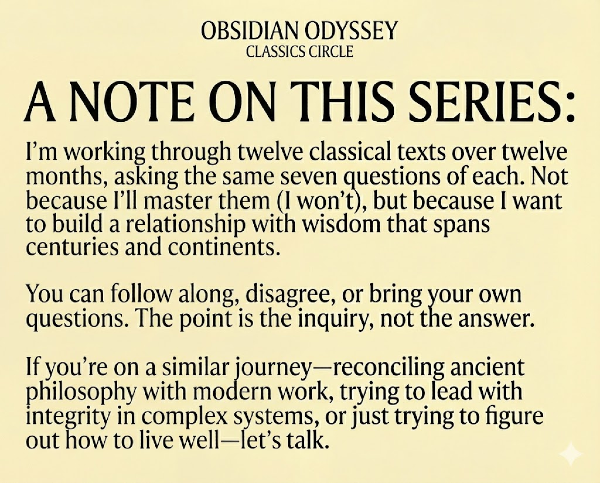
A Note on This Series:
Four months, four radically different philosophies:
- Marcus: Individual virtue through internal discipline
- Lao Tzu: Individual power through strategic emptiness
- Machiavelli: Individual survival through political realism
- Confucius: You're not an individual—you're a web of relationships
Each successive text complicates the previous. That's by design. The goal isn't synthesis (yet)—it's holding multiple truths in tension.
Next month: Chinua Achebe on what happens when entire worlds collide. After four months of philosophy focused on cultivation and strategy, we need literature that shows what happens when all your cultivation can't prevent collapse.
The work continues.
"The gentleman harmonizes but does not merely agree; the small person agrees but does not harmonize."
— Confucius, The Analects, Book XIII, passage 23
IMPORTANT DISCLAIMER
Personal Reflections Only: This essay represents my personal intellectual exploration and learning journey. Nothing herein constitutes investment advice, financial recommendations, or professional guidance of any kind.
No Investment Advice: Any references to investment decisions, portfolio construction, capital allocation, or financial strategies are illustrative examples of personal thought processes only. They do not constitute recommendations to buy, sell, or hold any securities or pursue any investment strategy.
Not Representative of Employer: All views expressed are strictly my own and do not represent the views, opinions, or investment strategies of any current or former employer, client, limited partner, or affiliated entity.
Use of AI Tools: This content was developed with the assistance of AI (Claude by Anthropic) as a thinking and writing partner. All final judgments, interpretations, and opinions remain my own.
Educational Purpose: This series explores classical philosophical texts for personal growth and intellectual development. It is not intended as professional development training or as a framework for institutional decision-making.
No Offer or Solicitation: Nothing in this essay constitutes an offer to sell, or a solicitation to buy, any securities or investment products. No investment decisions should be made based on this content.
Consult Professionals: Readers should consult qualified financial, legal, and tax professionals before making any investment or financial decisions.
![Obsidian Memo] Leadership Ground Truth: What Cuba, Puerto Rico, and Hawai'i Taught Me About Capital and Resilience](/content/images/size/w720/2026/02/Bad-Bunny.jpg)
![Obsidian Memo] Leadership Lessons for Founders: Building “You, Inc.” Without Burning It Down](https://images.unsplash.com/photo-1474917518260-23f84bd71c75?crop=entropy&cs=tinysrgb&fit=max&fm=jpg&ixid=M3wxMTc3M3wwfDF8c2VhcmNofDQyfHxzYWlsaW5nfGVufDB8fHx8MTc3MDkyODg3Mnww&ixlib=rb-4.1.0&q=80&w=720)
![Book] Leadership | Markets Are Made by People: Reading Ken Fisher's 100 Minds That Made the Market](https://images.unsplash.com/photo-1623524713064-257294b0e34b?crop=entropy&cs=tinysrgb&fit=max&fm=jpg&ixid=M3wxMTc3M3wwfDF8c2VhcmNofDN8fHdhbGwlMjBzdHJlZXR8ZW58MHx8fHwxNzcwOTM4MzYzfDA&ixlib=rb-4.1.0&q=80&w=720)
Comments ()