Book] Leadership | Classics Circle: Tao Te Ching - Lao Tzu
![Book] Leadership | Classics Circle: Tao Te Ching - Lao Tzu](/content/images/size/w1200/2026/02/Gemini_Generated_Image_spcaumspcaumspca.png)
A Conversation Across Centuries
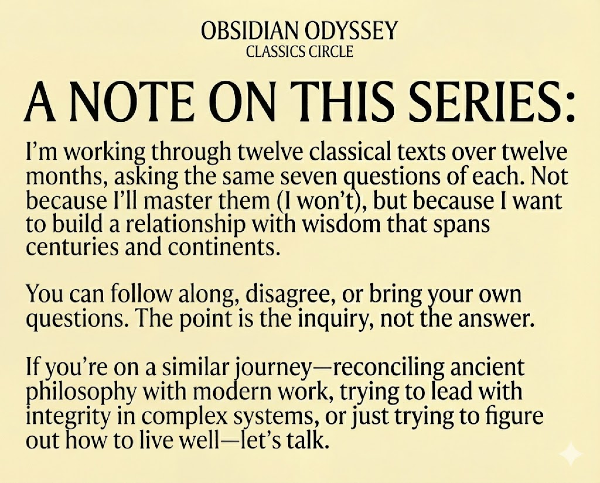
Reading Time: 13 minutes
Classical Period: 6th century BCE (Ancient China)
Core Philosophy: Lead by not forcing. Flow like water. The softest overcomes the hardest.
Why I'm Reading This
I opened the Tao Te Ching randomly to Chapter 78: "Nothing in the world is as soft and yielding as water. Yet for dissolving the hard and inflexible, nothing can surpass it."
I've been carrying Stephen Mitchell's translation of this text for a decade—ever since a mentor handed it to me. But I'd only been reading it in fragments, treating it like a fortune cookie dispenser rather than a coherent philosophy.
After working through Marcus Aurelius's Meditations last month (you can read that exploration here), I realized: I needed to understand Lao Tzu's alternative. If the Stoics teach you to build an inner fortress, the Taoists teach you to be like water—formless, adaptive, patient, and ultimately more powerful than anything rigid.
I'm sharing this exploration publicly because I want to be honest about something: Most of financial services culture is anti-Taoist. We worship force: force of conviction, force of will, forcing deals to close, forcing portfolio companies to scale. We use war metaphors constantly—"conquest," "killing it," "crushing targets."
But what if that's precisely backwards? What if the soft overcomes the hard? What if wu wei (action through non-action) is actually the highest form of strategic sophistication?
I'm working through this text with Claude not to "apply ancient wisdom to modern finance" like some LinkedIn thought leadership post, but because I genuinely don't know how to reconcile what Lao Tzu teaches with the world I operate in.
Let's figure it out together.
Part I: The Text and Its Time
Historical Context
- When & Why Written: Traditionally attributed to Lao Tzu (6th century BCE), though modern scholars debate whether this was one author or a compilation. Written during China's Warring States period—an era of intense political chaos and philosophical ferment.
- Original Audience: Initially, this was wisdom literature for rulers and sages. The text addresses how to govern without coercion, how to lead without domination.
- What Made It Radical: In a time of Confucian emphasis on rigid hierarchy and moral rules, Lao Tzu said: "The Tao that can be told is not the eternal Tao." He advocated for mystery, flexibility, and non-interference—heretical ideas for structured society.
The Core Argument
Full transparency: The Tao Te Ching is hard. It's 81 short chapters of poetic paradox. I'm reading Stephen Mitchell's translation, which scholars criticize as too loose but which makes the text accessible to non-specialists like me. I've also consulted Ursula K. Le Guin's version and the Red Pine translation for comparison.
Here's what I think Lao Tzu is saying (though I might be completely wrong):
The Tao (道, "The Way") is the fundamental principle underlying reality. It's nameless, formless, and cannot be grasped through logic or force. But you can align with it—by observing how water flows, how nature grows, how seasons change. Nature doesn't force. Nature yields, adapts, persists.
The central thesis: The soft overcomes the hard. Action through non-action (wu wei) is more powerful than force.
This isn't passivity—it's strategic patience. The classic example: Water doesn't fight rock. Water flows around rock. Given time, water dissolves rock. That's not weakness. That's ultimate power.
For governance (which is what most of the text is about), this means:
- Lead by not dominating — The best leader is barely noticed
- Accomplish without claiming credit — Results matter, ego doesn't
- Know when to stop — Overextension leads to collapse
- Empty yourself — Be receptive rather than full of opinions
Applied to capital allocation in 2025: What would it mean to invest like water rather than like a hammer? To find the natural flow rather than forcing a thesis? To accomplish results without the aggressive value-creation playbook?
I genuinely don't know yet. That's why I'm working through this.
Part II: Seven Questions I'm Bringing to This Text
Note: Same seven questions I ask of every book in this series. Not because they're "right," but because they're mine.
Q1: What does this text teach about staying grounded when everything is uncertain?
What Lao Tzu Seems to Say: "Do you have the patience to wait till your mud settles and the water is clear? Can you remain unmoving till the right action arises by itself?" (Chapter 15)
How I'm Translating This to 2025: This is radically counter-cultural in financial services. We're rewarded for doing—for having opinions, making moves, demonstrating conviction. "I'm waiting for clarity" sounds like indecision.
But Lao Tzu is saying: Sometimes the highest form of wisdom is not acting until the situation clarifies itself. Not because you're afraid, but because premature action in murky conditions often makes things worse.
In investing, I think this means: When everyone is panicking or euphoric, when data is contradictory, when the "right move" is unclear—maybe the right move is to wait. Let the mud settle. Watch what emerges.
This doesn't mean analysis paralysis. It means distinguishing between productive action and action-as-anxiety-relief.
What I'm Trying to Practice: I've started keeping a "Non-Action Log." When I feel the urge to do something—rebalance, make a call, send an email—I first write: "What am I afraid will happen if I don't act right now?"
Sometimes the answer reveals I'm just managing my own anxiety, not responding to real necessity. In those cases, I wait 24 hours. Often, the "urgent" action reveals itself as unnecessary.
This is uncomfortable. Finance culture doesn't reward waiting. But I'm experimenting with it anyway.
Q2: How does this work inform thinking about the ethics of capital—where money goes and why?
What Lao Tzu Seems to Say: "The Master does nothing, yet leaves nothing undone." (Chapter 37)
"When you realize there is nothing lacking, the whole world belongs to you." (Chapter 44)
How I'm Translating This to 2025: Lao Tzu's concept of wu wei (action through non-action) challenges the entire activist investment model. We're taught that value creation requires aggressive intervention—bring in new management, restructure operations, force strategic pivots.
But what if the highest form of capital stewardship is creating conditions for natural flourishing rather than forcing growth?
This doesn't mean being passive. It means asking: What does this company/ecosystem/community actually need to thrive on its own terms? How do I remove obstacles rather than impose solutions?
I'm thinking about this particularly in impact investing. So much "impact" is actually extraction dressed up in ESG language—we force our theory of change onto communities without listening to what they actually need.
Taoist capital allocation might mean: Patient, adaptive funding that follows the natural development curve rather than imposing artificial timelines. Backing founders who know their context better than I ever will. Knowing when to exit not because I hit my return target, but because my capital is no longer needed.
Q3: What does it reveal about power—how it's gained, wielded, and when to walk away?
What Lao Tzu Seems to Say: "The best leader is one whose existence is barely known. When the work is done and the aim fulfilled, the people will say, 'We did it ourselves.'" (Chapter 17)
How I'm Translating This to 2025: This is the opposite of the charismatic leader model dominating business culture. We celebrate CEOs who "take charge," who "drive transformation," whose personalities are inseparable from their companies.
Lao Tzu would find this grotesque. For him, the highest leadership is invisible leadership—you create conditions where the right things happen naturally, and people don't even realize you were involved.
In institutional investing, this challenges the entire GP/LP dynamic. Most fund managers want recognition for their value-add. They want portfolio companies to credit them publicly. They want LPs to see their interventions.
But Taoist power would be: making yourself so unnecessary that your portfolio companies thrive without you. Wielding influence so subtly that people think it was their idea. Walking away the moment your presence becomes about ego rather than value.
What I'm Trying to Practice: I'm experimenting with what I call "anonymous impact." In a recent situation, I helped facilitate a connection between two parties who could benefit from working together. I didn't announce it. I didn't ask for credit. I just made the introduction and stepped back.
They partnered successfully. To this day, I don't think either knows I was involved. Old me would've been frustrated by the lack of recognition. Taoist me felt strangely satisfied—the thing that needed to happen, happened. That's enough.
Still learning when this is wisdom versus when it's avoiding healthy acknowledgment of contribution.
Q4: How does it address playing the long game when the world rewards short-term thinking?
What Lao Tzu Seems to Say: "Nature does not hurry, yet everything is accomplished." (Chapter 2)
"A tree that grows as wide as a man's embrace grows from a tiny shoot." (Chapter 64)
How I'm Translating This to 2025: Financial markets are fundamentally anti-Taoist. We've commodified time—quarterly earnings, annual performance reviews, fund life cycles, exit timelines. Everything must happen on a predetermined schedule.
But Lao Tzu observes: Natural systems don't work on schedules. Trees grow at the pace trees grow. You can't force a forest into existence. You plant, you water, you wait. Rushing doesn't help.
For long-term capital (endowments, sovereign wealth, family offices), this should be intuitive. But even multi-generational capital often operates on artificial timelines because humans crave milestones and validation.
(This is my purely blue sky dreaming for my future retirement project - if I ever were to run my own foundation or family office at one point in my life) I'm thinking about what it would mean to invest on "natural time" rather than "calendar time." To fund initiatives not with a 5-year expectation but with a "as long as it takes" patience. To evaluate success not by IRR but by "did something meaningful come into being?"
What I'm Trying to Practice: I've stopped using the phrase "patient capital" because even that implies waiting is hard. Instead, I'm trying to think in terms of "natural capital"—capital that moves at the pace the opportunity actually requires.
Practically: When I'm assessing an investment opportunity, I ask: "What is the natural development cycle of this solution?" If it's climate adaptation infrastructure, that might be 20-30 years. If I can't commit to that timeframe, I shouldn't deploy capital just to hit deployment targets.
This requires institutional courage I'm not sure I always have. But I'm working on it.
Q5: What wisdom does it offer about identity—especially for those of us who don't fit neatly into one box?
What Lao Tzu Seems to Say: "The Tao is like a well: used but never used up. It is like the eternal void: filled with infinite possibilities." (Chapter 4)
"Empty yourself of everything. Let the mind rest at peace." (Chapter 16)
How I'm Translating This to 2025: Last month with Marcus Aurelius, I worked through identity as "character in action." Lao Tzu offers something different: identity as emptiness—not in a nihilistic sense, but as infinite adaptability.
For those of us who've lived across cultures, this resonates. I'm not Korean enough for Seoul, not ruthless enough for New York, not British enough for London. I used to experience this as fragmentation.
Lao Tzu reframes it: That's not fragmentation. That's emptiness in the Taoist sense—being unformed enough to take any shape required. Like water, which has no fixed form but can fill any container.
This is different from code-switching (which I talked about in the Meditations essay). Code-switching is exhausting performance. Taoist emptiness is effortless adaptation—you're not pretending to be something you're not, you're simply being whatever the situation calls for without resistance.
What I'm Trying to Practice: I'm working on what I think of as "formless presence." In any context—whether I'm speaking with founders, negotiating with institutional partners, or presenting to boards—I'm trying to arrive without a fixed identity to defend.
Not: "I am the ESG expert" or "I am the global investor" or "I am the woman challenging male-dominated systems." Just: "I am here. What does this situation need?"
Sometimes it needs expertise. Sometimes it needs listening. Sometimes it needs challenge. I'm practicing letting that emerge naturally rather than coming in with a predetermined role.
This is weird and uncomfortable. But I think it might be getting at something important.
Q6: How does it challenge our relationship with time and what we leave behind?
What Lao Tzu Seems to Say: "If you want to become whole, let yourself be partial. If you want to become straight, let yourself be crooked. If you want to become full, let yourself be empty." (Chapter 22)
How I'm Translating This to 2025: Where Marcus Aurelius dealt with mortality head-on ("You could die tomorrow"), Lao Tzu approaches it obliquely through paradox. The way to become whole is to embrace incompleteness. The way to achieve fullness is to remain empty.
For legacy-building, this is provocative: Maybe the way to leave a meaningful legacy is to stop trying to leave a legacy. Maybe the obsession with being remembered is precisely what makes our work less durable.
I think about family offices and foundations named after patriarchs/matriarchs. The names are literally carved in stone—"The [Name] Foundation." But does that naming actually preserve their values, or does it ossify them? What if the highest form of legacy is creating something so adaptive it survives precisely because it's not tied to your identity?
What I'm Trying to Practice: I'm experimenting with what I call "legacy by dissolution." Rather than trying to build something with my name on it, I'm asking: What would it mean to create structures that could outlast me because they're not about me?
Practically, this means: When I fund initiatives, I don't require my involvement to be visible. When I build systems, I design them to be transferable. When I mentor, I explicitly tell people: "The goal is for you to outgrow needing me."
This runs counter to every incentive in professional life—we're supposed to build personal brands, cultivate dependent relationships, make ourselves indispensable. But I'm exploring what happens when you deliberately make yourself dispensable.
Early results: It's terrifying and liberating in equal measure.
Q7: What does it teach about the inner life—the part of leadership no one sees?
What Lao Tzu Seems to Say: "To the mind that is still, the whole universe surrenders." (Chapter 45, some translations)
"In dwelling, live close to the ground. In thinking, keep to the simple." (Chapter 8)
How I'm Translating This to 2025: Marcus Aurelius taught me to journal, to examine thoughts, to build an inner fortress. Lao Tzu teaches something harder: stillness. Not mental discipline, but mental emptiness.
This is challenging in a knowledge-work culture that valorizes constant thinking. We're supposed to have opinions, frameworks, analyses ready at all times. "I don't know" feels like weakness. Silence in meetings feels like having nothing to contribute.
But Lao Tzu suggests: The person with the still mind sees more clearly than the person with the busy mind. Receptivity is a form of power.
I'm thinking about this in the context of decision-making under uncertainty. When I'm dealing with complex situations—geopolitical risk, technological disruption, systemic transitions—my instinct is to think harder, analyze more, build better models.
But what if the answer is the opposite? What if I need to think less? To create more internal space? To let understanding arise from stillness rather than force it through analysis?
What I'm Trying to Practice: I've added what I'm calling "Taoist pauses" to my daily rhythm:
- Before major decisions: 10 minutes of sitting in silence. Not meditation with a technique—just sitting. Seeing what arises.
- Before meetings: 60 seconds of doing absolutely nothing. Not reviewing notes, not formulating strategy. Just being still.
- Weekly "emptiness day": One day where I schedule nothing. No calls, no emails, no work. I call it "maintenance of the void."
Does this make me a better investor? I honestly don't know yet. It makes me a calmer human, which probably matters more.
Part III: Five Things I'm Taking From This
(And One Thing I'm Leaving Behind)
Taking #1: Strategic Patience as Competitive Advantage
The Tao Te Ching teaches that water doesn't break rocks by force—it flows around them. Given time, the rock dissolves. This isn't passivity; it's understanding that time is a form of power.
In investing, everyone is racing—racing to deploy, racing to exit, racing to prove thesis. What if the competitive advantage is being the only one willing to wait? To let opportunities come to you rather than chasing them? To outlast competitors through sheer patience?
I'm testing this by tracking "opportunities I didn't pursue" and checking back 12-24 months later. Hypothesis: Most of what feels urgent in the moment wasn't actually important. The practice is building the muscle to distinguish true opportunity from manufactured urgency.
Question I'm sitting with: When does patience become procrastination? How do you know?
Taking #2: Lead by Creating Space, Not Filling It
"The Master leads by emptying people's minds and filling their cores." (Chapter 3)
I used to think leadership meant having answers. Coming into every situation with solutions, frameworks, opinions. But Lao Tzu suggests: Maybe great leadership is creating space for other people's wisdom to emerge.
In practice: In meetings, I'm experimenting with asking more questions and offering fewer opinions. In funding relationships, I'm trying to listen to what founders actually need rather than imposing what I think they need. In team settings, I'm practicing silence—creating space for quieter voices.
This is uncomfortable because it looks like I'm "not adding value." But I'm noticing: When I stop filling every silence, other people's insights emerge. Often better than what I would've said.
Question I'm sitting with: How do you balance "creating space" with shirking responsibility?
Taking #3: The Power of Knowing When to Stop
"Whoever knows contentment will not suffer disgrace. Whoever knows when to stop will not suffer harm. This is enduring forever." (Chapter 44)
Financial culture has no concept of "enough." Every fund wants to be bigger. Every portfolio company must scale faster. Every career must reach higher. Contentment is treated as lack of ambition.
But Lao Tzu observes: Overextension leads to collapse. A tree that grows too fast topples in wind. Knowing when to stop is wisdom.
I'm thinking about this in terms of fund size, deployment pace, geographic expansion. What if "we're the right size" was a legitimate strategy? What if "we're not pursuing that opportunity" wasn't failure but discipline?
Practically, I'm asking before every new initiative: "What are we saying no to in order to say yes to this? Is that trade worth it?"
Question I'm sitting with: In a competitive field, does "knowing when to stop" just mean losing to someone willing to go further?
Taking #4: Your Reputation Is What Others Say After You Leave
"When the Master governs, the people are hardly aware that he exists. When his work is done, his aim fulfilled, they will say: 'We did it ourselves.'" (Chapter 17)
Last month, Marcus Aurelius taught me not to care about reputation. Lao Tzu offers something subtler: The highest form of leadership is when people don't even realize you led them.
This is the opposite of personal branding. It's about making your contribution so naturally integrated that it's invisible. The infrastructure that works so well you forget it's there. The mentorship that empowers people to believe they succeeded independently.
I'm trying this by making my interventions less visible. Not announcing "wins." Not requiring acknowledgment. Just quietly doing what needs doing and letting results speak.
Question I'm sitting with: Is this wisdom or is it just avoiding healthy recognition of contribution? Where's the line?
Taking #5: Emptiness as Capacity
"Thirty spokes share the wheel's hub; It is the center hole that makes it useful. Shape clay into a vessel; It is the space within that makes it useful." (Chapter 11)
Lao Tzu's insight: The value is in the emptiness. The wheel works because of the hole. The cup is useful because it's hollow.
For someone whose professional worth is supposedly measured by expertise and knowledge, this is threatening. It suggests my value might actually be in not knowing—in creating space rather than filling it.
I'm experimenting with "strategic ignorance." Not pretending to have opinions on things I don't understand. Being genuinely curious rather than strategically inquisitive. Arriving at situations without predetermined conclusions.
Early observation: When I don't come in with fixed views, I learn faster and people share more openly.
Question I'm sitting with: How do you communicate value to stakeholders when your value is increasingly "creating space for emergence" rather than "delivering answers"?
Leaving Behind: The Fantasy of Total Non-Attachment
Lao Tzu writes beautifully about non-attachment, but he was allegedly an Imperial Archivist who renounced society and rode off on a water buffalo. That's a luxury most of us don't have.
I'm embedded in systems—contractual obligations, fiduciary duties, team responsibilities. I can't just "flow like water" when people are depending on me to show up in specific ways at specific times.
The Tao Te Ching can romanticize withdrawal. Chapter after chapter suggests the sage lives apart, undisturbed by worldly concerns. That's fine if you're a hermit. It's not fine if you're managing other people's capital or responsible for other people's livelihoods.
So I'm taking the principles—patience, non-force, strategic emptiness—while acknowledging I can't fully embody the Taoist ideal. I'm looking for "Taoism within institutional constraints," which might be a contradiction but is the reality I'm working with.
The practice is: Take what's useful. Acknowledge the limits. Don't pretend you're living in ancient China.
Part IV: How I'm Working With This
My Co-Writing Process with Claude
I read Stephen Mitchell's translation first, by hand, marking passages. Then I read Ursula K. Le Guin's version (which is more poetic) and consulted Red Pine's translation (which includes historical commentary). I brought my confusions and questions to Claude.
The Tao Te Ching is genuinely difficult because it's paradoxical by design. Lao Tzu intentionally uses language that defeats logical analysis. So Claude and I went in circles a lot—trying to understand what "action through non-action" actually means, debating whether Lao Tzu is talking about passivity or sophisticated strategy.
This essay is the result of that conversation, heavily edited by me to reflect what I'm genuinely struggling with (not what sounds wise).
I'm being transparent about this because I want peers to see: You can engage with difficult philosophy without having a PhD. You can work with AI tools without pretending you're a scholar. The point is sincere engagement, not perfect understanding.
What Claude adds: Multiple translation comparisons, historical context, pushback when I'm misreading something.
What I add: The discomfort. The honest confusion. The attempt to map ancient wisdom onto modern dilemmas where they might not fit.
Integration Experiments (What I'm Actually Trying)
In the Next 30 Days: Before any major decision, I'm asking: "What would happen if I waited one more week? What would emerge?" Not as analysis paralysis, but as experiment in patience.
In the Next Crisis: When something goes wrong, I'm going to try the Taoist response: "Interesting. What wants to happen here?" Rather than immediately strategizing a fix, see what naturally unfolds.
In My Next Reflection: Journal prompt: "Where am I forcing versus flowing? What would it look like to remove obstacles rather than impose solutions?"
If You're Reading This Too
Where to Start:
Stephen Mitchell's translation (Harper Perennial, 2006) is the most accessible, though scholars critique it as too interpretive. Ursula K. Le Guin's version (Shambhala, 2019) is more poetic. Red Pine's translation (Mercury House, 2009) includes historical commentary if you want more context.
Read Next:
- The Book of Chuang Tzu (the other foundational Taoist text, more playful)
- Zen and the Art of Archery by Eugen Herrigel (Eastern philosophy applied to practice)
- The Wisdom of Insecurity by Alan Watts (modern interpretation of Eastern non-attachment)
Pair With:
- Podcast: "The Tao of Craft" conversations on embodied practice
- Film: Crouching Tiger, Hidden Dragon (2000)—watch for the water fight scene
- Music: Philip Glass's Koyaanisqatsi soundtrack—or just sit in silence
Questions I'm Still Sitting With
- Is "Taoist capital" even possible within fiduciary structures? If I have a duty to maximize returns for beneficiaries, can I practice wu wei? Or is that just failing to do my job?
- How do you distinguish strategic patience from fear? Sometimes waiting is wisdom. Sometimes it's avoidance. How do you know which?
- What's the difference between Taoist emptiness and checking out? Between creating space for emergence and just not engaging? This line feels very thin to me.
- Can you lead a team using Taoist principles in a non-Taoist organization? Or do you just confuse everyone and underperform?
- Is the goal to "be like water" or to know when to be like water versus when to be like rock? Maybe the highest wisdom is knowing which element the situation requires?
Published in: Obsidian Odyssey
Series: Classics Circle (#2 of 12)
Previous in Series: Meditations by Marcus Aurelius – "The Inner Fortress"
Next in Series: The Prince by Niccolò Machiavelli – "Power Without Illusions"
"The Tao that can be told is not the eternal Tao.
The name that can be named is not the eternal name.
The nameless is the beginning of heaven and earth."
— Lao Tzu, Tao Te Ching, Chapter 1
IMPORTANT DISCLAIMER
Personal Reflections Only: This essay represents my personal intellectual exploration and learning journey. Nothing herein constitutes investment advice, financial recommendations, or professional guidance of any kind.
No Investment Advice: Any references to investment decisions, portfolio construction, capital allocation, or financial strategies are illustrative examples of personal thought processes only. They do not constitute recommendations to buy, sell, or hold any securities or pursue any investment strategy.
Not Representative of Employer: All views expressed are strictly my own and do not represent the views, opinions, or investment strategies of any current or former employer, client, limited partner, or affiliated entity.
Use of AI Tools: This content was developed with the assistance of AI (Claude by Anthropic) as a thinking and writing partner. All final judgments, interpretations, and opinions remain my own.
Educational Purpose: This series explores classical philosophical texts for personal growth and intellectual development. It is not intended as professional development training or as a framework for institutional decision-making.
No Offer or Solicitation: Nothing in this essay constitutes an offer to sell, or a solicitation to buy, any securities or investment products. No investment decisions should be made based on this content.
Consult Professionals: Readers should consult qualified financial, legal, and tax professionals before making any investment or financial decisions.
![Obsidian Memo] Leadership Ground Truth: What Cuba, Puerto Rico, and Hawai'i Taught Me About Capital and Resilience](/content/images/size/w720/2026/02/Bad-Bunny.jpg)
![Obsidian Memo] Leadership Lessons for Founders: Building “You, Inc.” Without Burning It Down](https://images.unsplash.com/photo-1474917518260-23f84bd71c75?crop=entropy&cs=tinysrgb&fit=max&fm=jpg&ixid=M3wxMTc3M3wwfDF8c2VhcmNofDQyfHxzYWlsaW5nfGVufDB8fHx8MTc3MDkyODg3Mnww&ixlib=rb-4.1.0&q=80&w=720)
![Book] Leadership | Markets Are Made by People: Reading Ken Fisher's 100 Minds That Made the Market](https://images.unsplash.com/photo-1623524713064-257294b0e34b?crop=entropy&cs=tinysrgb&fit=max&fm=jpg&ixid=M3wxMTc3M3wwfDF8c2VhcmNofDN8fHdhbGwlMjBzdHJlZXR8ZW58MHx8fHwxNzcwOTM4MzYzfDA&ixlib=rb-4.1.0&q=80&w=720)
Comments ()