Book] Leadership | Classics Circle: One Hundred Years of Solitude - Gabriel García Márquez
![Book] Leadership | Classics Circle: One Hundred Years of Solitude - Gabriel García Márquez](/content/images/size/w1200/2026/02/Gemini_Generated_Image_q1ac2gq1ac2gq1ac.png)
A Conversation Across Centuries
Reading Time: 16 minutes
Classical Period: Published 1967 (set in fictional Macondo, Colombia, spanning ~100 years)
Core Philosophy: Time is circular. Families repeat patterns. Solitude is the inheritance we can't escape.
Why I'm Reading This
After Achebe showed me worlds collapsing, I needed García Márquez to show me worlds that never really change—where the same patterns repeat across generations, where progress is illusion, where time moves in circles not lines.
I'm reading One Hundred Years of Solitude at my family home during a rare visit. My father is showing me documents—genealogy charts tracing our family back nine centuries, to Song Dynasty China. Records of scholars, officials, landowners. A millennium of documented lineage.
He's proud. I'm overwhelmed.
Then I read García Márquez's opening: "Many years later, as he faced the firing squad, Colonel Aureliano Buendía was to remember that distant afternoon when his father took him to discover ice."
And I understand: This is a book about the weight of family history. About how the past doesn't stay in the past—it repeats, disguised as present. About how each generation thinks they're breaking free while actually reenacting the same dramas with different costumes.
The Buendía family founds Macondo (a town), builds it up, watches it decay, and eventually sees it erased from existence. Seven generations of Aurelianos and Arcadios, all making the same mistakes, loving the same way, dying the same deaths. The names repeat. The patterns repeat. Nothing fundamentally changes.
I'm sharing this because after five months of texts teaching me how to be better, García Márquez asks: What if we can't escape our inheritance? What if families—biological and institutional—are condemned to repeat their founding patterns until they destroy themselves?
This terrifies me as someone managing multi-generational capital. Family offices, endowments, foundations—they all imagine themselves as exceptions. We won't fall into the usual traps. We'll preserve values across generations. We're different.
But García Márquez whispers: The Buendías thought that too. Every generation thinks they're the enlightened ones. And every generation recreates the same solitude.
Let's sit with this uncomfortable inheritance.
Part I: The Text and Its Time
Historical Context
- When & Why Written: Published 1967, during the Latin American "Boom" of magical realist literature. García Márquez drew on Colombia's history—civil wars, political violence, economic exploitation—but rendered it as myth rather than realism.
- Original Audience: Written in Spanish for Latin American readers who recognized the patterns (civil war, foreign exploitation, family dynasties). But translated into dozens of languages, it became a global phenomenon.
- What Made It Radical: García Márquez treated historical events (wars, massacres, banana company exploitation) with the same matter-of-fact tone as magical events (levitating priests, women ascending to heaven, plagues of insomnia). The message: What we call "real" and what we call "magical" are equally strange, equally tragic.
The Core Argument (As I Understand It)
One Hundred Years of Solitude follows the Buendía family across seven generations in the town of Macondo, which they found in a remote Colombian region. The family is cursed—or perhaps just human—to repeat patterns:
- Men named Aureliano are introspective, solitary, doomed to emotional isolation
- Men named Arcadio are impulsive, passionate, doomed to violent deaths
- Women in the family try to hold things together while men pursue obsessions
- Each generation makes the same mistakes in love, ambition, solitude
- The family ends when two relatives (unaware of their kinship) produce a child with a pig's tail—the curse foretold
The novel is famously nonlinear. Time circles back on itself. Characters with the same names blur together. The end reveals the beginning was always the end.
What García Márquez is showing (as I read it):
Families are not linear progress. They are cycles of repetition until the cycle breaks—usually through self-destruction. Solitude is not what happens to you; it's what you inherit. Breaking the pattern requires seeing the pattern, which almost no one can do from inside it.
Key themes:
- Cyclical Time: The novel's structure is circular. The last sentence loops back to the beginning. History doesn't progress; it repeats with variations.
- Inherited Solitude: Each Buendía is alone in their own particular way—obsessed with alchemy, or war, or Latin translations, or ice factories. They live together but can't truly connect.
- Memory and Forgetting: Macondo suffers a plague of insomnia that leads to collective amnesia. They forget words, names, purposes. Without memory, identity dissolves.
- External Exploitation: The banana company arrives, exploits resources, massacres workers, leaves. The government denies it happened. Pattern repeats.
- The Unreadable Prophecy: The founder's friend, Melquíades, writes prophecies in Sanskrit that predict everything that will happen. But no one can read them until it's too late. The pattern was always visible—from the outside.
Part II: Seven Questions I'm Bringing to This Text
Note: Six months in, patterns in my questions are emerging too. Am I repeating myself? García Márquez would say: Of course you are.
Q1: What does this text teach about staying grounded when everything is uncertain?
What García Márquez Seems to Say:
"It was then that she realized that the yellow butterflies preceded the appearances of Mauricio Babilonia." (Part II)
How I'm Translating This to 2025:
García Márquez's answer is: You don't stay grounded. You're caught in a pattern you can't see from inside.
The Buendías keep trying to "ground" themselves—in science (alchemy), in politics (civil war), in business (ice factory, banana plantation), in family (marriages, children). None of it works. The ground itself is quicksand because the ground is the inherited pattern.
For someone trying to "stay grounded" in volatile times: García Márquez suggests you might be trying to ground yourself in the very pattern that's the problem. If your grounding strategy is itself inherited (from mentors, from culture, from family), you might just be reenacting.
This is darker than previous texts:
- Marcus: Ground in virtue → But what if your definition of virtue is inherited trauma?
- Lao Tzu: Ground in flow → But what if you're flowing in circles?
- Confucius: Ground in relationships → But what if relationships repeat dysfunctional patterns?
What I'm Trying to Practice:
I'm asking: "What am I inheriting that I think is me?"
Specifically in professional life:
- My drive to prove myself → Inherited from family story of displacement/rebuilding
- My distrust of institutions → Inherited from watching my father navigate corrupt bureaucracies
- My certainty I can do things better → Inherited from every generation's delusion
García Márquez doesn't give me solutions. He gives me suspicion: Maybe what I think is my ground is just my assigned spot in the family pattern.
Still don't know what to do with this. Sitting with the discomfort.
Q2: How does this work inform thinking about the ethics of capital—where money goes and why?
What García Márquez Seems to Say: "After they had taken away the bodies, they washed the terrace down with a water cannon and took the wounded to the hospital in trucks... But the army announced that nobody had been killed... 'There haven't been any dead here,'" (Part III - The Banana Massacre)
How I'm Translating This to 2025: This passage—based on the real 1928 Colombian banana workers' massacre—haunts me. The banana company extracts resources, workers strike for better conditions, the government massacres them, and then officially denies it happened. By the next generation, even survivors question their memories.
For capital allocation ethics: García Márquez is showing how capital creates its own narrative where exploitation becomes invisible.
The pattern:
- Capital enters with promises of progress/development
- Capital extracts value systematically
- When local populations resist, violence (economic or literal)
- Official history denies or minimizes the harm
- Next generation doubts it was really that bad
- Repeat
I see this in investment contexts:
- Vulture funds restructuring sovereign debt → countries lose social services → is framed as "fiscal discipline"
- Private equity "rationalizing" portfolio companies → mass layoffs → is framed as "efficiency gains"
- Impact investments that displace communities → is framed as "development"
The victims remember. The capital remembers a different story. The official record sides with capital.
What I'm Trying to Practice:
Before any investment, I'm asking: "Whose story will this become? Who gets to narrate what happened here?"
And crucially: "If this goes badly, will the official record even admit it went badly?"
Recent example: An opportunity in a region with history of land disputes. The investment would've been legal—papers were in order. But talking to community members revealed: The "legal" ownership was the result of forced sales two generations ago. Legal but not ethical.
We passed. Not because it was illegally wrong—but because we'd be investing in inherited injustice and calling it development.
García Márquez teaches: Pay attention to what's being forgotten. That's usually where the truth lives.
Q3: What does it reveal about power—how it's gained, wielded, and when to walk away?
What García Márquez Seems to Say: "Colonel Aureliano Buendía promoted thirty-two armed uprisings and he lost them all... He had seventeen male children by seventeen different women and they were exterminated one after the other on a single night... The only one that remained, without his knowledge, was a boy of four, who was killed later... He executed fourteen thousand times and once... he survived a charge of strychnine in his coffee that was enough to kill a horse." (Opening of Part II)
How I'm Translating This to 2025: This passage—delivered in one run-on sentence—captures the futility of power pursued through force. Colonel Aureliano fights thirty-two wars for "liberal" causes. Loses all of them. His children are assassinated. He survives assassination attempts. For what?
By the end, he can't even remember why he started fighting. The ideology is gone. Only the war habit remains.
For institutional power dynamics: García Márquez shows how people get trapped in power struggles that long ago lost their original purpose. The fight continues because fighting is all they know.
I see this in organizations constantly:
- Feuds between departments that no one remembers how they started
- Strategic initiatives that continue because no one wants to admit they failed
- Leaders holding onto power not because they want it, but because they don't know what else to be
The question García Márquez forces: What are you fighting for that you no longer actually believe in?
What I'm Trying to Practice:
I'm conducting quarterly "purpose audits"—asking of each major commitment: "Do I still believe in this, or am I just maintaining it because I started it?"
Example: I've been on a particular advisory board for years. It was meaningful once. Now it's just meetings and obligation. I keep going because I said I would. Colonel Aureliano energy—doing the thing because doing the thing is all that's left.
I resigned last month. It felt like failure. García Márquez would say: No, it's sanity. Walking away from dead commitments is wisdom, not weakness.
Q4: How does it address playing the long game when the world rewards short-term thinking?
What García Márquez Seems to Say: "It was the history of the family, written by Melquíades, down to the most trivial details, one hundred years ahead of time... Macondo was already a fearful whirlwind of dust and rubble being spun about by the wrath of the biblical hurricane..." (Final pages)
How I'm Translating This to 2025: The devastating ending: Aureliano (the last Buendía) finally deciphers Melquíades's prophecies—and discovers they've been reading the family's entire history, including this moment of reading them. Everything was predetermined. The long game was already written.
For multi-generational capital: This is the nightmare scenario. You build institutions meant to last centuries, but the founding conditions—the family dynamics, the wealth origin story, the unspoken values—already contain the seeds of eventual destruction.
90% of family wealth is gone by third generation. 70% of family businesses fail in transition to second generation. These aren't random failures—they're pattern manifestations.
Common patterns I've witnessed:
- Founding generation creates wealth through risk-taking → second generation becomes conservative → third generation rebels or dissipates
- Founder's workaholism → children resent absence → grandchildren idealize or reject work entirely
- Immigrant success story → children straddling cultures → grandchildren fully assimilated (pattern broken, identity lost)
García Márquez says: The pattern is written at the founding. You think you're playing the long game, but you're actually playing out an inherited script.
What I'm Trying to Practice:
I'm studying founding stories of institutions I work with—not the official version, but the hidden dynamics:
- What was suppressed to create success?
- Who was sacrificed?
- What trauma was never processed?
- What became unspoken rules?
Because those founding suppressions will manifest in later generations as "inexplicable" dysfunction.
Q5: What wisdom does it offer about identity—especially for those of us who don't fit neatly into one box?
What García Márquez Seems to Say: "The first of the line is tied to a tree and the last is being eaten by the ants." (The prophecy, revealed at the end)
How I'm Translating This to 2025: The Buendías are condemned from the beginning. Their identities—Aureliano the solitary, Arcadio the impulsive—are roles in a pattern, not authentic expressions of individuality.
For those of us trying to "construct identity" across multiple cultures/contexts: García Márquez suggests identity might be less constructed and more inherited than we'd like to admit.
I keep trying to "figure out" who I am—Korean? Canadian? American? British? Finance professional? Impact investor? Woman in male-dominated field? Immigrant? Cosmopolitan?
García Márquez whispers: What if these aren't choices? What if you're playing out inherited possibilities? Your grandmother fled war. Your father rebuilt in exile. You're the third generation wanderer. That's the pattern. Your "identity work" is the family's repetition compulsion, not your individual journey.
This is deeply uncomfortable. I want to believe I'm authoring my own story. García Márquez says: Everyone thinks that. And everyone reenacts.
What I'm Trying to Practice:
I'm mapping family patterns going back multiple generations, asking: "What am I repeating?"
Discoveries:
- My geographic restlessness → Family has been displaced multiple times across centuries
- My focus on "building things that last" → Every generation tries to create permanence after experiencing impermanence
- My ambivalence about money → Family has experienced both wealth and poverty, never settled which is "right"
These aren't my individual neuroses—they're inherited. I'm the current iteration of recurring themes.
This doesn't mean: "Therefore I can't change." It means: "To change, I need to see the pattern." Which García Márquez suggests is nearly impossible from inside the pattern.
Q6: How does it challenge our relationship with time and what we leave behind?
What García Márquez Seems to Say: "Before reaching the final line, however, he had already understood that he would never leave that room, for it was foreseen that the city of mirrors (or mirages) would be wiped out by the wind and exiled from the memory of men at the precise moment when Aureliano Babilonia would finish deciphering the parchments, and that everything written on them was unrepeatable since time immemorial and forever more, because races condemned to one hundred years of solitude did not have a second opportunity on earth." (Final sentence)
How I'm Translating This to 2025: The entire town of Macondo—its buildings, its people, its history—is erased. Not just destroyed but forgotten. "Exiled from the memory of men."
For legacy work: This is the ultimate nihilism. You build something, it seems substantial, and then it's not just gone—it's as if it never existed.
But there's something else here too. García Márquez is saying: Some legacies deserve to be erased. The Buendías' pattern—of solitude, obsession, exploitation, incest—doesn't deserve continuation. The erasure is mercy.
For institutional legacy: Maybe the question isn't "How do I build something that lasts?" but "Does this deserve to last?"
I've worked with family offices where the answer is honestly: No. The wealth was built through extraction. The family dynamics are toxic. The values being "preserved" are harmful. The best thing that could happen is dissolution.
But no one inside can say that. They're trapped in the pattern of "we must preserve the legacy." García Márquez asks: What if some legacies need to die?
What I'm Trying to Practice: I'm asking of institutions I'm building or supporting: "If this were erased tomorrow, would the world actually lose something valuable?"
Not "Does this make money?" or "Does this employ people?" but "Is the world better with this in it or would erasure be merciful?"
This has led to difficult conversations. Recently, with an endowment struggling to articulate its mission: "Maybe the founding purpose is obsolete. Maybe the ethical thing is wind-down, not preservation."
This terrifies boards. It should. But García Márquez insists: Not everything that can continue should continue.
Q7: What does it teach about the inner life—the part of leadership no one sees?
What García Márquez Seems to Say: "José Arcadio Buendía dreamed that night that right there a noisy city with houses having mirror walls rose up. He asked what city it was and they answered him with a name that he had never heard, that had no meaning at all, but that had a supernatural echo in his dream: Macondo."
How I'm Translating This to 2025: The founder dreams the city before building it. But was it vision or was it predetermined? Did he choose or was he chosen by the pattern?
For inner life of leadership: García Márquez asks uncomfortable questions:
- Are your visions original or inherited?
- Are your drives your own or are you acting out family scripts?
- Is your ambition vision or is it compensation for ancestral wounds?
Every Buendía thinks their obsession is unique—alchemy, war, fish-making, Latin translations. But they're all expressions of the same inherited solitude. The content changes; the pattern doesn't.
What I'm Trying to Practice: I'm distinguishing between "What I want" and "What I'm supposed to want based on family pattern."
Specific inquiry:
- Do I want to "build lasting institutions" or am I trying to give my displaced family a permanent home I never had?
- Do I want to "do meaningful work" or am I trying to retroactively justify my parents' sacrifices?
- Do I want to "be successful" or am I trying to prove something about worthiness after generations of being made to feel less-than?
García Márquez suggests: Most of what you think is your inner life is actually family pattern. The unique individual is mostly myth.
This is deeply unsettling. But also—maybe liberating? If I'm enacting a pattern, I can stop performing it as if it's destiny. I can witness it: "Ah, this is the family's achievement drive. Hello, old friend. I see you."
That witnessing might be the only crack in the pattern.
Part III: Five Things I'm Taking From This
(And One Thing I'm Leaving Behind)
Taking #1: Patterns Repeat Until You See Them
The Buendías never see their pattern. Each generation thinks they're breaking free while reenacting. García Márquez suggests: Seeing the pattern is the only chance of breaking it.
Taking from this: I'm studying my family's multi-generational patterns—in relationship, in work, in how we handle conflict, in what we value—not to blame anyone, but to see what I'm unconsciously repeating.
Question I'm sitting with: Can you ever fully see your own pattern? Or do you always need someone outside (therapist, friend, book) to show you?
Taking #2: Not Everything Should Be Preserved
Macondo is erased. The Buendía line ends. García Márquez doesn't frame this as tragedy—it's resolution. Some patterns need to die.
Taking from this: Permission to let some things end. Not every organization needs perpetuation. Not every family business needs succession. Sometimes the ethical choice is wind-down.
Question I'm sitting with: How do you know when something needs to end versus when you're just tired?
Taking #3: Memory Is Political
The banana massacre happens. The government denies it. Within a generation, even survivors doubt. García Márquez shows: Those with power control what's remembered.
Taking from this: Paying attention to whose stories are being erased in official narratives. In organizations, whose version becomes "what really happened"? Who's erased from the story?
Question I'm sitting with: How do you preserve counter-narratives without becoming conspiracy theorist?
Taking #4: Solitude Is Inherited, Not Chosen
Every Buendía is alone in their specific way. It's the family condition. You don't choose solitude—you inherit the particular form it takes in your family line.
Taking from this: My experience of alienation across cultures isn't personal failure—it's family pattern. My family has been displaced repeatedly. I inherited the wandering, the non-belonging.
Question I'm sitting with: Does naming it as inherited reduce the pain or just add intellectual distance from unfelt grief?
Taking #5: The Prophecy Is Visible—From Outside
Melquíades wrote everything that would happen. It was readable—just not from inside the pattern. You need an outside perspective.
Taking from this: Seeking external perspectives (coaches, advisors, people not embedded in my contexts) not for advice but for pattern-recognition.
Question I'm sitting with: But aren't their perspectives also patterned by their inheritances? Is there ever truly "outside"?
Leaving Behind: Fatalism as Excuse
García Márquez's circularity can become excuse: "It's all patterns, so why try?"
I'm leaving behind: Using inherited patterns as excuse for not doing hard work of change. Yes, I'm enacting scripts. But witnessing that is itself a crack in the pattern. Fatalism is just another way of not taking responsibility.
The work is: See the pattern, witness it, and then choose—consciously—whether to enact or interrupt. That thin space of choice is everything.
Part IV: How I'm Working With This (The Transparent Part)
My Co-Writing Process with Claude
One Hundred Years of Solitude is dense, layered, intentionally confusing (characters have same names, time is non-linear). I read it slowly over two weeks, taking notes on recurring images: rain, ice, butterflies, mirrors, alchemy.
Then I mapped the family tree to track which generation did what. The patterns became visible: Aurelianos always alone, Arcadios always impulsive, women always holding things together, men always obsessed.
Claude helped me connect these patterns to:
- Institutional dysfunction I've witnessed
- Multi-generational capital patterns
- My own family patterns
We wrestled with: Is García Márquez's fatalism true or is it a cultural artifact of Latin American history? Can patterns actually be broken? Is this book wisdom or just beautifully written nihilism?
This essay reflects my discomfort. I'm not sure I agree with García Márquez. But I can't dismiss him either.
What Claude adds: Literary analysis, helping me see structure and symbolism. Historical context on Colombian civil wars and banana companies.
What I add: The gut-level recognition of inherited patterns. The experience of trying to build lasting institutions knowing most fail. The question of whether I'm author of my story or just current iteration of family script.
Integration Experiments (What I'm Actually Trying)
In the Next 30 Days: Map my family's multi-generational patterns in three domains: relationship to work, relationship to money, relationship to belonging. Just observe, don't judge.
In the Next Crisis: When I'm in conflict or anxiety, ask: "Whose conflict is this? Whose anxiety? Mine or inherited?" Not to abdicate responsibility—to see clearly.
In My Next Reflection: Journal prompt: "What am I trying to make permanent? Why? Whose need for permanence is this? What would happen if I let it be temporary?"
If You're Reading This Too
Where to Start:
Read it slowly. The names are confusing (track them with the family tree at the front). The magical realism is disorienting on purpose. Let yourself be confused—the confusion is part of the experience.
Gregory Rabassa's English translation (Harper Perennial) is canonical. The 50th anniversary edition (2017) has helpful notes.
Read Next:
- Love in the Time of Cholera by García Márquez (same author, different energy—less fatalistic)
- The House of the Spirits by Isabel Allende (similar multi-generational family saga)
- Pedro Páramo by Juan Rulfo (short, Mexican magical realism about inherited guilt)
Pair With:
- Film: Coco (2017)—Pixar's take on memory, family patterns, and breaking cycles
- Music: Listen to vallenato (Colombian folk music)—the rhythms and storytelling influenced García Márquez
- Practice: Draw your family tree back at least three generations. Look for patterns.
Questions I'm Still Sitting With
- Are patterns actually breakable or is that just hopeful thinking? García Márquez suggests they're not. Can I accept that and still try?
- How do you distinguish between inherited pattern and authentic self? Or is "authentic self" just another pattern?
- Is multi-generational capital always condemned? The statistics suggest yes. Is there a way to structure it that escapes the pattern?
- What's the difference between witnessing patterns and being paralyzed by them? How do you maintain agency while acknowledging constraint?
- If Macondo needed to be erased, what needs to be erased in my own work? What am I preserving that shouldn't continue?
Published in: Obsidian Odyssey
Series: Classics Circle (#6 of 12)
Previous in Series: Things Fall Apart by Achebe – "When the Center Cannot Hold"
Next in Series: Man's Search for Meaning by Viktor Frankl – "Finding Purpose in the Abyss"
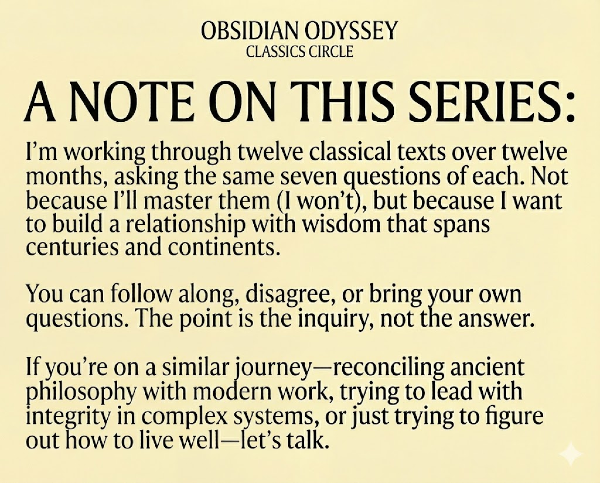
A Note on This Series:
Halfway through. Six months of reading, and the trajectory is becoming clear:
Months 1-4: Philosophy on how to be better (discipline, flow, power, relationship) Month 5: Literature on collapse (Achebe—when being better isn't enough) Month 6: Literature on repetition (García Márquez—when nothing ever really changes)
The second half will need to reckon with: If we're caught in collapsing, repeating patterns, what's the point? How do we find meaning anyway?
Next month: Viktor Frankl on meaning-making in concentration camps. After García Márquez showed me cyclical futility, I need Frankl to show me meaning-making in literal hell.
The reading continues. The inheritance deepens.
"The first of the line is tied to a tree and the last is being eaten by the ants."
— Gabriel García Márquez, One Hundred Years of Solitude
IMPORTANT DISCLAIMER
Personal Reflections Only: This essay represents my personal intellectual exploration and learning journey. Nothing herein constitutes investment advice, financial recommendations, or professional guidance of any kind.
No Investment Advice: Any references to investment decisions, portfolio construction, capital allocation, or financial strategies are illustrative examples of personal thought processes only. They do not constitute recommendations to buy, sell, or hold any securities or pursue any investment strategy.
Not Representative of Employer: All views expressed are strictly my own and do not represent the views, opinions, or investment strategies of any current or former employer, client, limited partner, or affiliated entity.
Use of AI Tools: This content was developed with the assistance of AI (Claude by Anthropic) as a thinking and writing partner. All final judgments, interpretations, and opinions remain my own.
Educational Purpose: This series explores classical philosophical texts for personal growth and intellectual development. It is not intended as professional development training or as a framework for institutional decision-making.
No Offer or Soliculation: Nothing in this essay constitutes an offer to sell, or a solicitation to buy, any securities or investment products. No investment decisions should be made based on this content.
Consult Professionals: Readers should consult qualified financial, legal, and tax professionals before making any investment or financial decisions.
![Obsidian Memo] Leadership Ground Truth: What Cuba, Puerto Rico, and Hawai'i Taught Me About Capital and Resilience](/content/images/size/w720/2026/02/Bad-Bunny.jpg)
![Obsidian Memo] Leadership Lessons for Founders: Building “You, Inc.” Without Burning It Down](https://images.unsplash.com/photo-1474917518260-23f84bd71c75?crop=entropy&cs=tinysrgb&fit=max&fm=jpg&ixid=M3wxMTc3M3wwfDF8c2VhcmNofDQyfHxzYWlsaW5nfGVufDB8fHx8MTc3MDkyODg3Mnww&ixlib=rb-4.1.0&q=80&w=720)
![Obsidian Memo] Davos 2026: Reflections on Geopolitics, AI, Energy, and the Future of Sustainable Capitalism](https://images.unsplash.com/photo-1551524484-635f78221cc4?crop=entropy&cs=tinysrgb&fit=max&fm=jpg&ixid=M3wxMTc3M3wwfDF8c2VhcmNofDR8fGRhdm9zfGVufDB8fHx8MTc3MDY2MTg4M3ww&ixlib=rb-4.1.0&q=80&w=720)
Comments ()