Book] Leadership | Classics Circle: On the Shortness of Life - Seneca
![Book] Leadership | Classics Circle: On the Shortness of Life - Seneca](/content/images/size/w1200/2026/02/Seneca.jpg)
A Conversation Across Centuries
Reading Time: 15 minutes
Classical Period: ~49 CE (Roman Empire, Stoic philosophy)
Core Philosophy: Life isn't short—we waste it. You will die. Live accordingly.
Why I'm Reading This
Penultimate month. Eleven months of reading classics, and I'm hitting a wall that has nothing to do with intellectual difficulty. It's simpler and more brutal: I'm running out of time.
Not just for this series (one month remains), but for everything. The awareness that started as abstract with Marcus Aurelius's memento mori has become visceral. Time is relative. The years are accelerating in that way everyone warns you about but you don't believe until it's happening.
"It is not that we have a short time to live, but that we waste a lot of it. Life is long enough, and a sufficiently generous amount has been given to us for the highest achievements if it were all well invested."
Wait. Life isn't short? We're just wasting it?
I look at my calendar: meetings I don't remember scheduling and commitments that seemed important at the time but now feel like obligations to my past self's poor judgment. Seneca continues:
"You are living as if destined to live forever; your own frailty never occurs to you; you don't notice how much time has already passed, but squander it as though you had a full and overflowing supply."
I'm sharing this because after ten months of philosophical and literary wisdom, I need the most practical question: Am I actually living, or am I just... busy? And given that I will die (not might—will), what does it mean to use time well?
This isn't morbid. It's urgent. After Tagore reminded me to witness beauty, Seneca reminds me: You won't have forever to witness it. You probably don't have as long as you think. What are you waiting for?
Let's get ruthlessly honest about time.
Part I: The Text and Its Time
Historical Context
- When & Why Written: Written around 49 CE by Seneca the Younger to his father-in-law Paulinus. Seneca was a Stoic philosopher, playwright, and advisor to Emperor Nero. He wrote this during relatively peaceful period, before Nero's tyranny intensified.
- Original Audience: Roman elite who complained about not having enough time while spending it on trivial pursuits, political maneuvering, and seeking others' approval.
- What Made It Radical: Seneca challenged the excuse "I don't have time." He said: You have plenty of time. You're just using it terribly. This was direct confrontation of Roman elite's self-importance.
The Core Argument (As I Understand It)
On the Shortness of Life (De Brevitate Vitae) is a short essay—you can read it in an hour. But it's ruthlessly efficient, much like the life it advocates.
I'm reading the Penguin Classics translation by C.D.N. Costa. I've also consulted John Davie's translation for comparison on key passages.
What Seneca is arguing:
Life is long enough for great achievements—IF you don't waste it. But most people squander their time on trivialities, other people's agendas, and pursuit of things that don't matter. Then they complain life is short. It's not. You just used it badly.
Key principles:
- The Past/Present/Future Triad: "The present is short, the future is doubtful, the past is certain." Only the past is truly yours—it can't be taken away. Most people squander the present and live in anxiety about the future.
- Living vs. Existing: Most people exist but don't live. They're busy but not engaged. They fill time but don't use it. Living means deliberate engagement with what matters.
- Your Time Isn't Yours (Until It Is): People are generous with money but stingy with time, even though time is the only truly irreplaceable resource. They give it freely to employers, to social obligations, to anyone who asks. Then they complain they have none left.
- Study of Philosophy = Living: Seneca argues that studying philosophy (and poetry, and great works) isn't leisure—it's living. It's conversation with the great minds across centuries. It's the most productive use of time because it's actual engagement with life's deepest questions.
- The Old Who Never Lived: The tragedy isn't dying young. It's being old but never having lived—having spent your entire life in busyness without ever asking: "What am I actually doing? What matters?"
- Retirement Delusion: People say "I'll live once I retire/finish this project/achieve that goal." But they never arrive. There's always one more thing. And even if they reach retirement, they don't know how to live because they never practiced.
Applied to professional life in 2025: Seneca would be scathing about modern busy-ness culture. The endless meetings, the email at all hours, the "hustling," the productivity optimization that never asks: "Productive toward what?"
He'd say: You claim you're building something important. But you have no time for reflection, for relationships, for beauty, for actually thinking about whether what you're building matters. You're mistaking activity for living.
Part II: Seven Questions I'm Bringing to This Text
Note: Eleven months in. This is the final reckoning before the series concludes.
Q1: What does this text teach about staying grounded when everything is uncertain?
What Seneca Seems to Say: "Begin at once to live, and count each separate day as a separate life."
How I'm Translating This to 2025: Seneca's answer to uncertainty: Stop waiting for certainty. Each day is a complete life. Live it fully or you're wasting the only resource you have.
This synthesizes previous texts:
- Marcus: Ground in virtue (but you could die practicing virtue tomorrow)
- Lao Tzu: Ground in flow (but time is still flowing away)
- Frankl: Ground in meaning (but meaning is found in time you have NOW)
Seneca adds urgency: You're not preparing to live later. This day—today—is a complete life. Will you live it or squander it?
For operating amid uncertainty: Stop postponing. The conditions will never be perfect. You'll never have "enough" information. Act now with what you have or waste the time you definitely possess worrying about the future you might not see.
What I'm Trying to Practice: I've started treating each day as complete life unit—asking at day's end: "If this were my whole life, would I be satisfied with how I lived it?"
Not: "Was I productive?" (productivity toward what?) Not: "Did I accomplish goals?" (whose goals? why?) But: "Did I actually live today or just exist?"
Recent day that was "complete life":
- Morning reading (Seneca, actually)
- Difficult conversation handled with honesty and care
- Work on project that matters
- Lunch with colleague, genuine connection
- Evening with family
- Noticed beauty (light through trees)
Another recent day that was "wasted life":
- Back-to-back meetings I don't remember
- Email responses to things I don't care about
- Dinner while working on laptop
- Collapsed exhausted having touched nothing that matters
Seneca: Both days had same amount of time. One was lived. One was squandered.
This practice is uncomfortable because it reveals how many days I'm squandering.
Q2: How does this work inform thinking about the ethics of capital—where money goes and why?
What Seneca Seems to Say: "People are frugal in guarding their personal property; but as soon as it comes to squandering time they are most wasteful of the one thing in which it is right to be stingy."
How I'm Translating This to 2025: Seneca points out the absurdity: We carefully analyze financial capital but carelessly spend temporal capital. We'll argue over fees but give our time to anyone who asks.
For capital allocation: This applies doubly. You're allocating both financial capital (others' money) and temporal capital (your finite life).
Every investment decision consumes both:
- Financial capital: This many dollars deployed here
- Temporal capital: This many hours/days/years of my life spent on this
We analyze the former rigorously. We barely think about the latter. Seneca would say: You're being foolish. Financial capital can be replenished. Temporal capital cannot.
What I'm Trying to Practice:
Before committing to any investment or project, I now calculate both:
- Financial commitment: Capital deployed, expected returns, risk
- Temporal commitment: Hours required for diligence, work, monitoring, exits. Years of my life this will consume.
Then ask: "Is this worthy use of my finite time?"
Seneca: "You are living as if destined to live forever." No. I'm living as if I'll die. Maybe soon. This investment isn't worth years of my life.
Q3: What does it reveal about power—how it's gained, wielded, and when to walk away?
What Seneca Seems to Say: "No one will bring back the years; no one will restore you to yourself. Life will follow the path it began to take, and will neither reverse nor check its course... It will cause no commotion to remind you of its swiftness, but glide on quietly."
How I'm Translating This to 2025: Seneca's power insight: Time is slipping away quietly while you pursue power, wealth, status. You'll "succeed" and be old, having never lived. That's not winning.
For institutional power dynamics: We treat power as if it's permanent. We sacrifice time (present, relationships, health) to accumulate power. Then we're powerful but old, having missed life.
Seneca asks: What's the point of power if you never used your time well? What victory is it to be powerful but to have never actually lived?
Q4: How does it address playing the long game when the world rewards short-term thinking?
What Seneca Seems to Say: "It is not that we have a short time to live, but that we waste a lot of it... The life we receive is not short but we make it so; we are not ill provided but use what we have wastefully."
How I'm Translating This to 2025: Seneca's temporal paradox: Life is both long enough (for great achievements) and terrifyingly short (you'll waste it if not careful).
For long-term capital: The institutions I'm building—designed for decades or centuries—will take more time than I have. I won't see fruition. Seneca says: That's okay IF you're actually using your time well now.
The mistake is sacrificing present living for future payoff you might not see. That's double waste: squandering present AND possibly not reaching future.
Better: Work on long-term projects WHILE living fully now. Don't defer life. Don't say "I'll live after this project." Live now, on the project, through the work.
What I'm Trying to Practice:
I've stopped deferring life until some future milestone.
Old pattern: "After this project closes, I'll read more/travel/spend time with family/pursue interests." Seneca pattern: I do those things NOW. While the project is closing. Or the fund doesn't close—because if it requires sacrificing actual living, it's not worth it.
Practical changes:
- I read daily (this series proves it). Not waiting for retirement.
- I protect family time weekly. Not waiting for work to slow down.
- I pursue beauty and transcendence daily. Not waiting for "right time."
Ironically, this makes me BETTER at long-term work because I'm not exhausted and resentful from years of deferred living.
Seneca: Life is long enough. But only if you use it well starting NOW, not after some imagined future success.
Q5: What wisdom does it offer about identity—especially for those of us who don't fit neatly into one box?
What Seneca Seems to Say: "Of all people only those are at leisure who make time for philosophy, only those are really alive. For they not only keep a good watch over their own lifetimes, but they annex every age to theirs."
How I'm Translating This to 2025: Seneca's identity answer: You are who you're in conversation with across time. By reading philosophy (and literature, poetry, history), you're not alone in your particular context. You're in dialogue with humans across all times and places.
For those of us not fitting neat categories: Seneca offers radical expansion. You're not just Korean or Western, finance or activist, immigrant or citizen. You're in conversation with Marcus Aurelius (Roman emperor), Lao Tzu (Chinese sage), Confucius (ancient teacher), Achebe (Nigerian novelist), Tagore (Bengali poet).
Your identity is this conversation—across centuries, cultures, languages. The particular categories you don't fit are too small anyway.
Q6: How does it challenge our relationship with time and what we leave behind?
What Seneca Seems to Say: "Can anything be more idiotic than certain people who boast of their foresight? They keep themselves officiously preoccupied in order to improve their lives; they spend their lives in organizing their lives!"
How I'm Translating This to 2025: Seneca's brutal insight: People spend entire lives planning to live rather than actually living. "I'll live after this promotion/project/achievement." Then they die having planned but never lived.
For legacy work: This challenges entire multi-generational planning frameworks. We spend years building institutions meant to last centuries. But are WE living while building? Or are we deferring life to build legacy for people who'll live later?
Seneca says: If you're not living now—genuinely, fully living—while building, you're doing it wrong. The building should BE living, not preparation for future living.
What I'm Trying to Practice: I'm rejecting the "sacrifice now, benefit later" mindset.
New framework: Everything I commit to must be either: A) Worthwhile use of time NOW (even if it also has future benefit), OR B) Eliminated
This means:
- Work that's meaningful in present (not just "will be important later")
- Relationships I value now (not "networking for future")
- Projects where the doing itself is satisfying (not just outcome)
Recent audit using this framework: 40% of my commitments failed the test. They were "preparing to live later."
I've started withdrawing from those. Colleagues think I'm losing ambition. Seneca would say: No, I'm gaining life.
Q7: What does it teach about the inner life—the part of leadership no one sees?
What Seneca Seems to Say: "True wisdom consists in not departing from nature and in molding our conduct according to her laws and model. A happy life therefore is one which is in accordance with its own nature."
How I'm Translating This to 2025:
Seneca's inner life principle: Stop living according to others' expectations or social conventions. Live according to your nature.
For leadership: The inner work is discovering your actual nature (not who you think you should be) and having courage to live accordingly.
This requires:
- Brutal honesty about what you actually value (not should value)
- Courage to disappoint others' expectations
- Willingness to be misunderstood
- Accepting that living well looks different for each person
What I'm Trying to Practice:
I'm asking weekly: "Am I living according to my nature or according to internalized expectations?"
Discoveries through this practice:
My actual nature: Values depth over breadth, quality over quantity, meaning over achievement, beauty alongside utility, solitude alongside connection.
What I was doing: Accumulating achievements, maximizing optionality, staying excessively busy, attending everything, saying yes by default.
Gap between nature and behavior was causing the exhaustion. Not the work itself—the mismatch.
Changes:
- Fewer, deeper commitments (instead of many surface commitments)
- Protected solitude (I'm actually introverted—the networking was performance)
- Explicit "no" as default (yes only when genuinely aligned)
- This reading practice (deep engagement with wisdom vs. skimming trending articles)
Seneca: Living according to your nature requires knowing your nature. Most people never investigate. They live according to convention and wonder why they're miserable.
Part III: Five Things I'm Taking From This
(And One Thing I'm Leaving Behind)
Taking #1: Life Isn't Short—I'm Just Wasting It
Seneca's core provocation: You have enough time. You're using it badly.
Taking from this: Radical ownership. Stop complaining "not enough time." I have 24 hours daily like everyone else. The question is: How am I using them?
Current audit showing: ~40% of time goes to things I don't remember, don't value, wouldn't choose if choosing consciously.
Action: Ruthlessly eliminate that 40%. Reclaim those hours for actual living.
Question I'm sitting with: How do you maintain this against constant pressure to fill time?
Taking #2: Each Day Is a Complete Life
"Count each separate day as a separate life." If today were your whole existence, would you be satisfied?
Taking from this: Daily evaluation. Not "was I productive?" but "did I live today?"
This changes priority completely. A productive day that wasn't lived is failed day.
Question I'm sitting with: Can you actually sustain this or is it too intense?
Taking #3: Studying Philosophy IS Living
"Of all people only those are at leisure who make time for philosophy, only those are really alive."
Taking from this: This eleven-month reading series isn't indulgence. It's the most important work—learning how to live before I die.
Validation for protecting reading time, reflection time, conversation-with-wisdom time.
Question I'm sitting with: But doesn't this risk becoming another form of consumption/accumulation?
Taking #4: Don't Defer Life to Build Legacy
People spend lives organizing lives instead of living lives. Building for future at expense of present.
Taking from this: Any work I do must be worthy NOW. Future benefit is bonus, not justification.
If I'm not living while building institutions, I'm doing it wrong.
Question I'm sitting with: Is this just impatience disguised as wisdom?
Taking #5: The Past Is the Only Time You Own
"The present is short, the future is doubtful, the past is certain." Only the past can't be taken away.
Taking from this: What I've witnessed, experienced, learned—that's mine. No one can audit it or take it away.
Makes legacy less about what I leave and more about what I've experienced.
Question I'm sitting with: Does this risk becoming solipsistic—only my experience matters?
Leaving Behind: The Retirement Delusion
"I'll live after I retire/achieve this/finish that." No. You'll be old and won't know how to live because you never practiced.
I'm leaving behind: Any temporal framing that defers actual living to some imagined future.
If I can't live now, I won't magically be able to live later. Living is a skill. Practice daily or lose capacity.
Part IV: How I'm Working With This (The Transparent Part)
My Co-Writing Process with Claude
On the Shortness of Life is mercifully short—45 pages. But it's dense. Every sentence contains critique or instruction.
I read it three times:
- First pass: Let it gut-punch me
- Second pass: Marked every passage that described my life (uncomfortable)
- Third pass: Highlighted what to do differently
Claude helped me:
- Understand historical context (Roman elite Seneca was addressing)
- Connect to earlier Stoic texts (Marcus)
- Identify what's applicable vs. what's cultural artifact
- Articulate what was uncomfortable to admit
What Claude adds: Philosophical rigor, connections, challenge to my rationalizations.
What I add: Actual time audit showing how I'm wasting life. Vulnerability about busyness as avoidance. Willingness to change.
Integration Experiments (What I'm Actually Trying)
In the Next 30 Days: Daily question: "If this were my whole life, am I satisfied with how I lived it today?"
In the Next Crisis: When tempted to defer living ("I'll do that after this crisis"), remember: There will always be another crisis. Live now or never.
In My Next Reflection: Audit all commitments. Which are worthy use of finite life? Which are preparing-to-live-later? Eliminate the latter ruthlessly.
If You're Reading This Too
Where to Start:
It's 45 pages. Read it in one sitting. Let it disturb you. Then read it again taking notes on how you're wasting time.
Penguin Classics edition (C.D.N. Costa translation) is excellent. Includes other Seneca essays worth reading.
Read Next:
- Letters from a Stoic by Seneca (more accessible, bite-sized wisdom)
- Meditations by Marcus Aurelius (if you haven't—fellow Stoic, complementary)
- The Power of Now by Eckhart Tolle (modern take on similar themes)
Pair With:
- Exercise: Do time audit. Track every hour for one week. See how much you're actually wasting.
- Practice: Daily question—"If this were my whole life, am I satisfied?"
- Accountability: Tell someone you're reclaiming wasted time. Report weekly.
Questions I'm Still Sitting With
- Is Seneca right that life is long enough? Or is this privilege talking? Some people genuinely don't have time—poverty, caregiving, survival.
- How do you balance "live each day fully" with "build for long term"? Aren't these in tension?
- Can you really eliminate all waste? Some busyness is inescapable in modern systems. Where's the line?
- What about people who need external structure? Seneca assumes agency/freedom most don't have.
- Is studying philosophy actually living or is it intellectual masturbation? When does learning become avoidance of doing?
Published in: Obsidian Odyssey
Series: Classics Circle (#11 of 12)
Previous in Series: Gitanjali by Tagore – "Songs of Divine Humanity"
Next in Series: The Republic by Plato – "Justice and the Return to the Cave"
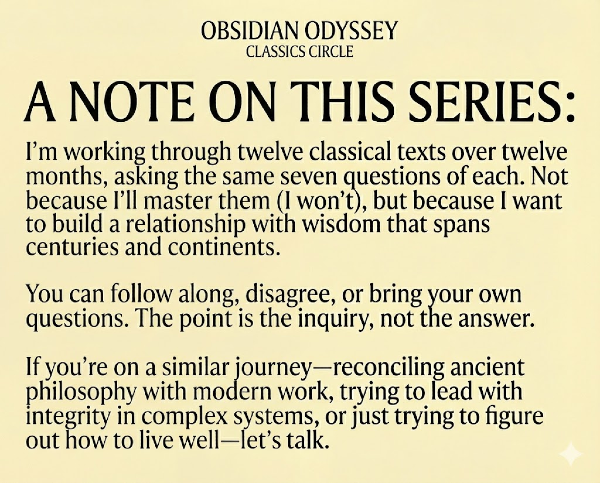
A Note on This Series:
Eleven months complete. One remains.
After learning to be better, finding meaning, operating strategically, witnessing beauty—Seneca adds the urgency: You don't have forever. Probably not even as long as you think. Stop wasting time. Live now.
Final month: Plato's Republic—returning to where Western philosophy began, asking what justice is, how we should live, what we owe to others. After eleven months of transformation, time to integrate and return to the cave.
The reading continues. The time diminishes.
"It is not that we have a short time to live, but that we waste a lot of it."
— Seneca, On the Shortness of Life
IMPORTANT DISCLAIMER
Personal Reflections Only: This essay represents my personal intellectual exploration and learning journey. Nothing herein constitutes investment advice, financial recommendations, or professional guidance of any kind.
No Investment Advice: Any references to investment decisions, portfolio construction, capital allocation, or financial strategies are illustrative examples of personal thought processes only. They do not constitute recommendations to buy, sell, or hold any securities or pursue any investment strategy.
Not Representative of Employer: All views expressed are strictly my own and do not represent the views, opinions, or investment strategies of any current or former employer, client, limited partner, or affiliated entity.
Use of AI Tools: This content was developed with the assistance of AI (Claude by Anthropic) as a thinking and writing partner. All final judgments, interpretations, and opinions remain my own.
Educational Purpose: This series explores classical philosophical texts for personal growth and intellectual development. It is not intended as professional development training or as a framework for institutional decision-making.
No Offer or Solicitation: Nothing in this essay constitutes an offer to sell, or a solicitation to buy, any securities or investment products. No investment decisions should be made based on this content.
Consult Professionals: Readers should consult qualified financial, legal, and tax professionals before making any investment or financial decisions.
![Obsidian Memo] Leadership Ground Truth: What Cuba, Puerto Rico, and Hawai'i Taught Me About Capital and Resilience](/content/images/size/w720/2026/02/Bad-Bunny.jpg)
![Obsidian Memo] Leadership Lessons for Founders: Building “You, Inc.” Without Burning It Down](https://images.unsplash.com/photo-1474917518260-23f84bd71c75?crop=entropy&cs=tinysrgb&fit=max&fm=jpg&ixid=M3wxMTc3M3wwfDF8c2VhcmNofDQyfHxzYWlsaW5nfGVufDB8fHx8MTc3MDkyODg3Mnww&ixlib=rb-4.1.0&q=80&w=720)
![Book] Leadership | Markets Are Made by People: Reading Ken Fisher's 100 Minds That Made the Market](https://images.unsplash.com/photo-1623524713064-257294b0e34b?crop=entropy&cs=tinysrgb&fit=max&fm=jpg&ixid=M3wxMTc3M3wwfDF8c2VhcmNofDN8fHdhbGwlMjBzdHJlZXR8ZW58MHx8fHwxNzcwOTM4MzYzfDA&ixlib=rb-4.1.0&q=80&w=720)
Comments ()