Book] Leadership | Classics Circle: Man's Search for Meaning - Viktor Frankl
![Book] Leadership | Classics Circle: Man's Search for Meaning - Viktor Frankl](/content/images/size/w1200/2026/02/Gemini_Generated_Image_1vm28h1vm28h1vm2.png)
A Conversation Across Centuries
Reading Time: 14 minutes
Classical Period: Published 1946 (based on 1942-1945 in Nazi concentration camps)
Core Philosophy: You cannot control what happens to you. You can control how you find meaning in it.
Why I'm Reading This
After García Márquez showed me inherited futility—families condemned to repeat patterns until erasure—I needed to know: Can meaning be found when everything is stripped away? When there's no hope of escape, no pattern to break, just raw survival?
I'm reading Man's Search for Meaning during the darkest time of year. Short days, long nights. Markets turbulent. Geopolitical tensions escalating. Climate news increasingly dire. The existential questions I've been avoiding: What if none of this matters? What if all my work—the institutions I'm building, the capital I'm allocating, the relationships I'm tending—what if it's all just sophisticated distraction from fundamental meaninglessness?
Then I read Frankl: "Everything can be taken from a man but one thing: the last of the human freedoms—to choose one's attitude in any given set of circumstances, to choose one's own way."
He wrote this after surviving Auschwitz, Dachau, and other concentration camps. His wife, mother, and brother were murdered. His life's work (a manuscript) was confiscated and destroyed. He had every reason to conclude life was meaningless.
Instead, he observed: The prisoners who survived longest weren't necessarily the strongest or the youngest. They were those who found meaning—even in hell. Maybe a task waiting after liberation. Maybe a person to love. Maybe witnessing the suffering so others would know.
I'm sharing this because after six months of classics, I'm hitting the existential wall every serious inquiry eventually hits: What's the point?
- Marcus taught inner discipline → But for what?
- Lao Tzu taught strategic flow → Toward what?
- Machiavelli taught power dynamics → To what end?
- Confucius taught relational cultivation → Why?
- Achebe showed worlds collapsing → And then?
- García Márquez showed patterns repeating → Forever?
Frankl answers: The point is whatever meaning you choose to find. Not discover—choose. Meaning isn't out there waiting. It's created through your response to life's demands.
This is both empowering and terrifying. Let's sit with both.
Part I: The Text and Its Time
Historical Context
- When & Why Written: Frankl, a Viennese psychiatrist, was imprisoned in Nazi concentration camps 1942-1945. He wrote Man's Search for Meaning in nine days in 1946, reconstructing his observations and developing what would become logotherapy—therapy focused on meaning-making.
- Original Audience: Initially German-speaking post-war readers. The book was eventually translated into dozens of languages and became one of the most influential psychology texts of the 20th century.
- What Made It Radical: Frankl didn't pathologize suffering. He didn't offer techniques for avoiding pain. Instead: Pain is inevitable; the question is how you find meaning within it. This challenged both Freudian psychoanalysis (focused on pleasure/libido) and behaviorism (focused on conditioning).
The Core Argument (As I Understand It)
The book has two parts:
Part I: Experiences in a Concentration Camp—Frankl describes camp life with clinical precision. The dehumanization, arbitrary cruelty, constant proximity to death. But his focus isn't the horror (though it's present). His focus is: How did people respond psychologically?
He identifies three phases:
- Shock (upon arrival)
- Apathy (emotional death as survival mechanism)
- Liberation psychology (difficulty reintegrating)
Part II: Logotherapy in a Nutshell—Frankl outlines his therapeutic approach:
- The primary human drive isn't pleasure (Freud) or power (Adler) but meaning
- Meaning can be found through: creating work, loving people, or finding meaning in unavoidable suffering
- You can't give someone meaning—you can only help them discover what life is asking of them
What Frankl is arguing (as I understand it):
Suffering is inescapable. But suffering without meaning is unbearable. The task isn't to eliminate suffering—it's to find meaning within it. That meaning isn't universal; it's unique to each person's situation. Your job is to answer: What is life asking of me right now?
Key insights:
- The Last Freedom: External circumstances can take everything—freedom, dignity, loved ones, physical health. But they can't take your freedom to choose your attitude and response.
- Meaning Through Responsibility: Don't ask "What do I want from life?" Ask "What does life want from me?" Meaning emerges from responding to life's demands, not satisfying your desires.
- Suffering Has Potential Meaning: If suffering is unavoidable (terminal illness, loss, historical catastrophe), you can still choose how to bear it. That bearing can have meaning—for you, for witnesses, for those who come after.
- Existential Vacuum: Modern people suffer less from repression (Freud's focus) and more from meaninglessness. The existential vacuum—the sense of "What's the point?"—is the pathology of our time.
- Tragic Optimism: You can say "yes" to life despite suffering, guilt, and death. This isn't naive optimism—it's optimism with full knowledge of tragedy.
Applied to institutional work in 2025: Frankl would ask: You're allocating capital, building institutions, making decisions. For what? What meaning are you creating? And crucially: Are you asking life what it wants from you, or just trying to impose your agenda on life?
Part II: Seven Questions I'm Bringing to This Text
Note: Seven months in. My questions are getting sharper—or maybe just more desperate.
Q1: What does this text teach about staying grounded when everything is uncertain?
What Frankl Seems to Say: "When we are no longer able to change a situation, we are challenged to change ourselves."
How I'm Translating This to 2025:
Previous texts gave me strategies for uncertainty:
- Marcus: Ground in virtue
- Lao Tzu: Flow with change
- Machiavelli: Adapt ruthlessly
- Confucius: Honor relationships
Frankl says something different: When you can't change circumstances, find meaning in how you respond to them.
This isn't just reframing or coping. It's claiming the one freedom that can't be taken: the freedom to choose your attitude.
In professional contexts where I feel powerless—market crashes I can't prevent, political decisions I can't influence, technological disruptions I can't stop—Frankl asks: Can you find meaning in how you respond? Not just "survive it" or "adapt to it" but what meaning will you make from this?
What I'm Trying to Practice:
I've started asking, in difficult situations: "What is this asking of me?"
Not: "How do I fix this?" or "How do I protect myself?" but "What response would be meaningful?"
Recent example: A portfolio company facing existential crisis—technology they'd built was being made obsolete by AI advancement. I couldn't fix it. Neither could they.
Old question: "How do we salvage returns?" Frankl question: "What is this situation asking of us?"
Answer that emerged: Help the team transition with dignity. Document what they learned so others benefit. Tend the relationships even in failure.
Still lost money. But the experience had meaning beyond the P&L.
Q2: How does this work inform thinking about the ethics of capital—where money goes and why?
What Frankl Seems to Say: "Man should not ask what the meaning of his life is, but rather must recognize that it is he who is asked. In a word, each man is questioned by life; and he can only answer to life by answering for his own life."
How I'm Translating This to 2025: Frankl inverts the question. Don't ask: "What do I want to do with this capital?" Ask: "What is this capital asking me to do?"
This sounds abstract, but it's profound reorientation:
Traditional approach: I have capital. I have preferences (risk/return, sectors, geographies). I deploy accordingly.
Frankl approach: Capital exists in a context—communities with needs, ecosystems under pressure, innovations wanting support. What is the situation asking? What would be a meaningful response?
This doesn't mean ignoring returns. It means: Returns are necessary but not sufficient. The meaning question matters too.
What I'm Trying to Practice:
Before capital deployment, I'm asking: "What would be the meaningful response to this situation?"
Not: "What's the highest-returning opportunity?" Not: "What aligns with our thesis?" But: "What does this situation need? What is it asking of us?"
Q3: What does it reveal about power—how it's gained, wielded, and when to walk away?
What Frankl Seems to Say:
"The one thing you can't take away from me is the way I choose to respond to what you do to me. The last of one's freedoms is to choose one's attitude in any given circumstance."
How I'm Translating This to 2025:
Frankl experienced total powerlessness—literally stripped of everything, at the mercy of guards who could kill him on whim. And yet he insists: There's one freedom they couldn't take.
For power dynamics in institutions: This is radical. It means:
- Even when you're the junior person in the room, you have power—the power to choose your response
- Even when you're the senior person, you don't have the power you think—you can't control others' inner freedom
Traditional power frameworks (Machiavelli, organizational behavior) focus on external power—who controls resources, decisions, narratives. Frankl says: That's not the deepest power. The deepest power is internal—choosing your attitude and response.
What I'm Trying to Practice:
In situations where I lack formal power, I'm asking: "What's the meaningful response here?"
Q4: How does it address playing the long game when the world rewards short-term thinking?
What Frankl Seems to Say: "Live as if you were living already for the second time and as if you had acted the first time as wrongly as you are about to act now!"
How I'm Translating This to 2025: Frankl's temporal perspective: Imagine yourself at the end of your life, looking back. What will have mattered? What will you wish you'd done differently?
This is similar to Marcus's memento mori but with different emphasis. Marcus says: "You'll die; what matters?" Frankl says: "You'll die; looking back, what will you wish you'd prioritized?"
For long-term capital: This cuts through short-term incentives. If I'm looking back from 80, will I care about IRR differentials? Or will I care about whether the work had meaning?
What I'm Trying to Practice:
I've created what I call "deathbed reviews"—quarterly practice where I imagine myself at 80, looking back at current decisions.
Questions from that perspective:
- Will this matter?
- Will I be proud of this?
- Will I wish I'd been braver/more patient/more discerning?
Q5: What wisdom does it offer about identity—especially for those of us who don't fit neatly into one box?
What Frankl Seems to Say: "The salvation of man is through love and in love... For the first time in my life I saw the truth as it is sung by so many poets, proclaimed by so many thinkers. The truth—that Love is the ultimate and highest goal to which man can aspire."
How I'm Translating This to 2025: Frankl's identity answer is: You are who you love and what you dedicate yourself to.
Not: Korean, Western, finance professional, immigrant, woman—these are descriptors. Your identity is: What do you love? What are you dedicated to?
For someone struggling with not fitting boxes: Frankl would say you're asking the wrong question. Identity isn't about fitting categories. It's about: What meaning are you creating? Who/what do you love?
This is liberating. I don't need to reconcile "Korean" and "Western." I need to answer: What am I dedicated to? What meaning am I making?
What I'm Trying to Practice:
Instead of trying to construct coherent identity across categories, I'm identifying what I'm dedicated to:
- Channeling capital toward regeneration (environmental and social)
- Building institutions that outlast me
- Tending relationships across cultures
- Witnessing and documenting what I'm seeing
That's my identity—not the categories I fit or don't fit, but what I'm dedicated to.
This doesn't resolve the alienation of not belonging. But it reframes it: Maybe not belonging anywhere is the position from which I can do this particular work. The displacement is part of the meaning.
Q6: How does it challenge our relationship with time and what we leave behind?
What Frankl Seems to Say: "What man actually needs is not a tensionless state but rather the striving and struggling for a worthwhile goal, a freely chosen task."
How I'm Translating This to 2025: Frankl says: Legacy isn't what you leave behind. Legacy is the meaning you create through your striving.
The process—the struggle toward meaningful goals—is itself the legacy. Not the outcome, the striving.
This challenges achievement culture: You think legacy is the endowment you build, the company you found, the returns you generate. Frankl says: Those might all disappear (his manuscript was destroyed). What matters is: Did you strive for something meaningful? That striving is the legacy.
For multi-generational capital: This suggests legacy isn't preservation—it's meaningful striving in each generation. The question isn't "How do we preserve what our founders built?" but "What is this generation's meaningful task?"
What I'm Trying to Practice:
I'm reframing legacy as verb, not noun. Not "What will I leave?" but "What am I striving toward?"
Current strivings:
- Building governance structures that empower communities, not just extract value
- Documenting what I'm learning so others can build on it
- Maintaining integrity in systems that don't always reward it
Will any of this "succeed" by conventional metrics? Maybe not. But the striving itself has meaning. That's enough.
This is hard to communicate to stakeholders who want measurable outcomes. But Frankl insists: The meaning is in the task itself, not the outcome.
Q7: What does it teach about the inner life—the part of leadership no one sees?
What Frankl Seems to Say: "Between stimulus and response there is a space. In that space is our power to choose our response. In our response lies our growth and our freedom."
How I'm Translating This to 2025: This is Frankl's core psychological insight: You can't control stimuli (what happens to you), but there's a gap—however tiny—between stimulus and response. In that gap lives your freedom.
For inner life of leadership: The work is expanding that gap. Most people have almost no gap—stimulus triggers automatic response. Meditation, reflection, therapy—these practices expand the gap, giving you more choice in how you respond.
Marcus's journaling, Lao Tzu's emptiness, Confucius's ritual propriety—all are ways of expanding that gap. Frankl adds: The gap is where meaning gets made. Your response is where you exercise freedom.
What I'm Trying to Practice:
I'm explicitly working to expand the stimulus-response gap through:
Pause practices: When triggered (bad news, conflict, criticism), I physically pause before responding. Sometimes seconds, sometimes hours.
Response optionality: Before responding, I list three possible responses and their meanings:
- Response A would mean X
- Response B would mean Y
- Response C would mean Z
Then choose based on what meaning I want to create.
Example: If you receive harsh criticism in a meeting. Stimulus: anger, defensiveness.
In the gap, three responses: A) Defend/justify → meaning: "I'm right, they're wrong" B) Ignore/dismiss → meaning: "Their opinion doesn't matter" C) Consider/inquire → meaning: "I'm interested in understanding, not being right"
Victor would choose C. The conversation becomes productive. But more importantly, exercise freedom in the gap. That's where growth happens.
Part III: Five Things I'm Taking From This
(And One Thing I'm Leaving Behind)
Taking #1: Meaning Is Created, Not Found
Frankl doesn't promise meaning is "out there" waiting to be discovered. You create it through your response to life's demands.
Taking from this: Stop looking for "meaningful work" as if it exists independently. Any work becomes meaningful if you respond to it meaningfully.
Question I'm sitting with: Is this empowering or is it pressure to make everything meaningful when sometimes things are just hard?
Taking #2: Suffering Can Have Meaning—But Doesn't Have To
Frankl doesn't romanticize suffering. He says: If suffering is unavoidable (terminal illness, historical catastrophe, irreversible loss), you can still choose how to bear it. That bearing can have meaning.
But—and this is crucial—Frankl also says: If suffering is avoidable, you're obligated to change it. Accepting avoidable suffering isn't wisdom; it's pathology.
Taking from this: Discern between unavoidable and avoidable suffering. Change what can be changed. Find meaning in what can't.
Question I'm sitting with: How do you know which is which? I've definitely accepted things I should have changed and fought things I should have accepted.
Taking #3: Ask What Life Wants From You
"Don't ask what life can give you. Ask what life is asking of you."
Taking from this: Reorienting from "What do I want?" to "What is being asked of me?" This feels less about desires and more about responsibility—not in a burdensome way, but in a responsive way.
Question I'm sitting with: But don't desires matter? Is Frankl asking me to suppress all personal wants in favor of duty?
Taking #4: The Inner Freedom Cannot Be Taken
Even in total powerlessness, you have one freedom: choosing your attitude and response.
Taking from this: When I feel trapped (by circumstances, by others' decisions, by structural constraints), remember: I still have the freedom to choose my response. That's real power.
Question I'm sitting with: Can this become excuse for tolerating injustice? "I can't change it, so I'll just choose my attitude"? Where's the line between acceptance and complicity?
Taking #5: Tragic Optimism Is Possible
You can say "yes" to life despite knowing life includes suffering, guilt, and death. This isn't naive—it's optimism with eyes open.
Taking from this: I don't have to choose between realism (life is hard) and optimism (life is good). I can hold both: Life is hard AND life is worth affirming.
Question I'm sitting with: Some days I can hold this. Other days I can't. Is that okay? Or am I failing at tragic optimism?
Leaving Behind: The Heroic Survivor Narrative
Frankl survived concentration camps. The temptation is to read this as: "If he could find meaning there, you have no excuse."
I'm leaving behind: Using extreme examples to shame myself or others. Frankl's experience was extraordinary. Most of us aren't facing literal death camps. Our suffering is different—not less real, just different.
The work is: Find meaning in YOUR circumstances, not compare your suffering to his.
Part IV: How I'm Working With This (The Transparent Part)
My Co-Writing Process with Claude
Man's Search for Meaning is short but dense—the concentration camp memoir is visceral and disturbing; the logotherapy section is dry and technical. I read it in three sittings across a week.
Claude helped me distinguish between:
- What Frankl actually experienced (Part I)
- What he theorized from that experience (Part II)
- What's generalizable to people not facing extremity
We wrestled with: Is it appropriate to apply lessons from Holocaust survival to ordinary professional challenges? Isn't that trivializing?
I decided: Frankl himself generalized his insights beyond camps. He wrote this for everyone. The question isn't "Is my suffering equivalent?" (it's not) but "Can his insights help me respond more meaningfully to MY circumstances?"
What Claude adds: Psychological context, distinguishing Frankl from Freud/Adler. Philosophical connections to existentialism (Kierkegaard, Sartre).
What I add: The gut-level exhaustion of asking "What's the point?" after six months of classics. The need for meaning-making tools, not just more frameworks for being better.
Integration Experiments (What I'm Actually Trying)
In the Next 30 Days: In every difficult situation, pause and ask: "What is this asking of me? What would be the meaningful response?"
In the Next Crisis: When I can't change circumstances, focus on the gap between stimulus and response. Expand that gap. Choose my response consciously.
In My Next Reflection: Journal prompt: "What am I currently striving toward? Is it meaningful? If I were looking back from 80, would this striving matter?"
If You're Reading This Too
Where to Start:
Just read it. It's short (under 200 pages). Part I (concentration camp experiences) is harder to read—it's disturbing. Don't skip it. Part II (logotherapy theory) can feel dry—push through.
The Beacon Press edition (2006) with new foreword is standard.
Read Next:
- The Will to Meaning by Viktor Frankl (more on logotherapy)
- When Breath Becomes Air by Paul Kalanithi (neurosurgeon facing terminal cancer, finding meaning)
- The Denial of Death by Ernest Becker (meaning in face of mortality)
Pair With:
- Film: Life Is Beautiful (1997)—finding meaning in camps through love
- Documentary: Clips of Frankl lecturing (available on YouTube)—hearing him speak adds dimension
- Practice: "What is life asking of me?" as daily question
Questions I'm Still Sitting With
- Can meaning-making become avoidance? If I can "find meaning" in any situation, do I lose motivation to change bad situations?
- How do you distinguish between meaningful suffering and pointless suffering? Frankl says suffering can have meaning. But some suffering is just... bad. How do you know?
- Is "what is life asking of me?" too passive? Does it surrender too much agency to "what life wants" versus "what I want"?
- Can you have too much meaning? Can the pressure to make everything meaningful become exhausting?
- What about people who don't find meaning? Frankl focuses on those who did. What about those who couldn't? Is that failure or just honest response to horror?
Published in: Obsidian Odyssey
Series: Classics Circle (#7 of 12)
Previous in Series: One Hundred Years of Solitude by García Márquez – "The Burden of Circular Time"
Next in Series: The Art of War by Sun Tzu – "Winning Without Fighting"
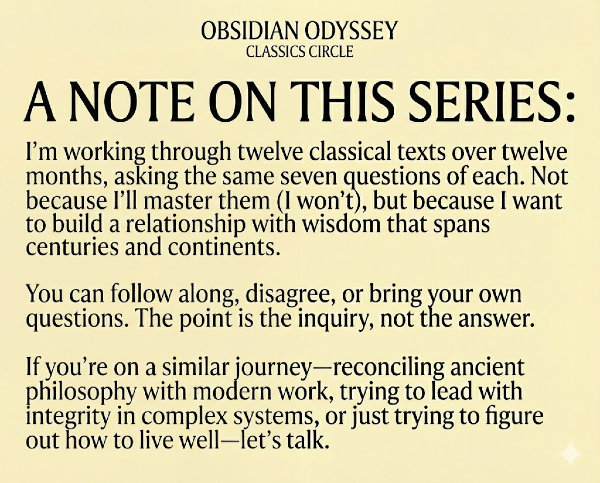
A Note on This Series:
Seven months. More than halfway. The trajectory:
Months 1-4: Philosophy on how to be better Month 5: Literature on collapse (Achebe) Month 6: Literature on repetition (García Márquez) Month 7: Psychology on meaning-making (Frankl)
After showing me everything can fall apart and patterns repeat endlessly, Frankl shows: You can still choose meaningful response. That choosing is your freedom.
Next month: Sun Tzu on strategy and the art of winning without fighting. After Frankl taught me meaning-making in extremity, I need tactical wisdom on how to operate effectively in competitive environments while maintaining that meaning.
The reading continues. The meaning deepens.
"Everything can be taken from a man but one thing: the last of the human freedoms—to choose one's attitude in any given set of circumstances, to choose one's own way."
— Viktor Frankl, Man's Search for Meaning
IMPORTANT DISCLAIMER
Personal Reflections Only: This essay represents my personal intellectual exploration and learning journey. Nothing herein constitutes investment advice, financial recommendations, or professional guidance of any kind.
No Investment Advice: Any references to investment decisions, portfolio construction, capital allocation, or financial strategies are illustrative examples of personal thought processes only. They do not constitute recommendations to buy, sell, or hold any securities or pursue any investment strategy.
Not Representative of Employer: All views expressed are strictly my own and do not represent the views, opinions, or investment strategies of any current or former employer, client, limited partner, or affiliated entity.
Use of AI Tools: This content was developed with the assistance of AI (Claude by Anthropic) as a thinking and writing partner. All final judgments, interpretations, and opinions remain my own.
Educational Purpose: This series explores classical philosophical texts for personal growth and intellectual development. It is not intended as professional development training or as a framework for institutional decision-making.
No Offer or Solicitation: Nothing in this essay constitutes an offer to sell, or a solicitation to buy, any securities or investment products. No investment decisions should be made based on this content.
Consult Professionals: Readers should consult qualified financial, legal, and tax professionals before making any investment or financial decisions.
![Obsidian Memo] Leadership Ground Truth: What Cuba, Puerto Rico, and Hawai'i Taught Me About Capital and Resilience](/content/images/size/w720/2026/02/Bad-Bunny.jpg)
![Obsidian Memo] Leadership Lessons for Founders: Building “You, Inc.” Without Burning It Down](https://images.unsplash.com/photo-1474917518260-23f84bd71c75?crop=entropy&cs=tinysrgb&fit=max&fm=jpg&ixid=M3wxMTc3M3wwfDF8c2VhcmNofDQyfHxzYWlsaW5nfGVufDB8fHx8MTc3MDkyODg3Mnww&ixlib=rb-4.1.0&q=80&w=720)
![Book] Leadership | Markets Are Made by People: Reading Ken Fisher's 100 Minds That Made the Market](https://images.unsplash.com/photo-1623524713064-257294b0e34b?crop=entropy&cs=tinysrgb&fit=max&fm=jpg&ixid=M3wxMTc3M3wwfDF8c2VhcmNofDN8fHdhbGwlMjBzdHJlZXR8ZW58MHx8fHwxNzcwOTM4MzYzfDA&ixlib=rb-4.1.0&q=80&w=720)
Comments ()