Book] Leadership | Classics Circle: Gitanjali - Rabindranath Tagore
![Book] Leadership | Classics Circle: Gitanjali - Rabindranath Tagore](/content/images/size/w1200/2026/02/Gemini_Generated_Image_frjt8ifrjt8ifrjt.png)
A Conversation Across Centuries
Reading Time: 14 minutes
Classical Period: Published 1910 (Bengali), 1912 (English translation)
Core Philosophy: The divine is found in ordinary life. You are simultaneously separate from and united with the infinite.
Why I'm Reading This (And Why With You)
After nine months of philosophy, literature, and epic journeys—Marcus's discipline, Lao Tzu's flow, Machiavelli's realism, Confucius's relationships, Achebe's collapse, García Márquez's cycles, Frankl's meaning, Sun Tzu's strategy, Homer's odyssey—I needed something different.
I needed beauty. Pure, transcendent beauty that doesn't demand anything except attention and receptivity.
I'm reading Gitanjali (গীতাঞ্জলি, "Song Offerings") during a rare moment of stillness. No crisis. No decision pending. Just morning light streaming through windows, tea cooling in my cup, and Tagore's poems creating space for something I'd forgotten could exist: the experience of beauty as its own form of knowledge.
Then I read Poem #35:
"Where the mind is without fear and the head is held high;
Where knowledge is free;
Where the world has not been broken up into fragments by narrow domestic walls..."
And I realize: After nine months of rigorous intellectual work—analyzing, questioning, integrating—I've been living almost entirely in my head. Tagore is reminding me: There are ways of knowing that bypass analysis. Beauty. Poetry. Music. The sacred in the ordinary.
I'm sharing this because financial services culture is aggressively anti-poetic. We worship data, metrics, analysis, proof. We treat beauty as frivolous—a nice-to-have at best, distraction at worst. Poetry? That's for people with too much time.
But Tagore—Nobel Prize winner, polymath, founder of universities—insists: Poetry isn't escape from serious work. It's essential to being fully human. Beauty itself is a form of knowledge.
After nine months of heavy lifting, I needed to remember: The examined life includes examining beauty, experiencing transcendence, allowing yourself to be moved by something you can't quantify.
This feels vulnerable to admit in professional context. But if this year of reading has taught me anything, it's that the personal and professional aren't as separate as we pretend. Who you are in your inner life shapes how you show up in work.
Let's explore what happens when we take beauty seriously.
Part I: The Text and Its Time
Historical Context
- When & Why Written: Originally published in Bengali as Gitanjali (1910), Tagore translated a selection of these plus other poems into English (1912). W.B. Yeats wrote the introduction. Tagore won the Nobel Prize for Literature (1913)—the first non-European to do so.
- Original Audience: Bengali readers in colonial India. The poems emerged from the Bengali Renaissance—cultural flowering combining Indian classical traditions with Western influences. Later, English translation reached global audience.
- What Made It Radical: Tagore wrote devotional poetry in everyday Bengali (not Sanskrit), making spiritual literature accessible. His vision synthesized Hindu devotional tradition (bhakti) with universal humanism. He challenged both rigid traditionalism and uncritical Westernization.
The Core Argument
Gitanjali is a collection of 103 prose poems (in English translation) expressing the relationship between the individual soul and the divine. But Tagore's "divine" isn't distant or abstract—it's present in ordinary life, in relationships, in nature, in work.
I'm reading the Macmillan 1913 edition with Yeats's introduction, which captures the historical moment when these poems arrived in the West. I've also consulted more recent translations and commentary on the original Bengali.
Full disclosure: I don't read Bengali. I don't come from Hindu tradition. I'm reading Tagore as outsider to both the language and the spiritual framework. But his poems transcend these barriers—which is perhaps their point.
What Tagore is expressing (as I understand it):
You are simultaneously separate from and united with the divine/infinite/universal. The work isn't choosing one or the other—it's holding both. Separation is real (you are particular, individual, limited). Connection is realer (you are part of everything, the divine dwells in you, you are never alone).
Key themes:
- The Divine in the Ordinary: God/the infinite isn't found by renouncing the world but by fully engaging with it. "Leave this chanting and singing and telling of beads! Whom dost thou worship in this lonely dark corner of a temple with doors all shut? Open thine eyes and see thy God is not before thee!" (Poem #11)
- Longing and Union: The poems express both separation (the soul seeking the divine) and union (the divine already present). This isn't contradiction—it's paradox. You long for what you already have. The longing itself is the connection.
- Work as Worship: "Deliverance is not for me in renunciation. I feel the embrace of freedom in a thousand bonds of delight." (Poem #73) Service, work, engagement with life—these are spiritual practice, not obstacles to it.
- The Guest and the Host: Recurring image of the divine as guest you're preparing to receive, but who has already arrived unrecognized. You're always already in relationship with what you seek.
- Humility and Joy: The poems express deep humility (I am small, limited, flawed) alongside profound joy (I am connected to everything, the infinite delights in me). Both are true.
Applied to professional life in 2025: Tagore challenges the sacred/secular split. Your work isn't separate from your spiritual life—it's where you encounter the sacred. The question isn't "When do I get to escape work for real life?" but "How do I recognize the sacred already present in work?"
For someone allocating capital: This isn't about making every investment decision "spiritual." It's about recognizing that the work itself—tending relationships, making thoughtful decisions, building institutions—can be practice of connection to something larger than yourself.
Part II: Seven Questions I'm Bringing to This Text
Note: Ten months in. My questions now include space for beauty and transcendence.
Q1: What does this text teach about staying grounded when everything is uncertain?
What Tagore Seems to Say: "On the seashore of endless worlds children meet. The infinite sky is motionless overhead and the restless water is boisterous. On the seashore of endless worlds the children meet with shouts and dances." (Poem #60)
How I'm Translating This to 2025: Tagore's answer to uncertainty is unexpectedly playful: Meet it with the attitude of children at the seashore—with wonder, play, and trust.
This is radically different from previous texts:
- Marcus: Ground in virtue through discipline
- Lao Tzu: Ground in flow through adaptation
- Frankl: Ground in meaning through choice
Tagore says: You're not seeking ground. You're playing at the seashore where infinite meets finite. The uncertainty itself is the meeting place of eternal and temporal. Don't flee it—delight in it.
For operating in volatile markets and uncertain conditions: What if the uncertainty isn't the problem? What if trying to eliminate uncertainty is what creates suffering?
Tagore suggests: You can hold your serious responsibilities (capital allocation, fiduciary duties) while maintaining childlike openness to mystery, beauty, surprise. These aren't opposed—they're complementary.
What I'm Trying to Practice:
I'm experimenting with what I call "wonder practice"—deliberately noticing beauty and mystery in professional contexts:
- Morning light in the office
- Elegant solution to complex problem
- Moment of genuine connection in negotiation
- Pattern that emerges from data
Not stopping work to appreciate these—but noticing them within work. Letting them be moments of connection to something larger.
Tagore would say: That delight is the divine present in your work. The beauty you experience isn't distraction from serious analysis—it's deeper knowing.
Still learning to trust this. Finance culture treats aesthetic appreciation as soft thinking. But Tagore insists: Beauty is a way of knowing truth.
Q2: How does this work inform thinking about the ethics of capital—where money goes and why?
What Tagore Seems to Say: "I slept and dreamt that life was joy. I awoke and saw that life was service. I acted and behold, service was joy." (Poem #68)
How I'm Translating This to 2025: Tagore's economic ethics: Work/service isn't obligation separate from joy—it's where joy is found. The division between duty and delight is false.
This challenges both:
- The Protestant work ethic (work is virtuous suffering)
- The hedonistic alternative (pleasure is found outside work)
Tagore says: Neither. When work is genuine service (contributing to others' flourishing), it becomes joy. Not despite the difficulty, but through meaningful engagement.
For capital allocation: This reframes the entire endeavor. You're not "sacrificing returns for impact" or "doing good after making money." If the work is genuine service—deploying capital in ways that support human and ecological flourishing—then that work itself is joyful.
Not naively—Tagore acknowledges difficulty, failure, suffering. But underneath: If you're genuinely serving something larger than yourself, the work has intrinsic satisfaction regardless of outcomes.
Q3: What does it reveal about power—how it's gained, wielded, and when to walk away?
What Tagore Seems to Say:
"Thou hast made me endless, such is thy pleasure. This frail vessel thou emptiest again and again, and fillest it ever with fresh life." (Poem #1)
How I'm Translating This to 2025:
Tagore's power framework is completely different from Machiavelli or Sun Tzu. He doesn't talk about gaining, wielding, or maintaining power. He talks about being a vessel—emptied and filled, used and renewed.
This is radical reorientation: You don't possess power. You're a temporary conduit for forces larger than yourself.
For institutional leadership: This changes everything. You're not building personal power to accomplish your agenda. You're making yourself available to serve what's needed. The power flows through you, not from you.
This sounds passive—but Tagore's life proves otherwise. He founded schools, opposed British colonialism, advocated for Indian independence, built institutions. He acted powerfully in the world. But from foundation of: I am vessel, not source.
What I'm Trying to Practice:
I'm reframing my role from "decision-maker" to "conduit."
Practically: Before major decisions, I'm asking: "What wants to happen here? What is this situation asking for?" Rather than "What do I want to accomplish?"
This doesn't mean abdicating responsibility. It means listening more carefully to what's actually needed rather than imposing my preferences.
Q4: How does it address playing the long game when the world rewards short-term thinking?
What Tagore Seems to Say:
"The song that I came to sing remains unsung to this day. I have spent my days in stringing and in unstringing my instrument." (Poem #13)
How I'm Translating This to 2025:
Tagore expresses beautiful acceptance: You may spend your entire life preparing and never complete what you intended. That's not failure—that's the human condition.
This is different from Seneca's urgency ("life is short, stop wasting time"). Tagore says: Yes, life is short. You probably won't finish your song. But the preparation itself—the "stringing and unstringing"—is valuable. The process is the point.
For long-term capital: This is permission to work on things that won't pay off in your lifetime. The endowment that won't reach full impact for 50 years. The institutional culture change that takes generations. The relationships you're tending knowing you won't see all their fruits.
Tagore says: The incomplete work still matters. Your stringing and unstringing of the instrument—the preparation, the practice, the iteration—this is valuable even if you never perform the final song.
What I'm Trying to Practice:
I'm embracing the long timeline without attachment to completion.
Current long-term work:
- Building governance frameworks for institutions that will outlast me
- Cultivating next generation of thoughtful capital allocators
- This series of essays documenting learning journey
Will I see full fruition of any of this? Unlikely. Tagore says: That's okay. The work itself—the daily practice of stringing and unstringing—is valuable.
This actually reduces pressure. I'm not racing to "finish" before I die. I'm practicing today. Tomorrow I'll practice again. Someone else will continue the work. The song will eventually be sung—maybe not by me, maybe not in my lifetime.
Tagore: "The song that I came to sing remains unsung to this day." He's okay with that. So am I.
Q5: What wisdom does it offer about identity—especially for those of us who don't fit neatly into one box?
What Tagore Seems to Say: "I am like a remnant of a cloud of autumn uselessly roaming in the sky, O my sun ever-glorious!" (Poem #86)
How I'm Translating This to 2025: Tagore expresses the experience of not-belonging with such beauty: "remnant of a cloud... uselessly roaming." He doesn't frame displacement as problem to solve. It's just reality—you drift between contexts, not fully belonging anywhere.
But then: "O my sun ever-glorious!" Even in displacement, connection to the infinite remains. Your particular identity (remnant cloud) and your universal connection (to the sun) coexist.
For those of us crossing cultures, professions, identities: Tagore offers different framework than previous texts. Not integration (Confucius), not strategic ambiguity (Sun Tzu), not defiant authenticity (Achebe).
Instead: You are both the drifting particular AND connected to the universal. The not-belonging is real. The belonging (to everything) is realer.
What I'm Trying to Practice:
I'm holding both truths:
Particular truth: I'm Korean who's not Korean enough, Western who's not Western enough, finance professional questioning finance, impact investor doubting impact. I drift. I don't fully belong anywhere.
Universal truth: I'm connected to traditions spanning millennia, to people across continents, to work that matters, to beauty that transcends culture, to the infinite that doesn't care about categories.
Both are true. The particular displacement and the universal connection.
Q6: How does it challenge our relationship with time and what we leave behind?
What Tagore Seems to Say: "When I go from hence let this be my parting word, that what I have seen is unsurpassable." (Poem #96)
How I'm Translating This to 2025: Tagore's approach to legacy: Don't focus on what you leave behind. Focus on what you've witnessed and experienced. That's unsurpassable—no one can take it from you.
This is completely different from achievement-oriented legacy thinking. Most legacy frameworks ask: "What will you build that outlasts you?" Tagore asks: "What beauty have you witnessed? What joy have you experienced? What love have you known?"
The witness—your experience of being alive—is the legacy. Not the monuments. Not the institutions. Not even the good work.
For professional legacy: This is both humbling and liberating. The institutions I'm building might fail. The impact I intend might not materialize. But that I witnessed beauty in this work, that I experienced connection, that I knew genuine relationships—that's unsurpassable.
No one can audit that. No one can measure it. No one can take it away.
What I'm Trying to Practice:
I'm keeping what I call a "witness journal"—separate from work journal or goals tracking.
Weekly practice: "What beauty did I witness this week? What moments of connection? What experiences of transcendence?"
Not achievements. Not outcomes. Just: What did I see/feel/experience that was unsurpassable?
Recent entries:
- Light through office window creating patterns on wall
- Moment of genuine laughter in tense negotiation
- Watching junior colleague have breakthrough insight
- Morning music while making tea
- This poem by Tagore
Tagore says: When you go from hence, these witnesses are your legacy. The fact that you were here, alive, experiencing beauty—that's unsurpassable.
Nothing I build in finance will be unsurpassable. Markets change. Institutions fail. Work becomes obsolete. But that I witnessed beauty while doing the work—that's eternal.
Q7: What does it teach about the inner life—the part of leadership no one sees?
What Tagore Seems to Say: "In the deep shadows of the rainy July, with secret steps, thou walkest, silent as night, eluding all watchers." (Poem #66)
How I'm Translating This to 2025: Tagore describes the divine as something that arrives quietly, in secret, when you're not performing. "Silent as night, eluding all watchers."
For the inner life of leadership: The most important work happens when no one's watching. In silence. In solitude. In moments you can't put on LinkedIn.
This synthesis everything about inner life from previous texts:
- Marcus's journaling (private self-examination)
- Lao Tzu's emptiness (creating space)
- Frankl's meaning-making (choosing your response)
Tagore adds: The inner life isn't just preparation for outer work. It's where you encounter the sacred. The silence, the solitude, the unwitnessed moments—this is where the divine walks "silent as night."
What I'm Trying to Practice:
I'm protecting unwitnessed time—time that can't be monetized, explained, justified to stakeholders.
Daily practices:
- Morning silence: 20 minutes before email/news. Just sitting with tea, watching light, being present.
- Walking without purpose: Not "walking meeting" or "exercise." Just walking, noticing, being available to beauty.
- Reading poetry: Not to extract insights for work. Just to experience language, rhythm, beauty.
These practices don't make me "better at my job" in measurable ways. But they keep me human. They create space for the divine to walk "eluding all watchers."
Tagore: The sacred doesn't arrive in boardrooms or on stages. It arrives in rainy July shadows, when you're alone, when no one's watching, when you've stopped trying to accomplish anything.
That's why protecting unproductive time is essential. Not despite your serious work—for the sake of it.
Part III: Five Things I'm Taking From This
(And One Thing I'm Leaving Behind)
Taking #1: Beauty Is a Way of Knowing
After nine months of analytical reading, Tagore reminds: There are truths you access through beauty that bypass analysis.
The elegant solution that suddenly appears. The rightness you feel before you can articulate why. The moment of connection that shifts everything.
Taking from this: Trusting aesthetic sense as valid knowledge. When something feels beautiful—a deal structure, a partnership, a solution—that beauty might be signal of deeper truth.
Question I'm sitting with: Can you trust beauty in competitive contexts where others might exploit that trust?
Taking #2: The Sacred in the Ordinary
"Open thine eyes and see thy God is not before thee!" (Poem #11) The divine isn't in temples—it's in daily life, work, relationships.
Taking from this: Stop waiting for work to be over to access the sacred. The sacred is already present—in the work itself, in relationships, in service.
Question I'm sitting with: How do you maintain this awareness amid pressure and demands?
Taking #3: Service and Joy Aren't Opposed
"Service was joy." When work is genuine service, it becomes inherently satisfying. Not despite difficulty, but through meaningful engagement.
Taking from this: Choosing work based on whether it serves something meaningful, trusting the joy will follow (or not needing it to).
Question I'm sitting with: What about work that's genuine service but still miserable? Is Tagore too idealistic?
Taking #4: You Can Be Both Particular and Universal
The "remnant cloud" connected to "sun ever-glorious." Your specific displacement and your universal belonging both true.
Taking from this: Stop trying to resolve the tension between identities. Hold both—the particular (I don't fit) and universal (I'm connected to everything).
Question I'm sitting with: Is this just intellectual framework or can it actually ease the pain of not-belonging?
Taking #5: The Unsung Song Still Matters
"The song that I came to sing remains unsung." You probably won't complete what you intend. The preparation itself is valuable.
Taking from this: Permission to work on things that won't complete in my lifetime. The daily practice matters regardless of completion.
Question I'm sitting with: But doesn't this reduce urgency? If incompletion is okay, why push hard?
Leaving Behind: The Productivity Obsession
Tagore celebrates: "uselessly roaming," unsung songs, time spent in preparation. He doesn't optimize.
I'm leaving behind: The guilt about "unproductive" time. Reading poetry isn't productive. Watching light isn't productive. Being moved by beauty isn't productive.
Tagore says: Those are when you're most alive. That's the point of everything else.
Part IV: How I'm Working With This (The Transparent Part)
My Co-Writing Process with Claude
Gitanjali is poetry—it works through imagery, rhythm, feeling, not argument. You can't "analyze" it the way you analyze philosophy. You have to let it work on you.
I read the poems slowly, repeatedly. Some I read aloud to hear the rhythm. Some I copied by hand to slow down. Some I just sat with, not trying to "understand" but to experience.
Claude helped me:
- Understand Bengali cultural/spiritual context I'm missing
- Connect Tagore's themes to previous texts in the series
- Articulate what the poems evoked in me
But Claude can't do the primary work—experiencing beauty, being moved, allowing transcendence. That's mine to do.
What Claude adds: Context, connections, helping me articulate what I'm feeling.
What I add: The actual experience of reading poetry. The vulnerability of being moved. The willingness to value beauty in professional context.
Integration Experiments (What I'm Actually Trying)
In the Next 30 Days:
Read one Tagore poem each morning before work. Not to extract insights—just to experience beauty. Notice how it affects the day.
In the Next Crisis:
When stressed, read Poem #35 ("Where the mind is without fear"). Let it remind me of larger vision.
In My Next Reflection:
Journal prompt: "What beauty did I witness this week? What moved me? What was unsurpassable?"
If You're Reading This Too
Where to Start:
The 1913 Macmillan edition with W.B. Yeats's introduction is worth reading for historical context. More recent translations attempt to capture more of the original Bengali—I recommend William Radice's translation.
Don't read it like philosophy. Read it like poetry—slowly, repeatedly, letting it work on you.
Read Next:
- The Gardener by Tagore (love poems)
- Sadhana by Tagore (spiritual philosophy in prose)
- Leaves of Grass by Walt Whitman (similar themes of universal connection)
Pair With:
- Music: Listen to Rabindrasangeet (songs based on Tagore's poetry)—the poems were meant to be sung
- Film: Charulata (1964) by Satyajit Ray—set in Tagore's Bengal
- Practice: Start each day with one poem. Just read it. Let it be.
Questions I'm Still Sitting With
- Is beauty actually a form of knowledge or am I just justifying aesthetic pleasure? Can you trust it in serious decisions?
- How do you maintain poetic sensibility in aggressively unpoetic environments? Does finance culture eventually beat it out of you?
- Can you be both rigorous analyst and poet? Or does one corrupt the other?
- What about cultures that don't value beauty the way Tagore does? Is this just personal preference or universal human need?
- If the divine is in ordinary life, why does ordinary life so often feel deadening? What am I missing that Tagore saw?
Published in: Obsidian Odyssey
Series: Classics Circle (#10 of 12)
Previous in Series: The Odyssey by Homer – "The Long Journey Home"
Next in Series: On the Shortness of Life by Seneca – "Time and Mortality"
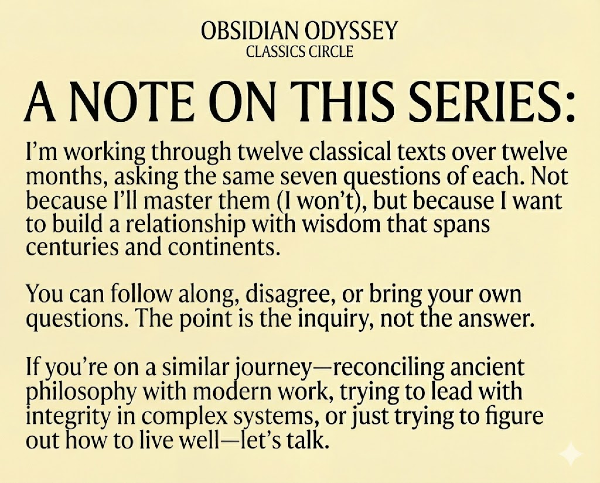
A Note on This Series:
Ten months. Two remain. The penultimate phase:
After learning discipline, flow, power, relationships, meaning, strategy, and the long journey home, Tagore adds: Don't forget beauty. Don't forget transcendence. Don't forget the sacred in ordinary life.
Next month: Seneca on time and mortality—the final reckoning before the series concludes. After Tagore reminded me to witness beauty, Seneca will remind me: You won't have forever to witness it. Act accordingly.
The reading continues. The beauty deepens.
"When I go from hence let this be my parting word, that what I have seen is unsurpassable."
— Rabindranath Tagore, Gitanjali, Poem #96
IMPORTANT DISCLAIMER
Personal Reflections Only: This essay represents my personal intellectual exploration and learning journey. Nothing herein constitutes investment advice, financial recommendations, or professional guidance of any kind.
No Investment Advice: Any references to investment decisions, portfolio construction, capital allocation, or financial strategies are illustrative examples of personal thought processes only. They do not constitute recommendations to buy, sell, or hold any securities or pursue any investment strategy.
Not Representative of Employer: All views expressed are strictly my own and do not represent the views, opinions, or investment strategies of any current or former employer, client, limited partner, or affiliated entity.
Use of AI Tools: This content was developed with the assistance of AI (Claude by Anthropic) as a thinking and writing partner. All final judgments, interpretations, and opinions remain my own.
Educational Purpose: This series explores classical philosophical texts for personal growth and intellectual development. It is not intended as professional development training or as a framework for institutional decision-making.
No Offer or Solicitation: Nothing in this essay constitutes an offer to sell, or a solicitation to buy, any securities or investment products. No investment decisions should be made based on this content.
![Obsidian Memo] Leadership Ground Truth: What Cuba, Puerto Rico, and Hawai'i Taught Me About Capital and Resilience](/content/images/size/w720/2026/02/Bad-Bunny.jpg)
![Obsidian Memo] Leadership Lessons for Founders: Building “You, Inc.” Without Burning It Down](https://images.unsplash.com/photo-1474917518260-23f84bd71c75?crop=entropy&cs=tinysrgb&fit=max&fm=jpg&ixid=M3wxMTc3M3wwfDF8c2VhcmNofDQyfHxzYWlsaW5nfGVufDB8fHx8MTc3MDkyODg3Mnww&ixlib=rb-4.1.0&q=80&w=720)
![Book] Leadership | Markets Are Made by People: Reading Ken Fisher's 100 Minds That Made the Market](https://images.unsplash.com/photo-1623524713064-257294b0e34b?crop=entropy&cs=tinysrgb&fit=max&fm=jpg&ixid=M3wxMTc3M3wwfDF8c2VhcmNofDN8fHdhbGwlMjBzdHJlZXR8ZW58MHx8fHwxNzcwOTM4MzYzfDA&ixlib=rb-4.1.0&q=80&w=720)
Comments ()